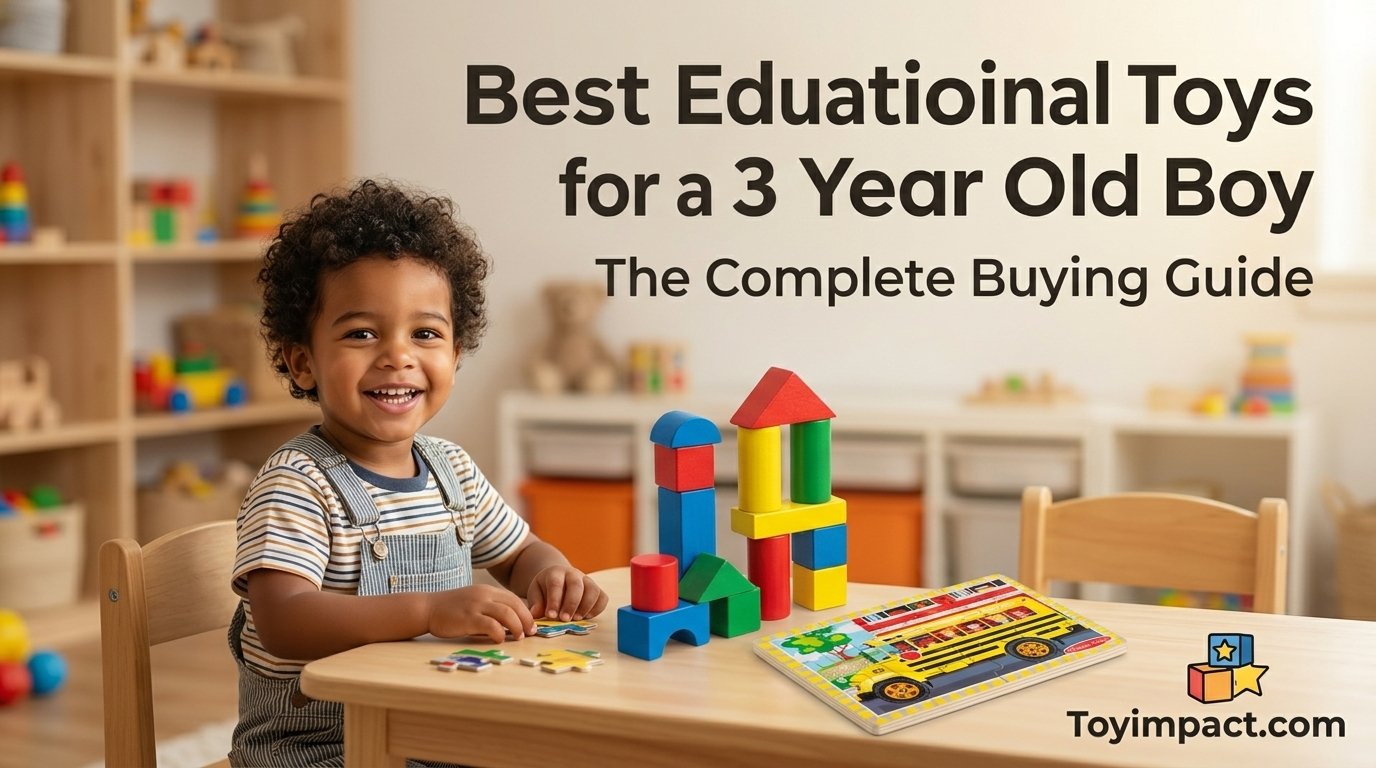
Best Educational Toys for a 3 Year Old Boy: The Complete Buying Guide
A hands-on breakdown of the building blocks, puzzles, and STEM starter kits that actually hold a toddler’s attention while quietly teaching real skills.
Why the Right Toy Matters at Age 3
Three is a strange and wonderful age. Your son can suddenly hold a real conversation, negotiate over snacks, and stack ten blocks without knocking them over on purpose. His brain is also going through one of the fastest growth spurts of his entire life, wiring up language, fine motor control, early math reasoning, and emotional regulation almost simultaneously. The toys he plays with during this window aren’t just entertainment — they’re the raw material his brain uses to build those connections.
That’s why “educational toy” shouldn’t mean flashcards and drills. At this age, learning happens through hands, not worksheets. A toddler who spends twenty minutes sorting shapes into a clock face is doing geometry. A boy who builds a wobbly block tower and watches it fall is running his first physics experiments. The trick for parents is finding toys that disguise real cognitive work as genuinely fun play, and that’s exactly what this guide is built around.
We’ve also tried to think beyond a single afternoon of novelty. The best toys for this age group tend to have a long play life — they can be used one way at three and a completely different way at four or five. That kind of flexibility is what separates a toy that gets forgotten in a week from one that becomes a genuine fixture in your child’s room.
If you’re also shopping for toys that survive long car rides or plane trips, our guide to best toys for car rides and long trips pairs nicely with several of the picks below.
It also helps to understand what’s actually happening developmentally at this age so the toy choices feel less like guesswork. Around age three, most boys are refining what’s called the “pincer grasp” — the coordinated use of thumb and forefinger — which is why puzzles with knobs, magnetic fishing rods, and small building pieces show up so often on lists like this one. That same window is also when symbolic play really takes off: a wooden block stops being just a block and starts being a phone, a sandwich, or a spaceship. Toys that leave room for that kind of imaginative leap tend to age better than ones that only do one specific thing.
Language is exploding too. Most three-year-olds go from a few hundred words to well over a thousand within a single year, and toys that involve naming, describing, or narrating — like the Laugh & Learn chair or even just talking through a block tower’s construction — reinforce that growth naturally. None of this means every toy needs to be overtly “educational” in the flashcard sense. In fact, the toys that do the most good at this age are often the ones that don’t look academic at all.
There’s also a social dimension worth mentioning. Three is typically the age where parallel play starts shifting into more genuinely cooperative play, especially with siblings or daycare friends. Toys that can flex between solo and group use, like the fishing game or a shared block set, do double duty by supporting both individual skill-building and early social negotiation — whose turn it is, how to share pieces, and how to handle the disappointment of a knocked-over tower without a meltdown.
There’s another dimension that often gets overlooked when parents shop for educational toys, and it’s the emotional one. At age three, children are just beginning to develop the vocabulary and cognitive tools to name their feelings, and they still rely heavily on physical actions — squeezing a toy, pounding play dough, or carefully arranging objects in a line — as emotional regulation strategies. Toys that allow for that kind of sensory and physical expression aren’t just teaching fine motor skills; they’re giving your son a safe outlet for processing the overwhelming flood of emotions that comes with being three. It’s the age of first friendships, first frustrations, and first moments of genuine pride when something they built actually works, and all of that emotional scaffolding happens through play.
It’s also worth understanding that at age three, the concept of “attention span” is still highly fluid. Most three-year-olds can focus on a single activity for somewhere between five and fifteen minutes, depending on the task, their energy level, and how recently they’ve eaten or napped. This means that the ideal educational toy for this age isn’t necessarily the one with the most features or the longest play time — it’s the one that can deliver a satisfying burst of engagement within that natural window, and then invite the child back for another round later. Toys with multiple modes of play, or ones that can be “completed” and then started fresh, align much better with this reality than long, drawn-out activities that expect sustained concentration beyond what a three-year-old brain is wired for.
Developmental Milestones at Age 3: A Complete Breakdown
Understanding what your son is actually capable of — and what he’s working hard to master — makes choosing toys feel less like a guessing game. While every child develops at their own pace, there are broad patterns that most three-year-olds follow, and each one maps directly to specific toy categories. Let’s walk through the major developmental domains and what they mean for toy selection.
Fine Motor Skills
By age three, most boys can turn pages of a book one at a time, unscrew a jar lid, and use scissors with some degree of accuracy (though the results look more like abstract art than anything recognizable). They can also thread large beads onto a string, copy simple shapes like circles and crosses, and manage buttons and zippers with increasing independence. This is the golden window for toys that involve small-scale hand work — puzzles with knobbed pieces, lacing activities, shape sorters, and building sets with connectors that require a satisfying push-and-click motion. The wooden building blocks and shape sorting clock on our list directly target this domain. What’s particularly interesting about fine motor development at this age is that it’s closely linked to later academic success, particularly in handwriting. Children who develop strong hand control through play-based activities at three tend to transition into pencil-based writing tasks at five and six with considerably less frustration than peers who haven’t had that physical foundation.
Gross Motor Skills
Three-year-olds are typically able to run with more coordination, climb playground equipment with increasing confidence, pedal a tricycle, and walk up stairs alternating feet (rather than stepping with both feet on each step). They can also catch a large ball, balance on one foot for a few seconds, and jump forward with both feet leaving the ground simultaneously. While many educational toys focus on fine motor skills, gross motor development deserves equal attention because it’s the foundation for physical confidence and spatial awareness. Toys like balance boards, ride-on vehicles, and outdoor activity sets all play a role here. The VTech Sit-to-Stand Walker on our list bridges this gap for younger threes who are still refining their walking mechanics, while the Green Toys Dump Truck encourages active engagement during sandbox and outdoor play where gross motor movement is naturally involved — squatting, standing, pushing, and carrying.
Cognitive Development
This is where things get really interesting. At three, children begin to understand the concept of “two” as an actual quantity, can sort objects by one attribute (color or shape, but not both simultaneously), and start grasping cause and effect at a more sophisticated level. They can complete simple puzzles of four to six pieces, understand the concept of “same” and “different,” and begin following two-step instructions. Their memory is also developing rapidly — they can recall events from earlier in the day and start to anticipate routines (“We always read a book after bath”). The DUPLO Number Train taps directly into this emerging numeracy, while the Coding Critters toy introduces basic sequencing — understanding that the order of actions matters — which is the cognitive precursor to more formal logical reasoning. Parents sometimes underestimate how much abstract thinking is happening at this age. A three-year-old who lines up toy animals from smallest to largest is demonstrating comparative reasoning. One who insists that the tall skinny cup has “more” water than the short wide one (even when it doesn’t) is demonstrating an early — and developmentally appropriate — misunderstanding called “conservation,” which Piaget identified as a key stage in cognitive development.
Language and Communication
The language explosion that begins around 2.5 really hits its stride at three. Most three-year-olds speak in sentences of four to six words, can be understood by strangers roughly 75 percent of the time, and are beginning to use pronouns, prepositions, and past tense with increasing accuracy. They ask “why” constantly — sometimes to the point of parental exhaustion — because they’re genuinely trying to build a causal model of the world around them. They can also follow stories with simple plots, retell familiar events, and engage in basic conversations about feelings and preferences. The Fisher-Price Laugh & Learn Chair supports this domain directly, but virtually every toy on the list can become a language-building tool when a parent narrates play: “You put the red block on top of the blue block — that’s a tall tower!” or “The fish is going into the bucket — how many fish do we have now?” This kind of parallel narration during play is one of the most effective language-building strategies available, and it doesn’t require any special training or materials — just a willingness to talk through what’s happening.
Social and Emotional Development
Three is the age where children begin playing with other children rather than simply alongside them, and this shift from parallel play to associative and eventually cooperative play is one of the most significant social milestones of early childhood. They’re learning to share (often reluctantly), take turns (often imperfectly), and navigate the complex emotional territory of wanting what someone else has. They also begin developing empathy — they might notice when a friend is sad and offer comfort, though their solutions are often charmingly literal (“Here’s my truck — don’t cry”). Emotionally, three-year-olds experience feelings intensely but have limited tools for managing them, which is why tantrums remain common even as verbal ability increases. Toys that support cooperative play — like the magnetic fishing game, shared block sets, or simple board games — give children a structured context in which to practice these emerging social skills without the high stakes of real-world social conflicts.
Self-Help and Independence
Three-year-olds are in the middle of what developmental psychologists sometimes call the “I do it myself” phase. They want to dress themselves, pour their own drinks, choose their own clothes, and make their own decisions about what to eat and when. This fierce independence is healthy and important, even when it means that putting on shoes takes twenty minutes and the shirt is on backwards. Educational toys can support this drive for autonomy by offering activities with a clear beginning, middle, and end that the child can complete independently. Puzzles are a classic example — there’s a defined goal (fill the frame), a clear sense of completion (all pieces in place), and no adult help needed. Building blocks work similarly: the child decides what to build, how high to stack, and when the structure is “done.” These small moments of self-directed accomplishment are enormously important for building the kind of internal confidence that carries into preschool and beyond.
The Science of Play-Based Learning
The idea that children learn through play isn’t just a feel-good talking point — it’s one of the most well-supported conclusions in developmental psychology. Researchers have been studying the relationship between play and learning for over a century, and the findings are remarkably consistent: children who engage in rich, varied play during the early years develop stronger cognitive, social, emotional, and physical skills than those who are pushed into formal academic instruction too early.
The key figure in this field is Lev Vygotsky, a Soviet psychologist whose concept of the “zone of proximal development” has become foundational to early childhood education. Vygotsky argued that children learn most effectively when they’re working on tasks that are just slightly beyond their current independent ability — not so easy that they’re bored, and not so hard that they’re frustrated. In play, children naturally gravitate toward this zone. A three-year-old who’s mastered four-piece puzzles will instinctively reach for a six-piece one. A child who can build a three-block tower will attempt a five-block one. This self-calibrating challenge is something that good educational toys facilitate naturally, which is one reason they’re so much more effective than worksheets or flashcards at this age.
Neuroscience has added another layer of understanding to this picture. Brain imaging studies show that play activates multiple neural networks simultaneously — motor cortex, prefrontal cortex (responsible for planning and decision-making), hippocampus (memory), and amygdala (emotional processing). This multi-network activation during play creates what researchers call “enriched neural environments,” where connections between different brain regions are strengthened through simultaneous use. In simpler terms: when a child builds a block tower, they’re not just learning about balance. They’re training their brain to integrate physical manipulation, spatial reasoning, emotional management (dealing with the frustration of a collapse), and narrative thinking (telling themselves a story about what they’re building) all at once.
Dr. Jaak Panksepp’s research on “rough-and-tumble play” in mammals has shown that play isn’t optional for brain development — it’s essential. In animal studies, depriving young mammals of play opportunities led to measurable deficits in social competence, emotional regulation, and problem-solving ability that persisted into adulthood. While we obviously can’t draw direct parallels to human children with strict experimental controls, the broader principle holds: play is the primary mechanism through which young brains wire themselves for competence, and restricting it — whether through excessive screen time, over-scheduling, or pushing formal academics too early — comes at a genuine developmental cost.
The American Academy of Pediatrics released a clinical report in 2018 specifically recommending that pediatricians write “prescriptions for play,” recognizing that play is not a luxury or a break from learning — it is learning, in its most natural and effective form. The report noted that play improves executive function skills (working memory, cognitive flexibility, and self-regulation), builds the architecture of the developing brain, and serves as a buffer against toxic stress. For parents choosing between a structured “educational” program and a well-stocked playroom full of open-ended toys, the science is clear: the playroom wins, by a wide margin, every time.
What does this mean practically? It means that when you set out a collection of wooden blocks and step back, you’re not wasting time — you’re creating one of the most powerful learning environments available to a three-year-old. When your son spends fifteen minutes figuring out how to make a fishing rod’s magnet connect to a wooden fish, he’s doing more for his hand-eye coordination, patience, and problem-solving ability than any educational app could accomplish in the same amount of time. The toys on this list were chosen not just because they’re popular or well-reviewed, but because they align with what the research says about how young brains actually build capability: through self-directed, hands-on, emotionally engaging play.
How We Picked These Toys
We didn’t just pull a list of popular products and call it a day. Every toy here was evaluated against a consistent set of criteria that actually matters for a three-year-old boy’s development stage:
We also leaned on thousands of verified parent reviews, manufacturer safety documentation, and age-grading standards to make sure nothing on this list is a poor fit for the specific developmental window a 3-year-old sits in. Toys that scored well on novelty but poorly on durability or safety were cut, even if they were trending online.
We also paid attention to how each toy performs after the first few weeks, not just the initial unboxing reaction. It’s easy for any new toy to generate excitement on day one — the real test is whether it’s still coming off the shelf a month later. That meant weighting longer-term reviews more heavily than early impressions, and specifically looking for mentions of durability issues like cracking plastic, fading colors, or pieces that go missing too easily. A toy that’s genuinely well-designed for this age group should be able to handle drops, chewing at the edges, and being dragged across hardwood floors without falling apart within the first few months.
Price was factored in too, but not as a primary filter. Instead, we looked at value relative to play life — a $15 toy that gets played with daily for a year is a better investment than a $40 toy that’s abandoned within a week. That’s part of why this list spans a fairly wide price range rather than clustering around one budget tier.
We also gave significant weight to what we call the “adult tolerance factor.” Let’s be honest: some educational toys are technically excellent but drive parents up the wall with incessant noise, flashing lights, or songs that burrow into your brain and refuse to leave. A toy that’s educational but makes the entire household miserable isn’t actually a good pick. We favored toys with reasonable noise levels, pleasant aesthetics, and the kind of design that lets them fit into a living room without making the space look like a daycare explosion. This isn’t just about parental comfort, either — children actually play better and longer in environments that aren’t sensorially overwhelming, so a calmer toy often produces more sustained engagement than a loud, flashy one.
Finally, we considered the “toy shelf test.” This is a purely practical criterion, but it matters: will this toy actually get played with when it’s sitting on a shelf alongside fifteen other options? Toys that require specific setups, lots of adult help, or a particular mood tend to get passed over in favor of ones that are immediately grabbable and instantly engaging. The best educational toys for three-year-olds are the ones that practically leap off the shelf into a child’s hands — visually inviting, tactilely satisfying, and immediately comprehensible without a manual or an explanation.
Our Top 11 Picks at a Glance
Before we dive into the deep-dive reviews, here’s the shortlist. Each one earns its place for a different reason — some build fine motor skills, others introduce coding logic, and a couple are simply built to survive years of enthusiastic toddler abuse.
| Toy | Best For | Skill Focus |
|---|---|---|
| Melissa & Doug Wooden Building Blocks | Open-ended creative play | Spatial reasoning, balance |
| Melissa & Doug 4-in-1 Vehicle Puzzle | Puzzle beginners | Problem solving, shape matching |
| LEGO DUPLO Number Train | Early counting | Number recognition, fine motor |
| VTech Sit-to-Stand Walker | Younger 3-year-olds still cruising | Gross motor, cause and effect |
| Fisher-Price Laugh & Learn Chair | Language development | Vocabulary, letters, songs |
| Osmo Genius Starter Kit | Tech-curious households | Early literacy, math, creativity |
| Melissa & Doug Magnetic Fishing Game | Hand-eye coordination | Fine motor, colors, counting |
| Learning Resources Coding Critters | Screen-free coding intro | Sequencing, logic |
| Green Toys Dump Truck | Sandbox and bath play | Imaginative play, durability |
| Melissa & Doug Shape Sorting Clock | Shape and time concepts | Shape recognition, early time-telling |
1. Melissa & Doug Wooden Building Blocks Set

There’s a reason wooden blocks have survived a century of toy trends without going out of style: they simply work. This set gives your son a chunky, satisfying collection of shapes — cylinders, arches, cubes, triangles — that invite building rather than dictate it. There’s no “right” way to use them, which is exactly the point. One afternoon it’s a castle, the next it’s a garage for his toy cars.
What stands out here is the sanding quality. Cheaper block sets often have splintery edges or inconsistent sizing that makes stacking frustrating for small hands. These blocks are uniformly smooth and sized so a 3-year-old’s still-developing grip can manage them without constant adult help, which matters a lot for building independent play stamina.
Parents also tend to underestimate how much math is quietly happening during block play. Balancing a triangular piece on top of a cylinder without it rolling off requires an intuitive grasp of center of gravity. Lining blocks up end-to-end to compare lengths is an early form of measurement. None of this needs to be explained to a three-year-old in those terms — the learning happens automatically through trial, error, and the occasional dramatic tower collapse. What matters from a parent’s side is simply making sure there’s enough uninterrupted time and floor space for that experimentation to happen.
One aspect of block play that’s often overlooked is the narrative dimension. Around age three, children start assigning roles and stories to their structures — the tower becomes a lighthouse, the row of blocks becomes a train, the arch becomes a bridge that toy cars drive through. This narrative play is a critical component of cognitive development because it exercises what psychologists call “symbolic representation” — the ability to let one thing stand for another. It’s the same mental muscle that children later use for reading, where symbols (letters) stand for sounds, which combine into words that stand for concepts. A child who regularly practices symbolic thinking through block play is, in a very real sense, building the cognitive infrastructure for literacy. This is why the most “basic” toy on the list — a box of wooden blocks — is arguably the most educationally valuable thing you can buy for this age group.
For families with limited floor space, block play doesn’t require an entire room. A large tray or a dedicated blanket on the living room floor can define a “building zone” that makes cleanup easier and signals to your son that this is a space where he has creative freedom. Some parents find that keeping blocks in a visible, accessible basket rather than a closed bin increases the frequency of spontaneous play, because the visual reminder alone triggers the impulse to build. Others prefer a rotation approach, keeping half the blocks available at a time and swapping them out every few weeks to maintain a sense of novelty without buying anything new.
Pros
- Encourages completely open-ended play
- Smooth, splinter-free wood
- Builds spatial reasoning and balance
- No batteries, screens, or noise
Cons
- Small pieces need supervision with younger siblings
- No instructions if your child wants structured building
See current pricing and availability on Amazon.
Check Price on Amazon2. Melissa & Doug 4-in-1 Wooden Vehicle Jigsaw Puzzle Set

If your son is obsessed with anything that has wheels, this puzzle set turns that obsession into a genuine cognitive workout. Four chunky wooden puzzles — a car, a truck, a plane, and a tractor — each teach shape recognition and problem-solving without ever feeling like schoolwork. The pieces have raised wooden knobs, which is a small design detail that matters enormously for a toddler’s still-developing pincer grip.
Because there are four separate puzzles rather than one big one, your son can experience the satisfaction of “finishing” something in a couple of minutes rather than getting stuck and frustrated on a single 20-piece puzzle. That quick win-loop is exactly what keeps three-year-olds engaged rather than walking away.
What makes puzzles particularly valuable at this age is the problem-solving process itself, not just the finished picture. When a child picks up a piece and tries it in the wrong spot, they’re exercising spatial reasoning — mentally rotating the piece, comparing its shape to the hole, and making a judgment call about fit. When it doesn’t work, they try again, which builds frustration tolerance and persistence. These are executive function skills that are just beginning to emerge at three, and puzzles provide one of the safest and most natural contexts in which to practice them. The fact that the “wrong” answer is immediately visible (the piece doesn’t fit) rather than abstract (a wrong answer on a test) makes the feedback loop intuitive and non-threatening, which is exactly the kind of learning environment that three-year-olds thrive in.
Parents sometimes wonder whether their child is “ready” for jigsaw puzzles, and the answer at three is almost always yes — it’s just a question of starting with the right piece count and shape complexity. Four-piece puzzles with clearly distinct colors and images are an ideal entry point. As your son masters those, you can gradually introduce more pieces and subtler color variations. This puzzle set sits right at that sweet spot where it’s achievable enough to build confidence but challenging enough to require actual thought, which is the balance that keeps children coming back to a toy day after day.
An additional benefit of the vehicle theme is that it connects to the broader world your son sees around him. After completing the truck puzzle, he might want to go look at real trucks out the window or narrate a story about where the truck is going. This kind of “toy-to-world” connection deepens engagement and turns a five-minute puzzle session into a broader learning conversation. It’s also a useful example of how the best educational toys aren’t just teaching isolated skills — they’re creating entry points into wider explorations of the world.
Pros
- Four complete puzzles in one set
- Knobbed pieces build fine motor control
- Vehicle theme appeals strongly to this age group
- Compact storage tray included
Cons
- Can be mastered quickly by more advanced puzzlers
- Wooden tray edges can chip with rough handling
See current pricing and availability on Amazon.
Check Price on Amazon3. LEGO DUPLO My First Number Train

DUPLO is essentially LEGO scaled up for toddler-safe hands, and the Number Train is one of the smartest sets in the line. Each numbered brick carries the correct number of studs on top, so kids build an intuitive, tactile sense of quantity long before they’re doing formal math. Stacking “3” on top of “1” and “2” and physically seeing that it’s bigger is a much stronger foundation than pointing at numbers on a page.
The train itself rolls, which adds a satisfying push-and-pull play element on top of the counting mechanic. It’s also compatible with other DUPLO sets your family might already own, so it slots into existing collections instead of becoming an isolated one-off toy.
Beyond the counting mechanic, there’s a quieter benefit worth mentioning: sorting. Many kids naturally start separating the numbered cars by color or by digit before they’re even asked to, which is an early form of categorization — a skill that shows up again and again in later academic contexts, from basic math to reading comprehension. Because the pieces are large and satisfying to click together, this kind of self-directed sorting tends to happen organically rather than needing to be prompted by a parent.
There’s also a strategic dimension to how children play with DUPLO that’s worth appreciating. When a three-year-old decides to build a “long train” versus a “short train,” they’re making architectural decisions that involve planning ahead — even if that planning is just “I want it to go from here to the couch.” That kind of intentionality, where a child has a goal and works toward it through sequential steps, is the seed of project management, engineering thinking, and even basic scientific method. The train format is particularly effective because it has a clear linear structure: cars connect in a line, each one has a purpose (its number), and the whole thing rolls at the end. This built-in narrative arc — from pieces to completed train to playing with it — gives the play session a satisfying structure that many open-ended toys lack, which is helpful for children who find completely unstructured play a bit overwhelming.
The compatibility factor deserves a closer look too. If your family already owns other DUPLO sets — an animal set, a house set, a vehicle set — the Number Train integrates seamlessly. The numbered cars can become part of a larger city, and the number bricks can be repurposed as building material for other structures. This kind of cross-set compatibility is one of LEGO’s greatest strengths, and it means that each new DUPLO purchase doesn’t just add a single toy — it expands the entire play ecosystem. Over time, a collection of DUPLO sets becomes something much greater than the sum of its parts, offering almost limitless recombination possibilities that keep children engaged for years.
Pros
- Teaches number recognition through physical stacking
- Compatible with other DUPLO sets
- Rolling train adds active play
- Large, choke-safe pieces
Cons
- Pricier per piece than generic building sets
- Numbers only go up to 10
See current pricing and availability on Amazon.
Check Price on Amazon4. VTech Sit-to-Stand Learning Walker
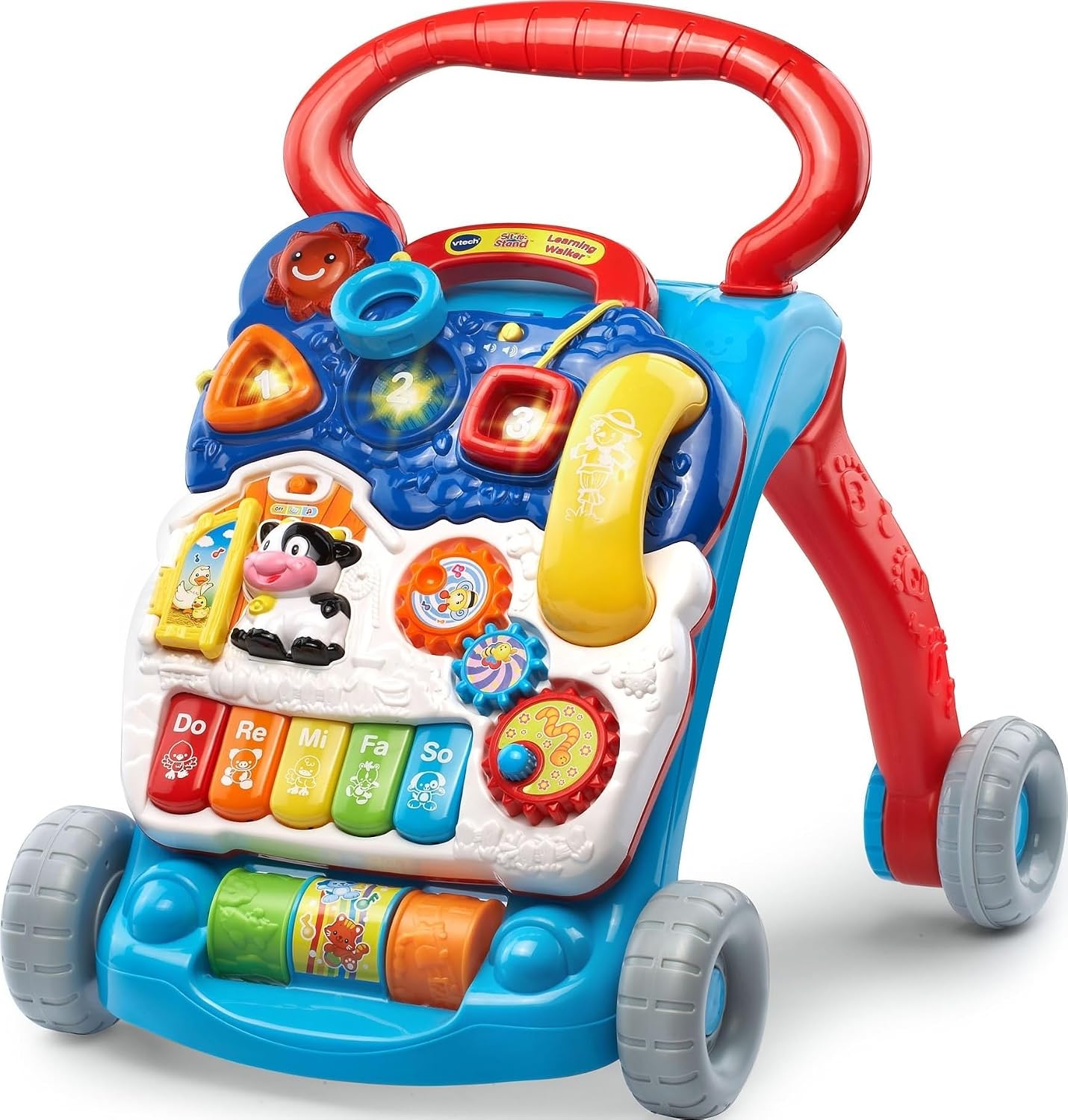
This one skews slightly younger, but it’s worth including because plenty of 3-year-olds — especially ones still building leg strength or confidence walking longer distances — get genuine mileage out of it. The activity panel detaches so it can be used as a stationary sit-and-play toy once your son has outgrown the “push it around the living room” phase, which stretches the usable lifespan considerably.
The panel covers letters, numbers, shapes, and early phrases through songs and light-up buttons, which gives it a genuine educational layer rather than being pure noise-making.
What’s particularly valuable about the walker format is that it combines gross motor activity with cognitive engagement in a way that few other toys manage. When your son pushes the walker across the room, he’s practicing balance, coordination, and leg strength. When he stops to press a button and hear a letter sound, he’s switching into cognitive mode and then transitioning back to physical activity. This constant switching between motor and cognitive tasks is actually excellent brain training — it exercises what neuroscientists call “task switching,” a core executive function skill that will serve him well in preschool and beyond. Many children who are reluctant to engage with purely sit-down educational toys will happily interact with this kind of mixed-mode device because the physical movement keeps their energy channeled while the buttons and sounds provide intellectual stimulation.
The detachable panel is a genuinely thoughtful design feature. Once your son has mastered walking confidently and no longer needs the walker function, the panel becomes a standalone activity center that can be used in the car, at a restaurant, or anywhere you need a portable engagement tool. This dual-purpose design means you’re essentially getting two toys in one, which makes the price point easier to justify. Parents who initially bought this for the walking function are often pleasantly surprised by how long the detached panel continues to get use as a travel toy.
Pros
- Detachable panel extends usable age range
- Combines gross motor and early literacy content
- Volume control keeps parents sane
Cons
- Some 3-year-olds may find the walking function too basic
- Requires batteries
See current pricing and availability on Amazon.
Check Price on Amazon5. Fisher-Price Laugh & Learn Smart Stages Chair

This little chair punches well above its size. The “Smart Stages” technology adjusts the songs and phrases based on a selectable learning level, so the content grows alongside your child rather than staying static. At three, kids are usually deep in the vocabulary-explosion phase, and this chair leans directly into that with letters, colors, manners, and simple counting songs.
It also functions as an actual small chair, which is a nice bit of dual-purpose furniture design — it’s not just a toy taking up floor space, it’s something he can genuinely sit in while reading books or having snack time.
Parents often notice their child starts imitating the phrases from the chair during unrelated play, repeating manners or counting sequences while playing with something else entirely. That kind of spontaneous carryover is a good sign the content is actually being absorbed rather than just tuned out as background noise, and it’s one of the clearer signals that a “talking” toy is earning its keep rather than just adding to the noise level in the house.
The “Smart Stages” concept deserves a closer look because it addresses one of the most common problems with electronic learning toys: rapid obsolescence. Most talking toys have a fixed set of phrases and songs, which means that after a few weeks of exposure, a child has heard everything and engagement drops sharply. The adjustable levels on this chair mean you can start on Level 1 (which focuses on simple cause and effect — press a button, hear a sound) and progress to Level 3 (which involves more complex phrases, questions, and multi-step interactions) as your child’s comprehension grows. This kind of built-in progression turns what could be a two-week novelty into a toy that remains relevant across many months, which is a much better return on investment than it might initially appear.
There’s also a subtle confidence-building element at work. When a child sits in their own special chair and the chair “talks” to them — asking questions, praising their responses, singing their name — it creates a personalized interactive experience that makes them feel seen and acknowledged. For three-year-olds who are navigating the complex social dynamics of sibling relationships, daycare, and growing independence, this kind of reliable, affirming interaction can be surprisingly valuable. The chair always responds, always praises, and never gets impatient — and while that’s obviously no substitute for human interaction, it creates a low-stakes environment where practicing verbal skills feels safe and fun.
Pros
- Doubles as functional toddler furniture
- Adjustable learning levels grow with the child
- Reinforces letters, manners, and counting
Cons
- Songs can become repetitive for parents
- Plastic construction feels less premium than wood alternatives
See current pricing and availability on Amazon.
Check Price on Amazon6. Osmo Genius Starter Kit

Osmo occupies a genuinely unique space in this list: it’s the only pick here that bridges physical play with a tablet, but it does so in a way that’s fundamentally different from passive screen time. Your son manipulates real tiles, letters, and shapes on the table in front of him, and the camera-and-mirror system reflects that physical action into interactive games on-screen. It’s closer to an augmented-reality workbook than a video game.
For families who are cautious about screens but still want to introduce some early tech literacy, this kit is one of the most thoughtfully designed compromises on the market. The games scale from simple shape-tracing for younger threes up to number and word games for kids approaching four.
One detail worth calling out is how the system handles mistakes. Instead of a harsh buzzer or a “wrong answer” screen, most Osmo games nudge the child toward the correct move through visual hints, which keeps frustration low and encourages another attempt rather than giving up. That kind of gentle failure-handling is genuinely important at this age, when self-esteem around “getting things right” is still fragile and easily discouraged by overly punishing feedback loops.
If you’re weighing this against fully screen-free sensory options, our guide on best sensory toys covers some excellent alternatives.
What sets Osmo apart from standard tablet apps is the physical-tangible component. Research on embodied cognition suggests that children learn abstract concepts more effectively when they can physically manipulate objects related to those concepts, rather than interacting purely through a touch screen. When a child picks up a physical letter tile, turns it in their hand, and places it on the table to form a word, they’re engaging proprioceptive and tactile feedback channels that a flat screen simply cannot provide. This multi-sensory engagement creates stronger memory traces and deeper conceptual understanding than tapping letters on glass, which is why Osmo consistently shows up on recommended lists from educators who are otherwise skeptical of screen-based learning.
The Genius Starter Kit specifically covers five distinct game modes: Tangram (spatial reasoning through physical puzzle pieces), Words (letter recognition and spelling), Newton (physics-based problem solving), Masterpiece (drawing and tracing), and Numbers (counting and arithmetic). At three, most children will focus primarily on the simpler end of Tangram and Words, with the other modes becoming relevant as they approach four and five. This built-in growth curve means the kit can remain a relevant part of your toy rotation for two to three years, which significantly improves the cost-per-use ratio despite the higher initial price point.
Pros
- Blends physical manipulation with digital feedback
- Games scale in difficulty as skills grow
- Encourages creativity, not just passive watching
Cons
- Requires a compatible tablet, sold separately
- Higher price point than most items on this list
See current pricing and availability on Amazon.
Check Price on Amazon7. Melissa & Doug Magnetic Wooden Fishing Game

Few toys deliver as much laughter-per-dollar as a magnetic fishing game. Your son “casts” a small magnetic rod toward a pond of colorful wooden fish, and the satisfaction of successfully hooking one is immediate and obvious even to the youngest players. Underneath that simple joy, though, is real skill-building: the hand-eye coordination required to line up the rod, and the color and number recognition built into the fish themselves.
It’s also a rare toy that comfortably supports multiple kids playing together, which makes it a strong pick if you’re also browsing our list of best toys for siblings to play together.
What makes this particular fishing game stand out from cheaper alternatives is the quality of the magnetic connection. In poorly made versions, the magnets are weak or inconsistently positioned, which means the rod slides off the fish more often than it connects — a recipe for toddler frustration. The Melissa & Doug version uses reliably strong magnets embedded securely in each fish, which means the connection-to-attempt ratio is high enough to keep the game feeling rewarding rather than punishing. This seemingly small design difference has an outsized impact on how long a three-year-old will stick with the activity before losing interest.
The fishing game also provides natural opportunities for parent-child interaction that feel organic rather than forced. When you take turns fishing alongside your son, you’re modeling turn-taking, showing him how to handle the rod (gentle movements work better than wild swings), and creating shared moments of excitement (“You got the red one!”) that reinforce the social dimension of play. Many parents find that this game becomes a go-to bonding activity precisely because the rules are so simple that there’s no overhead — you can start playing within seconds of pulling it out, and the game naturally generates conversation, counting practice, and color identification without any explicit “teaching” required.
Pros
- Strong hand-eye coordination practice
- Naturally supports group and sibling play
- Colors and numbers built into gameplay
Cons
- Small fish pieces require supervision around toddlers under 3
- Rod string can tangle with rough play
See current pricing and availability on Amazon.
Check Price on Amazon8. Learning Resources Coding Critters

Coding sounds like a concept far beyond a 3-year-old, but this toy strips it down to its most basic building block: sequencing. Your son presses colored buttons in an order to make a cute animal character move through a simple course, and every wrong sequence is an instant, harmless lesson in cause and effect. There’s no screen involved at all, which makes it an easy sell for parents who want early logic skills without adding to screen time.
It’s a natural companion to our guide on how to introduce STEM toys to preschoolers, which walks through pacing these kinds of logic toys appropriately by age.
The concept of sequencing — understanding that events happen in a specific order and that changing the order changes the outcome — is foundational to virtually every academic discipline. In math, it’s the basis of algorithms and equations. In reading, it’s the structure of narratives. In science, it’s the logic of experimental procedures. By introducing this concept through a physical, screen-free toy at age three, you’re building neural pathways that will support formal learning across multiple subjects for years to come. The key insight is that Coding Critters makes this abstract concept tangible: the child can see the character move left when they press the left button, forward when they press forward, and so on. Each button press is a discrete, observable event, which makes the cause-and-effect relationship impossible to miss.
What also makes Coding Critters special is the “pet” framing. The coding character is presented as a little animal that the child is caring for and guiding, which taps into the nurturing instinct that’s powerful at this age. The included storybook adventures give the coding sequences a narrative purpose — “Help the bunny reach the carrot!” — which transforms what could feel like a logic drill into a mission-driven story. This narrative scaffolding is a clever design choice because it leverages a three-year-old’s natural love of stories to motivate engagement with what is essentially a programming exercise.
Pros
- Screen-free introduction to sequencing and logic
- Adorable character design keeps kids engaged
- Builds patience through trial and error
Cons
- Some units are louder than parents expect
- Requires AA/AAA batteries not always included
See current pricing and availability on Amazon.
Check Price on Amazon9. Green Toys Dump Truck

Every household with a 3-year-old boy eventually needs a truck that can survive sandbox duty, bathtub duty, and living-room-floor duty without falling apart. This dump truck, made from recycled plastic milk jugs, is built exactly for that kind of abuse. The dumping bed operates smoothly enough for small hands to control, which supports fine motor development while your son narrates elaborate construction-site stories.
It also pairs naturally with outdoor play sessions — if you’re setting up a backyard play zone, check our list of best water table toys for backyard play for toys that combine well with this one.
Because it moves seamlessly between sand, water, and dry indoor floors, it tends to become one of the more frequently reached-for toys in a rotation, simply because it isn’t restricted to a single room or season. That kind of environmental flexibility is easy to overlook when comparing toys on a spec sheet, but it makes a real difference in how often a toy actually gets used across a full year rather than sitting unused for months at a time.
The imaginative play potential of the dump truck is enormous and often underappreciated by parents who see it as “just a truck.” In the hands of a three-year-old, this truck becomes a character with a job, a personality, and a daily routine. It hauls blocks from one side of the room to the other. It rescues stuffed animals that are “stuck.” It dumps sand at the construction site (the sandbox) and returns for another load. This kind of sustained pretend play is one of the most cognitively demanding activities a three-year-old can engage in, because it requires maintaining a narrative over time, managing multiple “characters” (even if some of them are blocks), and adapting the story when something unexpected happens (the truck tips over, the load spills — now the story becomes a rescue mission). Parents who sit nearby and occasionally ask “Where is the truck going?” or “What did it pick up?” will often be amazed at the complexity of the scenarios their three-year-old constructs.
The eco-friendly manufacturing is worth highlighting as well. Made from 100 percent recycled plastic with no BPA, phthalates, or external coatings, this truck is one of the safest plastic toys on the market. For families concerned about chemical exposure from plastic toys, Green Toys offers a level of transparency and material safety that most competitors don’t match. And because it’s made from recycled materials, it’s also an opportunity — when your son is old enough to understand — to start conversations about recycling and environmental responsibility in a concrete, tangible way.
Pros
- Extremely durable, sandbox and bath-safe
- Made from recycled materials
- Simple mechanism builds fine motor control
Cons
- No small parts or extra features for kids wanting more detail
- Can float away in bath water if not watched
See current pricing and availability on Amazon.
Check Price on Amazon10. Melissa & Doug Shape Sorting Clock

This toy manages to teach two completely different concepts at once: shape recognition through the sorting mechanic, and an early introduction to clock faces and numbers through its design. Each colorful shape has to be matched to its corresponding slot, which is a classic fine motor and problem-solving exercise, but the clock face framing adds a layer of numeracy that plain shape sorters don’t offer.
It’s compact, quiet, and battery-free, making it a good pick for car trips or waiting rooms where you need something engaging but low-mess. If travel toys are on your radar, it’s worth comparing against our best travel toys for airplane trips guide.
The clock element of this toy is more valuable than it might initially appear. While no three-year-old is going to learn to tell time from a shape sorter, they will begin absorbing the spatial structure of a clock face — the circular arrangement of numbers, the concept that the hands point to specific positions, and the idea that numbers have a fixed sequence around a circle. This is what educators call “pre-mathematical awareness,” and it creates a foundation that makes actual clock-reading instruction significantly easier when it arrives in kindergarten or first grade. Children who’ve played with clock-shaped toys tend to recognize clock faces faster and understand the spatial relationships between numbers more intuitively than peers who haven’t had that tactile exposure.
The shape-sorting component works on a different developmental axis entirely: spatial reasoning and geometric vocabulary. When a child picks up a star-shaped piece and tries it in three wrong slots before finding the right one, they’re building a mental library of geometric forms through physical repetition. After enough play sessions, they begin to “see” that a star won’t fit in the square hole before they even try it, which represents the transition from trial-and-error learning to pattern recognition — a significant cognitive leap. Parents can accelerate this learning by naming the shapes during play (“That one has five points — it’s a star!”) and asking questions (“Which hole do you think the star goes in?”), but the toy works perfectly well without any adult narration too.
Pros
- Teaches shapes and early clock concepts together
- Compact and travel-friendly
- No batteries or noise
Cons
- Can be solved quickly by kids with prior shape-sorter experience
- Wooden shapes can be lost if not stored carefully
See current pricing and availability on Amazon.
Check Price on AmazonToy Philosophies Compared: Montessori, Waldorf, and Traditional
When you start shopping for educational toys, three names come up over and over again: Montessori, Waldorf, and traditional. Each represents a fundamentally different philosophy about how children learn through play, and understanding the differences can help you make more intentional choices rather than just buying whatever looks nice on the shelf.
Montessori Approach to Toys
The Montessori philosophy, developed by Dr. Maria Montessori in the early 1900s, emphasizes self-directed learning through carefully designed materials. Montessori toys are typically made from natural materials (wood, metal, fabric), are designed to isolate a single skill or concept, and are meant to be used in a specific, self-correcting way. A classic example is the Montessori knobbed cylinders — a set of wooden blocks with holes of varying sizes and corresponding cylinders that fit only in the correct hole. The child doesn’t need an adult to tell them they’ve made a mistake; the cylinder either fits or it doesn’t. This self-correction is central to the Montessori approach because it builds independence and intrinsic motivation — the child learns to evaluate their own work rather than depending on external validation.
For three-year-olds, Montessori-aligned toys tend to focus on practical life skills (pouring, scooping, buttoning), sensorial exploration (textures, colors, sounds), and early math concepts (counting rods, number boards). The emphasis is always on reality over fantasy — Montessori philosophy discourages imaginative play with fantastical elements in favor of real-world role modeling. So instead of a plastic dragon, a Montessori-aligned toy selection might include a child-sized broom, a pouring set, or a realistic animal figurine. Many of the wooden toys on our list — the building blocks, the shape sorting clock, the fishing game — align naturally with Montessori principles, even though they’re not marketed specifically as Montessori products.
Waldorf Approach to Toys
Waldorf education, founded by Rudolf Steiner, takes a strikingly different approach. Where Montessori isolates specific skills, Waldorf embraces ambiguity and imagination. Waldorf toys are deliberately simple and often unfinished — a faceless doll, a set of colored silks, a few pieces of driftwood. The idea is that open-ended, unstructured materials force children to fill in the details with their own imagination, which builds creative thinking in a way that pre-designed, detailed toys cannot. A Waldorf doll with no facial expression can be happy, sad, sleepy, or excited depending on the child’s mood and the story they’re telling, which makes it an infinitely more flexible emotional tool than a doll with a fixed smile.
For three-year-olds, Waldorf-aligned play emphasizes natural materials (wood, beeswax, wool, cotton), sensory-rich experiences (watercolor painting, beeswax modeling, bread baking), and a strong connection to nature and seasonal rhythms. The aesthetic is warm, soft, and muted — lots of natural wood tones, gentle pastels, and organic textures. The wooden building blocks on our list could easily fit into a Waldorf play environment, as could simple wooden vehicles and natural-fabric dolls. Waldorf philosophy also emphasizes rhythm and routine in a child’s day, which extends to how toys are introduced and used — the same toys appear at the same time each day, creating a predictable, calming structure.
Traditional Educational Toys
Traditional educational toys — the category that includes most products from brands like Fisher-Price, VTech, LeapFrog, and Melissa & Doug — take a more pragmatic approach. They tend to incorporate the latest educational research into accessible, affordable products that appeal to a wide range of families. They may use plastic alongside wood, include electronic features like songs and lights, and combine multiple skills in a single toy rather than isolating one concept. The Fisher-Price Laugh & Learn Chair, for example, teaches letters, numbers, colors, and manners simultaneously through songs and phrases — a perfectly valid educational approach, just a different one from the Montessori principle of isolating a single concept.
None of these philosophies is inherently superior to the others. The best approach for your family depends on your values, your son’s temperament, and the practical realities of your household. A child who thrives on structure might do exceptionally well with Montessori-style materials. A child with a vivid imagination might gravitate naturally toward Waldorf-style open-ended toys. And most families will find that a mix of approaches — some structured, some open-ended, some electronic, some natural — creates the most engaging and developmentally rich toy environment. The important thing is to choose with intention rather than defaulting to whatever happens to be trending on social media.
Combining Approaches in Practice
In reality, most families end up blending elements from multiple philosophies, and that’s perfectly fine. Your son might use Montessori-style knobbed puzzles during quiet morning time, build with Waldorf-aligned open-ended blocks in the afternoon, and enjoy a traditional electronic learning toy before dinner. The key principle that all three philosophies share — and that the research consistently supports — is that active, hands-on, child-directed play is superior to passive consumption at this age. Whether that play involves a wooden Waldorf doll or a DUPLO train matters far less than whether the child is engaged, choosing their own activities, and having fun. A toy that’s philosophically “perfect” but sits unused on a shelf is less valuable than a “less ideal” toy that your son plays with enthusiastically every day.
Understanding Your Child’s Learning Style
Not every three-year-old learns the same way, and recognizing your son’s natural learning preferences can help you choose toys that genuinely resonate rather than ones that look good on paper but collect dust in practice. While the concept of rigid “learning styles” (visual, auditory, kinesthetic) has been somewhat oversimplified in popular parenting discourse, the underlying observation is real: children do show preferences for how they take in and process information, and these preferences influence which toys engage them most deeply.
The Mover and Shaker (Kinesthetic Learner)
Some three-year-olds seem to be in constant motion. They learn best by doing — touching, building, tearing apart, pushing, pulling, and physically manipulating everything they encounter. These children often struggle with purely verbal instructions (“Put the red block on the blue block”) but excel when they can figure things out through physical trial and error. For these kids, the building blocks, the fishing game, the dump truck, and the DUPLO train are ideal because they provide immediate tactile feedback. The VTech walker is another strong pick because it combines physical movement with learning content. Parents of kinesthetic learners often find that their child does best when allowed to stand or move during play rather than sitting still at a table, so providing a large floor space for block play or letting them play with the dump truck while standing rather than sitting can make a significant difference in engagement time.
The Listener and Talker (Auditory Learner)
Other three-year-olds are drawn to sounds, songs, and conversation. They learn by listening, repeating, and narrating their activities out loud. These children often talk to themselves while they play, describing what they’re doing and why, and they may prefer toys that include songs, sounds, or conversational prompts. The Fisher-Price Laugh & Learn Chair is a natural fit for this profile because it’s built around verbal content. But auditory learners also benefit enormously from parent narration during play with any toy — the fishing game becomes a language-building exercise when a parent describes each fish’s color and size, and block play becomes a vocabulary lesson when the parent names the shapes and describes the construction process. For auditory learners, the toy itself matters less than the verbal context in which it’s used.
The Observer (Visual Learner)
Some children are natural observers. They watch carefully before they act, study patterns and details that other kids miss, and often prefer to arrange objects in visually organized ways — lining up cars by color, sorting blocks by shape, or arranging puzzle pieces by image before actually assembling the puzzle. These children tend to gravitate toward the shape sorting clock (which rewards careful visual matching), puzzles (which are fundamentally visual-spatial tasks), and the Osmo kit (which uses visual feedback to reinforce learning). Parents of visual learners often notice that their child will spend a long time simply looking at a toy or arrangement before touching it — this isn’t disengagement, it’s processing, and it should be respected rather than interrupted with prompts to “just try it.”
The Social Learner
Some three-year-olds learn best in the company of others. They want a play partner, they want to show you what they’ve done, and they want to talk about it. These children may resist independent play and prefer toys that facilitate interaction — the fishing game (which is naturally two-player), board games, and building activities where the parent participates as a co-builder. For social learners, the toy is almost secondary to the interaction it enables, and the best investment a parent can make is simply being present and engaged during play. This doesn’t mean directing the play — it means being available, responsive, and interested, which is often enough to transform a reluctant player into an enthusiastic one.
The Independent Explorer
On the other end of the spectrum are children who genuinely prefer to play alone, figure things out independently, and resist help even when they’re struggling. These children are often strong candidates for self-correcting toys like puzzles, shape sorters, and the Coding Critters toy, where the feedback is built into the toy itself rather than requiring adult involvement. Parents of independent explorers sometimes worry that their child isn’t getting enough social interaction, but it’s important to respect this preference while also creating gentle opportunities for cooperative play. A balance of independent toys and shared activities tends to work best — blocks and puzzles for solo time, the fishing game and simple board games for family interaction time.
How to Introduce a New Toy for Maximum Engagement
You’ve done the research, read the reviews, and bought the perfect educational toy. Now what? The way you introduce a new toy to your three-year-old can make the difference between it becoming a beloved staple and it being ignored after ten minutes. There’s an art to introducing toys at this age, and it’s simpler than you might think.
Let Them Discover It
The single most effective introduction strategy is also the simplest: put the toy somewhere visible and accessible, and then step back. Don’t explain how it works. Don’t demonstrate the “right” way to play with it. Don’t hover. Just let your son discover it on his own terms, in his own time. This is particularly important for open-ended toys like building blocks, where the whole point is that there’s no prescribed use. When a child discovers a toy independently, they develop a sense of ownership over the experience that’s impossible to replicate when a parent has already shown them what to do.
The Demonstration-and-Retreat Method
For toys with a specific mechanism — like the fishing game’s magnetic rod or the shape sorting clock — a brief, low-key demonstration can help overcome the initial “I don’t know what this does” barrier. The key word is “brief.” Show your son how the fishing rod works by catching one fish, hand him the rod, and then physically move away. Give him space to experiment, fail, and figure it out on his own. Resist the urge to coach from the sidelines — at three, a parent’s voice saying “Try the red fish!” can actually be counterproductive because it shifts the child’s attention from the physical task to processing the verbal instruction.
Timing Matters
Introducing a new toy when your son is tired, hungry, or overstimulated is a recipe for rejection. The ideal time to present a new toy is during a calm, alert period — after a meal and nap, when he’s rested and curious but not hyper. Some parents find that introducing a new toy during a quiet morning window, before the day’s activities ramp up, produces the best results. Others prefer the pre-dinner “witching hour” when a new distraction is genuinely welcome. Watch your son’s natural energy patterns and time accordingly.
The Art of the Toy Rotation
If your son already has a crowded toy shelf, a new toy can get lost in the visual noise. One of the most effective strategies for maximizing engagement with any toy — new or old — is rotation. Instead of making all toys available at once, keep only six to eight out at any given time and store the rest out of sight. Every two to three weeks, swap a few items. When a “stored” toy reappears on the shelf, it feels new again, even though it’s been in the closet for a month. This approach costs nothing, reduces clutter, and dramatically increases engagement with every toy in the collection. It also teaches your son a subtle lesson about scarcity and value — things that are always available tend to be taken for granted, while things that appear and disappear feel more special and worth exploring. For a more detailed breakdown of rotation strategies, see our guide on how often to rotate kids’ toys.
Pair New Toys with Familiar Contexts
A new toy introduced in a familiar setting — alongside existing favorites, in a comfortable play area, during a routine playtime — is more likely to be accepted than one presented in an unfamiliar environment. If your son already plays with blocks on the living room floor every afternoon, adding the DUPLO train to that same space during that same time slot leverages the existing habit. The new toy benefits from the positive associations your son already has with that playtime, reducing the “what is this?” resistance that sometimes accompanies brand-new items.
Best Musical and Sound-Based Toys for 3-Year-Olds
Music isn’t just entertainment for three-year-olds — it’s a full-brain workout. Research consistently shows that musical activity activates auditory processing, fine motor coordination, pattern recognition, and emotional regulation simultaneously. Children who engage regularly with musical play tend to show stronger phonological awareness (the ability to hear and manipulate individual sounds in words), which is one of the strongest predictors of later reading success. For boys especially, who sometimes develop language skills slightly later than girls, musical play can provide an alternative and highly effective pathway into sound discrimination and vocabulary building.
What to Look For in Musical Toys
The best musical toys for three-year-olds share a few characteristics. First, they produce a real, pleasant sound — not the tinny, distorted beep that many cheap electronic toys emit. A xylophone with properly tuned metal bars, a drum with a resonant head, or a shaker filled with the right material all produce sounds that are genuinely musical, which matters because children internalize the sounds they hear most often. Second, they allow the child to control the sound — pressing a button to hear a pre-recorded song is less musically valuable than striking a key and hearing the note that results from the child’s own action. Third, they’re durable enough to handle enthusiastic (read: violent) play. Three-year-olds don’t gently tap drums; they pound them. A musical toy that can’t survive that kind of intensity isn’t worth buying.
Types of Musical Toys Worth Considering
A xylophone or glockenspiel is often the best first musical instrument for this age because it combines visual and auditory feedback — the child can see which bar they’re hitting and hear the corresponding note, which builds an intuitive understanding of pitch and the relationship between physical position and sound. Drums and percussion instruments (tambourines, maracas, rhythm sticks) are excellent for rhythm development and are particularly good for high-energy children who need to physically engage with their toys. A small keyboard or piano with real keys introduces the concept of melody and can be the starting point for formal music lessons later. And ukuleles, while challenging at three, can be a fun introduction to stringed instruments if the child shows interest.
Integrating Music into Everyday Play
Musical toys don’t have to exist in isolation. The most effective approach is to weave music into the broader play environment. Building blocks can be stacked to a rhythm. The fishing game can be played while singing a counting song. Even cleanup time can become musical when a tambourine signals the transition from play to tidying. This integration helps children understand that music isn’t a separate activity — it’s a way of experiencing and enhancing everything they do. Parents who aren’t musically inclined themselves needn’t worry: singing “Twinkle Twinkle Little Star” off-key while your son shakes a maraca is just as developmentally valuable as a perfect performance, because the benefit comes from the shared rhythmic experience, not the musical quality.
The Noise Management Challenge
Let’s be realistic: musical toys can be loud, and living with a three-year-old percussionist can test anyone’s patience. The practical solution isn’t to avoid musical toys — it’s to set boundaries around when and where they’re used. Designating a “music time” during the day (perhaps mid-morning when energy is high) and a “music space” (not next to the home office or the baby’s nursery) makes it possible to enjoy the developmental benefits of musical play without the entire household suffering. Some parents find that offering headphones with a kid-safe volume limit for electronic musical toys is a workable compromise, though for acoustic instruments like xylophones and drums, the spatial boundary approach tends to be more practical.
Best Outdoor and Active Educational Toys
Indoor educational toys get the lion’s share of attention in guides like this one, but outdoor play is where some of the most powerful learning happens — and it’s where many three-year-old boys are at their happiest and most engaged. The combination of fresh air, physical movement, and unstructured natural environments creates a learning context that no indoor toy can fully replicate. Research from the American Academy of Pediatrics indicates that outdoor play supports gross motor development, reduces stress and anxiety, improves attention span, and even strengthens immune function through exposure to diverse microbes in soil and natural environments.
Sand and Water Play
A sandbox or water table is one of the most versatile educational investments a parent can make. Sand and water are what educators call “open-ended media” — they can be scooped, poured, molded, mixed, and explored in infinite combinations. When a three-year-old fills a cup with sand and pours it into a bucket, they’re learning about volume, measurement, and cause and effect. When they build a sandcastle, they’re experimenting with structural engineering. When they dig a hole and fill it with water, they’re exploring absorption and saturation. The Green Toys Dump Truck on our list is a natural companion to sandbox play, and pairing it with simple tools — shovels, cups, funnels, and sieves — creates an outdoor learning environment that can hold a child’s attention for hours.
Garden and Nature Exploration
Three-year-olds are natural scientists, and the garden is their laboratory. Planting a seed and watching it grow teaches patience, sequencing (seed, soil, water, sun, sprout), and basic biology. A magnifying glass transforms a backyard into a world of discovery — suddenly, ants have legs, leaves have veins, and bark has texture. Bug catchers, butterfly nets, and simple field guides designed for preschoolers can extend this exploration into a sustained interest in the natural world. The cognitive benefits are substantial: nature-based play develops observation skills, scientific thinking, and an intuitive understanding of living systems that no textbook can match.
Balance and Ride-On Toys
At three, many boys are ready for their first balance bike or tricycle. These toys develop spatial awareness, coordination, and confidence in a way that static toys cannot. A balance bike (which has no pedals — the child pushes with their feet and learns to balance through natural body mechanics) is widely considered superior to training wheels for developing true cycling skills, because it teaches balance first and pedaling second. Tricycles are a good option for children who aren’t yet ready for the balance bike concept or who prefer the stability of three wheels. Either way, ride-on toys get children outside, moving, and developing the gross motor skills that underpin all physical confidence.
Outdoor Building and Construction
Large outdoor building sets — oversized interlocking blocks, logs, planks, and connectors — allow children to build at a scale that’s impossible indoors. There’s something qualitatively different about building a structure you can actually walk inside versus one that sits on a tabletop. Outdoor building also introduces real-world engineering constraints: wind can knock down a wall, rain can erode a sand structure, and gravity is less forgiving when the structure is taller than the builder. These natural feedback mechanisms teach lessons about physics and materials science that are more vivid and memorable than any classroom demonstration.
Creating an Outdoor Play Space
You don’t need a large yard to create an effective outdoor play environment. A small patio with a water table, a few sand toys, and a balance bike can provide as much educational value as a sprawling playground. The key elements are variety (different types of activities), accessibility (toys that the child can reach and use independently), and regularity (daily outdoor time, even if it’s just fifteen minutes). Children who have consistent access to outdoor play develop stronger physical skills, better emotional regulation, and more creative problem-solving abilities than those who are primarily confined to indoor environments. And for parents, the added benefit of outdoor play is that children who’ve spent time running, climbing, and exploring tend to be calmer and more focused during indoor activities afterward — a welcome side effect that makes the rest of the day run more smoothly.
Pretend Play and Imaginative Development Toys
If your three-year-old has recently started narrating elaborate scenarios with his toy animals, “cooking” meals in a play kitchen, or declaring that a cardboard box is actually a spaceship, you’re witnessing one of the most important cognitive developments of early childhood: pretend play. Also called “symbolic play” or “dramatic play,” this is the stage where children begin using objects, actions, and language to represent something other than what they literally are. A block becomes a phone. A blanket becomes a cape. A stick becomes a sword. This ability to mentally transform objects is the foundation of abstract thinking, and it’s one of the strongest predictors of later academic success — stronger, according to some studies, than early letter or number recognition.
Why Pretend Play Matters So Much
The research on pretend play is extensive and compelling. Dr. Sandra Russ at Case Western Reserve University has documented links between imaginative play in early childhood and creative thinking, emotional processing, and divergent thinking (the ability to generate multiple solutions to a problem) in later years. Children who engage in rich pretend play at three tend to show stronger narrative skills at five, better emotional regulation at seven, and more creative problem-solving throughout their school years. The mechanism isn’t mysterious: when a child pretends a block is a phone, they’re exercising the same cognitive muscles used in metaphor, analogy, and abstract reasoning. When they assign emotions to a stuffed animal (“Bear is sad because he lost his toy”), they’re practicing empathy and theory of mind — the ability to understand that others have thoughts and feelings different from their own.
Toys That Support Pretend Play
The best pretend-play toys are simple enough to be transformed but specific enough to inspire. A set of realistic animal figurines gives a child characters for their stories. A play kitchen with pots, pans, and play food provides a setting. A doctor’s kit offers a scenario. Costumes and dress-up clothes allow children to literally step into another role. What all these toys have in common is that they’re props rather than scripts — they suggest possibilities without dictating outcomes. This is why simple, open-ended toys tend to produce richer pretend play than highly detailed, feature-heavy ones. A basic wooden cash register invites more creative scenarios than an electronic one that plays pre-recorded phrases, because the child has to supply the narrative themselves.
The Role of the Parent in Pretend Play
Parents play a unique role in pretend play: they’re the audience, the co-star, and the vocabulary source, all at once. When you sit down and accept the role your son assigns you (“You be the doctor and I’ll be the patient”), you’re validating his imagination and giving him a safe space to experiment with social roles and emotional scenarios. When you introduce new vocabulary during play (“Oh, the doctor needs to check your temperature — that’s called a thermometer”), you’re building language skills in the most natural possible context. And when you ask open-ended questions during the narrative (“What happens next?”), you’re encouraging narrative development and creative thinking. The key is to follow your child’s lead rather than taking over the story — your role is supporting actor, not director.
When Pretend Play Looks Like Something Else
It’s worth noting that pretend play doesn’t always look like what adults expect. A three-year-old who spends twenty minutes lining up toy cars in a precise row is engaging in a form of organized play that serves a different but equally valuable developmental purpose — categorization and sequencing. A child who repeatedly dumps out a basket of blocks and then puts them back is practicing sorting and spatial organization. Parents sometimes worry that their child’s play doesn’t look “imaginative enough,” but these systematic play patterns are the building blocks of logical thinking and are every bit as developmentally valuable as dramatic storytelling. The important thing is to observe without judgment and to recognize that play takes many forms, all of which serve the child’s development in different ways.
Best Art Supplies and Craft Kits for Creative Growth
Art supplies might not be the first thing that comes to mind when you think of “educational toys,” but for three-year-olds, creative materials are among the most powerful learning tools available. Drawing, painting, cutting, gluing, and molding all develop fine motor control, hand-eye coordination, color recognition, and creative expression simultaneously. And unlike many toys that have a finite number of possible uses, a blank piece of paper and a set of crayons offer literally infinite possibilities — which makes art supplies one of the highest-value educational investments you can make.
Essential Art Supplies for Age 3
At three, the best art supplies are those that are easy to grip, non-toxic, and forgiving of mess. Chunky crayons (the thick, triangular ones designed for small hands) are the ideal starting point — they require a proper grip to use effectively, which builds the hand muscles and finger positioning that will later support pencil writing. Washable markers are another staple, providing bright color with easy cleanup. Finger paint is messy but enormously satisfying for kinesthetic learners who need to feel the creative process with their whole body. Play dough (whether store-bought or homemade) is excellent for hand strengthening and creative sculpting. And safety scissors with spring-loaded handles that reopen automatically introduce the cutting motion in a way that’s both safe and frustration-reducing.
The Developmental Value of Messy Art
Many parents dread the mess that comes with art activities, and that’s understandable. But the mess is actually part of the learning. When a three-year-old squeezes paint from a tube, they’re building hand strength. When they mix two colors together and discover a third, they’re doing experimental science. When they paint outside the lines, they’re exercising creative freedom. The developmental benefits of art-making are so substantial that they significantly outweigh the cleanup cost, and there are practical strategies for managing the mess — a dedicated art mat on the floor, smocks or old shirts for clothes protection, washable supplies only, and a designated “art time” when cleanup is part of the routine.
Process vs. Product
One of the most important principles in early childhood art education is the distinction between process-oriented and product-oriented art. At three, the focus should be almost entirely on the process — the experience of making marks, mixing colors, and shaping materials — rather than on creating a recognizable product. A three-year-old’s painting of “a dog” might look like a swirl of brown paint to an adult eye, but if the child is engaged, experimenting, and narrating their creative choices, the learning is happening regardless of what the result looks like. Parents can support process-oriented art by asking “Tell me about your painting” rather than “What is it?”, and by resisting the urge to “fix” or “improve” their child’s work. A parent who redraws the dog’s ears is well-intentioned but inadvertently communicating that the child’s version wasn’t good enough, which can suppress creative risk-taking.
Art as Emotional Expression
For three-year-olds who are still developing the verbal skills to express complex emotions, art provides a crucial alternative channel. A child who’s had a difficult day at daycare might not be able to articulate what happened, but they might express it through aggressive scribbling, dark color choices, or a painting that’s all crashing and colliding shapes. This isn’t a problem to be fixed — it’s a healthy emotional outlet, and the process of creating it can be genuinely therapeutic. Parents who notice consistent patterns in their child’s art (always using dark colors, always drawing destruction scenes) might gently explore what’s behind them through conversation, but the art itself should be welcomed without judgment or interpretation.
Magnetic Building Sets: Are They Worth the Investment?
Magnetic building sets like Magna-Tiles, PicassoTiles, and similar brands have exploded in popularity over the past few years, and for good reason — they occupy a unique space between blocks and construction kits that appeals strongly to three-year-olds. The tiles snap together magnetically, which means no fine motor frustration from trying to align connectors or press pieces into place. For children who love building but get frustrated by traditional blocks that topple easily, magnetic tiles can be a revelation.
How Magnetic Tiles Differ from Traditional Blocks
The Melissa & Doug wooden blocks on our list and magnetic building sets serve similar purposes but work in fundamentally different ways. Traditional blocks teach balance and gravity — the child has to understand that a tower needs a stable base and that certain shapes can’t support certain placements. Magnetic tiles bypass gravity entirely, allowing children to build structures that would be impossible with regular blocks — tall vertical walls, 3D cubes, and sprawling horizontal planes that extend outward without collapsing. This means magnetic tiles exercise different spatial reasoning skills: where blocks teach balance and weight distribution, magnetic tiles teach geometric relationships, structural symmetry, and the concept that shapes can combine to create new shapes (two triangles make a square, four squares make a larger square).
Age Appropriateness
Most magnetic tile sets are rated for ages three and up, and that’s appropriate for the standard tile sizes. However, some budget brands use smaller magnets or tiles that may not hold up as well under enthusiastic toddler play. If you’re buying for a three-year-old, look for sets with larger tiles, strong magnets, and reinforced edges that can withstand being stepped on, thrown, and sat upon — because all of these things will happen. The premium brands tend to be significantly more durable than their budget counterparts, which matters when the toy is going to be used daily by a child whose building philosophy might best be described as “enthusiastic destruction.”
Getting the Most Out of Magnetic Tiles
The play value of magnetic tiles extends far beyond simple stacking. They can be used on light tables for color-mixing experiments, on cookie sheets for vertical building (the tiles stick to metal surfaces), and in combination with other toys — building a garage for the Green Toys Dump Truck, a house for animal figurines, or a ramp for rolling balls. Parents who add a few complementary materials — a flashlight for projecting colored shadows, small figurines for pretend play inside the structures, or balls for rolling through tunnels — find that the tiles remain engaging for much longer than they would in isolation. This kind of toy combination thinking is one of the most effective strategies for extending the life of any educational toy: the toy itself is just the starting point, and the real magic happens when it’s integrated into broader play scenarios.
Best Board Games and Turn-Taking Toys for Toddlers
Board games might seem premature for a three-year-old, but there’s actually a growing category of games designed specifically for the preschool age group, and they offer benefits that no other toy category provides. At their core, board games teach two skills that are notoriously difficult to develop through solo play: turn-taking and graceful losing. These are social-emotional skills that matter enormously for preschool readiness, and games provide a structured, low-stakes context in which to practice them.
What Makes a Good Board Game for Age 3
The best board games for three-year-olds share several characteristics. The rules are extremely simple — ideally no more than two or three. The game is short — five to ten minutes per round, maximum. There’s no reading required. The outcome involves some element of luck rather than pure strategy, which ensures that a three-year-old can genuinely beat an adult sometimes (crucial for motivation). And the components are large, durable, and engaging enough to be played with independently outside the context of the game itself. Games that fail these criteria tend to produce frustration rather than fun, which defeats the purpose entirely.
Game Types That Work at This Age
Simple matching games (like a toddler-friendly version of Memory with large, sturdy cards) work well because the core mechanic — finding two matching pictures — is achievable for three-year-olds while still exercising visual memory. Cooperative games, where players work together against the game rather than competing against each other, are particularly valuable at this age because they eliminate the sting of losing while still teaching turn-taking and shared decision-making. “First Orchard” by HABA is a frequently recommended cooperative game for this age group — players work together to harvest fruit from a tree before a raven reaches it. Spinner games (where a spinner determines the move rather than dice, which can be hard for small hands to roll) and simple action games (where each turn involves performing a physical action like hopping or spinning) are also strong choices.
Handling Losing and Winning
Three-year-olds are terrible losers, and that’s completely normal. The prefrontal cortex — the brain region responsible for emotional regulation and impulse control — is still years away from full development, which means that the disappointment of losing a game can feel overwhelming and lead to tears, tantrums, or accusations of cheating. The solution isn’t to let your child win every time (which teaches them that losing is intolerable) or to insist they “play fair” (which is beyond their current developmental capacity). Instead, model good losing behavior yourself (“Oh no, I didn’t win this time — that’s okay, let’s play again!”), keep games short enough that losing doesn’t feel like a catastrophic time investment, and use cooperative games as training wheels for the competitive ones. Over time, with consistent exposure and parental modeling, most children gradually develop the emotional tools to handle losing gracefully — but that timeline is measured in months, not days, so patience is essential.
Board Games as Family Rituals
One of the most valuable things about board games at this age is their potential to become family rituals. A regular “game time” — perhaps after dinner on weekends or during a weekend afternoon — creates a predictable social context that children find deeply comforting. The ritual itself is as valuable as the game: setting up the board, explaining the rules, taking turns, celebrating wins, and handling losses together. These shared experiences build family cohesion and create positive associations with structured social interaction. Children who grow up with regular family game time tend to develop stronger social skills, better frustration tolerance, and more positive attitudes toward rules and fair play — all of which ease the transition into school environments where these skills are constantly in demand.
Alphabet, Letter, and Early Reading Toys
By age three, most children are beginning to recognize some letters — particularly the ones in their own name — and are starting to understand that letters represent sounds. This “alphabetic awareness” is the foundation of reading, and toys that support it during this natural window of curiosity can make the later transition to formal reading instruction significantly smoother. However, it’s important to approach letter-learning through play rather than drilling, because the goal at this age is familiarity and positive association, not mastery.
What Alphabet Toys Should Do at Age 3
The best alphabet toys for three-year-olds do three things. First, they make letters tactile and physical — wooden letter blocks, foam bath letters, magnetic fridge letters, and sandpaper letters all allow children to trace, hold, and manipulate letter shapes, which builds the visual-motor connection that supports later handwriting. Second, they connect letters to sounds and words in meaningful contexts — the letter “B” is connected to “ball” and “bear” and “brother,” not just presented in isolation. Third, they keep the experience fun and pressure-free. A child who’s forced to practice letters against their will may learn to associate reading with stress rather than pleasure, which is counterproductive in the long run.
Letter Recognition Strategies
At three, the most effective letter-learning strategy is immersion rather than instruction. Point out letters in the environment — on signs, cereal boxes, and book covers. Sing the alphabet song, not as a memorization exercise, but as a fun musical activity. Read alphabet books where each letter is illustrated with engaging images. Write your son’s name on his artwork and point to the letters as you say them. These informal exposures add up over time, creating a rich tapestry of letter familiarity that formal instruction can later build on. The Fisher-Price Laugh & Learn Chair on our list supports this kind of immersion by weaving letters into songs and phrases that children encounter during everyday play, but the most powerful alphabet-learning tool is simply a parent who notices and names letters during the normal course of the day.
Phonics at Three: How Much Is Appropriate?
Formal phonics instruction — “The letter B makes the ‘buh’ sound” — is generally more appropriate for four- and five-year-olds than for three-year-olds. At three, the goal is letter recognition (knowing that the squiggly line on the sign is the letter “S”) and phonological awareness (being able to hear that “ball” and “bear” both start with the same sound), not systematic phonics. Toys and activities that play with sounds — rhyming games, alliteration games (“Let’s think of words that start with ‘mmm’!”), and songs that emphasize letter sounds — build phonological awareness naturally without the pressure of formal instruction. The Coding Critters toy on our list touches on this concept indirectly through its sequencing activities, which build the kind of pattern recognition that supports phonics learning later.
When to Be Concerned (and When Not To)
It’s important not to panic if your three-year-old shows zero interest in letters. At this age, the range of normal is enormous — some three-year-olds can identify every letter of the alphabet, while others can’t reliably identify any, and both are completely fine. Letter recognition typically emerges between ages three and five, and children who don’t know their letters at three are often reading at grade level by first grade. The best approach is to offer letter-rich environments and alphabet toys without pressure, and to follow your child’s lead. If he’s interested, lean in. If he’s not, don’t force it — there will be plenty of time for formal literacy instruction in the years ahead. The worst outcome at this age isn’t a child who doesn’t know his letters; it’s a child who’s learned to associate reading with stress and coercion.
Sensory Play: Why It Matters and the Best Materials
Sensory play — any activity that engages a child’s senses of touch, sight, sound, smell, or taste — is one of the most powerful and least appreciated categories of educational play for three-year-olds. When children squish play dough, pour water, dig in sand, or explore textures with their hands, they’re building neural pathways that support everything from fine motor development to emotional regulation. Sensory play is also one of the most accessible forms of education: it requires minimal equipment, can happen almost anywhere, and costs very little.
The Neuroscience of Sensory Play
When a child touches a new texture — the gritty feel of kinetic sand, the cool smoothness of water, the sticky resistance of play dough — their brain receives a flood of sensory information through nerve endings in their hands and fingers. Processing this information strengthens the neural connections between the sensory cortex (which receives touch signals) and the motor cortex (which controls hand movements), creating more refined and coordinated fine motor control over time. This is why occupational therapists frequently use sensory play as a therapeutic tool for children with motor delays or sensory processing challenges — it’s one of the most natural and effective ways to build hand-brain coordination.
Sensory Materials Worth Having at Home
You don’t need a specialized sensory toy collection to provide rich sensory experiences. Some of the best sensory materials are household items. Play dough (homemade with flour, salt, water, and cream of tartar) is the gold standard — it’s squeezable, moldable, and endlessly reusable. Kinetic sand offers a different tactile experience that many children find mesmerizing. Rice and dried pasta in a bin with scoops and cups create a simple sensory station. Water play — pouring, scooping, funneling — is another perennial favorite that can be set up with kitchen supplies. Shaving cream on a tray provides a messier but extremely satisfying sensory experience that also doubles as a pre-writing surface (children can practice “drawing” letters and shapes in the cream).
Sensory Bins and How to Use Them
A sensory bin is simply a container filled with a sensory base material (rice, sand, water beads, dried beans, shredded paper, etc.) plus some small toys, tools, or objects for exploration. The concept is simple, but the play potential is enormous. A bin of rice with hidden small animal figurines becomes a “dig and discover” game. A bin of water with cups and funnels becomes a pouring station. A bin of dried beans with construction vehicles becomes a construction site. The key to a good sensory bin is variety — different textures, different tools, and different themes that you can rotate to maintain interest. Sensory bins are also excellent for independent play because they’re self-contained (relatively — a mat underneath catches most of the mess) and the child can explore at their own pace without needing adult direction.
Sensory Play and Emotional Regulation
One of the most underappreciated benefits of sensory play is its calming effect. Many children (and adults) find repetitive sensory activities — squeezing play dough, running fingers through sand, watching water flow — to be genuinely soothing. For three-year-olds who are still developing emotional regulation skills, having access to sensory materials during moments of stress or overstimulation can be remarkably effective at helping them self-regulate. Some parents keep a small container of play dough or a sensory fidget toy in a “calm-down corner” specifically for this purpose. The rhythmic, repetitive nature of sensory manipulation activates the parasympathetic nervous system (the “rest and digest” response), which physiologically counteracts the stress response. It’s not a magic solution for tantrums, but it’s a useful tool in the parental toolkit. For families navigating sensory processing differences, our guide on best sensory toys for autism offers more targeted recommendations.
How Play Evolves: Age 2 vs. Age 3 vs. Age 4
Understanding how play changes across these three critical years helps parents make smarter purchasing decisions and set realistic expectations for how long a given toy will hold their child’s interest. The differences between a two-year-old’s play and a four-year-old’s play are dramatic, and the three-year-old sits right at the inflection point where many of the most important transitions begin.
At Age 2: Sensory-Motor Dominance
Two-year-olds play is primarily sensory-motor — they explore the world by touching, mouthing, banging, throwing, and tasting. Their play tends to be repetitive (opening and closing a door, stacking blocks and knocking them down, filling a container and dumping it out) because repetition is how their brains build neural pathways. Symbolic play is just beginning — a two-year-old might hold a banana to their ear and say “phone,” but this is usually imitation of observed behavior rather than genuinely creative pretend play. Toys at this age need to be extremely simple, physically robust, and rewarding for repetitive actions. Shape sorters, stacking rings, large blocks, and simple cause-and-effect toys (push a button, something pops up) are ideal. The VTech walker on our list is at its best during this age range.
At Age 3: The Symbolic Revolution
This is the year where play transforms. The block that was just a block at two becomes a phone, a sandwich, or a spaceship at three. Children begin assigning roles to themselves and others (“You be the baby, I’ll be the daddy”), creating storylines, and using objects symbolically. Their building becomes more intentional — instead of random stacking, they start building things with recognizable shapes (a tower, a road, a house). Problem-solving emerges: a three-year-old who can’t reach something will look for a tool (a stick, a chair) rather than just crying about it. Puzzles, building sets, pretend-play props, and open-ended construction toys all align beautifully with this developmental stage. This is the age range where every toy on our list is at its peak relevance.
At Age 4: Rules, Roles, and Complexity
Four-year-olds take everything three-year-olds do and add a layer of complexity. Their pretend play has multi-character storylines with conflict and resolution. Their building has engineering ambition — they plan structures before building them and get frustrated when reality doesn’t match their mental image. They begin understanding and following game rules (though they’ll still bend them when they can). And crucially, they start comparing themselves to peers, which means toys that produce shareable results (a completed puzzle, a built structure, a drawing) become more important for social status. The transition from three to four is also when many children begin showing clear preferences for certain toy categories over others, and when “obsessions” with specific topics (dinosaurs, trucks, space, animals) often emerge. These obsessions are healthy and should be encouraged through targeted toy and book selection — they’re a sign that the child is developing deep knowledge in an area of genuine interest, which is the foundation of intrinsic motivation and expertise development.
What This Means for Toy Purchases
The ideal toy for a three-year-old is one that can accommodate this rapid developmental trajectory. Toys that are too simple will be mastered and abandoned within weeks. Toys that are too complex will be frustrating and ignored. The sweet spot is a toy that offers an accessible entry point at three but has enough depth and flexibility to remain engaging as the child’s skills grow toward four. Blocks (which can be stacked simply at three and built into complex structures at four), puzzles (which can be graduated from fewer to more pieces), and open-ended construction sets all hit this sweet spot. The DUPLO Number Train, for example, is a counting toy at three and a building-and-narrative toy at four when the child starts incorporating it into larger DUPLO city scenarios. This kind of built-in growth curve is one of the most valuable features an educational toy can have, and it’s worth paying a small premium for.
Eco-Friendly and Sustainable Toy Guide for Conscious Parents
As awareness of environmental issues grows, many parents are looking for toys that are not only good for their child but also good for the planet. The good news is that the most eco-friendly toys are often the most educational ones too — wooden toys, simple materials, and open-ended designs tend to produce deeper, longer-lasting play than their plastic, battery-dependent counterparts. This isn’t coincidence; it’s a direct consequence of design philosophy. Toys built to last are built with more care, more thought, and better materials, which usually translates to better play experiences.
What Makes a Toy Eco-Friendly?
The environmental impact of a toy depends on several factors: what it’s made from, how it’s manufactured, how far it travels, how long it lasts, and what happens to it when it’s discarded. A wooden toy made from sustainably harvested timber with non-toxic finishes and manufactured locally has a dramatically lower environmental footprint than a plastic toy made from virgin petroleum-based materials in a distant factory. But the equation is more nuanced than “wood good, plastic bad.” The Green Toys Dump Truck on our list, for example, is made from recycled plastic — which keeps existing plastic out of landfills and oceans while avoiding the harvesting of new resources. This is arguably more eco-friendly than a wooden toy made from non-sustainably harvested timber shipped halfway around the world.
Certifications to Look For
Several certifications help parents identify genuinely eco-friendly toys. The Forest Stewardship Council (FSC) certification indicates that wooden materials come from responsibly managed forests. The EU’s CE marking and the US’s ASTM F963 standard address safety but also touch on material composition. GREENGUARD certification indicates low chemical emissions. And for textiles, the OEKO-TEX Standard 100 ensures that fabrics are free from harmful substances. None of these certifications are perfect, but they provide a useful starting point for parents who want to make more informed choices without spending hours researching individual supply chains.
Building a Sustainable Toy Collection
The most sustainable approach to toy-buying isn’t necessarily buying only eco-labeled products — it’s buying fewer, better things. A high-quality wooden block set that lasts through three children and then gets passed on to a cousin is infinitely more sustainable than three cheap plastic sets that break and end up in the trash within a year. Toy swaps with other families, buying secondhand, and choosing toys with long play lifespans are all strategies that reduce environmental impact while actually improving the quality of your child’s play experience. This is one of those rare cases where the “greener” choice is also the better choice in every other dimension — more durable, more educational, and more aesthetically pleasing. The Melissa & Doug products on our list exemplify this principle: they’re made from wood, built to last, and designed with enough open-ended flexibility to remain relevant for years rather than weeks.
Talking to Your Child About Sustainability
Three-year-olds are too young to grasp the concept of environmental sustainability in abstract terms, but they’re perfectly capable of understanding concrete concepts like “this toy is made from trees” and “we take care of our things so they last a long time.” Choosing eco-friendly toys creates natural opportunities for age-appropriate conversations about nature, resources, and responsibility. When your son plays with the Green Toys Dump Truck, you can mention that it was made from old milk jugs that would otherwise be trash. When a wooden toy gets a scratch, you can talk about how it still works fine — unlike a cheap plastic toy that might have broken. These small, casual conversations build the foundation for environmental awareness that will deepen as your child’s cognitive capacity grows. It’s not about lecturing or creating anxiety about the planet; it’s about gently weaving environmental thinking into the fabric of everyday life in a way that feels natural and positive.
DIY Educational Toys and Activities You Can Make at Home
Some of the most engaging educational activities for three-year-olds don’t require a store-bought toy at all. With a few household materials and a little creativity, you can create play experiences that are every bit as educational as the commercial products on this list — and in some cases more so, because DIY toys can be customized to your son’s specific interests and developmental needs.
Sensory Bottles
Fill a clear plastic bottle with water, glitter, food coloring, and small objects (beads, sequins, buttons), then seal the cap with hot glue. The result is a mesmerizing visual tool that teaches cause and effect (shake it and watch the contents swirl), provides a calming sensory experience, and can be customized with themes — ocean (blue water with plastic fish), space (dark water with silver glitter), or garden (green water with fake leaves). These are particularly useful as calm-down tools and can be made in minutes with materials most households already have.
Homemade Play Dough
A basic recipe of two cups flour, one cup salt, two tablespoons cream of tartar, two tablespoons vegetable oil, and one and a half cups of boiling water, with food coloring added for color, produces play dough that’s softer, less toxic, and more pleasant-smelling than most store-bought versions. You can add scent (vanilla, peppermint extract), texture (rice, sand, glitter), or tools (cookie cutters, rolling pins, garlic presses) to create different sensory experiences. Making the dough together is itself an educational activity — measuring, mixing, and watching the ingredients transform from separate components into a unified material is early chemistry in action.
Pom-Pom Sorting Station
A set of colorful pom-poms, some tweezers or tongs, a muffin tin, and a few cups or containers create a sorting station that develops fine motor control, color recognition, and categorization skills. Ask your son to sort the pom-poms by color into different cups, or use the tweezers to pick up and transfer individual pom-poms — the squeezing motion builds hand strength, and the precision required develops the pincer grasp that supports later handwriting. This activity can be extended by adding number labels to the cups (“Can you put three pom-poms in this one?”) or by introducing patterns (“Red, blue, red, blue — what comes next?”).
Cardboard Box Creations
The humble cardboard box might be the most versatile “toy” available. A large box becomes a car, a boat, a house, or a spaceship. Cut windows, add crayon decorations, tape on paper plate wheels, and you have a custom creation that exercises spatial planning, creative design, and narrative play simultaneously. Smaller boxes become buildings for a toy city, storage containers for collections, or the starting point for countless inventions. The beauty of cardboard as a play material is its disposability — there’s no pressure to keep it forever, which frees children to take creative risks they might avoid with a “real” toy they’re worried about breaking.
Nature Collage
A walk around the neighborhood or backyard collecting leaves, sticks, pebbles, flowers, and seed pods, followed by gluing them onto paper to create a nature collage, combines outdoor exploration, fine motor practice (gluing), artistic expression, and natural science education in a single activity. Children learn to observe differences between leaves (size, shape, color, texture), develop vocabulary for describing natural objects, and create something beautiful from found materials. It’s also a wonderful way to slow down and appreciate the natural world together — a three-year-old examining a leaf’s veins with genuine fascination is a reminder that wonder doesn’t require expensive materials.
Free Play vs. Guided Play: Finding the Right Balance
One of the most common questions parents have about educational toys is how much they should be involved in their child’s play. Should you sit down and play alongside your son? Should you give him space to figure things out on his own? Should you gently guide him toward the “right” way to use a toy? The answer, like most things in parenting, is: it depends.
The Case for Free Play
Free play — unstructured, child-directed play with no adult agenda — is where creativity, independence, and self-regulation develop most naturally. When a child plays freely, they choose what to do, how to do it, and when to stop. They experiment without fear of being corrected, take risks without worrying about getting it wrong, and follow their curiosity wherever it leads. Research consistently shows that children who have ample time for free play develop stronger executive function skills (planning, impulse control, flexible thinking) than those who are primarily engaged in adult-structured activities. For parents, the challenge of free play is resisting the urge to intervene — to correct the “wrong” way to stack blocks, to suggest a “better” way to use the fishing rod, or to redirect a child who’s using a puzzle piece as a phone. But that restraint is itself a valuable parenting skill, because it communicates trust and respect for the child’s autonomy.
The Case for Guided Play
Guided play — where the adult sets up an activity or asks questions but lets the child direct the action — occupies a valuable middle ground. Research by Dr. Deena Weisberg at the University of Pennsylvania has shown that guided play produces better learning outcomes than either free play or direct instruction for certain types of learning, particularly vocabulary acquisition and spatial reasoning. The key distinction is that in guided play, the adult provides the scaffold (the materials, the setting, the occasional question) but the child maintains control of the action. “I wonder how tall you can make this tower?” is guided play. “Put the big block on the bottom and the small one on top” is instruction. The first invites exploration and self-discovery; the second dictates a specific outcome. Both have their place, but for three-year-olds, the guided approach tends to produce more engaged, more sustained, and more deeply encoded learning.
Finding the Balance
A practical approach for most families is to aim for roughly a 70-30 split between free play and guided interaction, though the exact ratio will vary by day, by toy, and by the child’s mood. Some days, your son will want to play independently for an hour straight — let him. Other days, he’ll want you to sit next to him and participate — do it. When you do participate, follow his lead, ask open-ended questions (“What happens if you put the blue block here?”), narrate what you see (“You’re building a very long bridge!”), and model slightly more advanced play without correcting or taking over. The goal isn’t to turn every play session into a teaching moment — it’s to be a responsive, present, and occasionally stimulating companion in a play environment that your son ultimately controls.
How to Evaluate Any Toy Before You Buy It
Walking into a toy store or scrolling through an online retailer can be overwhelming — thousands of products all claiming to be educational, developmentally appropriate, and fun. Here’s a practical framework for cutting through the marketing noise and evaluating any toy against the criteria that actually matter for a three-year-old boy.
The 5-Question Test
Before buying any toy, ask yourself these five questions. If you can answer “yes” to at least three of them, it’s probably a good pick. If you can answer “yes” to all five, it’s an excellent one.
1. Can my child play with this in more than one way? Open-ended toys that support multiple play modes (building, sorting, pretending, experimenting) consistently outperform single-function toys in engagement time and developmental value. A set of blocks can be a tower, a road, a house, a pattern, or abstract art. A toy that only does one thing has a limited shelf life.
2. Does it require my child to do something, not just watch or listen? The best educational toys are active, not passive. If the child’s primary role is pressing a button and watching, the toy is probably doing more entertaining than educating. If the child has to manipulate, build, sort, balance, or create, their brain is doing the heavy lifting.
3. Will it still be interesting in three months? This is the hardest question to answer, but it’s the most important one. Look for reviews from parents who’ve owned the toy for months, not days. Look for toys with adjustable difficulty, multiple play modes, or compatibility with other sets that can expand the experience over time.
4. Is it safe for my specific child’s age and situation? Check the age rating, but also consider your individual situation. A toy rated “3 and up” with many small pieces might not be safe if you have a younger sibling who can access it. A toy with magnets might be fine for a mature three-year-old but risky for one who still mouths objects.
5. Does it look fun? This seems obvious, but it’s easy to forget in the pursuit of educational value. If a toy doesn’t look appealing to your son — if the colors are dull, the theme doesn’t match his interests, or the play concept is too abstract — it won’t get played with, no matter how many developmental skills it targets. Fun first, education second. The education happens automatically when the fun is genuine.
Red Flags to Watch For
Some marketing signals should make you cautious. Toys that claim to make your child “smarter” or “ahead of the curve” are usually overselling. Toys that require batteries to function at all (with no non-electronic play mode) tend to have shorter engagement lifespans. Toys that come with a long list of “included activities” but no open-ended play potential are often over-engineered and under-fun. And toys that are only available through limited-time offers or impulse-buy platforms (checkout aisle, social media ads) are specifically designed to exploit impulse purchasing rather than to serve your child’s genuine needs. Take your time, read reviews from multiple sources, and don’t let urgency marketing push you into a purchase you haven’t thought through.
Common Mistakes Parents Make When Buying Educational Toys
Even well-intentioned, research-savvy parents fall into certain traps when shopping for educational toys. Here are the most common ones, and how to avoid them.
Mistake 1: Buying Too Many Toys at Once
When birthdays or holidays approach, it’s tempting to go big — a pile of wrapped presents looks exciting and feels generous. But research on choice overload (sometimes called “the paradox of choice”) shows that having too many options actually decreases engagement with each individual item. A child who receives ten new toys is likely to play superficially with each one rather than deeply with any of them. A better strategy is to give two or three well-chosen gifts and save the rest for future occasions or rotation.
Mistake 2: Choosing Based on Your Own Nostalgia
Many parents buy the toys they loved as children, which isn’t necessarily wrong — classic toys are often classic for a reason — but it can lead to choices based on parental sentiment rather than the child’s actual interests and developmental needs. Your son’s world is different from the one you grew up in, and his toy preferences may not match yours. The best approach is to observe what he’s already drawn to and find educational toys that align with those existing interests rather than trying to redirect him toward your own childhood favorites.
Mistake 3: Confusing “Educational” Labels with Actual Educational Value
The word “educational” on a toy box is not regulated — any manufacturer can use it regardless of whether the toy has genuine developmental value. A plastic toy that plays the alphabet song when you press a button isn’t necessarily “educational” in any meaningful sense, even though it involves letters. True educational value comes from the child’s active engagement with the toy — building, problem-solving, creating, experimenting — not from the toy’s passive content delivery. When evaluating a toy’s educational claims, focus on what the child does, not what the toy does.
Mistake 4: Ignoring the Child’s Current Interests
Three-year-olds are passionate, opinionated, and vocal about what they like. If your son is currently obsessed with dinosaurs, buying him a farm animal set — even an excellent one — is likely to result in disappointment for everyone. Lean into his interests. An obsession with trucks can be supported with vehicle puzzles, construction-themed block sets, and books about how trucks work. An obsession with animals can be channeled into animal figurines, nature exploration kits, and animal-themed coding toys. Meeting a child where they are, rather than where you want them to be, is one of the simplest and most effective strategies for ensuring that educational toys actually get played with.
Mistake 5: Expecting Too Much Too Soon
It’s natural to want your three-year-old to be learning constantly, but children need downtime, unstructured time, and time to be bored. Not every moment needs to be optimized, and not every toy needs to be “educational” in the formal sense. A child who spends twenty minutes staring out the window is processing, thinking, and resting his brain in ways that are just as developmentally valuable as a structured learning activity. The most important thing isn’t the quality of the toys — it’s the quality of the overall childhood experience, which includes plenty of time for doing nothing in particular.
Mistake 6: Comparing Your Child to Others
Every three-year-old develops at their own pace, and the range of “normal” at this age is extraordinarily wide. A child who can’t do a 10-piece puzzle isn’t behind — he might be developing in other areas that aren’t as visible. A child who seems advanced in one area might lag in another. When choosing toys, focus on your individual son’s current skills, interests, and frustrations, not on what the neighbor’s kid or the social media influencer’s toddler is doing. The best educational toy is the one that meets your child where he is today, not the one that pushes him toward where someone else’s child is.
Best Educational Toy Subscription Boxes
Toy subscription boxes have become increasingly popular, and for good reason — they solve several common parenting problems at once. They eliminate the decision fatigue of choosing toys from thousands of options. They provide curated, age-appropriate selections that rotate regularly. And they deliver the element of surprise that makes toys exciting for children. For families who believe in the toy rotation principle but struggle to execute it consistently, subscription boxes can be a genuinely practical solution.
How Toy Subscription Boxes Work
Most toy subscription services operate on a similar model: you sign up for a monthly or quarterly delivery, specify your child’s age and sometimes their interests, and receive a curated box of toys selected by child development experts. Some services send new toys to keep; others send toys on loan that you return when the next box arrives. The keep model is simpler and more familiar; the loan model is more sustainable and prevents toy accumulation, though it requires the discipline of actually sending things back.
What to Look For
The best subscription services share certain qualities. They’re curated by actual child development professionals, not just marketers. They include toys that are open-ended and age-appropriate rather than cheap novelty items. They provide guidance for parents on how to use each toy for maximum developmental benefit — play guides, activity suggestions, and developmental context. And they offer flexibility in subscription length, frequency, and age range adjustments as your child grows. Services that are primarily focused on volume (lots of items per box) rather than quality tend to disappoint, because the individual items are usually lower quality than what you’d choose for yourself.
The Subscription Box Trade-Off
The main disadvantage of subscription boxes is cost — you’re paying a premium for curation, convenience, and surprise, which means the per-toy cost is often higher than buying the same items individually. For parents who enjoy researching and choosing toys themselves, a subscription may feel like an unnecessary expense. But for busy families who value convenience and trust the expertise of the curators, the time saved and the quality of the selections often justify the premium. It’s also worth noting that subscription boxes can be an excellent gift option from grandparents or other relatives who want to give something educational but aren’t sure what to choose — the curation removes the guesswork and ensures that the gift will be age-appropriate and developmentally valuable.
Decoding Toy Marketing: What Claims Actually Matter
Toy packaging is designed to sell to parents, not to children, and the marketing language is carefully crafted to trigger specific parental anxieties and aspirations. Understanding how these claims work can help you make more rational purchasing decisions.
“STEM” and “STEAM” Labels
These acronyms (Science, Technology, Engineering, Art, Mathematics) have become marketing gold, and they’re applied to toys ranging from genuine engineering kits to completely unrelated products with a few gears or numbers slapped on the box. A truly STEM-oriented toy involves the child in some form of inquiry, experimentation, or problem-solving. A toy that merely depicts scientific imagery (a picture of a microscope, a robot-shaped figurine) without engaging the child in scientific thinking isn’t STEM — it’s decoration. When evaluating STEM claims, ask: does this toy require my child to test a hypothesis, solve a problem, or build something that works? If yes, it’s genuinely STEM. If no, the label is marketing.
“Developed by Educators”
This claim is meaningful only when it’s specific. “Developed with input from early childhood educators at XYZ University” is more credible than a generic “designed by educators.” The specific claim is verifiable; the generic one isn’t. That said, even genuine educator involvement doesn’t guarantee that a toy will be engaging or effective for your specific child. Educators design for the average child; your child isn’t average — he’s a specific individual with specific interests, strengths, and challenges. Use educator endorsements as a positive signal, not as a guarantee.
“Award-Winning”
Toy awards range from the genuinely prestigious (Oppenheim Toy Portfolio, Parents’ Choice Award, Good Housekeeping) to the essentially meaningless (awards created by the manufacturer themselves). When you see “award-winning” on a package, look up which award it actually won. If it’s from an independent organization with published evaluation criteria, the award is a useful data point. If the awarding body is obscure or affiliated with the manufacturer, it’s just packaging copy.
“Eco-Friendly” and “Non-Toxic”
These terms are not legally regulated in the toy industry. Any toy can claim to be “non-toxic” as long as it meets basic safety standards, which all legally sold toys in the US already must. “Eco-friendly” is similarly unregulated. Look for specific certifications (FSC, GREENGUARD, OEKO-TEX) rather than relying on generic environmental claims. And remember that the most eco-friendly toy is the one that lasts the longest and gets the most use — a durable toy that stays in use for years has a smaller environmental footprint per play session than a “green” toy that breaks after a month.
Building Emotional Intelligence Through Play
Emotional intelligence — the ability to recognize, understand, manage, and express emotions — is increasingly recognized as being just as important as cognitive intelligence for long-term success and well-being. For three-year-olds, who are experiencing intense emotions but have very limited tools for managing them, play provides one of the safest and most effective contexts for developing emotional skills.
How Toys Support Emotional Development
Every toy on this list supports emotional development in some way, though most aren’t marketed that way. Building blocks teach frustration tolerance (the tower falls and you rebuild). Puzzles teach patience and persistence. The fishing game teaches graceful winning and losing. Pretend play with figurines teaches empathy and perspective-taking. Board games teach turn-taking and impulse control. The key is recognizing that emotional learning is happening during these play activities and supporting it rather than suppressing it. When your son’s block tower collapses and he gets upset, that’s not a problem to be avoided — it’s an opportunity to practice recovering from disappointment. Your response (“Oh no, it fell! That’s frustrating. Should we try again?”) teaches him that frustration is normal, manageable, and not a reason to give up.
Specific Toys for Emotional Learning
While any toy can support emotional development, some are specifically designed for it. Emotion-themed puzzles (where children match facial expressions to emotion words), dolls and figurines that can be used for role-playing emotional scenarios, and books that address feelings directly all serve this purpose. The Laugh & Learn Chair on our list touches on emotional concepts through its manners and social skills content. But the most powerful emotional learning tool is simply a parent who’s present, attentive, and willing to narrate the emotional landscape of play: “You seem frustrated that the puzzle piece doesn’t fit. That’s okay — let’s take a breath and try a different one.”
Managing Big Feelings Through Physical Play
Three-year-olds often express emotions physically before they can express them verbally — hitting, throwing, pushing, or running away. While these behaviors need gentle limit-setting, they also signal a need for physical emotional outlets. Toys that provide sanctioned physical release — pounding play dough, hammering a toy workbench, building and crashing block towers, or running and pushing the VTech walker — give children a way to channel intense feelings through their bodies rather than through aggression. Parents who recognize the connection between physical play and emotional regulation can intentionally offer these outlets during high-emotion moments, replacing “Don’t hit!” with “It looks like you need to get some energy out — let’s build a tower and knock it down together.”
Toys That Support Bilingual or Multilingual Development
For families raising children in more than one language, the question of how toys can support bilingual development is an important one. While no toy can replace the immersive language exposure that comes from conversation with fluent speakers, certain toys can reinforce vocabulary, pronunciation, and language-switching skills in both languages.
Language-Neutral Toys
The most language-friendly toys are actually the ones that don’t rely on language at all. Building blocks, puzzles, shape sorters, and art supplies are completely language-neutral, which means a parent can narrate play in either language (or switch between them) without the toy dictating which language dominates. This makes open-ended, non-electronic toys particularly valuable for bilingual families, because the parent has complete control over the linguistic context of play. The Melissa & Doug products on our list are excellent examples — the building blocks, fishing game, and shape sorting clock can all be narrated in any language, making them ideal bilingual play tools.
Dual-Language Electronic Toys
Some electronic toys offer dual-language modes, where the same content is presented in two languages that the parent can switch between. The Fisher-Price Laugh & Learn Chair, for example, has content that can reinforce English vocabulary. For bilingual families, using the toy in the minority language (the one with less environmental exposure) during home play and letting the majority language be reinforced by the broader environment (school, media, peers) is a common and effective strategy.
Books as Bilingual Bridges
While not technically toys, bilingual books are among the most effective tools for supporting dual-language development. Reading the same story in both languages helps children build connections between vocabulary sets and understand that the same concept can be expressed in different ways. When paired with figurines or puppets that act out the story, bilingual books become multi-modal learning experiences that reinforce vocabulary, narrative comprehension, and language-switching ability simultaneously. The best approach is to read in one language at a time (not alternating sentence by sentence, which can be confusing) and to let the child ask questions and make comments in whichever language they choose, rather than insisting they respond in a specific language.
Nature, Weather, and Early Science Exploration Toys
Three-year-olds are natural scientists. They ask “why” about everything, they experiment constantly (what happens if I drop this? what happens if I pour this there?), and they observe the world with a level of attention to detail that adults have largely lost. Toys and tools that channel this natural scientific curiosity can build observation skills, hypothesis-testing habits, and a genuine love of inquiry that will serve your son well throughout his academic career.
Observation Tools
A child-sized magnifying glass is one of the simplest and most transformative science tools you can give a three-year-old. Suddenly, the backyard becomes a world of hidden detail — the texture of bark, the legs of an ant, the veins of a leaf, the crystals in a rock. Pair the magnifying glass with a simple nature journal (just a blank notebook where your son can draw or tape things he’s found) and you have an ongoing science project that costs almost nothing and can last for years. Bug catchers (with air holes and a release policy), binoculars designed for small hands, and a simple rain gauge extend this observational capacity into different domains.
Weather Tools
A simple weather chart where your son places a sun, cloud, or rain icon each morning builds observation habits, introduces the concept of daily tracking and data collection, and creates a natural conversation starter about weather patterns and seasons. Thermometers (the large, outdoor, non-mercury kind) introduce the concept of measurement and temperature, and wind socks or streamers make wind visible and measurable. None of these tools are complicated or expensive, but they collectively build what science educators call “scientific literacy” — the habit of observing the natural world carefully, recording what you see, and looking for patterns.
Simple Experiments
Three-year-olds can participate in surprisingly sophisticated experiments with the right framing. Mixing baking soda and vinegar to create a “volcano” teaches cause and effect and the concept of chemical reactions (in the most basic possible terms). Floating and sinking experiments (will this rock sink? will this leaf float?) introduce the concept of density. Growing a seed in a jar with a wet paper towel teaches the basic requirements for plant life. The key to successful science experiments at this age is keeping them short, visual, and interactive — a three-year-old’s attention span doesn’t accommodate lengthy procedures, but a thirty-second experiment with a dramatic result can produce genuine wonder and a lasting memory. The dump truck on our list can be incorporated into these experiments — will the truck sink or float in the bathtub? — which bridges imaginative play with scientific inquiry.
A Grandparent’s Guide to Choosing Educational Toys
Grandparents are often some of the most generous and enthusiastic toy buyers, but they face unique challenges when choosing educational gifts. The toy market has changed dramatically since they were raising children, age-appropriate standards have evolved, and the sheer volume of options can be overwhelming. This section is written specifically for grandparents (or any gift-giving relative) who want to make smart, appreciated choices.
Talk to the Parents First
The single most effective strategy for grandparents is to ask the parents what the child is currently interested in and what toys they already have. This avoids duplication (how many times has a child received the same toy twice?) and ensures the gift aligns with the family’s values and the child’s current developmental stage. A quick phone call or text conversation can save hours of shopping and dramatically increase the likelihood that the gift will be a hit. If the parents have a wish list or a specific request, trust it — they know their child’s play patterns better than anyone.
Favor Classics Over Trends
The toys that endure across generations — blocks, puzzles, art supplies, musical instruments, books — endure because they work. They don’t need batteries, they don’t become obsolete when a new model comes out, and they don’t rely on a passing fad for their appeal. For grandparents who want their gift to be meaningful and lasting, classic toys are almost always a better choice than the latest trending item. A beautiful set of wooden blocks or a hand-painted puzzle set carries a sense of timelessness and thoughtfulness that a last-minute electronic gadget can’t match.
Consider the Experience, Not Just the Object
Some of the most memorable grandparent gifts aren’t physical toys at all — they’re experiences. A membership to a children’s museum, a set of art supplies accompanied by an afternoon of painting together, or a nature exploration kit paired with a planned walk in the park creates memories that last far longer than any toy. For grandparents who live at a distance, sending a toy along with a video call where they “play together” via screen is a meaningful way to bridge the physical gap and create shared experiences around the gift.
Quality Over Quantity
Grandparents sometimes feel pressure to provide a mountain of presents, especially at holidays. But as we’ve discussed throughout this guide, more toys often means less engagement with each one. One beautifully chosen, high-quality toy that matches the child’s interests will be more valued, more played with, and more remembered than a pile of mediocre gifts. If budget allows, pairing a single great toy with a personal, handwritten note explaining why you chose it adds a layer of emotional significance that elevates the gift from a product to a cherished family memory.
Toy Minimalism: Doing More With Less
The concept of toy minimalism — intentionally keeping a small, curated collection rather than accumulating endlessly — has gained significant traction in recent years, and the evidence supports it strongly. Research on children’s play behavior consistently shows that fewer toys lead to deeper, more creative, and more sustained play. A landmark 2017 study published in the journal Infant Behavior and Development found that toddlers who had fewer toys available played with each toy for longer periods and engaged in more diverse play behaviors than toddlers surrounded by many toys.
Why Fewer Toys Works Better
The mechanism is straightforward: when a child has too many options, they cycle rapidly between them without settling into any one activity long enough to reach the deeper levels of play where the most learning happens. This “toy-hopping” pattern looks like engagement from a distance, but each individual interaction is shallow and brief. When the same child has fewer options, they’re more likely to settle into a single activity, explore it thoroughly, and discover new ways to use it. A child with five carefully chosen toys often plays more creatively than a child with fifty, because necessity is the mother of invention — when you can’t just grab the next thing, you figure out new ways to play with what you have.
Building a Minimalist Toy Collection
A minimalist toy collection for a three-year-old might include just eight to twelve items covering four categories: building (blocks, magnetic tiles, or DUPLO), creative (art supplies or play dough), cognitive (puzzles or a sorting toy), and imaginative (figurines, vehicles, or a play set). Add one or two outdoor toys and a few books, and you have a complete developmental toy environment that fits in a single shelf or basket. The rotation principle further extends this: keep half the collection available at any given time and swap items every few weeks, so a twelve-toy collection feels like a constantly refreshed selection of six. This approach reduces clutter, increases engagement, saves money, and — perhaps most importantly — makes cleanup manageable for both parents and children.
The Emotional Challenge of Toy Minimalism
For many parents, the hardest part of toy minimalism isn’t the logic — it’s the emotion. Saying “no” to a grandparent’s gift, donating a toy that was expensive, or limiting purchases during a holiday feels countercultural and even guilt-inducing. But the research is clear: a child with fewer, better toys is a child who plays more deeply, develops more skills, and is actually less overwhelmed and more content than a child drowning in options. The goal isn’t deprivation — it’s curation. It’s about making intentional choices that serve your child’s development rather than accumulating things out of habit, obligation, or guilt. And for the toys that do make the cut, the ones on this list represent some of the highest play-value-per-item options available — which is exactly the kind of thinking that minimalist toy philosophy rewards.
Side-by-Side Comparison Table
If you’re trying to decide between just a couple of these toys, this table lines up the most important differences at a glance — price tier, screen involvement, and the core skill each one targets.
| Toy | Price Tier | Screen Involved | Core Skill |
|---|---|---|---|
| Wooden Building Blocks | $ | No | Spatial reasoning |
| 4-in-1 Vehicle Puzzle | $ | No | Shape matching |
| DUPLO Number Train | $$ | No | Number recognition |
| Sit-to-Stand Walker | $$ | No | Gross motor + letters |
| Laugh & Learn Chair | $$ | No | Vocabulary |
| Osmo Genius Kit | $$$ | Yes (tablet-based) | Early literacy & math |
| Magnetic Fishing Game | $ | No | Hand-eye coordination |
| Coding Critters | $$ | No | Sequencing/logic |
| Green Toys Dump Truck | $ | No | Imaginative play |
| Shape Sorting Clock | $ | No | Shapes & early time |
Extended Comparison: Skill Coverage Matrix
This second table shows which major developmental skills each toy covers, helping you identify gaps in your collection or find a single toy that addresses multiple needs.
| Toy | Fine Motor | Gross Motor | Cognitive | Language | Social-Emotional | Creative |
|---|---|---|---|---|---|---|
| Building Blocks | Yes | No | Yes | Moderate | Moderate | Yes |
| Vehicle Puzzle | Yes | No | Yes | Low | Low | Low |
| DUPLO Number Train | Yes | No | Yes | Moderate | Moderate | Yes |
| VTech Walker | Moderate | Yes | Moderate | Yes | Low | Low |
| Laugh & Learn Chair | Low | No | Moderate | Yes | Moderate | Low |
| Osmo Genius Kit | Yes | No | Yes | Yes | Low | Yes |
| Fishing Game | Yes | No | Moderate | Moderate | Yes | Low |
| Coding Critters | Moderate | No | Yes | Moderate | Moderate | Moderate |
| Dump Truck | Moderate | Yes | Low | Moderate | Yes | Yes |
| Shape Sorting Clock | Yes | No | Yes | Low | Low | Low |
Looking at this matrix, you can see that building blocks and the DUPLO train offer the broadest skill coverage, while specialized toys like the shape sorting clock and vehicle puzzle focus intensely on a narrower set of skills. A well-rounded collection would include a mix of broad-coverage and specialized toys to ensure that all developmental domains are addressed without relying on any single item to do everything.
Buying Guide: What to Look For
Match the toy to his actual attention span, not his age on paper
Every “age 3+” label on a box is a rough guideline, not a guarantee of fit. Some three-year-olds have the patience for 20-piece puzzles; others need the quick-win satisfaction of a 4-piece one. Watch how long your son sticks with his current toys before buying more of the same type — if he’s blowing through them in five minutes, look for something with a slightly higher skill ceiling.
Favor toys with more than one way to play
Single-purpose toys get boring fast. Blocks, puzzles, and open-ended sets tend to outlast anything with only one function because kids invent new games with them as their imagination develops.
Balance screen-based and screen-free options
Tools like Osmo can be genuinely valuable, but they work best as one component of a broader toy rotation rather than the default option. If you rotate toys regularly, our guide on how often to rotate kids’ toys is a useful companion read.
Think about storage before you buy
A toy that ends up buried at the bottom of a bin rarely gets played with again. If clutter is already a problem in your house, it’s worth reading how to organize toy storage in small spaces before adding several new sets at once.
Don’t overlook budget-friendly options
Not every educational toy needs a big price tag. Several of the picks above sit comfortably in the budget tier, and our roundup of best toys under $20 for toddlers has more ideas if you’re stocking up for multiple occasions.
Consider how the toy fits into daily routines
A toy doesn’t have to be flashy to be valuable — sometimes the best pick is the one that slots naturally into an existing part of the day. A quiet shape sorter or puzzle can smooth over waiting-room boredom, while an active toy like the dump truck or building blocks might be better suited to a dedicated after-dinner play window. Thinking about when a toy will actually get used, not just whether it looks appealing on a shelf, tends to produce better long-term satisfaction with a purchase.
Watch for signs a toy has grown with your child, or hasn’t
Kids develop at different rates, and a toy that felt perfectly matched a few months ago can suddenly feel too easy or too limited. If your son starts modifying how he plays with a toy — using blocks as tools instead of building materials, for instance — that’s usually a sign he’s ready for something with a slightly higher skill ceiling. On the other end, if a toy is consistently ignored, it’s worth checking whether it was ever actually the right developmental fit in the first place, rather than assuming it’s simply “not his thing.”
Ask what age range you’re really shopping for
If you’re also buying for an older or younger sibling at the same time, it’s worth browsing broader by age. Our guide to best gift toys for a 5-year-old girl and our piece on the best age to introduce Montessori toys can help you round out a gift list that spans more than one age bracket without duplicating the same skill focus across every present.
Factor in the Total Cost of Ownership
The purchase price is just the beginning. Battery-dependent toys require ongoing battery purchases. Toys with proprietary refill systems (certain craft kits, art supplies, or science kits) have hidden costs that add up over time. On the other hand, battery-free, open-ended toys like wooden blocks and puzzles have essentially zero ongoing costs — buy them once and they work forever. When comparing two similarly priced toys, the one with lower ongoing costs is almost always the better value, even if its upfront price is slightly higher. Also consider replacement costs: a cheap toy that breaks within months and needs to be replaced is more expensive in the long run than a durable one that lasts for years.
Think About Portability
How often will this toy need to travel? If you frequently visit restaurants, waiting rooms, or relatives’ houses, a toy that’s easy to grab and go has extra value. The shape sorting clock, a small puzzle set, and the coding critters are all highly portable. Building blocks and the dump truck are less so. Having a dedicated “go bag” with a few portable educational toys ready to grab can transform stressful outings into manageable ones, and it’s worth considering portability as a factor when choosing which toys to add to your collection.
Safety Considerations for 3-Year-Olds
Three-year-olds are past the worst of the mouthing-everything phase, but small parts, magnets, and button batteries still deserve real caution, especially in households with younger siblings who might get access to an older child’s toys. Always check manufacturer age grading rather than relying on a toy’s general marketing, and inspect wooden and plastic toys periodically for cracks, splinters, or loose small pieces that could come free with heavy use.
For toys with magnets, like the fishing game above, make sure pieces stay accounted for and aren’t small enough to be swallowed. For anything battery-powered, check that the battery compartment requires a screwdriver to open — a basic but important safety standard in modern toys.
Regular cleaning matters too, especially for toys that end up on the floor or outdoors. If you’re unsure about safe cleaning methods for plastic toys specifically, this guide on how to clean plastic toys safely covers the details without damaging the toy.
It’s also worth periodically reassessing which toys are actually appropriate for your child’s current stage rather than assuming a toy purchased months ago is still a good fit. As kids grow, some toys that were once safe can become less relevant, either because a skill has already been mastered or because a slightly older sibling has introduced smaller parts into the play environment. Building a habit of a quick seasonal check — looking for wear, verifying pieces are all accounted for, and confirming batteries are functioning and compartments are secure — goes a long way toward keeping a rotating toy collection genuinely safe over time. And if you’ve ever wondered when kids naturally start losing interest in structured toys altogether, our piece on what age kids stop playing with toys offers some useful context for planning years ahead.
Choking Hazards: The Ongoing Vigilance
The standard test for choking hazards is the toilet paper roll test: if a toy or toy part fits inside a toilet paper roll, it’s a potential choking hazard for children under four. At three, most children have outgrown the compulsive mouthing behavior of infancy, but mouthing can resurface during periods of stress, teething (the last molars often come in around age three), or simply curiosity. This means that toys with small parts should still be used with supervision, even if the child doesn’t typically mouth objects. The situation becomes more complex in multi-child households where a three-year-old’s toy might be accessible to a younger sibling. In these cases, storage discipline — keeping small-part toys in high, closed containers — is essential.
Magnets: A Special Concern
Small, powerful magnets (like those found in some building sets and magnetic toys) pose a particularly serious ingestion risk. If a child swallows two or more magnets, they can attract each other through intestinal walls, causing bowel perforation, blockage, and potentially life-threatening complications. This risk is primarily relevant for small, powerful rare-earth magnets rather than the larger, weaker magnets found in most toddler-targeted magnetic toys like the fishing game on our list. Nevertheless, it’s important to inspect magnetic toys regularly for loose or exposed magnets and to teach children that magnets are for playing, not for putting in their mouths.
Strings, Cords, and Strangulation Risk
Any toy with a string, cord, or rope longer than 12 inches poses a strangulation risk for young children. The fishing game’s rod has a string that, while short enough for normal play, should be stored safely and used under supervision, particularly if the child tends to wrap things around their neck. Toys with pull strings (like some pull-along toys) should be inspected to ensure the string length is appropriate and that the mechanism doesn’t allow the string to extend beyond the safe threshold.
Chemical Safety
All toys sold in the US must comply with the Consumer Product Safety Improvement Act (CPSIA), which sets limits on lead, phthalates, and other hazardous substances. However, products from less regulated markets may not meet these standards. When in doubt, buy from established brands with transparent safety testing — the Melissa & Doug, Fisher-Price, VTech, LEGO, and Green Toys brands on our list all maintain rigorous safety testing programs. For parents who are particularly concerned about chemical exposure, wooden toys with water-based, non-toxic finishes and toys made from certified organic or recycled materials (like the Green Toys Dump Truck) offer the highest level of material safety assurance.
Frequently Asked Questions
What are the best educational toys for a 3-year-old boy specifically?
Open-ended building sets, shape puzzles, and screen-free sequencing toys tend to perform best at this age because they build fine motor skills and early logic without requiring long attention spans. The specific “best” depends on your child’s individual interests, but the Melissa & Doug building blocks, DUPLO Number Train, and Coding Critters consistently rank at the top across hundreds of parent reviews because they offer broad developmental coverage while remaining genuinely fun.
Are wooden toys really better than plastic ones?
Not universally, but wooden toys are often more durable, tend to have a calmer sensory profile, and typically avoid excess battery-powered noise. Plastic toys shine in areas like water play and outdoor durability, so the “better” choice really depends on the use case. The best approach is a mix: wooden toys for quiet, focused indoor play and high-quality plastic toys (like the Green Toys Dump Truck, made from recycled plastic) for outdoor and water play where durability and washability matter most.
How many educational toys does a 3-year-old actually need?
Quality matters far more than quantity. A rotating set of 8-12 toys covering different skill areas (building, puzzles, imaginative play, and gross motor) is usually plenty when paired with regular rotation. Research suggests that children with fewer toys actually play more deeply and creatively than those surrounded by many options. The rotation strategy — keeping half the collection available at a time and swapping every few weeks — makes a small collection feel constantly fresh without requiring constant new purchases.
Is screen-based learning like Osmo appropriate at age 3?
In moderation, tools that combine physical manipulation with screen feedback can be a reasonable middle ground, but they shouldn’t replace screen-free play as the primary activity type at this age. The American Academy of Pediatrics recommends limiting screen time for children ages 2-5 to one hour per day of high-quality programming, and tools like Osmo — which require active participation rather than passive watching — are among the better uses of that limited screen time. The key is ensuring that screen-based play is one component of a varied toy rotation, not the default activity.
What skills should a 3-year-old boy be developing through play?
Fine motor control, early number and shape recognition, basic sequencing and logic, vocabulary growth, and gross motor coordination are all realistic and valuable targets at this age. Beyond these concrete skills, three-year-olds are also developing crucial social-emotional capacities — turn-taking, frustration tolerance, empathy, and emotional vocabulary — that play supports as well. The most effective toy collections address all of these domains rather than focusing narrowly on just one.
Should I choose toys based on gender-specific marketing?
Skill-building toys like blocks, puzzles, and sequencing games benefit any child regardless of gender marketing on the box. Focus on developmental fit rather than marketing labels. A boy who loves animals will get more out of animal figurines and nature exploration tools than from a truck-themed toy he’s indifferent to, regardless of what the box says about the “intended” gender. Following your individual child’s interests produces better engagement and more learning than following gendered marketing categories.
How do I know if a toy is too advanced or too simple?
Watch engagement time. If your son loses interest in under a minute, it may be too simple or too complex for his current stage. Toys that hold attention for 10+ minutes independently are usually a good match. Other signs a toy is too advanced: repeated frustration, throwing the toy, or asking for help with every step. Signs a toy is too simple: breezing through it without any pause for thought, using it “wrong” on purpose (which may be the child’s way of making it more challenging), or ignoring it entirely in favor of more stimulating options.
Are magnetic toys safe for 3-year-olds?
Generally yes when supervised, provided pieces are large enough to avoid choking hazards and magnets are securely embedded rather than loose or exposed. The fishing game on our list uses large wooden pieces with well-embedded magnets that are appropriate for supervised three-year-old play. Smaller magnetic tiles (like Magna-Tiles) are also generally safe for this age, but should be inspected regularly for cracked tiles or loose magnets. If a magnet ever comes loose from any toy, remove the toy from circulation immediately.
What’s a good budget for educational toys at this age?
Effective educational toys span a wide price range, and several of the most valuable picks — like basic puzzles and shape sorters — sit in the affordable tier rather than the premium one. A reasonable budget for building a complete educational toy collection is somewhere between $75 and $200, depending on how many items you purchase and whether you choose premium brands. However, some of the best educational toys cost almost nothing — a set of homemade play dough, a cardboard box, and a collection of natural objects from a nature walk can provide hours of rich, developmentally valuable play.
How often should I rotate my son’s toys?
Many parents find a rotation every few weeks keeps toys feeling fresh without needing constant new purchases, though this varies by household and how many toys are already in circulation. The key signal that it’s time to rotate is declining engagement — when the current set of toys is consistently ignored in favor of other activities or when your son says “I’m bored” despite having visible toys available. Our detailed guide on how often to rotate kids’ toys covers specific timing strategies based on toy type and child temperament.
Can these toys be used for siblings of different ages?
Several picks, particularly the fishing game and DUPLO train, work well across a range of ages and support cooperative play between siblings with different skill levels. Building blocks are perhaps the most age-flexible item on the list — a one-year-old can mouth them, a three-year-old can stack them, and a six-year-old can build complex structures with them. When buying for multi-age households, prioritize toys with the widest possible age range rather than highly age-specific items, and consider how pieces can be separated for independent play while still allowing shared play opportunities.
When should I introduce more structured STEM-focused toys?
Most children begin showing readiness for slightly more structured STEM concepts, like basic coding logic, somewhere in the preschool years, though pacing should always follow the individual child’s interest and attention span rather than a strict age cutoff. The Coding Critters on our list is an excellent entry point for three-year-olds who show an interest in cause-and-effect relationships, and it can be gradually supplemented with more complex coding toys (like Botley or Cubetto) as the child approaches four and five. The key is to introduce STEM concepts through play and exploration rather than through instruction — a child who “codes” a toy animal through a maze at three is learning the same fundamental concepts as a teenager writing Python, just at a developmentally appropriate level.
What should I do if my child shows no interest in any educational toys?
First, don’t panic — this is more common than social media makes it seem. If a child consistently rejects structured educational toys, it often means one of three things: the toys don’t match their interests, the timing is off (they’re tired, hungry, or overstimulated when you’re offering them), or they simply prefer unstructured play (which is perfectly fine and still educational). Try offering educational toys during peak energy times, choosing toys that align with current obsessions, and participating in play yourself to model engagement. If a child truly has no sustained interest in any form of structured play, it’s worth mentioning to your pediatrician, but for the vast majority of children, the solution is patience and flexibility rather than concern.
Are expensive educational toys worth the extra cost?
Sometimes, but not always. Price correlates with quality in the toy industry, but it also correlates with brand premiums, packaging, and marketing costs. A $40 wooden puzzle isn’t necessarily twice as educational as a $20 one — it might simply have a more recognizable brand name or fancier packaging. The best approach is to evaluate each toy on its own merits (materials, durability, play value, developmental alignment) rather than assuming that a higher price tag guarantees a better toy. That said, extremely cheap toys often cut corners on material safety, durability, and design quality, so the lowest-priced option isn’t usually the best value either. The sweet spot tends to be mid-range products from reputable manufacturers — exactly the kind of products represented on this list.
Final Verdict
There’s no single “best” toy on this list — the right pick depends heavily on what your son is already drawn to and which skills you want to reinforce next. If he’s a builder at heart, the wooden blocks or DUPLO train will get the most mileage. If he’s constantly narrating stories with his hands full of vehicles, the puzzle set and dump truck are natural fits. And if you’re looking for something that grows with him over the next couple of years, the Osmo kit and Coding Critters both offer real room to scale up in difficulty.
Whatever you choose, the underlying goal is the same: toys that turn ordinary playtime into the building blocks of real cognitive growth, without ever feeling like a lesson.
It’s also worth remembering that no single toy needs to carry the full weight of your son’s development on its own. The real magic tends to happen through variety — a rotation that mixes quiet, screen-free options like the shape sorting clock with more active, imaginative picks like the dump truck, and occasionally something with a bit more structure like Coding Critters or Osmo. Kids at this age move between moods quickly, and having a small, well-chosen collection that covers different energy levels and skill types means there’s almost always something on hand that matches how he’s feeling in the moment.
If you’re building out a broader collection over time, it’s also worth thinking seasonally. Some toys, like the sensory-friendly picks or quiet puzzles, work well as everyday staples, while others — a big building set, for instance — make more sense saved for a birthday or holiday moment so the novelty lands with more impact. Spacing purchases out this way also tends to keep engagement higher across the year rather than front-loading everything into one overwhelming pile of new toys that gets only a week of real attention before the excitement fades.
Don’t underestimate the value of simply playing alongside him with any of these toys, at least some of the time. Educational toys are designed to hold up well during independent play, but the learning curve steepens noticeably when a parent narrates, asks open-ended questions, or gently models a slightly more advanced way to use the toy. A few minutes of shared play can turn a good toy into a genuinely great one, and that’s true no matter which pick from this list ends up under the tree or on the shelf.
As you build and refine your toy collection over the coming months and years, keep returning to the core principles that guided this guide: open-endedness beats single-function, active engagement beats passive consumption, and your child’s genuine interests should drive every purchase decision. The three-year-old mind is a remarkable thing — it’s wiring itself at astonishing speed, absorbing everything it encounters, and building the cognitive architecture that will support learning for decades to come. The toys you choose during this window aren’t just occupying time; they’re shaping the foundation. Choose with care, choose with intention, and above all, choose things that make your son light up with genuine excitement when he sees them on his shelf. That spark of excitement is the single best predictor of everything else — engagement, learning, creativity, and the kind of joyful, self-directed play that every child deserves.
Browse the full collection of top-rated educational toys for 3-year-olds on Amazon.
Shop the Full CollectionAs an Amazon Associate, this site earns from qualifying purchases. Prices and availability are accurate as of the date of publishing and are subject to change.