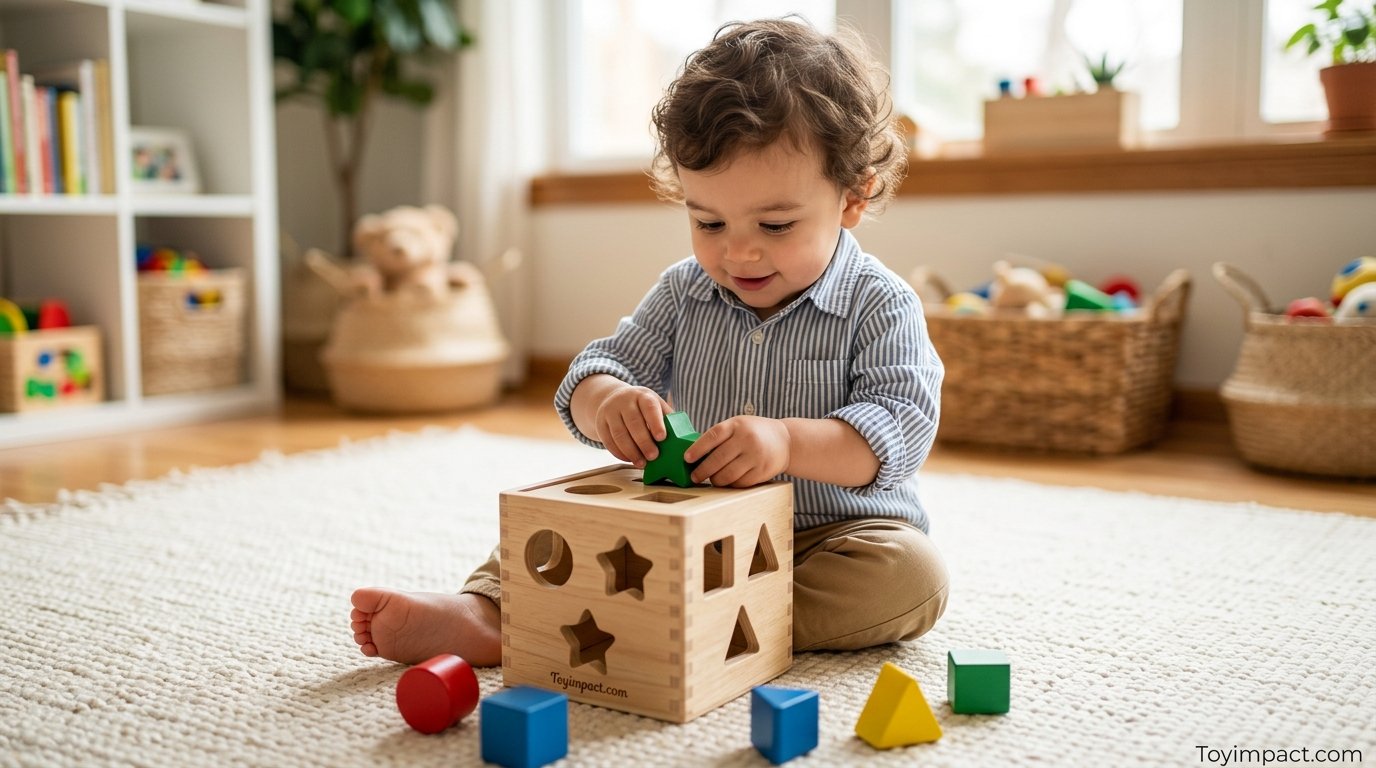
Best Age to Introduce Montessori Toys: A Stage-by-Stage Guide for Parents
From the newborn months through early elementary years — what actually belongs in your child’s hands, and when.
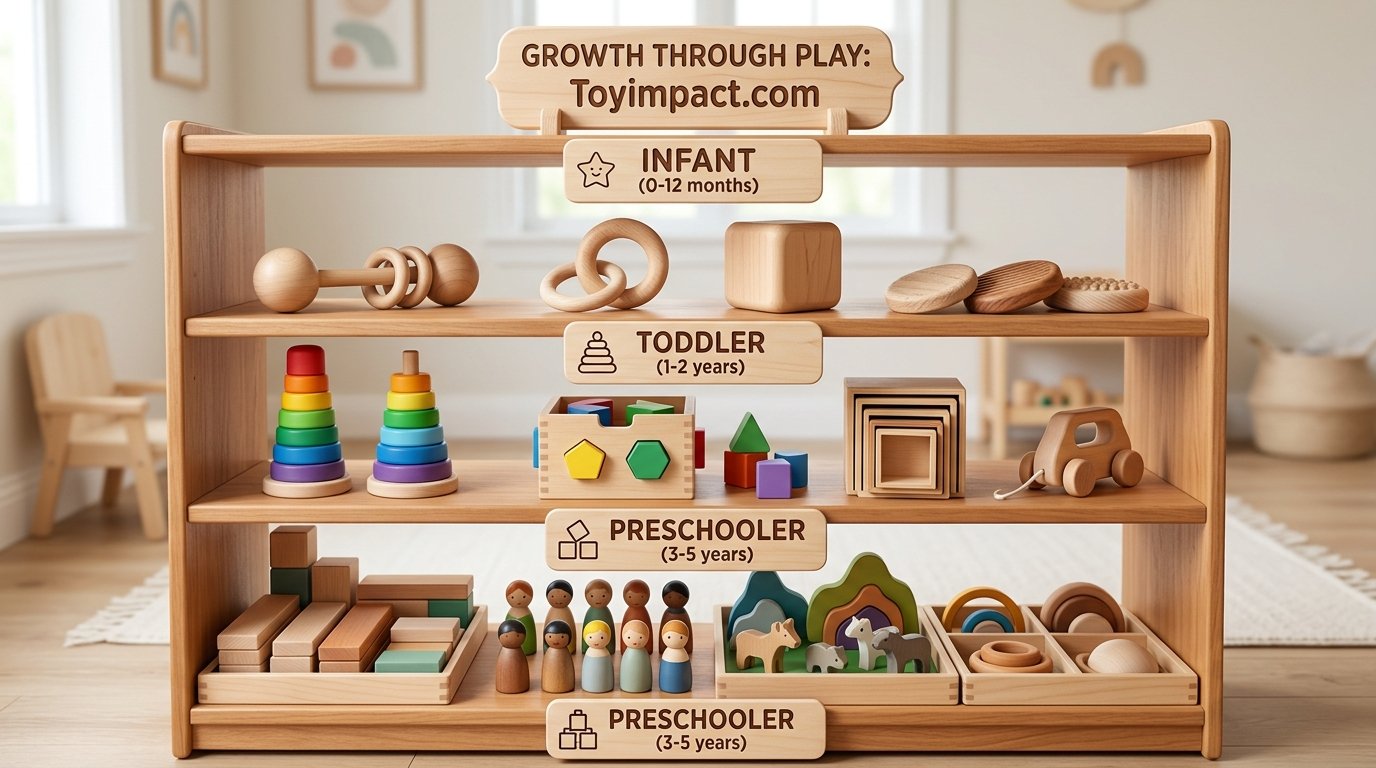
A well-organized, low shelf of open-ended materials — the visual heart of a Montessori-inspired play space.
What “Montessori Toys” Actually Means
Before we talk about timing, it helps to get clear on what we’re actually timing. The phrase “Montessori toys” gets used loosely across parenting blogs and product listings, but in the original Montessori philosophy, there’s no such thing as a toy designed purely for entertainment. Everything a child interacts with is considered a “material” — an object with a purpose, a built-in lesson, and a natural stopping point. A rattle that only makes noise is a toy. A rattle made of natural wood, sized for small hands, with a texture that invites grasping and a weight that teaches cause and effect, is a Montessori material.
Dr. Maria Montessori didn’t design these objects to be flashy. She designed them to be honest. A wooden ring stacker doesn’t light up or play a tune when a ring goes on incorrectly — the child has to look, adjust, and try again. That built-in feedback loop, often called the “control of error,” is the defining feature separating Montessori-aligned materials from conventional toys. The child, not the object, decides whether the task was completed successfully.
This matters enormously when we talk about age. Because these materials are calibrated to specific developmental windows called “sensitive periods,” timing isn’t a minor detail — it’s the entire point. A material introduced too early frustrates a child who lacks the physical or cognitive scaffolding to use it. Introduced too late, and the child may have already moved past the sensitive period that made the material so effective in the first place, leaving it to gather dust on a shelf that could hold something more useful.
It’s also worth noting what Montessori materials are deliberately not trying to do. They aren’t designed to entertain in the way a screen or a musical toy entertains, and they aren’t designed to hold a child’s attention through novelty. Instead, they’re designed to hold attention through mastery — the satisfaction of doing something increasingly precisely. That’s a slower, quieter kind of engagement, and it’s part of why timing matters so much: a child who isn’t developmentally ready for that kind of focused, repetitive work will simply walk away, no matter how nicely the material is made.

The Short Answer: Age-by-Age Overview
If you only have thirty seconds, here’s the compressed version. Montessori-aligned play begins essentially at birth with high-contrast visual materials, then moves through a fairly predictable sequence tied to physical development — grasping, sitting, crawling, walking, talking, and eventually fine motor refinement. There is no single “correct” starting age; there’s a correct starting stage, and every child arrives at each stage on their own timeline.
0–6 months
High-contrast cards, wooden rattles, mobiles that hang above a mirror.
6–12 months
Object permanence boxes, grasping balls, simple stacking rings.
12–18 months
Push-pull toys, simple puzzles, posting boxes, nesting cups.
18–24 months
Knobbed puzzles, sorting trays, early language cards, pouring activities.
2–3 years
Practical life tools, dressing frames, simple art materials, basic sequencing.
3–6 years
Sensorial materials, early math manipulatives, moveable alphabet, fine craft work.
That table is a starting compass, not a rulebook. Some babies show intense interest in object permanence at five months; others aren’t ready until closer to ten. The rest of this guide breaks each stage down in detail, including the physical and cognitive markers that tell you a child is actually ready — which is a far more reliable signal than the number printed on a box.
0–6 Months: The Observing Stage
Newborns aren’t playing with toys in any conventional sense during this window — they’re building the neurological foundation that later play depends on. Vision is blurry and low-contrast at birth, which is exactly why the earliest Montessori materials lean so heavily on stark black-and-white imagery. A newborn can focus on high-contrast patterns from roughly eight to twelve inches away, which happens to be almost exactly the distance from a baby’s face to a parent’s face during feeding — not a coincidence.
Around six to eight weeks, many babies start tracking a slowly moving object with their eyes. This is the appropriate moment for a simple mobile — not the battery-powered kind that spins and plays music, but a hand-turned or breeze-moved mobile made of geometric shapes or high-contrast patterns, hung roughly a foot above the child’s chest when lying on their back. The Montessori tradition uses a sequence here: the Munari mobile (black, white, and a single reflective sphere) tends to come first, followed by mobiles with slightly more color and complexity as the weeks progress.
By three to four months, grasping reflexes begin transitioning into intentional grasping. This is when a wooden ring or a lightweight rattle sized for a small fist becomes appropriate — not because the baby will “use” it correctly, but because mouthing, batting, and eventually gripping the object builds the hand strength and eye-hand coordination that later stages depend on.
What NOT to introduce yet
Skip anything involving sorting, stacking, or multi-step sequences. A baby under six months doesn’t have the working memory or fine motor control to benefit from a shape sorter, and offering one too early usually just results in a chewed piece of wood.
Good fits for this stage
- High-contrast board books
- Wooden ring rattles
- Low-hanging mobiles
- Floor mirror for tummy time
Skip for now
- Shape sorters
- Anything with small removable parts
- Puzzles
- Battery-operated, light-up toys
6–12 Months: The Grasping & Moving Stage
This six-month window covers an enormous amount of developmental ground, so it helps to split it into two rough halves. From six to nine months, most babies are refining their pincer grasp, learning to sit independently, and beginning to understand that objects continue to exist even when hidden — a concept called object permanence. From nine to twelve months, many are pulling to stand, cruising along furniture, and starting to combine two simple actions, like picking something up and dropping it into a container.
The object permanence box is the signature material of this stage, and for good reason. It’s a simple wooden box with a hole in the top and a ball attached to a string or tray. The baby pushes the ball through the hole, watches it disappear, and — crucially — has to remember it still exists somewhere below in order to look for it. This single, repeatable action reinforces one of the biggest cognitive milestones of infancy.
Around nine to ten months, once a baby can sit stably and manipulate objects with more control, simple posting activities (dropping large, safe objects into a container with a wide opening) and the earliest stacking rings become appropriate. Don’t expect correct size-order stacking yet — that skill typically doesn’t solidify until well into the second year. At this stage, the value is in the grasping, releasing, and repetition, not the “correct” outcome.
| Approx. Age | Physical Milestone | Matched Material |
|---|---|---|
| 6–7 months | Sits with support, transfers objects hand to hand | Textured grasping balls, fabric books |
| 7–9 months | Sits independently, refined pincer grasp emerging | Object permanence box, simple ring stacker |
| 9–12 months | Pulls to stand, points, may take first steps | Posting box, push toy, nesting cups |
If you’re looking for more ideas that fit this exact window and the toddler stage just beyond it, this roundup of toddler toys under $20 is a useful budget-friendly companion to this guide.

12–18 Months: The Purposeful Movement Stage
Once walking begins — usually somewhere between eleven and fifteen months, though the range is wide and completely normal — a child’s whole relationship to their environment shifts. Materials that involve carrying, pushing, and pulling become disproportionately appealing, simply because the child is finally mobile enough to use them properly. A wooden push wagon loaded with blocks, a pull-along animal on a string, or a low wagon they can fill and empty repeatedly all match this new physical capability.
This is also the stage where simple puzzles start to make sense — specifically single-piece knobbed puzzles where each shape has its own cutout and a small peg to grip. The knob matters more than it might seem; it isolates the three-finger pincer grasp that later becomes essential for holding a pencil. Avoid multi-piece jigsaw-style puzzles here — they require a level of spatial reasoning that typically doesn’t arrive until closer to age two or later.
Language explodes quietly in the background during this window even if spoken vocabulary lags. Simple picture-matching cards and real (not cartoonish) images of everyday objects support this internal vocabulary growth even before a child can say the words back.
18–24 Months: The Language & Order Stage
Somewhere around eighteen months, many toddlers enter what Montessori educators call the sensitive period for order — an intense, sometimes comically rigid preference for routines, sequences, and objects being “in their place.” This isn’t stubbornness for its own sake; it reflects a child’s brain actively building a mental model of how the world is structured. Materials that support sorting, matching, and simple sequencing land extremely well here.
Knobbed puzzles with two or three pieces, simple color-sorting trays, and pouring activities (dry rice or beans between two small pitchers, closely supervised) all fit naturally. This is also a strong window to introduce a low, child-accessible shelf if you haven’t already — the sensitive period for order applies to the environment itself, not just to individual toys, and toddlers at this age often take real satisfaction in returning an activity to its exact spot before choosing another.
Language acquisition is also accelerating rapidly, often adding new words daily. Simple three-part cards (a picture, a matching label, and a control card showing both together) introduce early vocabulary in a structured, low-pressure way, though most children won’t engage with these meaningfully until closer to the two-year mark.
For families managing a toddler alongside older siblings, this guide on toys siblings can enjoy together pairs well with the independent materials described here.
2–3 Years: The Independence Stage
The phrase “help me do it myself” captures this entire year better than almost any other description. Two-year-olds are physically capable of a surprising number of real tasks — pouring, scooping, buttoning, wiping — and Montessori’s “practical life” category of materials exists specifically to channel that drive toward genuine, useful skills rather than purely symbolic play.
This is the age for dressing frames (fabric-covered wooden frames with a single fastener — buttons, zippers, buckles, snaps — that a child practices in isolation), simple pouring and spooning trays, and child-sized real tools: a small broom, a real (not toy) whisk, a pitcher sized for small hands. The appeal of practical life work is that it’s inherently self-correcting — spilled water is immediately visible and gets wiped up, without a parent needing to intervene or praise.
Basic art materials also become appropriate here: thick crayons, simple play dough with basic tools, and large paper. Puzzles can now handle four to six pieces, and simple sequencing activities (biggest to smallest, first to last) start to click reliably for many children.
It’s worth saying a bit more about why practical life work carries so much weight in the Montessori sequence, because it’s easy for parents accustomed to conventional toy aisles to underestimate it. A two-year-old pouring water from a small pitcher into a cup isn’t a lesser activity than a flashier toy — it’s actually one of the more demanding tasks available at this age, requiring sustained attention, controlled wrist movement, and the patience to correct course when water sloshes over the rim. Because the task is real rather than symbolic, the child’s motivation comes from an authentic desire to participate in family life, not from external rewards. That intrinsic motivation tends to produce longer, calmer play sessions than novelty-driven toys typically manage at this age.
Signs a child is ready for this stage
- Insists on doing tasks “myself”
- Can follow a two-step instruction
- Shows interest in real household tasks
- Has steady enough hands to pour without heavy spillage
Not ready yet if…
- Still mouths most objects
- Frustrates quickly and abandons multi-step tasks
- Has limited attention span under 60–90 seconds
Parents shopping for a milestone gift around this age often browse guides like this one on educational toys for 3-year-old boys, which lines up closely with the practical life category described above.

3–6 Years: The Refinement Stage
This is the stage most people picture when they hear “Montessori classroom” — the pink tower, the knobbed cylinders, the moveable alphabet, the bead chains. These sensorial and early academic materials are designed to isolate one quality at a time: size, weight, texture, color gradation, or sound, so a child can refine a specific sense without competing variables getting in the way.
The famous Pink Tower (ten wooden cubes ranging from one to ten centimeters per side) teaches visual discrimination of size. The Brown Stair does the same for a single dimension of thickness. Knobbed cylinder blocks refine the grip needed for writing while simultaneously teaching diameter and height discrimination. None of these were designed as “toys” in the entertainment sense, but children in this age range often return to them repeatedly, drawn by the built-in challenge of getting the sequence exactly right.
Early literacy materials also fit well here — sandpaper letters (textured letters a child traces while saying the sound), followed later by a moveable alphabet for building words phonetically before handwriting is fully developed. On the math side, simple counting materials like number rods or spindle boxes introduce quantity in a concrete, touchable way well before abstract worksheets make sense.
| Material | Skill Isolated | Typical Starting Age |
|---|---|---|
| Pink Tower | Visual size discrimination | ~2.5–3 years |
| Knobbed Cylinders | Pincer grip, dimension | ~2.5–3 years |
| Sandpaper Letters | Phonetic sound-symbol link | ~3.5–4 years |
| Moveable Alphabet | Word building, encoding | ~4–4.5 years |
| Spindle Boxes | Quantity + numeral association | ~4 years |
| Bead Chains | Skip counting, early math | ~4.5–5 years |
For families layering in STEM-adjacent exploration alongside these classic materials, this guide on introducing STEM toys to preschoolers offers a natural next step once sensorial work is well established.
One nuance worth flagging: children in this three-to-six range often move through sensorial and language materials at noticeably different paces from one another, and even within the same child, math and literacy readiness rarely arrive on the same week. It’s entirely normal for a four-year-old to be confidently building three-letter words with a moveable alphabet while still working through single-digit spindle boxes, or the reverse. Resist the urge to synchronize progress across subject areas — the sequence within each area (sensorial, language, math, practical life) matters more than keeping pace evenly across all four at once.
6+ Years: Beyond the “Toy” Stage
By elementary age, the Montessori approach shifts noticeably away from discrete “materials” and toward projects, research, and real-world application — what Montessori herself called moving from the “concrete” to the “abstract.” A six- or seven-year-old who spent early years working with bead chains and number rods is often ready to move toward abstract math without needing the physical material every time, though many children continue benefiting from concrete tools well into this stage, especially for new or difficult concepts.
Open-ended construction materials (real woodworking tools sized for kids, advanced building sets, sewing kits) tend to replace single-purpose sensorial materials during this window, since the child’s own creativity and planning ability are now developed enough to generate the structure that a younger child needed built in. It’s also worth acknowledging that interest in structured, single-purpose materials naturally declines around this age for most children — which is a normal and expected transition, not a sign anything went wrong. This guide on what age kids typically stop playing with toys covers that transition in more depth.
Signs Your Child Is Ready for the Next Stage
Ages in this guide are averages, not deadlines, and leaning too hard on a printed age range is one of the most common mistakes parents make with Montessori materials. A far more reliable approach is watching for behavioral signals that a child has outgrown their current materials and is ready for more complexity.
- Mastery boredom: The child completes a familiar activity quickly, correctly, and without the focus it used to require.
- Repurposing: The child starts using a material in unintended ways — often a sign they’ve extracted the available challenge and are inventing a new one.
- Watching older peers: Persistent interest in a sibling’s or classmate’s more advanced activity is a strong readiness signal.
- Physical readiness: New fine or gross motor skills (a stronger pincer grip, better balance, longer sitting tolerance) often precede readiness for the next material by only a few weeks.
- Frustration vs. disinterest: Mild frustration during an appropriately challenging task is normal and productive; a child who won’t even attempt a material is usually signaling it’s still too advanced.
Comparison Table: Traditional vs. Montessori Toys
It’s worth being direct about the trade-offs, since Montessori materials aren’t automatically “better” in every situation — they’re built around a different goal than most mainstream toys.
| Feature | Traditional Toys | Montessori Toys |
|---|---|---|
| Feedback | Often external (lights, sounds, praise) | Built-in “control of error,” self-correcting |
| Materials | Mostly plastic, mixed durability | Mostly natural wood, fabric, metal |
| Play style | Often open-ended entertainment or pretend | Goal-directed, skill-isolating |
| Sensory input | Frequently high-stimulation (sound, light, color) | Deliberately calm, muted color palettes |
| Cost | Wide range, often lower per item | Typically higher per item, longer lifespan |
| Best for | Imaginative and social play, downtime | Focused skill-building, independent work |
In practice, most well-rounded playrooms use both categories rather than choosing one exclusively — Montessori materials for focused, independent skill work, and traditional toys for imaginative and social play.
Common Mistakes When Introducing Montessori Toys
Watch out for these
- Buying strictly by printed age range instead of observed readiness
- Offering too many materials at once, diluting focus
- Intervening too quickly when a child struggles
- Skipping practical life work in favor of “academic” materials
- Not rotating stale materials that no longer challenge the child
Better approach
- Watch for the readiness signals covered above
- Limit the shelf to 4–6 active choices
- Give a full minute of silent struggle before helping
- Balance practical life, sensorial, and language/math materials
- Rotate every 1–3 weeks based on engagement
How Often to Rotate and Introduce New Materials
Timing isn’t just about the first introduction of a material category — it also applies to how long any individual toy stays in rotation. A shelf that never changes eventually gets ignored regardless of how well-matched it was initially, while a shelf that changes too often prevents the deep, repetitive mastery that makes these materials effective in the first place.
A reasonable default is reviewing engagement every one to three weeks: materials still generating focused use stay, materials being ignored or mastered get rotated out and stored for a few months before reappearing (often to renewed interest). For a deeper breakdown of this process, this guide on how often to rotate kids’ toys walks through a practical rotation system, and this piece on organizing toy storage in small spaces is useful for families without room for a large open shelf.
What to Buy at Each Age (Practical Shopping Guide)
To make this guide immediately actionable, here’s a condensed shopping reference by stage, alongside a few related buying guides worth bookmarking depending on your specific situation.
- Newborn–6 months: high-contrast cards, wooden ring rattle, simple mobile
- 6–12 months: object permanence box, textured balls, posting box
- 12–18 months: push wagon, single-piece knobbed puzzle, nesting cups
- 18–24 months: sorting trays, 2–3 piece puzzles, pouring set
- 2–3 years: dressing frame, child-sized real tools, simple art supplies
- 3–6 years: sensorial towers/cylinders, sandpaper letters, counting materials
If you’re building out a broader collection beyond core Montessori materials, these related guides can help round things out: toys for long car rides, options for air travel, ideas for backyard water play, a gift guide for a 5-year-old girl’s birthday, and a curated list of sensory toys for autistic children for families who need materials calibrated to different sensory needs.

Frequently Asked Questions
What is the absolute earliest age to start Montessori toys?
Effectively from birth, though “toys” at this stage mean high-contrast visual cards and simple mobiles rather than anything a baby physically manipulates. Grasping-based materials typically start becoming useful around three to four months.
Are Montessori toys worth it compared to regular toys?
They serve a different purpose rather than being strictly superior. Montessori materials excel at focused, independent skill-building, while traditional toys often support imaginative and social play better. Most balanced playrooms include both.
My toddler is older than the “typical” age for a material — is it too late?
Generally no. Sensitive periods are windows of heightened interest, not hard cutoffs. A child who missed the “ideal” window for a material can usually still benefit from it, though engagement may look a little different than it would have earlier.
How many Montessori toys should be on the shelf at once?
Most Montessori-informed setups keep four to six active choices available at a time, rotating stale or mastered items out every one to three weeks to maintain focus and interest.
Do Montessori toys need to be made of wood?
Not strictly, but natural materials (wood, metal, fabric, glass) are strongly preferred because they offer richer sensory feedback — weight, temperature, texture — than uniform plastic, and they tend to hold up better over years of repeated use.
Can I mix Montessori toys with regular plastic toys?
Yes, and most families do. There’s no rule against combining approaches; the key is being intentional about which materials go on the low, accessible shelf for independent work versus which live in a general toy bin for open play.
What’s the difference between a Montessori toy and a sensory toy?
Sensory toys focus broadly on stimulating the senses and can include lights, sounds, and varied textures. Montessori materials are more narrowly designed to isolate a single skill or quality at a time, with a built-in way for the child to check their own work.
Should I intervene if my child is using a Montessori toy “incorrectly”?
Usually not immediately. Give at least a minute of uninterrupted exploration before offering guidance. Unstructured exploration is often how a child discovers a material’s built-in challenge on their own terms.
How do I know if a material is too advanced for my child?
Persistent disinterest, immediate frustration without any attempt, or repeatedly ignoring the material after a couple of introductions are all signs it may be too advanced right now. Set it aside and reintroduce it in a month or two.
Do I need a full Montessori classroom setup at home?
No. A single low shelf with four to six well-matched materials, refreshed periodically, captures most of the practical benefit without needing a dedicated room or a large budget.
At what age should I stop buying Montessori-style materials?
Most families transition away from discrete sensorial materials somewhere around age six or seven, shifting toward open-ended projects, real tools, and abstract academic work as the child’s own planning and reasoning skills take over.
Are Montessori toys safe for babies who still mouth objects?
Well-made wooden Montessori materials are generally safe for mouthing since they’re typically finished with non-toxic oils or waxes, but always check size guidelines and avoid materials with small detachable parts until a child is past the mouthing stage.
Conclusion: Trust the Stage, Not Just the Age
If there’s one idea worth carrying away from this guide, it’s that age ranges are a starting compass, not a strict schedule. The most useful thing a parent can do isn’t memorizing a chart — it’s watching closely for the signs of readiness covered throughout this guide: mastery boredom, physical readiness, and genuine curiosity about the next challenge. Introduce materials a little early, and simply set them aside if they don’t land yet. Introduce them a little late, and most children will still benefit, just with slightly different engagement than they might have shown in the “ideal” window.
Start small: a single low shelf, four or five well-matched materials for your child’s current stage, and a rotation habit reviewed every couple of weeks. That’s a genuinely complete Montessori-inspired setup, no matter how old your child is today.





Pingback: What Are Quiet Time Toys? Parent's Complete Guide
Pingback: How to Clean Squishy Toys Without Ruining the Squish
Pingback: When Do Babies Start Playing With Toys? Month Guide