How to Introduce STEM Toys to Preschoolers (Without Overwhelming Them)
A calm, step-by-step guide to bringing science, technology, engineering, and math into everyday play — starting exactly where your three, four, or five-year-old already is.
Why STEM Matters for Preschoolers
The idea of “STEM” — science, technology, engineering, and math — can sound like something reserved for middle schoolers with lab goggles and calculators, not a toddler who still needs help with a fork. But the truth is that STEM thinking begins the moment a child stacks two blocks and watches them fall, or pours water from one cup into another and notices it doesn’t disappear. Preschoolers are already scientists. They test, they observe, they repeat, and they draw conclusions, even if their conclusions are things like “the blue cup is magic.” Your job isn’t to install STEM knowledge into a blank slate; it’s to hand your child better tools for the investigating they’re already doing.
Research on early childhood development consistently points to the preschool years, roughly ages three through five, as a window when the brain is unusually receptive to pattern recognition, spatial reasoning, and cause-and-effect thinking. Children who get regular, low-pressure exposure to STEM concepts during this window tend to approach later academic STEM subjects with more confidence and less anxiety, simply because the ideas feel familiar rather than foreign. This isn’t about producing a prodigy. It’s about making numbers, shapes, forces, and structures feel like old friends by the time your child sits down in a kindergarten classroom.
There’s also a practical parenting reason to care about this now. Preschoolers who engage in STEM-flavored play tend to develop stronger fine motor control, longer attention spans, and better frustration tolerance, because building, sorting, and experimenting all involve a natural cycle of trying, failing, and trying again. If you’ve ever watched a four-year-old attempt to balance a fifth block on a wobbly tower for the tenth time, you’ve watched persistence being built in real time. That skill transfers far beyond the toy bin.
If your child is younger, it’s worth reading about the best age to introduce Montessori-style toys, since many of the same developmental principles overlap with STEM readiness. The two philosophies aren’t identical, but they share a belief that children learn best through hands-on, self-directed exploration rather than passive instruction.
Another reason this stage matters so much comes down to emotional confidence rather than raw intelligence. Preschoolers who are given repeated, low-stakes chances to experiment tend to develop a more relaxed relationship with getting things wrong. Because a tower falling over or a shape not fitting has no real consequence, the child learns early that mistakes are simply information, not failure. That single mindset shift, that a wrong answer is just data to work with, is one of the most valuable and transferable lessons a STEM toy can teach, and it tends to matter more in the long run than any specific fact the toy conveys.
It’s also worth noting that STEM exposure at this age doesn’t need to be constant or heavily scheduled to be effective. Even two or three short, genuinely engaged sessions a week produce noticeable growth over a few months, especially compared to toys that sit untouched on a shelf because they were introduced with too much pressure attached. Consistency in small doses beats intensity in rare bursts, which is good news for busy households that can’t dedicate an hour a day to structured play.
What Actually Counts as a “STEM Toy”
Marketing has muddied the definition of a STEM toy so thoroughly that it’s worth resetting expectations before you buy anything. A STEM toy for a preschooler is not necessarily a robot, a coding kit, or anything with a screen. In fact, for children under five, the most effective STEM toys are often the least “techy” objects in the house: measuring cups, magnetic tiles, a bucket of water, a ramp made from a cutting board.
What actually qualifies is simpler than the packaging suggests. A toy counts as STEM-supportive if it allows a child to test an idea and see a result. That’s the entire mechanism. Building blocks let a child test “will this stand?” Water beads let a child test “what happens when I squeeze this?” A simple balance scale lets a child test “which one is heavier?” None of these require electronics, and all of them build the exact reasoning skills that later show up in a science classroom.
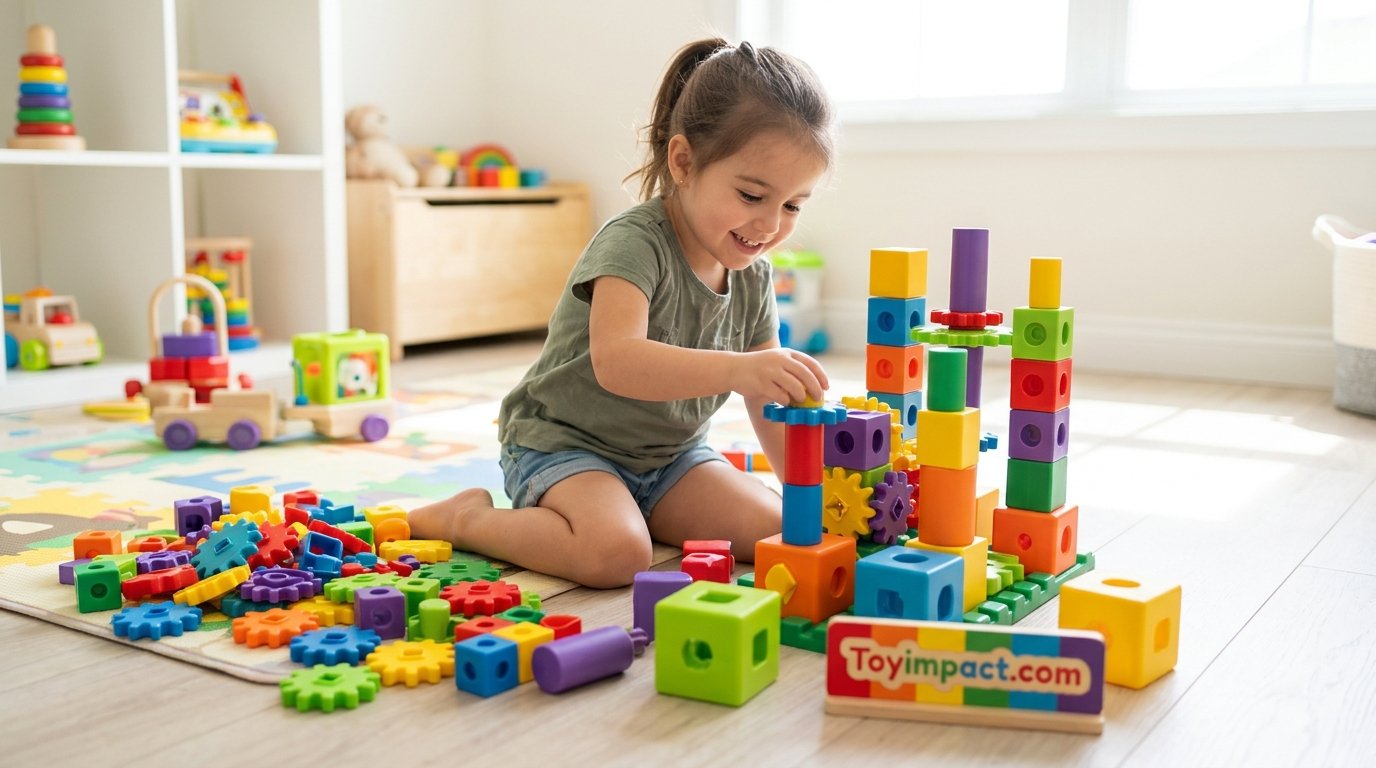
Broadly, STEM toys for this age group fall into a few overlapping categories: construction and building sets (blocks, magnetic tiles, interlocking gears), sensory and material-exploration toys (sand, water, sensory bins, playdough with tools), early math and logic toys (sorting sets, pattern blocks, simple scales), and nature or “real world” investigation tools (magnifying glasses, bug catchers, plant-growing kits). A well-rounded toy shelf usually has at least one item from each category, rather than five versions of the same building set.
If you’re shopping on a tight budget, it’s worth knowing that some of the most effective STEM toys are also the cheapest in the store; check out this roundup of the best toys under $20 for toddlers for proof that price and educational value don’t move together in a straight line.
Signs Your Preschooler Is Ready for STEM Play
Readiness for STEM toys isn’t about hitting a birthday. It’s about a cluster of behaviors that show up naturally, usually somewhere between two and a half and four years old, though every child’s timeline is different. Watching for these signs will tell you more than any age label printed on a box.
The first sign is repetitive testing. If your child dumps a cup of blocks out and puts them back in over and over, that’s not aimless fidgeting; that’s an early experiment loop. The second sign is question-asking, even nonverbal question-asking, like holding an object up to you with a confused expression as if to say, “explain this.” The third sign is an interest in “how things work” — opening drawers, peering into machines, pulling toys apart to see the inside. The fourth is growing hand strength and coordination sufficient to stack, twist, or connect small pieces without immediate frustration.
You don’t need all four signs present at once. Even one or two, showing up consistently over a couple of weeks, is a reasonable signal that your child is ready to move from purely sensory toys toward slightly more structured STEM play. If your child also has sensory sensitivities or is on the autism spectrum, readiness can look a little different, and it’s worth browsing this sensory toy gift guide for autism for options designed with those needs specifically in mind.

Magnetic Building Tiles Starter Set
A gentle, screen-free entry point into structural STEM thinking — snaps together with zero tools and zero frustration.
Check Price on AmazonStart With Sensory-Based STEM Toys
Every STEM journey for a preschooler should start with the senses, not the concepts. Before a child can understand “measurement,” they need hundreds of small physical experiences with more, less, full, and empty. This is why sensory bins, water tables, and material-exploration toys are the correct first step, even though they don’t look overtly educational.
A simple sensory bin filled with dried rice, small scoops, and a few measuring cups gives a toddler an early, hands-on lesson in volume and quantity long before they can count reliably. Water play does the same for concepts like buoyancy and displacement. The goal at this stage isn’t to name the science; it’s to let your child accumulate raw sensory data that later lessons will build on.
Set up a small bin on a towel or tray, add two or three tools (a scoop, a funnel, a small cup), and let your child direct the play entirely. Resist the urge to narrate every action or turn it into a lesson. At this stage, silence and observation from you are more valuable than commentary.
A basic sensory bin setup — the entry point to STEM exploration.
Because these first materials rarely come in a labeled “STEM” box, they’re also some of the cheapest supplies you’ll buy. A trip to the kitchen or a $10 bin of dried beans will outperform most flashy electronic “learning” toys for this age group, and it pairs well with rotating toys in and out of a small storage bin so the sensory materials stay novel; see this guide on how often to rotate kids’ toys for a simple schedule.
Introduce Simple Building and Construction Toys
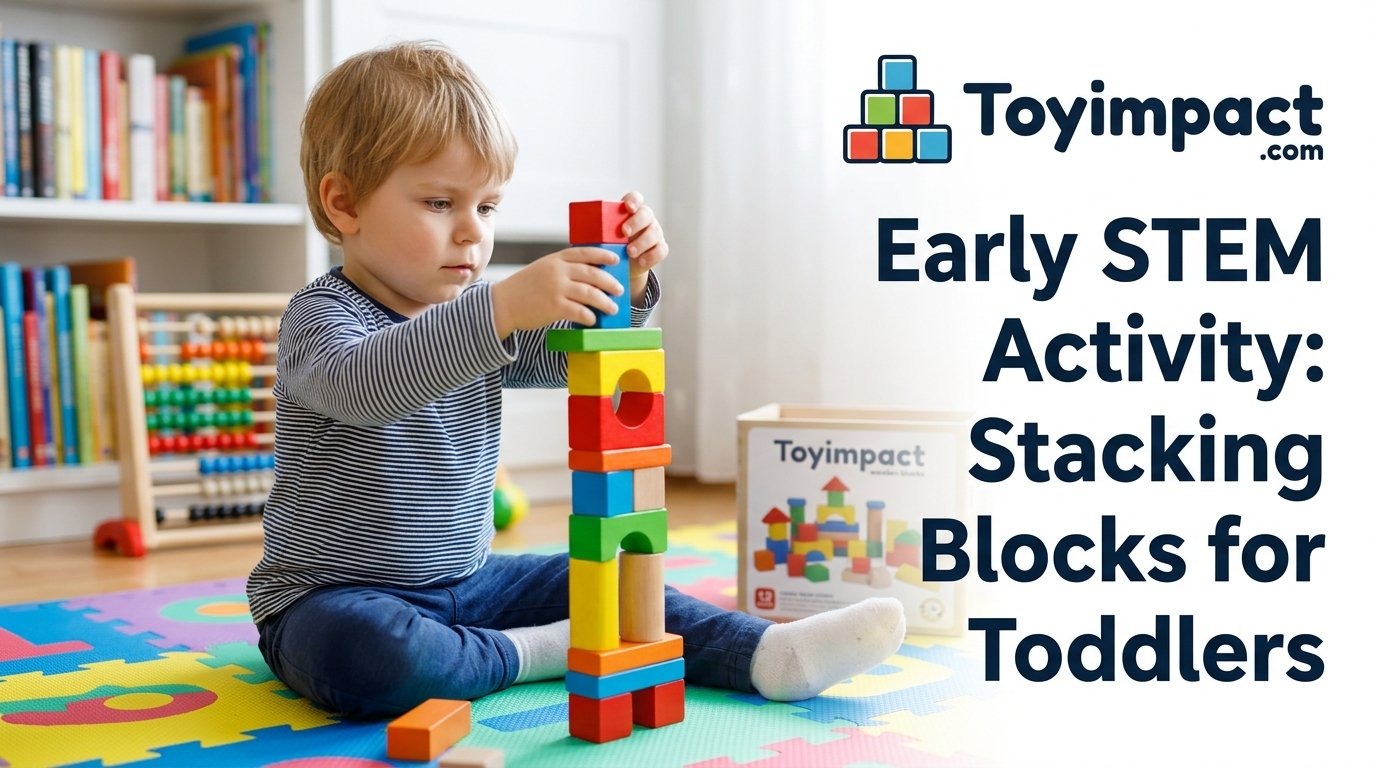
Once your child has logged plenty of sensory hours, building toys are the natural next step. Large wooden blocks, soft foam blocks, or magnetic tiles all work well because they give immediate, visible feedback: stack too high without a solid base, and the tower falls. That instant consequence is the single most powerful STEM teacher a preschooler has access to.
Start with a small set, no more than 15 to 20 pieces, and let your child build without a template. Templates and instruction cards are useful later, closer to age five, but for a three or four-year-old, open-ended free building teaches balance, symmetry, and gravity far more effectively than following a picture. If the tower falls, resist rebuilding it for them. Watching them problem-solve the rebuild, even imperfectly, is where the actual learning happens.
Identifying the balance point while stacking a small block tower.
If your preschooler shares a play space with an older or younger sibling, building sessions can also become a shared project rather than a solo one, which adds a light social-STEM layer where children negotiate design decisions together. There’s more on setting that up in this guide to the best toys for siblings to play together.

Chunky Wooden Building Block Set (30 pcs)
Large enough for small hands, heavy enough to teach real balance and gravity lessons without frustration.
Check Price on AmazonWeave STEM Into Daily Routines
The toy shelf is only one place STEM thinking lives. Some of the strongest early science and math exposure happens outside of designated “toy time,” folded into activities you’re already doing. Cooking, laundry, and even getting dressed all carry small STEM opportunities if you slow down enough to name them.
Measuring ingredients while baking introduces volume and fractions in the most concrete way possible: a half cup really does look different from a full cup, and a preschooler can see it rather than just hear about it. Sorting laundry by color or size builds classification skills, the same mental muscle used later for sorting numbers and shapes. Counting stairs while climbing them, comparing shoe sizes, or predicting which ice cube will melt first on a sunny windowsill versus a shaded one — all of these are STEM lessons disguised as ordinary life.
Everyday moments like measuring and time-tracking double as informal STEM lessons.
Car rides are another underused window for this kind of thinking — counting red cars, spotting shapes on road signs, or estimating how many minutes until the next stop. If you’re planning ahead for a longer trip, this list of the best toys for car rides and long trips includes several options built specifically around this kind of passive STEM engagement.
Use Guided, Open-Ended Play Sessions
There’s a middle ground between letting a child play completely alone and taking over the activity yourself, and that middle ground is where the richest STEM learning tends to happen. A guided, open-ended play session means you sit nearby, join occasionally, and ask questions rather than give instructions.
The key skill here is restraint. When a preschooler is trying to fit a square peg into a round hole, the instinct is to jump in and fix it. Instead, try narrating what you observe without solving it: “Hmm, that one’s not going in. I wonder what’s different about this hole.” This keeps the child in the driver’s seat of the experiment while still giving them a thinking partner.
Guided play keeps the adult nearby as a question-asker, not a problem-solver.
Aim for sessions of 10 to 20 minutes rather than long stretches. Preschool attention spans are short by design, and a shorter session that ends on a moment of success will do more for STEM confidence than a long session that ends in a meltdown. If you need a rotating set of quiet, low-mess options for these guided sessions, particularly for travel or waiting rooms, this list of the best travel toys for airplane trips covers several compact STEM-friendly picks.
Layer In Complexity Gradually
One of the fastest ways to kill a preschooler’s interest in STEM toys is to hand them something too advanced too soon. A 100-piece gear set might be exciting to you, but to a three-year-old with developing fine motor skills, it can feel like an instant, frustrating failure. Complexity should be added in small, deliberate increments, almost like leveling up a video game.
A useful mental model is a three-rung ladder. Level one toys have large pieces, obvious cause-and-effect, and very few steps (large blocks, simple shape sorters, big-piece puzzles). Level two toys add more pieces and slightly more planning (medium interlocking blocks, simple balance scales, basic pattern cards). Level three toys, usually appropriate closer to age five, introduce sequencing, multi-step building, or basic early coding logic (unplugged coding boards, gear sets with instruction cards, more complex magnetic construction sets).
Move up one rung only after your child has mastered the current level with ease.
Move up a level only after your child completes the current level with visible ease, not frustration. This might take a few weeks or a few months depending on the child, and that’s normal. There’s no prize for rushing to level three early, and doing so tends to backfire by making STEM toys feel like a source of failure rather than curiosity.
Ask Questions That Build Scientific Thinking
The final step is less about the toy itself and more about the language you use around it. The questions you ask during play shape whether your child experiences STEM toys as an investigation or as a task to complete correctly. Preschoolers respond best to open-ended prompts that have no single right answer.
Instead of “what color is that block,” which has one correct answer and closes the conversation, try “what do you think will happen if you put that block on top?” or “why do you think that one didn’t fit?” These prompts invite prediction and reasoning, the two cognitive skills that sit at the core of every STEM discipline. Over time, children who are asked prediction-based questions regularly start to ask themselves the same questions unprompted, which is really the entire goal of early STEM exposure.
Prediction-based questions turn ordinary play into scientific reasoning.
This step also works well outdoors, where the questions naturally multiply: why does the ball roll faster down this hill, what happens if we pour water on the sand, how many steps to the fence. If your family spends a lot of time in the backyard, a water table is one of the most efficient tools for generating this kind of spontaneous questioning, since water behaves in ways that are endlessly surprising to a three or four-year-old.

Sensory Water Table with Accessories
Built-in ramps, wheels, and pour spouts turn simple water play into a full afternoon of prediction and observation.
Check Price on AmazonSTEM Toy Categories by Age and Skill
Because “preschooler” spans a wide developmental range, from a wobbly two-and-a-half-year-old to a fairly coordinated five-year-old, it helps to see toy categories laid out side by side against age and the skill each one primarily targets.
| Toy Category | Best Age Range | Primary Skill Built | Mess Level |
|---|---|---|---|
| Sensory bins | 2.5–4 years | Volume, texture, cause-and-effect | Medium |
| Large building blocks | 2.5–5 years | Balance, gravity, spatial reasoning | Low |
| Magnetic tiles | 3–5 years | Geometry, structural thinking | Low |
| Shape sorters | 2–3.5 years | Classification, matching | Low |
| Simple balance scales | 3.5–5 years | Early measurement, comparison | Low |
| Water/sand tables | 2.5–5 years | Displacement, prediction | High |
| Unplugged coding boards | 4–5 years | Sequencing, early logic | None |
| Gear and pulley sets | 4–5 years | Mechanical reasoning | Low |
Notice that most of this list has nothing to do with screens or electronics. If you’re building out a toy rotation and want more targeted picks for a specific age or gender, this guide to the best educational toys for a 3-year-old boy and this one for the best gift toys for a 5-year-old girl both organize picks around the categories above.
Screen-Based vs. Screen-Free STEM Toys
Not every STEM toy on the market is screen-free, and parents are often understandably torn about whether tablet-based STEM apps or interactive robots belong in the mix. The honest answer is that both categories have a role, but the balance should heavily favor screen-free options for children under five.
Screen-Free STEM Toys
- Builds fine motor skills alongside cognitive skills
- No time limits or app-store distractions
- Encourages parent-child interaction by default
- Lower cost and no battery dependency
Screen-Based STEM Toys
- Some apps offer adaptive difficulty that’s hard to replicate physically
- Risk of passive tapping replacing genuine problem-solving
- Requires screen-time limits and supervision
- Can create dependency on instant feedback loops
If you do choose to include a screen-based element, treat it as a small supplement rather than the core of your STEM toy rotation, capped at short, supervised sessions rather than open-ended access. The bulk of the developmental benefit for preschoolers still comes from physical, hands-on materials.
Common Mistakes Parents Make When Introducing STEM Toys
A handful of well-meaning mistakes show up repeatedly when parents try to introduce STEM concepts too formally or too fast. Recognizing them early can save a lot of frustration for both you and your child.
Mistake 1: Turning play into a quiz
Constantly asking “what shape is this” or “what color is that” during free play shifts the activity from exploration to testing. Preschoolers pick up on this quickly and can start to disengage from toys they associate with being evaluated.
Mistake 2: Buying too many pieces at once
A 200-piece STEM kit dumped in front of a three-year-old is overwhelming rather than exciting. Smaller sets, introduced gradually, keep the toy approachable.
Mistake 3: Rescuing every failure
Rebuilding a fallen tower or fixing a stuck puzzle piece the moment it happens removes the exact struggle that builds resilience and problem-solving. A short pause before helping goes a long way.
Mistake 4: Ignoring toy rotation
Even excellent STEM toys lose their power if they’re always visible and never put away. Rotating toys in and out keeps novelty high without constant new purchases; this guide on how often to rotate kids’ toys covers a simple system for doing this without extra clutter.
Mistake 5: Forgetting cleanup as part of the lesson
Sorting toys back into bins by type or size at the end of play is itself a STEM activity in disguise. Skipping it skips a free lesson in classification.
How to Choose the Right STEM Toy
With so many options marketed as “educational,” it helps to have a short mental checklist before buying anything new. A toy is likely to earn its shelf space if it meets most of the following criteria.
- Open-ended use: Can it be played with in more than one way, or does it only have a single correct outcome?
- Age-appropriate piece size: Are pieces sized for your child’s current fine motor stage, not the stage you hope they’ll reach?
- Durability: Will it survive being dropped, sat on, and occasionally chewed?
- Room to grow: Does the toy have a “level two” version of play as your child’s skills improve?
- Low instruction dependency: Can your child start playing with minimal adult setup or explanation?
Storage matters just as much as selection. STEM toys with lots of small pieces can quickly turn into floor clutter if there’s no system for putting them away; this guide to organizing toy storage in small spaces is a useful companion once your STEM shelf starts to grow. And for keeping shared pieces sanitary between hands-on sessions, it’s worth bookmarking this piece on how to clean plastic toys safely.

Wooden Balance Scale with Weights
A simple, durable way to introduce comparison and early measurement without any batteries or setup.
Check Price on AmazonFrequently Asked Questions
What age should I start introducing STEM toys?
Most children show early readiness signs somewhere between two and a half and three years old, though sensory-based STEM play, like water and texture exploration, can start even earlier in a very loose, unstructured form.
Do STEM toys need to have batteries or electronics?
No. Some of the most effective STEM toys for preschoolers, including blocks, sensory bins, and balance scales, have no electronic components at all. Physical, hands-on materials tend to build stronger foundational skills at this age than screen-based options.
How long should a STEM play session last for a preschooler?
Somewhere between 10 and 20 minutes is realistic for most three to five-year-olds. Ending a session on a positive note, even a short one, builds more enthusiasm than pushing for a longer session that ends in frustration.
My child gets frustrated quickly with building toys. What should I do?
Drop down a complexity level. Fewer pieces, larger sizes, and simpler goals usually resolve frustration faster than encouragement alone. You can always work back up gradually once confidence returns.
Are STEM toys worth the extra cost compared to regular toys?
Often, the most effective STEM toys are inexpensive household items or budget-friendly sets rather than premium branded kits. Price and educational value don’t move together in a predictable way at this age.
Should I let my preschooler play with STEM toys unsupervised?
Short stretches of independent play are healthy and encourage self-directed problem-solving, but small pieces and water-based activities generally warrant nearby supervision for safety reasons.
How do I know if a toy is too advanced for my child?
Watch for signs of quick frustration, disinterest, or a need for constant adult help to make any progress. Any of these usually means it’s worth stepping back to a simpler version of the activity.
Can STEM toys help with speech or language development too?
Indirectly, yes. Describing what’s happening during play, “it’s heavier,” “it rolled away,” “the tower is taller now,” naturally expands vocabulary alongside the STEM concept being explored.
What’s a good first STEM toy for a child who has never had one?
A simple sensory bin or a set of large, chunky building blocks are both low-pressure, low-cost starting points that rarely overwhelm a first-time STEM player.
How many STEM toys should be out at once?
Two or three is usually plenty. Too many options at once can lead to scattered, shallow play rather than focused exploration.
Do boys and girls need different STEM toys?
Developmentally, no. Interests can vary child to child, but the underlying skills, balance, classification, prediction, are the same regardless of gender, and most STEM toys work well for any child.
What if my preschooler only wants to play with STEM toys one specific way?
That’s normal and often a sign of focused mastery rather than a problem. Gently introduce a slightly different use once they seem confident, rather than redirecting them away from their current favorite approach.
Conclusion: Start Small, Stay Consistent
Introducing STEM toys to a preschooler isn’t about a single perfect purchase or a rigid lesson plan. It’s about small, repeated moments, a sensory bin here, a wobbly block tower there, a question asked instead of an answer given, stacked patiently over weeks and months. Start with sensory play, move into simple building, fold STEM language into your everyday routines, and let your child lead more often than you direct. The goal isn’t a preschooler who can recite facts. It’s a preschooler who’s comfortable testing an idea, watching it fail, and trying again, which is really the entire foundation of scientific thinking.
Browse STEM Toys for Preschoolers on Amazon