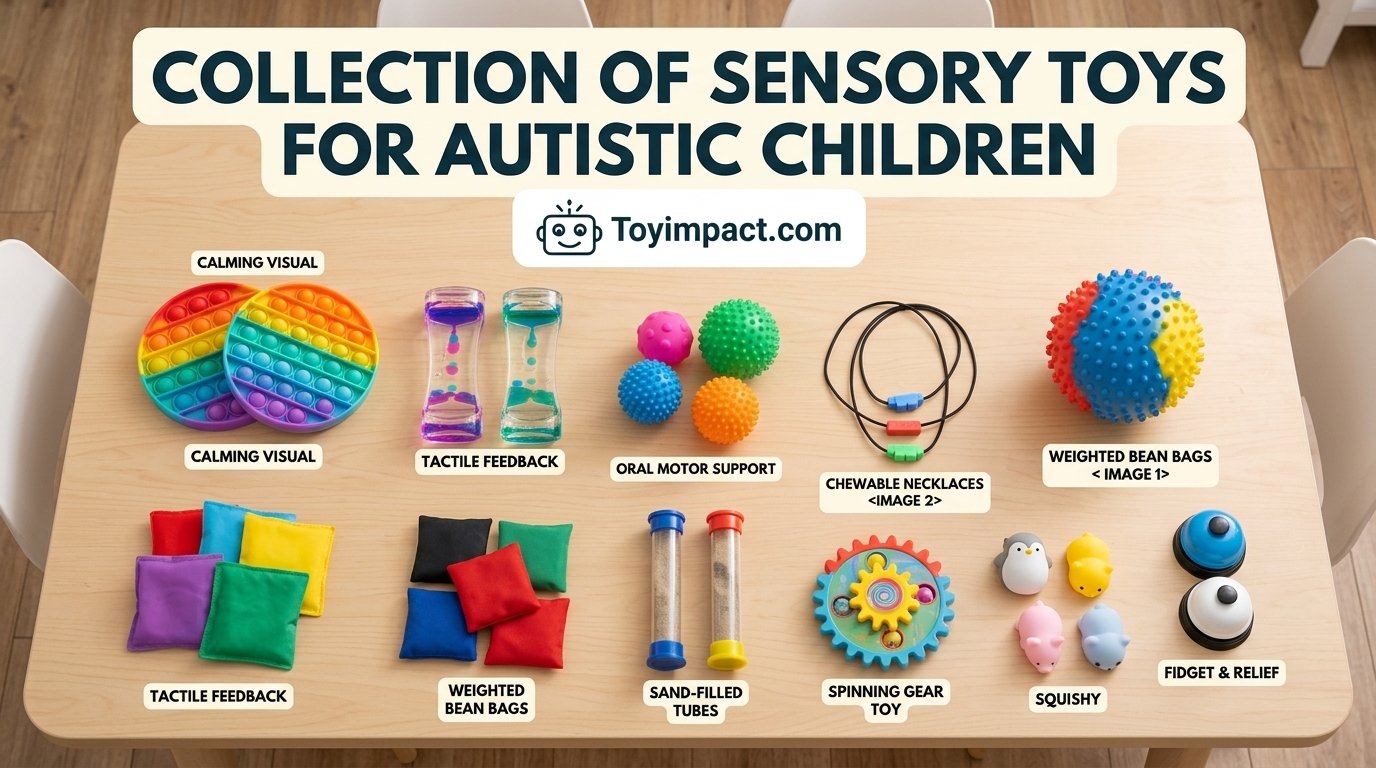
7 Best Sensory Toys for Autism: The Complete Gift Guide
Finding the right sensory gift can feel overwhelming when every product claims to be “calming” or “autism-friendly.” This guide breaks down seven genuinely useful sensory toys — what they do, who they help most, and how to choose between them — so you can buy with confidence instead of guessing.

Understanding Sensory Needs Before You Shop
Every autistic child processes sensory information differently, so the “best” toy really depends on the individual, not a universal ranking.
Some children are sensory seekers — they crave deep pressure, movement, and strong tactile input to feel regulated. Others are sensory avoiders, easily overwhelmed by sound, texture, or bright light, and benefit from tools that reduce input rather than add it. Many kids are a mix of both, seeking certain sensations while avoiding others entirely. That’s why a single gift guide can’t hand you one “correct” answer — instead, this list covers a spread of sensory categories so you can match the tool to the child in front of you rather than a generic label.
Before buying, it helps to think in terms of sensory systems: proprioceptive (body awareness and pressure), tactile (touch and texture), oral (chewing and mouthing), auditory (sound sensitivity), and visual (light and movement tracking). The seven items below map onto these systems in different ways, which is part of why occupational therapists tend to recommend a small toolkit rather than a single toy.
If you’re shopping for a child with layered needs — say, a toddler who also loves open-ended play — it’s worth browsing a broader list like our best toys under $20 for toddlers roundup alongside this one, since budget-friendly sensory options sometimes overlap with general toddler favorites.
It also helps to remember that sensory needs aren’t fixed. A child who avoided loud noises at age four might become far more tolerant by age eight, or a child who barely noticed textures as a toddler might suddenly develop strong tactile preferences during a growth spurt or a stressful season like starting a new school. Because of this, sensory toolkits tend to work best when they’re treated as evolving collections rather than one-time purchases. Revisiting this list every year or so, rather than assuming last year’s picks still fit, tends to produce better results than sticking rigidly to whatever worked once.
Parents and caregivers often describe a period of trial and error before landing on the right combination of tools — and that’s normal. A toy that looks perfect on paper might get rejected outright, while an unexpected favorite (a $6 fidget toy, say) becomes the item a child carries everywhere for a year. Buying two or three lower-cost, easily returnable items at first, rather than investing heavily in one expensive product, tends to reduce the frustration of guessing wrong.
Finally, it’s worth separating “sensory toy” from “regulation strategy.” A toy is a tool, not a fix — the goal isn’t to eliminate every uncomfortable sensation but to give a child something reliable to reach for when they’re overwhelmed, understimulated, or simply want something satisfying to do with their hands. That framing tends to lower the pressure on any single purchase, since no toy needs to be a magic solution to feel worthwhile.
Sensory Processing in Autism: A Deeper Dive
Understanding how the autistic brain processes sensory information helps explain why certain toys work for certain children — and why generic recommendations often miss the mark.
Sensory processing refers to the way the nervous system receives, organizes, and responds to input from the environment and from the body itself. In most people, this process happens largely unconsciously — a background hum that filters irrelevant stimuli and highlights important ones. In autistic individuals, that filtering system often works differently. Incoming sensory information may arrive with too much intensity, too little intensity, or at the wrong time relative to other signals, which creates a fundamentally different experience of the physical world.
This isn’t a matter of preference or discipline. Neuroimaging research has shown differences in how autistic brains integrate sensory information across regions — the connections between areas that process touch, sound, and movement don’t always coordinate the way they do in neurotypical brains. The result is that a fluorescent light that most people barely notice might register as painfully bright, or a gentle breeze might feel like an electric current. Conversely, some sensory channels seem muted, leading a child to seek out intense input — spinning, crashing into furniture, chewing on hard objects — just to register the sensation at all.
The clinical term for these patterns is sensory processing differences, and when they’re significant enough to interfere with daily functioning, they may be described as sensory processing disorder (SPD). SPD isn’t currently a standalone diagnosis in the DSM-5 (the diagnostic manual used by most clinicians), but it’s widely recognized by occupational therapists as a functional framework for understanding and addressing sensory challenges. Many autistic children receive occupational therapy specifically targeting sensory processing, and the tools recommended in this guide are frequently part of those therapy plans.
It’s important to understand that sensory processing isn’t a single dimension — it involves multiple sensory systems, each of which can function independently. A child might be a visual seeker (loving bright colors and moving patterns), an auditory avoider (covering their ears at unexpected sounds), a tactile seeker (craving rough textures), and a proprioceptive seeker (wanting to be squeezed or bear-hugged) all at the same time. This is why a single “sensory toy” can never address every need, and why the concept of a toolkit — multiple tools for multiple systems — is so central to sensory support.
The eight sensory systems most commonly discussed in occupational therapy are:
- Visual: Processing light, color, movement, and patterns in the visual field.
- Auditory: Processing sounds, including volume, pitch, and the ability to filter background noise from foreground speech.
- Tactile: Processing touch sensations against the skin, including pressure, temperature, texture, and pain.
- Gustatory: Processing taste, which often overlaps with oral sensory seeking in children who chew on non-food objects.
- Olfactory: Processing smells, which can be a powerful trigger for some autistic children, particularly in environments like school cafeterias or perfume-heavy spaces.
- Proprioceptive: Processing information from muscles and joints about body position, force, and movement — the sense that tells you where your arm is without looking at it.
- Vestibular: Processing balance and spatial orientation through the inner ear — the sense responsible for knowing whether you’re upright, upside-down, or moving.
- Interoceptive: Processing internal body signals like hunger, thirst, temperature, the need to use the bathroom, and emotional arousal. Many autistic children have difficulty recognizing or interpreting these signals, which is why interoceptive awareness has become a growing focus in occupational therapy.
The seven products in this guide primarily target visual, auditory, tactile, proprioceptive, and oral sensory processing. Vestibular and interoceptive needs are addressed through activities and environmental modifications rather than individual products, which we’ll cover in later sections on vestibular input and sensory-friendly spaces.
One additional concept worth understanding is the idea of a sensory threshold. Every person has a neurological threshold for sensory input — the point at which a sensation goes from unnoticeable to noticeable to overwhelming. In sensory avoiders, that threshold is low: even modest input registers as too much. In sensory seekers, the threshold is high: they need a lot of input to feel anything at all. Many autistic children fluctuate between these states depending on the day, the environment, their stress level, and even the time of day. A child who tolerates a crowded grocery store on a calm Saturday morning might completely fall apart in the same store on a Tuesday evening after a long school day. Recognizing that thresholds shift — and planning sensory tools accordingly — is one of the most practical things a parent or caregiver can do.
This variability is also why sensory preferences can seem contradictory or unpredictable. A child who loves deep pressure might reject a weighted blanket on a hot day. A child who usually enjoys a fidget cube might throw it across the room when they’re already overstimulated. These aren’t signs that the tool is wrong — they’re signs that the child’s sensory state has shifted, and what they need in that moment may be different from what worked yesterday. Building a toolkit with options for different states, rather than a single “best” item, accounts for this natural fluctuation.
Recognizing Sensory Overload: Signs, Triggers, and De-Escalation
Sensory overload happens when the nervous system receives more input than it can process — and recognizing it early is the key to preventing meltdowns rather than just reacting to them.
Sensory overload is one of the most common reasons autistic children experience meltdowns, shutdowns, or withdrawal, and yet it often goes unrecognized because the signs can look like misbehavior, defiance, or fatigue to someone unfamiliar with sensory processing differences. Understanding what overload looks like — and what triggers it — is the first step in knowing which sensory tools to reach for and when.
The signs of sensory overload vary from child to child, but some of the most common early indicators include increased restlessness or fidgeting, covering ears or eyes, becoming unusually quiet or withdrawn, speaking faster or louder than usual, clenching fists or jaw, complaining of headaches or stomachaches without a clear physical cause, and expressing a sudden, urgent need to leave an environment. In many children, these early signs are subtle — a slight increase in stimming intensity, a change in breathing pattern, or a glazed look that’s easy to miss if you’re not paying close attention.
If the early signs go unaddressed — or if the overwhelming stimulus continues — overload can escalate into a meltdown, which typically looks like intense crying, screaming, hitting, kicking, running away, or complete collapse into a nonverbal, nonresponsive state. It’s crucial to understand that a meltdown is not a tantrum. A tantrum is a goal-directed behavior (the child wants something and is protesting), while a meltdown is a nervous system response (the child is overwhelmed and cannot regulate). The difference matters because the intervention is completely different: tantrums benefit from calm boundaries, while meltdowns require environmental modification and sensory support.
Common triggers for sensory overload in autistic children include:
- Auditory triggers: Crowded restaurants, school assemblies, fire drills, hand dryers in public restrooms, vacuum cleaners, barking dogs, multiple people talking at once, echo-heavy spaces like gymnasiums or parking garages.
- Visual triggers: Fluorescent lighting (which flickers at a frequency most people don’t consciously notice but many autistic individuals can detect), busy patterned wallpaper, cluttered environments, rapidly moving screens, strobe lights at events.
- Tactile triggers: Certain fabric textures (tags in clothing, seams in socks, wool), sticky or wet substances on hands, unexpected light touch from others, uncomfortable seating, temperature extremes.
- Olfactory triggers: Perfumes and colognes, cleaning products, cafeteria food smells, new carpet or paint, scented markers, essential oil diffusers.
- Proprioceptive triggers: Crowded spaces where the child is being bumped or jostled, prolonged sitting without movement, transitions between activities that require sudden changes in body position.
- Social-emotional triggers: While not strictly sensory, social demands in overwhelming sensory environments compound the problem — a noisy classroom where the child is also expected to follow multi-step instructions creates a double load on the nervous system.
When you recognize early signs of overload, certain sensory tools from this guide can help de-escalate before a full meltdown occurs. Noise-reducing headphones are the most direct intervention for auditory overload — putting them on before the environment gets too loud is far more effective than trying to get a child to wear them once they’re already overwhelmed. A weighted lap pad or blanket placed on the child’s lap during a triggering situation provides grounding deep pressure that can lower arousal. A liquid motion bubbler offers a visual focal point that can redirect attention away from the overwhelming stimulus, and a chewable necklace gives the jaw and mouth something to do with the nervous energy that often accompanies rising overload.
The timing matters more than the tool. Introducing a sensory tool proactively — before overload hits — consistently outperforms offering one reactively, after the child is already in crisis. This is why experienced parents and therapists often carry sensory tools as preventive items rather than emergency items. A child wearing noise-reducing headphones at a family gathering from the moment they arrive will likely have a better experience than a child who’s given headphones mid-meltdown when they can no longer process the suggestion to put them on.
It also helps to map out a child’s personal “overload trajectory” — the sequence of events that typically leads from a calm state to an overwhelmed one. For many children, this follows a predictable pattern: initial excitement or engagement, increased stimming or fidgeting, signs of frustration or withdrawal, and then either explosive meltdown or internal shutdown. Recognizing where a child is on that trajectory at any given moment allows you to intervene at stage two or three rather than waiting for stage four, which is a fundamentally different (and more manageable) kind of support.
Understanding Stimming and How Sensory Toys Support It
Stimming — repetitive sensory behavior — is a natural, self-regulating activity that many autistic people rely on. Sensory toys don’t suppress stimming; they provide safer, more effective ways to do it.
“Stimming” is short for self-stimulatory behavior, and it describes any repetitive action that provides sensory input. Hand-flapping, rocking, spinning, humming, tapping, chewing, rubbing textures, cracking knuckles, repeating phrases, and bouncing are all forms of stimming. In autistic individuals, stimming serves a real neurological purpose: it helps regulate arousal, manage anxiety, express emotions, maintain focus, and process sensory information. It’s not a habit to break — it’s a coping mechanism to support.
Historically, some behavioral interventions tried to suppress stimming, particularly visible stims like hand-flapping or rocking. The current understanding within the autism community and among most modern therapists is that suppressing stims is both unnecessary and potentially harmful. Stims help autistic people self-regulate, and taking that tool away without providing an equivalent replacement often increases anxiety and decreases the person’s ability to cope. The goal of sensory toys isn’t to replace stims — it’s to give a child additional, safe options for the kind of sensory input their body is already seeking.
Different stims serve different sensory systems, and matching the toy to the type of stim matters. A child who stims by chewing (oral stimming) benefits from chewelry, which gives them a durable, safe surface to chew on rather than wearing through shirt collars or gnawing on pencil erasers. A child who stims by seeking tactile input — running fingers over textured surfaces, picking at fabric, squeezing things — benefits from fidget cubes and textured balls. A child who stims by seeking deep pressure — bear-hugging themselves, pressing into walls, lying under heavy objects — benefits from weighted lap pads and weighted stuffed animals.
Some stims are visually oriented: watching spinning objects, staring at lights, waving fingers in front of the eyes. For these children, liquid motion bubblers and other visual sensory tools provide a more structured, less conspicuous outlet. And for children whose stims are auditory — humming, tapping, making repetitive sounds — noise-reducing headphones can sometimes help by giving the child a calmer auditory environment that reduces the urgency of the stim, though it’s worth noting that headphones should never be used to silence a child’s vocal stimming unless the child themselves finds it distressing.
One important distinction is between stimming that’s self-regulatory and stimming that might indicate distress. The same behavior — say, hand-flapping — can mean very different things depending on context. Hand-flapping while watching a favorite video is often a sign of excitement and joy (sometimes called “happy flapping”). Hand-flapping in a loud, crowded room is more likely a sign of overwhelm and a self-regulatory attempt to cope. Learning to read the context around a stim, rather than just the behavior itself, helps you decide whether a child needs a sensory tool to deepen a positive experience or one to de-escalate a difficult one.
Sensory toys can also help redirect stims that are genuinely harmful or destructive — head-banging, skin-picking, biting oneself — toward safer alternatives that provide similar sensory input. A chewable necklace replaces self-biting with a safe oral outlet. A textured fidget tool replaces skin-picking with a tactile outlet. A weighted blanket replaces the pressure-seeking that might lead to head-banging with deep, distributed pressure across the whole body. These substitutions work because they satisfy the same underlying sensory need through a safer channel, not because the need itself is eliminated.
For parents and caregivers who are new to the concept of stimming, it can be helpful to observe the child carefully for a few days and note what stims they engage in most frequently, in what contexts, and whether they seem associated with positive or negative emotional states. This observation period can reveal patterns that make toy selection much more targeted and effective than guessing based on a general “autism-friendly” label.
How We Chose These Toys
We prioritized products with straightforward, well-documented sensory benefits, reasonable durability, easy cleaning, and price points that make sense for a gift rather than a specialty medical device. We also leaned toward items that are widely available, have washable or wipeable components, and don’t require batteries or apps to function — simplicity tends to age well and travel well.
We deliberately left off items that are more novelty than function, and we flagged safety considerations (like choking hazards for younger children) wherever they apply. None of these are diagnostic tools or medical devices; they’re gifts intended to support comfort, focus, and self-regulation as part of a broader toolkit that might include guidance from an occupational therapist.
In narrowing the list to seven, we focused on breadth across sensory systems rather than depth within a single category. A list of seven different fidget tools, for example, might be useful for a specific child but wouldn’t serve the wide range of sensory profiles represented in the autism community. The seven items here cover proprioceptive, oral, tactile, visual, and auditory sensory processing — the five systems most commonly addressed through standalone products — while vestibular and interoceptive needs are better served through activities and environmental modifications, which we cover in dedicated sections below.
We also weighted practical factors heavily. A sensory toy that works beautifully in a therapist’s office but falls apart after two weeks of home use isn’t actually a good recommendation. We looked for products with consistent user feedback about durability over months of daily use, because sensory tools are often used intensively — not occasionally, the way a board game or action figure might be. The fidget cube that a child clicks for six hours a day, five days a week, needs to hold up under that level of repetitive mechanical stress. The chewable necklace that’s chewed during every meal, homework session, and car ride needs food-grade silicone that won’t degrade or break off in chunks. These durability concerns are non-negotiable for tools that serve a regulatory function.
Weighted Lap Pad or Blanket
Weighted lap pads deliver deep pressure input — a calming, evenly distributed weight that many autistic children find grounding during homework, car rides, or transitions between activities. Unlike a full weighted blanket, a lap pad is small enough to use at a desk or in a wheelchair without restricting movement.
Look for adjustable weight options so the pad can grow with the child, and prioritize a removable, machine-washable cover — sensory toys get used constantly, and a pad that can’t be cleaned easily will fall out of rotation fast. Glass bead or poly-pellet fill tends to distribute weight more evenly than plastic pellets alone, and stitched internal compartments prevent the filling from bunching to one side.
The science behind weighted products centers on deep pressure stimulation (DPS), a concept studied in occupational therapy research for decades. Deep pressure activates the parasympathetic nervous system — the “rest and digest” branch — which counteracts the sympathetic “fight or flight” response that often accompanies sensory overload. In practical terms, this means that a weighted pad on a child’s lap can lower heart rate, reduce cortisol (the stress hormone), and increase serotonin and dopamine — neurochemicals associated with calm and well-being. This isn’t placebo or wishful thinking; it’s a well-documented physiological response that explains why weighted products are among the most consistently recommended sensory tools by occupational therapists worldwide.
For children who resist blankets because of heat or confinement, a lap pad is an excellent middle ground. It provides the pressure without the full-body coverage that can feel trapping, especially in warm climates or during summer months. Some families keep one lap pad at home and one in the car, so there’s always a grounding tool available during transitions — which are frequently the most challenging moments for sensory-sensitive children.
Pros
- Portable, desk-friendly size
- Machine-washable covers available
- Helps with transitions and focus
- Well-researched deep pressure benefits
Cons
- Not ideal for very hot climates
- Requires matching weight to body size
- Some children prefer full-body pressure

Chewable Sensory Necklace (“Chewelry”)
For children who chew on sleeves, pencils, or hair, chewable jewelry offers a safer, purpose-built alternative. Food-grade silicone options are BPA-free, dishwasher-safe, and now come in styles that look like ordinary necklaces or bracelets — a meaningful upgrade for older kids and teens who don’t want a sensory tool that stands out.
Firmness varies by brand, so it’s worth choosing a texture that matches the intensity of chewing: softer silicone for light chewers, firmer or textured options for children who need more resistance. Break-away clasps are a must for necklaces to reduce strangulation risk during active play.
Oral sensory seeking is one of the most common — and most commonly misunderstood — sensory needs in autistic children. Children who chew on everything aren’t being defiant or immature; their nervous system is craving input through the mouth, which is one of the most densely innervated parts of the human body. The jaw muscles, tongue, and oral tissues send a flood of proprioceptive feedback to the brain when they’re engaged in chewing, and for many children, this input is deeply calming. Occupational therapists sometimes describe it as “oral motor regulation” — the act of chewing helps organize the nervous system in the same way that deep pressure or rhythmic movement does.
Chewelry comes in three general firmness levels, and matching the right level to the child’s chewing intensity is important for both satisfaction and durability. Light chewers (those who mostly mouth objects gently) do well with softer silicone that’s easier to bite. Moderate chewers (those who gnaw steadily) benefit from medium-firmness pieces. Heavy chewers (those who chew aggressively and destroy softer items quickly) need the firmest available silicone, sometimes marketed as “XT” or “extra tough” by specialty brands. Buying the wrong firmness level is one of the most common reasons chewelry fails — a heavy chewer will shred a soft piece in days, while a light chewer might find a firm piece unsatisfying and uncomfortable.
For school-age children, the social dimension matters too. Chewelry that looks like a shark tooth pendant, a LEGO-style brick, or a simple geometric shape draws far less attention than a brightly colored, obviously “therapeutic” looking piece. Many parents report that their child is far more willing to use chewelry consistently when they’ve had a hand in choosing a design they actually like, rather than being handed something that looks clinical or babyish.
Pros
- Discreet, teen-friendly designs
- Dishwasher-safe silicone
- Reduces damage to clothing and pencils
- Multiple firmness levels available
Cons
- Needs regular cleaning
- Some kids reject certain textures
- Firmness must match chewing intensity

Fidget Cube or Fidget Pad
A fidget cube packs several tactile mechanisms — clicking buttons, sliding switches, spinning dials, rolling balls — into one compact block. Because it’s quiet and self-contained, it’s one of the easier sensory tools to bring into a classroom or place of worship without drawing attention.
The key differentiator between cheap and quality fidget cubes is mechanism durability. Cheaper versions often have buttons that stop clicking within weeks; better-built ones use more durable internal springs and slightly heavier plastic that holds up to daily, repetitive use.
The appeal of a fidget cube lies in its variety. Because it offers six or more different tactile mechanisms in a single device, it allows a child to cycle through different types of sensory input without needing to carry multiple items. Some children click the buttons for a few minutes, then switch to the smooth rolling ball, then move to the textured side — this self-directed cycling through different sensations can be more regulating than a single mechanism repeated endlessly. It’s the tactile equivalent of changing positions in a chair: the variety itself serves a regulatory purpose.
For classroom use specifically, the noise level of a fidget cube matters enormously. Some cubes have a dedicated “quiet” side with silent mechanisms — a smooth gliding joystick, a textured rubber pad, a spinning disc with minimal friction — while other sides include audible clicks and snaps. Teachers who are supportive of sensory tools generally appreciate cubes that have silent options, since a room full of clicking fidget cubes can become its own source of distraction. If you’re buying specifically for school use, look for cubes marketed as “silent” or “quiet edition,” or choose a fidget pad (which typically has fewer mechanical parts and less noise) as an alternative.
One practical consideration that’s easy to overlook: fidget cubes are small enough to be lost easily. They roll off desks, fall between couch cushions, and disappear into backpack black holes. Buying a two-pack (or a pack with a carrying clip or lanyard) can save you from replacing a lost cube within the first week.
Pros
- Quiet enough for classrooms
- Multiple sensations in one tool
- Inexpensive and easy to replace
- Self-directed sensory cycling
Cons
- Small parts — supervise with toddlers
- Lower-quality versions wear out fast
- Easy to lose due to small size

Liquid Motion Bubbler / Sensory Timer
A liquid motion bubbler is a sealed tube filled with slow-moving liquid, oil droplets, or glitter that drifts and swirls when tilted. The gradual, predictable movement gives eyes something calming to track, which many children find useful during meltdowns, waiting periods, or overstimulating environments.
Because there’s nothing to break or lose batteries in, these tend to last years and travel well in a backpack or car door pocket. Look for a sealed, leak-proof design — cheaper versions sometimes develop tiny cracks over repeated handling.
The calming effect of liquid motion bubblers is rooted in visual tracking — the eyes following a slow, predictable path of movement. This type of visual engagement activates neural pathways associated with focused attention and calm, similar to the effect of watching a campfire or waves on a beach. For children who are visual processors, this predictable, rhythmic movement can be deeply regulating, particularly during moments of emotional escalation when other sensory tools (like touch-based fidgets) might feel like too much additional input.
One of the less obvious benefits of liquid motion bubblers is their use as a transition timer. Some therapists and parents use them as a visual representation of “how much time is left” — “When all the drops have reached the bottom, it’s time to leave the park.” This gives a concrete, visible end point to an activity, which can ease the anxiety that many autistic children experience around transitions. Unlike a digital timer, which provides abstract numbers, a liquid bubbler provides a sensory experience of time passing that some children find easier to process.
For travel, these are particularly useful because they’re completely silent, require no power source, and occupy no more space than a water bottle. Families who fly frequently report keeping one in the seatback pocket for use during takeoff and landing, when cabin pressure changes and unexpected loud noises can create sensory challenges.
Pros
- No batteries or charging required
- Extremely portable
- Calming without sound or vibration
- Can double as a visual transition timer
Cons
- Can crack if dropped repeatedly
- Some kids prefer active over passive tools
- Less engaging for non-visual processors

Textured Sensory Balls Set
A set of textured balls — spiky, smooth, bumpy, ridged — gives tactile-seeking children a range of sensations to explore in one package. Beyond sensory play, squeezing and rolling these balls doubles as light grip-strengthening exercise, which occupational therapists sometimes recommend alongside handwriting practice.
Because these sets typically include several small balls, they’re best suited to children who are past the mouthing stage, and they should be stored somewhere pets or younger siblings won’t mistake them for chew toys.
Tactile processing is one of the most variable sensory systems in autism. Some children are hypersensitive to touch — they find certain textures unbearable and may refuse to touch sandpaper, velvet, or slimy substances. Others are hyposensitive — they barely register touch unless it’s intense, and they seek out rough, spiky, or firm textures to feel anything at all. A textured ball set serves both profiles by offering a range of textures in a single package, allowing the child to self-select which ones feel good and which ones don’t.
For tactile avoiders, the ball set can be introduced gradually. Placing a single ball of a mild texture (like a smooth or lightly ridged ball) in a shared play space lets the child encounter it on their own terms, without being asked to hold or squeeze it. Over time, many children will pick up a ball out of curiosity and discover that the texture is tolerable — or even pleasant. This self-directed exploration is far more effective than placing an unfamiliar texture in a child’s hand, which can trigger a defensive response and create a negative association with that texture.
For tactile seekers, the balls serve a more straightforward purpose: satisfying the craving for varied touch input. Many therapists use textured balls as part of a “sensory diet” — a planned schedule of sensory activities throughout the day — specifically to provide tactile input during breaks between academic tasks. Squeezing a spiky ball for two minutes between math worksheets, for example, can help reset the nervous system and improve focus for the next task.
The grip-strengthening benefit is worth highlighting separately, particularly for children who struggle with fine motor tasks like writing, buttoning clothing, or using utensils. The muscles in the hand and forearm develop through resistance work, and squeezing textured balls provides exactly that kind of low-intensity, high-repetition exercise. Some occupational therapists prescribe specific squeezing routines — “squeeze and hold for five seconds, repeat ten times” — using textured balls as the resistance tool.
Pros
- Wide variety of textures in one set
- Supports grip strength
- Inexpensive and durable
- Serves both tactile seekers and avoiders
Cons
- Choking hazard for very young children
- Can roll away and get lost
- Some textures may be rejected initially

Weighted Stuffed Animal
A weighted stuffed animal combines the emotional comfort of a plush toy with the proprioceptive benefits of deep pressure. Many families find it becomes a bedtime staple, easing the transition to sleep in a way a standard stuffed animal doesn’t.
Weight typically ranges from 2 to 5 lbs for smaller animals, and it’s worth checking the manufacturer’s weight-to-body-size guidance before choosing one for very young children. As with lap pads, a removable and washable cover extends the toy’s usable life considerably.
The reason weighted stuffed animals work so well for bedtime is that they engage two regulatory systems simultaneously. The soft, familiar texture and the presence of a “comfort object” activate emotional attachment pathways — the same ones that make a favorite blanket or teddy bear soothing for any child. The added weight simultaneously activates proprioceptive pathways, delivering the deep pressure input that promotes calm. This dual activation is particularly powerful during the transition from wakefulness to sleep, which is one of the most vulnerable sensory windows for many autistic children.
Beyond bedtime, weighted stuffed animals serve as portable comfort objects during difficult transitions — going to school, visiting unfamiliar places, attending medical appointments, or navigating airports. The combination of emotional comfort and physical grounding makes them versatile tools that children often adopt as their primary “carry-with-me” sensory item. Unlike a lap pad, which is clearly a therapy tool, a weighted stuffed animal looks like a beloved toy, which reduces the social friction of using it in public.
When choosing a weighted stuffed animal, consider the child’s existing attachment patterns. If they already have a favorite stuffed animal, some manufacturers offer weighted inserts that can be placed inside an existing plush toy — this approach gives you the proprioceptive benefits of weight while preserving the emotional attachment to a specific toy. If the child doesn’t have a strong plush preference, let them choose from available options, since the emotional connection to the specific animal shape matters more than most people realize.
Pros
- Doubles as comfort object and calming tool
- Great bedtime and transition aid
- Widely appealing gift, not “medical” looking
- Portable enough for travel and outings
Cons
- Weight should match body size
- Not all covers are machine-washable
- Some children are picky about animal shape

Noise-Cancelling / Noise-Reducing Headphones (Kids)
Not a toy in the traditional sense, but arguably the most-used item on this list for many families. Noise-reducing headphones lower the volume of overwhelming environments — school assemblies, birthday parties, fireworks, vacuum cleaners — without fully blocking out sound the way industrial earmuffs do.
Look for a padded, adjustable headband (kids’ head sizes vary widely), a folding design for backpacks, and a noise reduction rating appropriate for daily wear rather than industrial use. Bright colors or fun patterns can also help a child feel more comfortable wearing them in public rather than self-conscious.
Noise sensitivity (also called auditory hypersensitivity or hyperacusis) is one of the most commonly reported sensory challenges in autism. For many autistic individuals, everyday sounds that neurotypical people barely register — hand dryers, fire alarms, overlapping conversations, clattering dishes, construction noise — can be physically painful or deeply disorienting. The auditory system doesn’t just process sound at a higher volume; it processes it with less filtering, so background noise that most brains automatically tune out arrives at full intensity, competing with the sounds the child is actually trying to hear.
Noise-reducing headphones address this by lowering the overall volume of the environment without eliminating it entirely. This is a crucial distinction from earplugs or industrial earmuffs, which can create a disorienting sense of isolation and make it harder for the child to process speech and important environmental cues. Most children’s noise-reducing headphones offer between 20 and 30 decibels of noise reduction (NRR), which is enough to take the edge off overwhelming environments while preserving the ability to hear conversation and navigate safely.
For children who are reluctant to wear headphones, several strategies can help. First, offering a choice of color or pattern gives the child ownership over the decision. Second, introducing headphones during a calm, preferred activity (watching a favorite show, listening to music) creates a positive association before using them in more challenging environments. Third, modeling headphone use — wearing earplugs or headphones yourself during a loud event and commenting on how much more comfortable it makes you feel — normalizes the behavior. Some children respond better to ear defenders (which look more like ear protection at a construction site) than to traditional headphones, because ear defenders feel more “purpose-built” and less like something’s wrong with them.
Active noise-cancelling (ANC) headphones, which use microphones and speakers to generate sound waves that cancel incoming noise, are increasingly available in children’s sizes. ANC technology is particularly effective at reducing steady-state noise — the hum of an airplane cabin, the drone of a car engine, the buzz of fluorescent lights — while being somewhat less effective at sudden, sharp sounds like alarms or clapping. If a child’s primary triggers are environmental hums and crowd noise, ANC can be a significant upgrade over passive noise reduction. The trade-off is that ANC headphones require charging, and a dead battery in the middle of a loud event is worse than no headphones at all, so carrying a backup pair of passive ear defenders is a common recommendation from experienced families.
Pros
- Reduces overwhelm in loud settings
- Foldable and travel-friendly
- No batteries needed on passive models
- Available in fun colors and patterns
Cons
- Some kids resist wearing headgear at first
- Active noise-cancelling versions need charging
- May need multiple pairs for different contexts

Vestibular Input: Balance and Movement Toys
The vestibular system — your sense of balance and spatial orientation — is often overlooked in sensory toy guides, but it’s one of the most foundational sensory systems for many autistic children.
While the seven products above focus on proprioceptive, oral, tactile, visual, and auditory processing, the vestibular system deserves its own discussion because it profoundly affects how a child interacts with the world and because vestibular tools tend to be activity-based rather than product-based.
The vestibular system, located in the inner ear, detects head position and movement. It tells the brain whether the body is upright, tilted, spinning, accelerating, or still. This information is foundational to nearly every other sensory process — you can’t track a visual target accurately, maintain posture at a desk, or coordinate movement through space without reliable vestibular processing. When the vestibular system isn’t functioning typically, the downstream effects are wide-reaching: difficulty with balance, motion sickness, fear of heights or movement, poor spatial awareness, and challenges with tasks that require bilateral coordination (like climbing stairs, riding a bike, or catching a ball).
Many autistic children are either vestibular seekers (craving spinning, swinging, and rapid movement) or vestibular avoiders (feeling dizzy or nauseated by movement that other children enjoy). For vestibular seekers, common tools and activities include:
- Therapy swings: Indoor sensory swings that can be hung from a doorway or ceiling beam provide a safe, contained space for spinning and swinging. Lycra cocoon swings, which envelop the child in stretchy fabric, combine vestibular input with deep tactile and proprioceptive input simultaneously.
- Balance boards and wobble cushions: These provide subtle vestibular input while seated, which can be particularly helpful during homework or classroom time. The child’s body is constantly making micro-adjustments to maintain balance, which provides proprioceptive and vestibular input without requiring the child to leave their seat.
- Spinning seats and sit-and-spin toys: These allow the child to control their own spinning speed and duration, which is important because self-directed vestibular input is far more regulating than externally imposed movement (like being pushed on a swing when you’re not ready).
- Trampolines: A small indoor trampoline (with a handlebar for safety) provides rhythmic vestibular input combined with proprioceptive input from the impact of bouncing. Many occupational therapists incorporate trampoline time into sensory diet plans.
- Rocking chairs and gliders: The rhythmic back-and-forth motion of a rocking chair provides gentle, self-controlled vestibular input that’s particularly calming during reading, screen time, or wind-down periods.
For vestibular avoiders, the approach is different — these children need gradual, controlled exposure to movement at a pace they can tolerate. Starting with very slow, predictable movements (gently rocking in a rocking chair, rolling a ball while lying on their stomach) and gradually increasing intensity as tolerance builds is more effective than pushing a child into fast or unpredictable movement, which can trigger anxiety, nausea, or a vestibular shutdown response.
One practical sign that a child may need vestibular support: difficulty sitting still. Many children who fidget constantly, rock in their chairs, or get up and pace are actually seeking vestibular input — their body is telling them it needs movement, and sitting still in a rigid chair is fighting that need. Providing a wobble cushion or a resistance band tied around the chair legs (for the child to push their feet against) can satisfy the vestibular need without requiring the child to leave their seat.
Vestibular activities are also powerful tools for transitions. Two minutes of swinging or jumping on a trampoline before a challenging task (homework, therapy session, a difficult conversation) can significantly improve a child’s ability to focus and regulate, because the vestibular input “primes” the nervous system for organized processing. This is one of the reasons recess and physical education are so important for sensory-seeking children — the movement isn’t just exercise; it’s regulatory input that supports everything that follows.
Side-by-Side Comparison
If you’re deciding between two or three of these at once, this table lines up the essentials — sensory system targeted, typical price tier, and age fit — so you can compare at a glance.
| Toy | Sensory System | Typical Age Range | Price Tier |
|---|---|---|---|
| Weighted Lap Pad | Proprioceptive | 4+ | $$ |
| Chewelry | Oral | 3+ (teens too) | |
| Fidget Cube | Tactile | 5+ | $ |
| Liquid Motion Bubbler | Visual | 3+ | $ |
| Textured Sensory Balls | Tactile | 4+ | $ |
| Weighted Stuffed Animal | Proprioceptive | 2+ | $$$$ |
| Noise-Reducing Headphones | Auditory | 2+ | $$ |
| Therapy Swing | Vestibular + Proprioceptive | 3+ | $$$$$ |
| Wobble Cushion | Vestibular + Proprioceptive | 4+ | $ |
| Mini Trampoline | Vestibular + Proprioceptive | 3+ | $$ |
Price tiers are approximate: = under $15, $$$$ = $15–$40, $$$ = $40+. Actual prices fluctuate, so always check current listings before purchasing.
Choosing by Age
Younger children — roughly ages 2 to 4 — tend to do best with items that have no small, detachable parts and don’t require sustained fine-motor control. Weighted stuffed animals, headphones, and liquid motion bubblers fit that window well, while fidget cubes and textured ball sets are better suited to children past the mouthing stage.
For toddlers (ages 1 to 3), safety considerations dominate. Anything that can fit entirely inside a toilet paper roll is a potential choking hazard for this age group. Weighted stuffed animals and noise-reducing headphones are the safest sensory tools for very young children, along with larger sensory items like textured mats, pop-up tents used as sensory retreats, and simple cause-and-effect toys with sensory elements (like a ball that makes a gentle sound when shaken). Chewelry should be used with caution in this age range — only with direct supervision and only with products specifically designed for toddlers with extra-large, firmly attached pieces.
Preschoolers (ages 3 to 5) are often ready for a wider range of sensory tools, including liquid motion bubblers, basic fidgets (larger ones without detachable parts), textured balls with close supervision, and chewelry (with break-away clasps and age-appropriate firmness). This is also the age when sensory preferences become more visible and consistent, making it easier to identify whether a child is primarily a seeker, an avoider, or a mixed profile. If you’re shopping for a broader age range in one household, our educational toys for 3-year-old boys guide and our gift toys for 5-year-old girls roundup can help you round out a broader gift list alongside the sensory-specific picks here.
School-age children (ages 5 to 10) are the sweet spot for most of the items on this list. They’re old enough to manage small fidget cubes, keep track of chewelry, understand the purpose of a weighted lap pad at their desk, and articulate which sensory tools they prefer. This is also the age when classroom-specific tools become important — quiet fidgets, discreet chewelry, and noise-reducing headphones that the school will accommodate. Working with the child’s teacher to establish which tools are welcome in the classroom, and under what conditions, prevents misunderstandings and ensures the tools are actually available when needed.
Tweens and teens (ages 10+) are often the most self-aware about their sensory needs but also the most resistant to tools that look childish or draw attention. Discreet chewelry that resembles a necklace or bracelet, fidget tools that look like everyday carry items (spinner rings, textured keychains, magnetic putty in a small tin), and noise-reducing earbuds rather than bulky headphones are all popular with this age group. The social dimension becomes critical — a tool that helps a teenager self-regulate but embarrasses them in front of peers won’t get used, regardless of how well it works in theory.
Matching Toys to Sensory Profile
If a child is a proprioceptive seeker — someone who loves being squeezed, wrapped, or given firm pressure — start with the weighted lap pad or weighted stuffed animal. If they’re an oral seeker who chews on everything, chewelry solves a real, practical problem. Tactile seekers who love touching different textures will get the most mileage from the fidget cube and textured ball set, while visual thinkers who calm down watching slow movement will connect with the liquid motion bubbler.
For children who are sensory avoiders rather than seekers — particularly those overwhelmed by sound — noise-reducing headphones are usually the highest-impact purchase on this list, since they directly reduce an input rather than adding a new one.
Many children don’t fit neatly into a single category. A child might be a proprioceptive seeker, an auditory avoider, a tactile seeker, and a visual avoider simultaneously. Mapping out the child’s individual profile across all sensory systems — noting which inputs they seek and which they avoid — creates a much more useful shopping guide than any generic recommendation. If a formal sensory profile assessment has been done by an occupational therapist, the results can directly inform toy selection. If one hasn’t been done, a few days of careful observation often reveals the same patterns.
It’s also worth noting that the same child’s sensory profile can shift based on context. A child who is a tactile seeker at home (where they feel safe) might be a tactile avoider at school (where they’re already overstimulated by noise and social demands). A child who seeks vestibular input in the morning might avoid it by the afternoon when they’re tired. Gifting a range of lower-cost tools that cover different sensory systems — rather than investing heavily in one system — gives the child the flexibility to self-select based on their current state, which is ultimately more empowering and more effective than a caregiver trying to predict the child’s needs in advance.
The Sensory Diet Explained: What It Is and How Toys Fit In
A sensory diet is a planned, personalized schedule of sensory activities designed to keep a child’s nervous system regulated throughout the day — and sensory toys are one part of that larger strategy.
The term “sensory diet” was coined by occupational therapist Patricia Wilbarger and is now widely used in therapeutic and educational settings. Just as a nutritional diet provides balanced fuel for the body throughout the day, a sensory diet provides balanced sensory input throughout the day to keep the nervous system in an organized, regulated state. The goal isn’t to fill every moment with sensory activity — it’s to strategically place sensory inputs at key transition points and challenging moments to prevent dysregulation before it happens.
A sensory diet is typically designed by an occupational therapist in collaboration with the child’s parents and, when appropriate, their teachers. It takes into account the child’s specific sensory profile (which systems they seek, which they avoid, and at what intensity), their daily schedule (when dysregulation typically occurs), and the available tools and environments. A basic sensory diet for a school-age child might look something like this:
- Morning (before school): Five minutes of jumping on a mini trampoline or doing wall push-ups to provide proprioceptive and vestibular input that primes the nervous system for the school day.
- During school: A fidget cube available at the desk during seated work, a wobble cushion on the chair for subtle vestibular input, and scheduled movement breaks (even just standing up and stretching) every 20 to 30 minutes.
- After school (transition home): Ten to fifteen minutes of intense physical activity — running, swinging, rough-and-tumble play — to discharge the accumulated sensory load from a full school day before transitioning to homework or other seated activities.
- Homework time: A weighted lap pad on the lap, noise-reducing headphones if the environment is noisy, and chewelry if the child is an oral seeker. Breaks every 15 to 20 minutes involving a different type of sensory input (squeezing textured balls, spinning in a chair, drinking a thick smoothie through a straw for oral-motor input).
- Before bed: Deep pressure from a weighted stuffed animal or blanket, dim lighting, a liquid motion bubbler for visual calming, and a consistent wind-down routine that signals the nervous system to shift toward rest.
The sensory toys in this guide serve as tools within this larger framework. A weighted lap pad isn’t just a product — it’s the proprioceptive component of the homework segment of a child’s daily sensory diet. A liquid motion bubbler isn’t just a calming gadget — it’s the visual regulation component of the bedtime routine. Understanding this context makes the toys more effective because they’re being used intentionally, at the right time and in the right context, rather than randomly offered whenever the child seems dysregulated.
A sensory diet also typically includes “sensory breaks” — brief periods throughout the day when the child steps away from a demanding task to engage in a preferred sensory activity. These breaks are preventive, not reactive: they’re scheduled before the child shows signs of dysregulation, and they’re brief (usually two to five minutes) so they don’t significantly disrupt the child’s routine. A sensory break might involve squeezing a stress ball, swinging on a playground swing, chewing a piece of chewelry while walking laps around a hallway, or sitting under a weighted blanket for a few minutes. The key is that the activity is specifically chosen to address the sensory system that’s being most heavily taxed at that point in the day.
For parents who are new to the concept of a sensory diet, it’s worth requesting a sensory assessment from a pediatric occupational therapist. Many OTs will create a written sensory diet plan that parents can follow at home and share with teachers. If private OT isn’t accessible, some schools offer sensory assessments through their special education departments, and several books and online resources provide templates for building a basic sensory diet at home. The important thing is to have a plan rather than a random collection of sensory items — intentionality is what turns a toy into a therapeutic tool.
Over time, a sensory diet should be reviewed and adjusted as the child grows and their sensory needs change. A diet designed for a four-year-old won’t fit an eight-year-old, and a diet designed for a child in a small, quiet preschool may need significant modification when that child enters a large, noisy elementary school. Most occupational therapists recommend reviewing sensory diet plans at least every six months, and more frequently during periods of rapid developmental change or environmental transition.
Building a Sensory-Friendly Room or Corner at Home
You don’t need a dedicated therapy room — even a small corner of a bedroom or living room, set up intentionally, can serve as a reliable retreat space for sensory regulation.
A sensory-friendly space at home gives a child a predictable, controlled environment where they can go to regulate when the rest of the house feels like too much. The concept is simple: a small, low-stimulation area stocked with the child’s preferred sensory tools, where lighting, sound, and visual clutter are all minimized. For many families, this becomes one of the most-used “sensory tools” of all — not a single product, but an environment designed to support regulation.
The most basic version of a sensory corner requires very little: a pop-up tent, a canopy made from a bedsheet, or even a large cardboard box with a blanket draped over it. The enclosure itself provides a visual and auditory boundary that reduces incoming stimulation. Inside, place a few of the child’s preferred sensory tools — a weighted blanket or stuffed animal, a liquid motion bubbler, a few fidgets, and perhaps some soft lighting (a strand of fairy lights or a single warm-toned lamp, rather than the overhead fluorescent lights found in most rooms).
For a more developed sensory room, consider the following elements:
- Lighting: Replace overhead fluorescent lights with warm, adjustable LED lights. Many sensory-sensitive children are bothered by the flicker and color temperature of standard fluorescents. Battery-operated fairy lights, lava lamps, fiber optic lights, and LED strips with adjustable color and brightness all create a more controllable visual environment.
- Sound: A white noise machine or a small speaker playing ambient sounds (rain, ocean waves, brown noise) can mask unpredictable household sounds that trigger auditory overload. The goal is a consistent, predictable sound floor that covers sudden noises without adding new stimulation.
- Floor and walls: Soft flooring (a thick rug, foam tiles, or a padded mat) makes the space physically comfortable and safe for children who stim through body movement — rocking, rolling, lying on the floor. Wall-mounted sensory panels with zippers, gears, textured fabrics, and latches provide wall-level tactile engagement without taking up floor space.
- Seating: A bean bag chair, a crash pad (a large cushion designed for safe jumping and crashing), or a body sock (a stretchy Lycra tube that the child climbs inside for deep pressure and proprioceptive input) all provide proprioceptive seating options that are more regulating than a standard chair.
- Visual elements: A sensory wall with glow-in-the-dark stars, a bubble tube (a tall, clear tube with air bubbles rising through colored water), or a projector displaying slow-moving patterns on the ceiling can provide calming visual stimulation for children who are visual seekers.
- Tactile station: A small bin or table with rotating tactile materials — kinetic sand, play dough, putty, water beads, dried rice or beans, fabric swatches — gives tactile seekers a dedicated place to explore textures without the materials spreading throughout the house.
The most important feature of a sensory corner or room isn’t the specific products inside it — it’s the consistency of the space. When a child knows that there’s always a quiet, predictable, comfortable place available for regulation, it reduces the anxiety of “what do I do when I feel overwhelmed?” This predictability is itself a form of sensory support, because the nervous system can relax when it knows a safe environment is accessible.
A few practical rules help maintain the space’s effectiveness. First, the sensory corner should be a retreat, not a punishment — never send a child there as a consequence for behavior. If the space becomes associated with punishment, it loses its regulatory function. Second, respect the child’s need for solitude in the space — if they go there to calm down, check on them briefly to ensure they’re safe, but don’t hover or try to talk them through it unless they want that. Third, involve the child in setting up and modifying the space — their input on what feels good and what doesn’t is more valuable than any expert recommendation.
For families with limited space, a “sensory box” or “calm-down kit” — a portable container filled with the child’s preferred sensory tools — can serve the same function as a dedicated room. The box can travel between rooms, go in the car, or be brought to a grandparent’s house, providing a familiar sensory toolkit wherever the child goes. A shoebox or small tote filled with a fidget, a chewelry piece, a small liquid motion bubbler, and a pair of noise-reducing earplugs covers multiple sensory systems in a package that fits in a backpack.
DIY Sensory Toys You Can Make at Home
Not every sensory tool needs to be purchased — many effective options can be made with common household materials for a fraction of the cost.
DIY sensory toys are particularly useful when you’re in the trial-and-error phase of figuring out a child’s sensory preferences, because they let you test different types of input without investing in a product that might get rejected. They’re also valuable as backup tools — a homemade version that stays in the car, at the grandparents’ house, or in a travel bag ensures there’s always a sensory option available, even when the “good” versions are at home.
Here are some of the most effective DIY sensory toys and tools, organized by sensory system:
Tactile DIY Tools
- Sensory bottles: Fill a clear plastic bottle (a clean water bottle or soda bottle) with water, glitter glue, small beads, sequins, or food coloring. Seal the cap with hot glue or duct tape. Tilting the bottle creates a slow-moving visual display similar to a liquid motion bubbler. Different fillings create different visual effects — oil and water create a lava lamp effect, while glitter glue creates a slow, satisfying drip.
- Texture boards: Glue different textured materials onto a piece of cardboard or a cutting board — sandpaper, velvet, faux fur, bubble wrap, corrugated cardboard, mesh, felt, aluminum foil, rubber shelf liner. The child can run their fingers across the different surfaces to explore textures at their own pace.
- Sensory bags: Fill a zip-lock bag with hair gel, paint, or water mixed with glitter and small objects (plastic letters, beads, buttons). Seal the bag with duct tape along all edges. The child can squish, press, and move the contents through the bag without getting messy. This is particularly popular with toddlers and young children who are tactile seekers but haven’t yet developed the fine motor skills to manage loose materials.
- Rice or bean bins: Fill a shallow plastic bin with dried rice, dried beans, dried lentils, or kinetic sand. Bury small toys or objects inside for the child to find. This provides extended tactile exploration and can be themed (hide plastic dinosaurs, letter magnets, or small figurines) to combine sensory play with other interests.
Proprioceptive DIY Tools
- Homemade weighted lap pad: Fill a small pillowcase or fabric pouch with rice, dried beans, or poly-pellets (available at craft stores). Sew or tie the opening securely. The weight can be adjusted by adding or removing fill, and the cover can be washed by emptying the fill into a bowl, washing the fabric, and refilling. Aim for roughly 10% of the child’s body weight, distributed in a size that sits comfortably across the lap.
- Resistance band fidget: Tie a length of theraband (exercise resistance band) around the front legs of a chair. The child can push their feet against the band while seated, providing proprioceptive leg input that helps with focus and regulation during desk work. This is a common classroom accommodation that costs almost nothing.
- Weighted blanket alternative: Layering several heavy blankets on a child’s bed achieves a similar deep-pressure effect to a weighted blanket, though with less even distribution. For a more targeted version, sew a series of small fabric pouches filled with rice, arrange them evenly inside a duvet cover, and stitch them in place to prevent shifting.
- Heavy work activities: These aren’t toys, but they’re free and effective. Carrying groceries, pushing a loaded laundry basket, pulling a wagon filled with books, raking leaves, shoveling snow, and pushing against a wall (wall push-ups) all provide proprioceptive input through heavy work on the muscles and joints. Occupational therapists frequently recommend incorporating heavy work into a child’s daily routine as a free, accessible form of sensory regulation.
Oral Sensory DIY Tools
- Frozen fruit in a mesh feeder: Mesh feeders (designed for introducing solid foods to babies) filled with frozen fruit provide safe oral sensory input with temperature variation. The cold temperature adds a secondary sensory dimension that can be particularly calming.
- Thick drinks through a straw: Thick smoothies, milkshakes, or yogurt drinks consumed through a narrow straw provide oral-motor resistance work that satisfies oral sensory seeking. The sucking action engages the jaw, tongue, and cheek muscles in a way that’s similar to chewing, and the thick consistency requires more effort than drinking water. Some occupational therapists recommend “chewelry alternatives” like frozen fruit leathers or chewy (but safe) foods like bagels or dried mango as oral sensory snacks.
Visual DIY Tools
- Calm-down jar: Similar to a sensory bottle, but with a focus on slow movement. Mix warm water with glitter glue (or clear glue and glitter) in a sealed jar. When shaken, the glitter takes several minutes to settle, providing a visual calming tool. Some parents add a drop of food coloring to make the effect more dramatic.
- DIY lava lamp: Fill a clear bottle most of the way with vegetable oil, then add water and a few drops of food coloring. Drop in a piece of an effervescent tablet (like Alka-Seltzer) to create rising and falling colored bubbles. The effect is mesmerizing and the child controls the interaction by deciding when to add more tablet pieces.
Auditory DIY Tools
- DIY noise-reducing option: While professional noise-reducing headphones are ideal, over-ear hearing protection from a hardware store (designed for construction or lawn mearing) provides significant noise reduction at a lower price point. These are bulkier and less comfortable than children’s headphones, but they work in a pinch and are widely available.
- Sound jars: Fill pairs of small containers with different materials (rice, bells, sand, beads, marbles) and seal them. The child shakes them and matches pairs by sound. This provides controlled auditory input and can be adjusted — louder fillings for seekers, quieter fillings for children transitioning from auditory avoidance.
DIY sensory tools have one significant advantage over purchased ones: customization. If a child rejects a particular texture, filling, or size, the homemade version can be modified immediately rather than returned and reordered. This flexibility makes DIY options especially valuable during the initial exploration phase, when you’re still mapping out what works and what doesn’t.
Sensory Toys by Situation: School, Therapy, Travel, Bedtime, and Medical Visits
Different environments create different sensory challenges — the right tool depends not just on the child’s profile but on where and when it will be used.
Matching a sensory tool to the situation is just as important as matching it to the child. A fidget cube that’s perfect for a quiet classroom might not be enough to handle the sensory onslaught of a hospital waiting room. A weighted blanket that works beautifully at bedtime would be impractical during a car trip. Thinking situationally — “What sensory challenges will this environment create, and which tool addresses them?” — leads to more effective outcomes than thinking categorically.
School and Classroom
The school environment presents a unique combination of sensory challenges: fluorescent lighting, multiple simultaneous sounds (pencil sharpeners, chairs scraping, hallway noise), social demands, and extended periods of sitting still. The most effective classroom sensory tools are quiet, discreet, and don’t require the child to leave their seat. A fidget cube or pad, a wobble cushion, chewelry (if the teacher is informed), a resistance band around the chair legs, and a weighted lap pad (if the school allows it) are all classroom-compatible options. Noise-reducing headphones are sometimes allowed during independent work time, though this varies by school and teacher.
Working with the child’s teacher is essential. A brief email or conversation explaining the purpose of the sensory tool — “This isn’t a toy; it helps [child’s name] focus and stay regulated” — prevents the tool from being confiscated or creating a conflict. Many teachers are receptive once they understand that a fidget tool actually reduces disruptive behavior by meeting the child’s sensory needs proactively, rather than waiting for the child to become dysregulated and then acting out in ways that disrupt the whole class.
Therapy Sessions
Occupational therapy sessions are where many children first encounter sensory tools, and the tools used in therapy often become the basis for the child’s home sensory toolkit. If your child is in OT, ask the therapist which specific tools and activities they’re using in sessions — you can often purchase identical or similar versions for home use, ensuring consistency between the therapeutic environment and the home environment. This consistency matters because it allows the child to access the same regulatory input in both contexts, which strengthens the self-regulation skills being developed in therapy.
For other types of therapy (speech therapy, behavioral therapy, play therapy), sensory tools can serve as warm-up activities or transition aids. Five minutes of swinging or deep pressure before a speech therapy session, for example, can help the child arrive at the session in a more regulated state, improving their ability to participate. Similarly, having a preferred fidget available during a therapy session gives the child something to do with their hands while engaging in conversation or directed activities, which can improve focus and reduce restlessness.
Travel and Car Rides
Car rides and flights create sensory challenges through a combination of confinement (inability to move freely), unpredictable sounds (road noise, engine noise, announcements), and visual motion (passing scenery through windows, turbulence). Effective travel sensory tools are portable, silent, and don’t create mess. A liquid motion bubbler in a seatback pocket, chewelry worn as a necklace, a small fidget in a jacket pocket, and noise-reducing headphones are the core travel toolkit for most families. A weighted lap pad can also be used in the car, though it may be too warm in summer. For more on this, see our best toys for car rides and long trips and best travel toys for airplanes guides.
Bedtime and Sleep
Bedtime is one of the most challenging sensory windows for many autistic children. The transition from active, stimulating daytime activities to quiet, still sleep requires a significant nervous system shift, and sensory tools can help bridge that gap. A weighted stuffed animal or blanket provides deep pressure that promotes drowsiness. A liquid motion bubbler provides calming visual input. Dim, warm lighting (fairy lights, a salt lamp, or a dimmer switch on the bedside lamp) reduces visual overstimulation. White noise or a consistent sound machine masks unpredictable household sounds. The key is consistency — using the same tools in the same order every night creates a sensory ritual that the nervous system learns to associate with sleep, gradually making the transition easier over time.
Medical and Dental Visits
Medical environments are among the most sensory-overwhelming settings many autistic children encounter. Bright overhead lights, unfamiliar smells (antiseptic, latex), unexpected touch from strangers, the sound of medical equipment, and the visual complexity of a busy clinic all converge to create a near-ideal environment for sensory overload. Preparing a “medical visit sensory kit” — noise-reducing headphones, a chewable necklace, a small fidget, a weighted lap pad for the waiting room, and a liquid motion bubbler for during procedures — gives the child tools to manage the input they can’t control. Some families also bring a familiar blanket or weighted stuffed animal for the child to hold during examinations, which provides both emotional comfort and proprioceptive grounding.
Communicating with medical staff before the visit helps too. Many healthcare providers are increasingly aware of sensory needs and can make accommodations — dimming lights, using a quiet room, allowing extra time, explaining each step of a procedure before performing it. A brief note in the child’s medical record or a card handed to the nurse at check-in can initiate these accommodations without requiring the parent to explain everything in real time during an already stressful situation.
Grocery Stores and Public Spaces
Grocery stores are a surprisingly common trigger for sensory overload in autistic children. The combination of bright fluorescent lighting, background music, the hum of refrigeration units, crowds, unpredictable movements, and strong smells (from the bakery, deli, or cleaning products) creates a multi-sensory assault that many adults without sensory sensitivities find tiring. Noise-reducing headphones are often the single most impactful tool for grocery shopping, sometimes paired with a small fidget held in one hand and a visual focus point (looking at a phone screen, a book, or a designated item on the shopping list) to reduce visual scanning of the overwhelming environment.
Some families find that shopping at off-peak hours (early morning, late evening) reduces the sensory load enough that fewer tools are needed. Others use online grocery ordering specifically to avoid the sensory environment entirely during particularly difficult seasons. Neither approach is a failure — they’re rational adaptations to a real sensory challenge.
Sensory Toys for Non-Verbal or Minimally Verbal Children
When a child can’t tell you what feels good or what’s overwhelming, observation becomes your most important tool — and choosing sensory toys that are intuitive and self-explanatory becomes even more critical.
For non-verbal or minimally verbal autistic children, the challenge of selecting sensory toys is compounded by the difficulty of gathering feedback. A verbal child can say “I don’t like this texture” or “This feels good on my hands.” A non-verbal child communicates through behavior — reaching for something, pushing it away, stimming with it, ignoring it, or becoming distressed when it’s introduced. Learning to read these behavioral signals is the primary skill for choosing sensory tools for non-verbal children, and it requires patience and careful observation over time.
When introducing a new sensory toy to a non-verbal child, several principles help. First, offer the item without placing it in the child’s hand or on their body — place it near them and observe whether they reach for it. If they reach for it, watch how they interact with it: do they explore it visually, tactilely, or orally? Do they stim with it? Do they engage with it briefly and then move on, or do they hold onto it? Each of these observations tells you something about the child’s sensory preferences.
Second, introduce one new sensory tool at a time. For a non-verbal child who can’t explain their discomfort, introducing multiple unfamiliar items simultaneously creates a confusing, potentially overwhelming experience. Adding one new tool to a familiar environment, and observing the child’s response over several days before introducing another, gives you the clearest signal about whether each individual tool is beneficial.
Third, prioritize tools that are self-explanatory in their sensory function. A liquid motion bubbler requires no instructions — the child tilts it and watches the drips. A textured ball set requires no instructions — the child picks it up and feels the texture. Noise-reducing headphones require the most explanation (the child needs to understand that putting them on reduces sound), which can be demonstrated by wearing them yourself and showing exaggerated calm, or by putting them on the child during a calm moment so they experience the difference before they need it in a crisis.
For non-verbal children who use AAC (augmentative and alternative communication) devices, some therapists create sensory choice boards — visual grids showing pictures of different sensory tools that the child can point to or select when they want a specific type of input. This gives the child agency in their sensory regulation, which is empowering and also provides valuable data about their preferences. Over time, the pattern of selections reveals which tools are consistently chosen (clear favorites), which are occasionally chosen (useful in specific contexts), and which are never chosen (not beneficial or actively aversive).
Weighted products deserve special attention for non-verbal children, because the proprioceptive input they provide can be deeply calming for children who have difficulty self-regulating through other means. Many non-verbal children show visible calming — slower breathing, relaxed muscle tone, reduced self-injurious behavior — when given deep pressure through a weighted lap pad, a weighted vest, or a compression garment. However, the same safety rules apply: weight should not exceed 10% of body weight, and the child should never be left unsupervised with a weighted item that could shift and obstruct breathing.
Chewelry is particularly valuable for non-verbal children who engage in mouthing or biting behaviors, because it provides a safe oral outlet for sensory seeking that might otherwise lead to biting oneself, biting others, or chewing on dangerous objects. As always, break-away clasps are essential, and the firmness of the chewelry should match the intensity of the child’s chewing.
Sensory Tools for Emotional Regulation and Meltdown Prevention
Sensory input and emotional regulation are deeply intertwined — for many autistic children, the fastest way to shift an emotional state is through the body, not through conversation.
In neurotypical children, emotional regulation develops gradually through a combination of language development, social learning, and neurological maturation. By school age, most neurotypical children can use words to describe their feelings, employ simple coping strategies (taking a deep breath, counting to ten), and draw on past experience to predict that a difficult moment will pass. For many autistic children, this pathway to emotional regulation is disrupted — not because they lack emotions (they often feel them intensely) but because the interoceptive and language-based tools that neurotypical children rely on may not be accessible.
Many autistic children have difficulty with interoception — recognizing and interpreting internal body signals. They may not recognize the physical signs of rising anger (clenched jaw, rapid heartbeat, tight stomach) until the emotion has already escalated to the point of meltdown. They may not be able to distinguish hunger from anxiety, or fatigue from sadness, because those internal states register as a single, undifferentiated sense of “something is wrong.” This is one of the reasons that purely verbal approaches to emotional regulation (“Use your words,” “Tell me how you feel,” “Take a deep breath”) often fail for autistic children — the child may literally not have access to the internal information the strategy requires.
Sensory tools bypass this limitation by working through the body rather than through cognitive or linguistic processing. Deep pressure from a weighted blanket doesn’t require the child to identify their emotion — it activates the parasympathetic nervous system directly, lowering arousal regardless of whether the child can name what they’re feeling. Chewing on a chewelry necklace engages the jaw muscles and provides proprioceptive oral input that calms the nervous system without requiring any emotional vocabulary. Watching a liquid motion bubbler provides a visual anchor that can interrupt the escalation cycle by redirecting attention from the overwhelming stimulus to a predictable, calming visual pattern.
Many experienced parents and therapists describe a “sensory ladder” for emotional escalation — a sequence of sensory interventions that match the intensity of the child’s current state. At the earliest signs of dysregulation (slight fidgeting, a change in vocal tone, minor restlessness), a light-touch sensory tool like a fidget or chewelry may be sufficient. As escalation continues (increased stimming, withdrawal, verbal protest), more intensive tools like a weighted lap pad, a compression vest, or a sensory break in a quiet space may be needed. At the point of full meltdown, the focus shifts from regulation tools to environmental modification — reducing stimulation (turning off lights, reducing noise, moving to a quiet space) and waiting for the nervous system to exhaust the crisis response on its own, while ensuring physical safety.
One of the most valuable things a caregiver can do is map out this ladder in advance, during a calm moment, so that when escalation begins, there’s already a plan. “When you notice X, try Y. If Y doesn’t work within a few minutes, move to Z.” This removes the need for real-time decision-making during a stressful moment, which is when caregivers are most likely to default to whatever strategy is most familiar (which may not be the most effective one for the child’s current sensory state).
It’s also worth noting that sensory tools can support positive emotional expression, not just distress management. Many autistic children stim with sensory tools when they’re happy, excited, or engaged — hand-flapping with joy, squeezing a favorite fidget while watching a beloved show, chewing contentedly on a chewelry piece during a special interest activity. Supporting these positive stims, rather than only using sensory tools during difficult moments, helps normalize the child’s relationship with their sensory needs and prevents the association of sensory tools exclusively with crisis.
Common Mistakes Parents Make When Choosing Sensory Toys
Even with the best intentions, some patterns tend to reduce the effectiveness of sensory tools — knowing what to avoid is just as useful as knowing what to buy.
Mistake number one is buying based on a label rather than a need. Products marketed as “autism-friendly” or “sensory” aren’t automatically right for every autistic child. A sensory toy that addresses tactile processing is useless for a child whose primary need is proprioceptive. A visual sensory toy won’t help an auditory avoider. Starting with the child’s observed needs — “they chew on everything” or “they can’t sit still” or “they cover their ears in noisy places” — and then selecting a tool that addresses that specific need, consistently outperforms starting with a product recommendation and hoping it fits.
Mistake number two is investing heavily in a single tool before testing the child’s response. A $60 weighted blanket is a significant investment, and if the child hates the feeling of it on their legs, you’ve spent $60 on something that will gather dust in a closet. Starting with lower-cost items — a $10 fidget cube, a $8 chewelry piece, a $7 liquid motion bubbler — lets you learn the child’s preferences before committing to higher-priced products. Once you know that deep pressure is a hit, investing in a quality weighted blanket becomes a much safer bet.
Mistake number three is expecting a sensory toy to work immediately. Some children take to a new sensory tool instantly; others need days or weeks of exposure before they’ll engage with it. A child who pushes a fidget cube away on Monday might be clicking it constantly by Friday. Giving a new tool a fair trial period — offering it regularly without pressure, leaving it accessible in the child’s environment, modeling your own use of it — gives the child time to explore and adopt it at their own pace. Removing it after one rejection often means missing a tool that would have become a favorite with a little more time.
Mistake number four is using sensory tools as rewards or withholding them as punishment. A fidget cube that a child earns for good behavior is a behavioral management tool, not a sensory regulation tool. A chewelry piece that gets taken away as a consequence for misbehavior removes the child’s primary means of self-regulation at the exact moment they most need it. Sensory tools should be consistently available, the way glasses are consistently available to a child who needs them — you wouldn’t take away a nearsighted child’s glasses for talking back, and the same logic applies to sensory tools that serve a regulatory function.
Mistake number five is ignoring the social context. A sensory tool that works beautifully at home but embarrasses a child at school won’t get used at school, which is often where it’s needed most. Involving the child in choosing tools that they’re comfortable using in public — a chewelry piece in a color they like, a fidget that fits in a pocket, noise-reducing earbuds that look like music earbuds — dramatically increases the likelihood that the tools will actually be used in the environments that matter.
Mistake number six is buying too many tools at once. It’s tempting to order one of everything from a list like this, but sensory overload applies to sensory tools too — a child surrounded by fifteen different fidgets, three weighted items, and four visual tools may feel overwhelmed by the choices rather than supported by them. Starting with two or three well-chosen items, and adding more based on observed need, creates a focused toolkit that the child actually engages with rather than a toy bin full of neglected products.
Mistake number seven is neglecting to replace worn-out tools. A chewelry necklace that’s been chewed down to a nub, a fidget cube with broken buttons, or a weighted pad with a torn seam isn’t just less effective — it can be actively dangerous. Sensory tools see heavy daily use and need to be inspected regularly and replaced when they show signs of significant wear. Keeping a spare of the child’s most-used tool (a backup chewelry, a second fidget cube) ensures continuity when the primary one needs to be retired.
Mistake number eight is forgetting that the child is a person with preferences, not a diagnosis to be managed. The most effective sensory toolkit is one that the child actually likes — in terms of appearance, texture, color, and how it feels in their hand. Letting the child choose, when possible, transforms a therapy tool into a personal item they’re proud of, which is a fundamentally different (and more sustainable) relationship than one where the child passively receives tools that adults have decided are “good for them.”
Sensory Toys and Sleep: Building a Calming Bedtime Routine
Sleep difficulties affect an estimated 50 to 80 percent of autistic children — and a sensory-informed bedtime routine is one of the most effective non-pharmaceutical interventions available.
Sleep challenges in autism are well-documented and multifactorial. Differences in melatonin production, difficulty with interoception (recognizing the body’s signals of tiredness), anxiety around transitions, sensory sensitivities to bedding textures and bedroom lighting, and difficulty “shutting down” an active mind all contribute to the high prevalence of sleep difficulties in autistic children. While some of these factors require medical intervention (melatonin supplementation, for example, is widely recommended by pediatricians for autistic children with documented melatonin production differences), the sensory environment and routine around bedtime is something parents can directly influence.
A sensory-informed bedtime routine typically begins 30 to 60 minutes before the target sleep time and follows a predictable, consistent sequence every night. The predictability itself is regulatory — when the child knows exactly what comes next in the sequence, the nervous system begins to anticipate sleep rather than resisting the transition. Here’s a sample sensory bedtime routine that incorporates several of the tools from this guide:
- 60 minutes before bed — Active sensory input: A brief period of heavy work or vigorous movement — jumping on a trampoline, doing animal walks across the living room, carrying heavy pillows to the bedroom, rough-and-tumble play with a parent — provides the proprioceptive and vestibular input that helps discharge the day’s accumulated energy and prepares the nervous system to wind down.
- 45 minutes before bed — Warm bath or shower: Warm water provides both tactile and proprioceptive input (the pressure of water on the skin) and helps lower core body temperature afterward, which is one of the physiological triggers for sleep onset. Adding Epsom salts (magnesium sulfate) to the bath is a common recommendation, as magnesium absorption through the skin may promote muscle relaxation, though the evidence for this specific mechanism is still emerging.
- 30 minutes before bed — Sensory wind-down: Moving to the bedroom with dimmed lights. The child uses their preferred sensory tools — a weighted stuffed animal or blanket for deep pressure, a liquid motion bubbler for calming visual input, a chewelry piece if oral seeking tends to increase at night. White noise or a consistent sound machine is turned on. Screens are off (the blue light from screens suppresses melatonin production, and the rapid visual input from video content is stimulating rather than calming).
- 15 minutes before bed — Quiet connection: Reading a book together (the rhythmic, predictable cadence of a parent’s voice is itself a form of auditory sensory regulation), listening to calm music, or simply sitting together with the weighted blanket. The goal is low-stimulation, high-connection time that signals safety and calm.
- Bedtime — Sensory sleep tools in place: The weighted stuffed animal is in the bed, the white noise is on, the room is dark (or at the child’s preferred light level — some children sleep better with a nightlight or fairy lights), and the temperature is comfortable. The child has everything they need to self-regulate if they wake during the night.
Consistency is more important than perfection. A routine that’s followed 80% of the time is far more effective than a “perfect” routine that’s only followed on weekends. If the full routine isn’t possible on a given night (late return from an event, travel, illness), even a shortened version — dim lights, weighted animal, white noise, done — preserves the core sensory signals that the brain associates with sleep.
For children who wake frequently during the night, keeping a small sensory toolkit within reach — a weighted stuffed animal, a chewelry piece on the nightstand, a white noise machine that runs continuously — allows the child to self-soothe without requiring a parent to intervene for every waking. This isn’t about leaving the child alone; it’s about giving them the tools to manage mild nighttime arousal independently, which builds self-regulation skills over time while also preserving the parents’ sleep.
If sleep difficulties are severe or persistent despite consistent sensory routines, it’s worth discussing the situation with a pediatrician or a sleep specialist. Some sleep issues in autism have medical components (sleep apnea, restless leg syndrome, gastrointestinal discomfort) that sensory tools alone can’t address, and professional evaluation ensures those factors aren’t being overlooked.
Sensory Toys in the Classroom: A Teacher’s and Parent’s Guide
The classroom is where sensory tools can make the biggest daily impact — and where they’re most likely to be misunderstood, restricted, or taken away.
For many autistic children, school is the most challenging sensory environment they encounter on a daily basis. The sensory demands are relentless: fluorescent lighting for six or more hours, a constant background hum of 25 to 30 other children, the scraping of chairs, the slamming of lockers, the unpredictable blare of a fire drill. On top of the sensory demands, the cognitive and social demands of the classroom mean that the child’s nervous system is working overtime on multiple fronts simultaneously. Sensory tools in this context aren’t luxuries or distractions — they’re accommodations that allow the child to access the educational environment.
For parents, advocating for sensory tools in the classroom starts with understanding the legal framework. In many jurisdictions, sensory tools can be included in a child’s IEP (Individualized Education Program) or 504 plan as accommodations. This means the school is legally required to allow the child to use the specified tools during the school day. Even without a formal plan, many teachers are willing to accommodate sensory tools when the request is framed constructively — “This tool helps [child] focus during independent work time” rather than “You need to let my child use this.”
For teachers, the most helpful approach is to establish clear, consistent rules about sensory tool use rather than banning or allowing tools arbitrarily. Effective classroom rules for sensory tools might include: the tool stays in the child’s hand or on their desk (not thrown, passed, or shared), the tool is silent or near-silent, the tool is put away during direct instruction when the teacher needs full visual attention, and the tool is available during independent work, transitions, and wait times. These rules protect the learning environment for everyone while respecting the sensory needs of individual students.
The most classroom-compatible sensory tools from this guide are the fidget cube (quiet, pocket-sized, self-contained), chewelry (worn under clothing, invisible to peers if desired), and a weighted lap pad (under the desk, out of sight). Noise-reducing headphones are sometimes allowed during independent work time but are less commonly permitted during instruction. Liquid motion bubblers work well in a calm-down corner but can be distracting if used at the desk during lessons.
One common concern from teachers is that sensory tools will become distractions for the entire class. In practice, this is rare when the tool is appropriate for the setting (quiet, not visually flashy, not shared) and when the child has been taught the expected use. The far more common scenario is that the sensory tool reduces the child’s disruptive behavior — fidgeting in their chair, getting up to pace, making noise, engaging other students — by meeting the sensory need proactively. Several research studies have found that children with ADHD and autism who are allowed to use fidget tools during academic tasks show improved focus and task completion, not decreased focus.
Another useful strategy for classrooms is creating a “sensory station” or “calm-down corner” — a designated area of the classroom where any student (not just the autistic child) can go for a brief sensory break. This normalizes sensory regulation for everyone, reducing the stigma that the autistic child might feel about being the only one who “needs” a sensory tool. Stocking the station with a few fidgets, noise-reducing headphones, a weighted lap pad, and a visual timer creates a self-serve sensory regulation space that any student can access when they need it.
Safety Considerations
Weighted products should never exceed roughly 10% of a child’s body weight, and it’s worth checking manufacturer guidance rather than guessing. Chewelry should always use break-away clasps to reduce strangulation risk, and any item with small, detachable pieces — fidget cubes, textured ball sets — should be supervised around toddlers or children who still mouth objects.
None of these items are a substitute for guidance from an occupational therapist, especially for children with complex sensory processing needs. If a child has a formal sensory diet plan, it’s worth checking any new tool against that plan before introducing it.
It’s also worth thinking about supervision windows rather than assuming a toy is either “safe” or “unsafe” in every context. A textured ball set might be perfectly fine during supervised play on a living room floor but riskier left in a crib with a younger sibling nearby. Similarly, chewelry is designed to be worn and chewed under normal circumstances, but should be removed during activities like swimming, climbing, or anything where a cord around the neck could catch on equipment.
Material sensitivities are another consideration that’s easy to overlook. Some children have sensitivities to certain plastics or fabric treatments, so if a child has known skin sensitivities, checking material composition (silicone grade, fabric type, dye process) before buying can prevent an unpleasant surprise. Products that list themselves as food-grade, BPA-free, and phthalate-free tend to be the safer default choice for anything that will end up in or near a child’s mouth.
Finally, keep an eye on wear and tear over time. A fidget cube with a cracked casing, a chew necklace with a fraying cord, or a weighted pad with a torn seam that’s leaking filler should all be retired rather than repaired with tape — sensory tools see heavy daily use, and small failures compound quickly into safety issues.
Additional safety considerations for specific products: weighted blankets should never be used with infants under one year old or with children who cannot independently remove the blanket from their face. Liquid motion bubblers should be checked periodically for cracks or leaks, especially if they’ve been dropped. Noise-reducing headphones should not be worn during sleep, as they can shift and obstruct the ear canal. And all sensory tools should be introduced in a calm, controlled environment first, so you can observe the child’s reaction before using them in a more challenging setting.
Budget-Friendly Tips
You don’t need to buy all seven items at once. Many families start with one or two lower-cost tools — a liquid motion bubbler and a set of textured balls, for instance — and add higher-priced items like weighted products or headphones once they’ve confirmed which sensory system the child responds to most.
Buying multipacks (like a 3-pack of chewelry or a 6-piece ball set) also tends to be more cost-effective than buying single items repeatedly, since sensory tools sometimes get lost, chewed through, or simply fall out of favor as preferences shift.
If you’re building out a broader toy rotation on a budget, it’s worth periodically reviewing how often to rotate kids’ toys — sensory tools especially benefit from being rotated in and out rather than left out permanently, since novelty itself can renew engagement.
Additional budget strategies include checking local autism support groups and online communities for secondhand sensory tools in good condition, as many families pass along items their child has outgrown. Thrift stores sometimes carry weighted blankets and plush items at a fraction of retail cost. Dollar stores and discount retailers often stock fidget toys, textured balls, and basic noise-reducing ear protection. And the DIY options covered earlier in this guide can fill gaps in a sensory toolkit at minimal cost — a homemade sensory bottle costs essentially nothing beyond a clean plastic bottle and some glitter.
Insurance coverage for sensory tools varies widely. Some health insurance plans, particularly those that cover occupational therapy, will cover the cost of prescribed sensory tools with a letter of medical necessity from the child’s OT or pediatrician. HSA (Health Savings Account) and FSA (Flexible Spending Account) funds can sometimes be used for sensory tools that have been recommended by a healthcare provider. It’s worth asking your insurance provider and your OT about coverage before assuming that all sensory tools must be paid out of pocket.
Finally, resist the temptation to buy the most expensive version of every product. A $15 fidget cube performs the same sensory function as a $40 “premium” version in most cases. A basic noise-reducing headphone from a reputable brand provides the same decibel reduction as a designer version. Price often reflects aesthetics, packaging, and brand marketing rather than sensory effectiveness. The child’s nervous system doesn’t care about packaging — it cares about the pressure, texture, sound reduction, and movement that the tool provides.
Care, Cleaning, and Storage
Washable covers on lap pads and weighted animals should be laundered regularly, especially if used daily. Chewelry should be hand-washed with mild soap or run through a dishwasher’s top rack if the manufacturer allows it. Fidget cubes and textured balls can usually be wiped down with a damp cloth, and headphones benefit from occasional cleaning of the ear cushions with a mild disinfectant wipe.
Storage matters more than people expect — sensory tools that get buried in a toy bin tend to get forgotten. A small labeled basket or drawer kept somewhere accessible (a backpack pocket, a car door, a nightstand drawer) keeps these tools in active rotation. For more on this, see our guide on organizing toy storage in small spaces.
Establishing a regular cleaning schedule for sensory tools is important both for hygiene and for tool longevity. Chewelry that isn’t cleaned regularly can develop bacterial growth, especially in the textured crevices that many designs include. Weighted items with fabric covers absorb sweat, drool, and environmental odors over time. Fidget mechanisms can accumulate dirt and skin oils that affect their performance. A weekly wipe-down or wash cycle — tied to an existing routine like “Sunday evening cleanup” — keeps tools in good condition without feeling like an extra chore.
For tools that travel between home and school, a dedicated pouch or small bag helps keep them organized and clean. A pencil case or small zippered pouch works well for fidget cubes, chewelry, and a rolled-up liquid motion bubbler. Labeling the pouch with the child’s name prevents mix-ups in the classroom. For larger items like weighted lap pads, a designated spot in the child’s backpack or a hook near the door at home ensures the tool doesn’t get left behind on the morning rush.
Sensory Tools for Teens and Adults with Autism
Sensory needs don’t disappear with age — they evolve. The tools need to evolve too, becoming more discreet, more mature, and more integrated into adult life.
One of the most persistent misconceptions about autism and sensory processing is that sensory needs are a childhood issue that resolves with maturity. While some children do develop greater sensory tolerance over time — through neurological maturation, therapy, and learned coping strategies — many autistic teens and adults continue to experience significant sensory processing differences throughout their lives. The tools and strategies they use simply need to age with them.
For autistic teenagers, the social dimension of sensory tools becomes paramount. A 14-year-old is far more likely to use a sensory tool consistently if it doesn’t draw unwanted attention or mark them as “different” in front of peers. This is where the market for discreet, adult-appropriate sensory tools has expanded significantly in recent years. Chewelry now comes in designs that look like high-end jewelry — geometric pendants, braided leather bracelets, silicone rings. Fidget tools have evolved beyond the bright plastic cube to include magnetic fidget rings, textured spinner rings, worry stones, and sleek metal desk toys. Noise-reducing options now include wireless earbuds with active noise cancellation that look indistinguishable from music earbuds.
Weighted products for teens and adults come in more mature designs — weighted blankets in sophisticated colors and fabrics (linen, waffle-knit cotton, dark solids) that look like normal bedding rather than therapeutic equipment. Weighted lap pads in leather or canvas finishes can be used at an office desk without looking out of place. Some companies now make weighted vests that look like regular outerwear, and compression garments that look like athletic wear, providing proprioceptive input under everyday clothing.
The workplace presents its own sensory challenges for autistic adults. Open-plan offices with their constant background noise, harsh lighting, and social demands are a sensory processing nightmare for many people. Sensory tools for the workplace need to be office-appropriate — a small desktop fidget, noise-reducing earbuds used as “concentration tools” (a framing that most employers accept without needing to know about the underlying sensory need), a personal desk lamp that replaces overhead fluorescent lighting, and a small weighted item that stays in a desk drawer. Many autistic adults also benefit from negotiating workplace accommodations like a quieter desk location, permission to wear headphones during focused work time, or the option to work from home during periods of sensory overload.
For autistic adults managing their own households, the concept of a sensory-informed environment extends beyond toys and tools to the design of the living space itself. Controlling lighting (replacing fluorescents with warm LEDs, using dimmer switches), managing sound (white noise machines, acoustic panels on walls, choosing a home in a quieter location), selecting comfortable clothing (tagless, soft fabrics, preferred textures), and creating a dedicated sensory retreat space within the home are all forms of sensory self-care that build on the same principles as the sensory tools for children, just applied at a larger scale.
It’s worth noting that many autistic adults who were not diagnosed until later in life have spent years unknowingly building sensory coping strategies — always carrying earplugs, choosing seats near exits in restaurants, wearing sunglasses indoors, avoiding certain fabrics, fidgeting with pens during meetings. A formal understanding of sensory processing differences can help these adults refine their strategies and access better tools, but many of them have been managing their sensory needs effectively for years without having the vocabulary to describe what they’re doing.
Multisensory Learning and Development Through Play
When sensory play combines two or more sensory systems simultaneously, it creates richer, more integrated learning experiences — and many of the toys in this guide naturally support multisensory engagement.
Multisensory learning — engaging multiple senses simultaneously during an activity — has a strong evidence base in educational research, particularly for children with learning differences. The principle is straightforward: information that arrives through multiple sensory channels is encoded more richly in the brain than information that arrives through a single channel. A child who hears a word, sees it written, feels the letters in a textured alphabet, and traces the shape with their finger is engaging auditory, visual, tactile, and proprioceptive systems simultaneously, creating multiple neural pathways to the same information.
Many of the sensory tools in this guide naturally support multisensory engagement. Textured sensory balls engage tactile and proprioceptive systems simultaneously — the child feels the texture while also receiving grip-strengthening input from squeezing. A weighted stuffed animal engages tactile (the soft plush texture), proprioceptive (the weight), and emotional (the attachment to a familiar comfort object) systems. A liquid motion bubbler engages visual tracking and can be paired with a verbal countdown (“three drops left… two drops… one drop…”) to add an auditory timing component.
For parents and educators who want to build more intentional multisensory experiences, pairing sensory tools with academic or developmental activities is a productive approach. Here are some examples:
- Literacy + tactile: Using textured balls or a sensory bin filled with sand or rice to practice letter formation. The child traces letters in the sand while saying the letter sound aloud, engaging tactile, visual, and auditory systems simultaneously.
- Numeracy + proprioceptive: Using heavy work (carrying weighted items, pushing a loaded wagon) to practice counting. “Bring me five heavy books” combines proprioceptive input with counting practice.
- Science + visual: Using a liquid motion bubbler to introduce concepts like gravity, density, and viscosity. Watching the different speeds at which oil and water droplets move through the liquid creates a tangible, sensory experience of these abstract concepts.
- Social studies + oral sensory: Exploring different cultural foods as both a social learning activity and an oral sensory experience. Tasting foods from different countries engages gustatory processing while expanding the child’s cultural awareness and food tolerance simultaneously.
- Motor skills + vestibular: Combining movement activities (obstacle courses, balance beam walking, swinging) with academic tasks (naming colors while jumping on colored squares, reciting the alphabet while swinging) to integrate vestibular input with cognitive practice.
The key to effective multisensory play is not overwhelming the child with too many simultaneous inputs. Adding one additional sensory channel to a familiar activity is usually enriching; adding three or four channels at once can be overstimulating, particularly for sensory avoiders. The goal is enrichment, not bombardment — each sensory element should add something meaningful to the experience rather than being layered on for its own sake.
It’s also worth recognizing that the child’s preferred sensory channel can serve as a gateway to less-preferred channels. A child who loves visual input but avoids tactile input might be willing to try a textured activity if it also involves a strong visual component — for example, a bin of colored rice (visual appeal) that contains hidden objects to find (tactile engagement wrapped in a visual game). This principle of using a strength to scaffold a challenge is central to many occupational therapy approaches and can be applied at home through thoughtful toy selection and activity design.
Technology and Sensory Support: Apps, Wearables, and Digital Tools
While this guide focuses on physical sensory tools, technology-based options are expanding rapidly — and some fill gaps that traditional toys can’t.
The sensory tool landscape is evolving beyond physical products. Wearable devices, tablet apps, and smart home technology now offer sensory support in ways that weren’t possible even five years ago. While these tools don’t replace the tactile, proprioceptive, and physical benefits of hands-on sensory toys, they address specific needs — particularly in auditory processing, emotional self-awareness, and sensory environment control — that physical tools alone may not fully meet.
Wearable sensory devices include vibrating watches and bracelets that provide timed vibration alerts for transitions (a form of tactile cueing that can be less disruptive than verbal reminders), wearable sound generators that produce customizable white noise or nature sounds to mask environmental noise without fully blocking it, and compression garments that look like athletic wear but provide the deep-pressure proprioceptive input traditionally offered by weighted products. Some newer wearables monitor physiological signals (heart rate, skin conductance, body temperature) and provide real-time feedback or alerts when the wearer’s arousal level is rising, potentially giving the child or their caregiver an early warning of impending overload before behavioral signs appear.
Tablet and smartphone apps for sensory regulation include visual timers and countdown apps (digital versions of the liquid motion bubbler concept), customizable white noise and ambient sound generators, guided breathing and mindfulness apps adapted for children with autism (often with visual rather than verbal instruction), and emotion-identification apps that use visual scales, body maps, or avatar-based systems to help children with interoceptive challenges identify and communicate their emotional state. Some of these apps are designed specifically for non-verbal children, offering visual or icon-based interfaces that don’t require reading or speaking.
Smart home technology offers another avenue for sensory environment control. Smart lighting systems that allow you to adjust brightness, color temperature, and even color through a phone app or voice command give families precise control over one of the most common sensory triggers — lighting. Smart speakers can play white noise, nature sounds, or calm music on demand. Smart thermostats maintain consistent room temperature, which matters more than most people realize for children with temperature sensitivity. And smart locks and video doorbells can reduce the startle of an unexpected doorbell ring (a common auditory trigger) by sending a visual notification to a phone instead.
One important caveat about technology-based sensory tools: screen-based solutions need to be carefully evaluated for their potential to add stimulation rather than reduce it. A child who is already visually overstimulated may not benefit from a screen-based calming app, even if the app is well-designed. Similarly, a child who has difficulty transitioning away from screens may find that a tablet-based sensory tool creates a new problem (screen dependency) while solving an old one (sensory regulation). Physical sensory tools have the advantage of being screen-free by default, which is one of the reasons this guide prioritizes them. Technology-based tools are best used as supplements to, not replacements for, the hands-on tools that form the core of most sensory toolkits.
Sensory-Friendly Holidays, Parties, and Special Events
Holidays and special events are supposed to be joyful — but for many autistic children, the sensory intensity of celebrations can make them the most dreaded days of the year.
Think about what a typical birthday party or holiday gathering involves from a sensory perspective: loud music, flashing decorations, unfamiliar food smells, crowded rooms, unexpected hugs from relatives, bright colors, popping balloons, party horns, unpredictable schedule changes, and a general atmosphere of excited chaos. For a sensory-sensitive child, this isn’t a celebration — it’s a sensory assault. And because the event is supposed to be fun, the child’s distress is often met with confusion or frustration from family members who don’t understand why the child isn’t enjoying themselves.
Preparing for sensory-heavy events starts with setting realistic expectations. Not every autistic child will enjoy every social event, and that’s okay. Some children will participate happily for 30 minutes and then need to leave. Some will participate from the periphery — watching from a quiet corner, engaging with one or two familiar people, using sensory tools throughout. Some will decline entirely on certain days, and that’s a valid choice that should be respected. The goal isn’t to force participation; it’s to make participation possible when the child wants it.
Practical preparation strategies include arriving early (before the noise and crowd build, giving the child time to acclimate to the environment gradually), bringing a sensory toolkit (noise-reducing headphones, fidget, chewelry, weighted lap pad or stuffed animal), identifying a quiet retreat space in advance (a spare bedroom, a hallway, a car), establishing a signal with the child for “I need a break” (a hand gesture, a card, a specific word), and communicating with the host about the child’s needs in advance.
For holidays that involve specific sensory triggers, targeted preparation helps. Fireworks on the Fourth of July or New Year’s Eve are a well-known auditory trigger — noise-reducing headphones are essential, and watching from a distance (indoors, or from a car) rather than in a crowded viewing area reduces both auditory and visual intensity. Halloween involves unfamiliar costumes, dark environments, and unexpected knocks on doors — choosing a familiar, comfortable costume (or going without one), trick-or-treating in daylight, and visiting only familiar houses can reduce the sensory load. Christmas and Hanukkah involve flashing lights, unfamiliar food, disrupted routines, and excited family members — keeping some elements of the normal routine intact (same bedtime, same meals, same sensory tools available) provides anchor points in the midst of the disruption.
For hosts and family members who want to be supportive, small modifications can make a significant difference. Designating a quiet room at a family gathering where the child can retreat, lowering the music volume, avoiding strong fragrances, offering familiar food alongside the holiday spread, and greeting the child calmly rather than with enthusiastic hugs and loud exclamations all reduce sensory demand without diminishing the event for other guests. Many of these modifications benefit other attendees too — introverts, elderly relatives, and other children all tend to appreciate a quiet corner and moderate noise levels.
One particularly valuable strategy for holidays is creating a social story or visual schedule in advance. A social story is a short, simple narrative (with pictures for younger children) that describes what will happen at the event, what sensory experiences to expect, what tools are available, and what the child can do if they feel overwhelmed. Reviewing this story several times before the event helps the child prepare mentally and reduces the anxiety of the unknown, which itself is a significant contributor to sensory overload at events.
When to Seek Professional Help: Sensory Processing and Occupational Therapy
Sensory toys are tools, not treatment — when sensory challenges significantly interfere with daily life, a pediatric occupational therapist can provide the assessment and structured intervention that no product guide can replace.
This guide is designed to help you choose sensory tools with confidence, but it’s important to be clear: sensory toys are not a substitute for professional assessment and therapy when sensory processing differences are significantly impacting a child’s daily functioning, development, or quality of life. Knowing when to seek professional help — and what that help looks like — is an important part of the picture.
Signs that professional evaluation may be warranted include: sensory challenges that prevent the child from participating in normal daily activities (eating a limited diet due to food texture sensitivity, refusing to wear clothing due to fabric sensitivity, inability to tolerate school or public environments), sensory behaviors that pose safety risks (head-banging, self-biting, running into traffic without awareness of danger), significant regression in skills or function following sensory overload events, sensory challenges that are worsening over time rather than improving, and parental instinct that the child’s sensory experiences are more intense or more pervasive than what you’d expect from typical developmental variation.
A pediatric occupational therapist who specializes in sensory processing can conduct a comprehensive sensory profile assessment — typically using standardized tools like the Sensory Profile (developed by Winnie Dunn) or the Sensory Processing Measure (SPM) — that maps the child’s sensory processing patterns across all sensory systems. The assessment usually includes parent questionnaires, structured observation of the child in a sensory-rich clinical environment, and sometimes standardized motor and developmental assessments that help identify the downstream effects of sensory processing differences on other areas of function.
Based on the assessment, the OT will develop an individualized treatment plan that typically includes a sensory diet for home and school, direct therapeutic activities in the clinic (often using specialized equipment like therapy swings, crash pads, and tactile bins), environmental modification recommendations for home and school, parent and teacher education about sensory processing, and specific tool and strategy recommendations — which may include many of the products and approaches covered in this guide, but tailored to the individual child’s profile rather than selected from a general list.
Finding the right OT matters. Look for a therapist who has specific training and experience in sensory processing (not all OTs specialize in this area), who takes a collaborative approach that includes parents as active participants in the therapy process, who provides written sensory diet plans and environmental recommendations that can be implemented at home and school, and who respects the child’s autonomy and comfort level during sessions (therapy should feel safe and engaging, not forced or overwhelming). The American Occupational Therapy Association (AOTA) directory, local autism support organizations, and referrals from pediatricians are good starting points for finding qualified therapists.
For families who face barriers to accessing private OT — cost, waitlists, geographic limitations — there are some alternatives worth exploring. Many school districts offer occupational therapy services through the special education department for children who qualify. Some universities with OT programs offer reduced-cost services through their training clinics. Telehealth OT services have expanded significantly and can be effective for parent coaching, sensory diet planning, and environmental modification guidance, even when direct hands-on therapy requires in-person visits. And some nonprofit organizations offer sensory processing resources and parent education programs that can supplement or partially substitute for individual therapy.
Beyond the Toy Itself: Building a Sensory Toolkit
Rather than thinking of these as individual purchases, it can help to think of them as a small toolkit — a few tools for different situations. A liquid motion bubbler and chewelry for the car, a weighted lap pad for homework time, headphones for loud outings, and a weighted stuffed animal for bedtime. Having designated tools for designated contexts often works better than one all-purpose sensory toy.
If you’re introducing sensory tools for the first time, our guide on the best age to introduce Montessori-style toys covers some overlapping principles about matching developmental readiness to tool complexity, which applies just as well to sensory toys as it does to open-ended play materials.
A complete sensory toolkit typically includes at least one tool for each sensory system the child seeks or avoids, with an emphasis on the systems that create the most significant daily challenges. A child who is primarily an auditory avoider and a proprioceptive seeker might have noise-reducing headphones as their primary tool, supported by a weighted lap pad and a weighted stuffed animal. A child who is a tactile and oral seeker with minimal auditory sensitivity might have a textured ball set and chewelry as their core tools, with a fidget cube for classroom use.
The toolkit should also be situation-aware. Home tools can be larger and less portable (a full-size weighted blanket, a therapy swing, a sensory bin). School tools need to be quiet, discreet, and classroom-compatible. Travel tools need to be compact, silent, and battery-free. Bedtime tools need to be soft, calming, and sleep-compatible. Having a designated set for each context — a “school pouch,” a “car kit,” a “bedtime collection” — ensures the right tools are available where they’re needed without requiring the child to transport everything everywhere.
Building a Long-Term Sensory Strategy: What Changes as Kids Grow
A sensory toolkit is a living collection, not a one-time purchase — what works at age four won’t necessarily work at age eight, and what works at school won’t necessarily work at home.
Thinking about sensory support as a long-term strategy rather than a series of individual purchases produces better outcomes for several reasons. First, it normalizes the idea that sensory needs are ongoing and evolving, which reduces the pressure to “fix” sensory challenges with a single product. Second, it allows for proactive planning — anticipating that the child’s needs will change with age, environment, and developmental stage, and building flexibility into the toolkit. Third, it creates a framework for evaluating whether current tools are still working and when it’s time to update or replace them.
Key transition points that typically require toolkit reassessment include starting school (the sensory environment changes dramatically, and school-compatible tools need to be added), entering puberty (sensory preferences may shift, social acceptability of tools changes, and new sensory challenges like body odor sensitivity or clothing texture preferences emerge), changing schools or classrooms (different teachers have different policies on sensory tools, and the physical environment may differ), moving to a new home (new sensory environment — different lighting, different sounds, different layout), and periods of increased stress or change (divorce, new sibling, family illness, pandemic — all of which can temporarily or permanently alter a child’s sensory thresholds and preferences).
For each transition, the approach is the same: observe the child’s current sensory behavior, identify any new or intensified challenges, review the existing toolkit for tools that still work and tools that need to be replaced or supplemented, and introduce new tools gradually with adequate time for the child to explore and adopt them. This isn’t a one-time process — it’s a cycle that repeats throughout childhood and into adulthood, with the child taking increasing ownership of the process as they develop self-awareness and self-advocacy skills.
The ultimate goal of a long-term sensory strategy is self-regulation — the child’s ability to recognize their own sensory needs, select appropriate tools or strategies, and advocate for accommodations independently. This develops gradually. A toddler has no self-awareness of sensory needs and relies entirely on caregivers to provide tools and modify the environment. A school-age child begins to recognize patterns (“Loud places make me feel bad; headphones help”) and can make simple choices (“I want my chewelry for the car ride”). A teenager can articulate their sensory profile, advocate for accommodations at school, and manage their toolkit independently. An adult can design their living and working environments to support their sensory needs and seek professional help when needed.
This developmental progression is the reason why involving the child in sensory tool selection — even at a young age, even in small ways — is so important. A child who chooses their own chewelry, selects the color of their headphones, or decides which fidget stays in their school bag is beginning the lifelong process of sensory self-advocacy. Each small choice builds self-awareness and agency, which are ultimately more valuable than any individual sensory tool on the market.
A Note on Gifting Sensory Toys
If you’re buying for someone else’s child, it’s worth checking with the parent first — sensory preferences are highly individual, and a tool that helps one child can genuinely bother another. A gift card to a specialty sensory shop, or simply asking “does your child prefer chewy, squeezy, or quiet tools?” tends to land better than guessing.
For long car rides or flights where sensory tools often get the most use, pairing this list with our best toys for car rides and long trips and best travel toys for airplanes guides can round out a travel-specific gift bundle.
If you’re putting together a sensory gift bundle for a family you know well, consider including a mix of tool types (tactile, proprioceptive, visual) rather than multiple tools for the same sensory system, so the child has options across different regulatory needs. A well-rounded starter bundle might include a chewelry piece, a fidget cube, a liquid motion bubbler, and a textured ball set — covering oral, tactile, visual, and tactile-motor systems at a total cost of roughly $25 to $40.
If you’re less familiar with the child’s preferences, a lower-risk approach is to give a gift card to an online sensory toy retailer, accompanied by a printed copy of this guide or a similar resource. This lets the parent make informed choices based on their child’s specific profile while still receiving a thoughtful, generous gift.
Questions to Ask Before You Buy
Before adding any item to your cart, it can help to run through a short mental checklist. Is this solving a specific, observed need — chewing, fidgeting, sound sensitivity — or is it a general-purpose guess? Does the child currently reject similar textures or mechanisms, and if so, is this different enough to be worth trying? Is the price point low enough that it’s not a major loss if the child doesn’t take to it, or high enough that it’s worth researching more thoroughly first?
It’s also worth asking whether the tool fits into the child’s actual daily routine. A beautifully designed weighted lap pad won’t help much if it lives in a closet because it’s inconvenient to bring to school. A liquid motion bubbler that’s too large for a backpack pocket might get left at home exactly when it’s needed most. Matching the physical form factor to where and when the tool will actually be used often matters more than the specific brand or design.
Finally, consider whether the child has any say in the decision. Older children and teens in particular tend to engage more consistently with sensory tools they picked out themselves, even if a caregiver’s first instinct points toward a different option. Offering two or three choices from this list and letting the child choose can improve both engagement and follow-through.
A few additional questions worth considering: Does the tool require maintenance I’m willing to provide (regular cleaning, battery replacement, recharging)? Is the tool durable enough to withstand the child’s specific use patterns (a heavy chewer needs tougher silicone than a light chewer)? Does the tool work independently, or does it require another person to operate it (a tool the child can use on their own is generally more useful than one that requires an adult to set it up each time)? And is the tool safe for the specific context where it will be used — at a desk, in a car, in bed, in a bathtub?
Sensory Play and Broader Development
Sensory toys don’t exist in isolation from a child’s broader play and learning. Many of the same principles that guide sensory toy selection — matching complexity to readiness, allowing open-ended exploration, avoiding overstimulation — also show up in conversations about introducing STEM toys or Montessori materials. If you’re building out a fuller picture of a child’s toy rotation, our guide on introducing STEM toys to preschoolers covers some of that overlapping territory, particularly around pacing and avoiding overwhelm during early exploration.
It’s also worth remembering that sensory preferences shift as children grow, and toy needs shift alongside them. Parents sometimes ask what age kids stop playing with toys altogether, and the honest answer is that sensory tools in particular tend to have a longer shelf life than typical toys — a chew necklace or a fidget tool that started as a childhood aid often continues to serve a real purpose well into the teenage years, just in a more discreet form factor.
The intersection of sensory play and cognitive development is well-documented in developmental psychology. Children who engage in regular sensory play develop stronger neural connections between sensory processing areas and higher-order cognitive areas of the brain. This isn’t just about autism — all children benefit from sensory-rich play environments. But for autistic children, where sensory processing is often a primary area of difference, intentional sensory play can have outsized developmental benefits in areas like attention, self-regulation, motor planning, and even language development (because language processing relies on the same auditory and proprioceptive systems that sensory play engages).
Frequently Asked Questions
What is the best sensory toy for a child who seeks deep pressure?
A weighted lap pad or weighted stuffed animal is usually the best starting point, since both deliver consistent, even pressure that many proprioceptive seekers find calming. For children who want even more pressure, a compression vest or a body sock (a stretchy Lycra enclosure) can provide full-body proprioceptive input that a lap pad can’t.
Are chewelry necklaces safe for young children?
Chewelry is generally designed for children past the toddler stage, and it should always have a break-away clasp to reduce strangulation risk during active play. For toddlers who are oral sensory seekers, supervised use of age-appropriate chewelry with extra-large, firmly attached pieces is possible, but constant supervision is essential and the child should never sleep with chewelry on.
How heavy should a weighted lap pad be?
Most guidance suggests staying around 10% of the child’s body weight, though it’s best to follow the specific manufacturer’s recommendation for the product you choose. When in doubt, start lighter — a pad that’s too light can be supplemented with a blanket on top, but a pad that’s too heavy can be uncomfortable or unsafe.
Do noise-cancelling headphones block out all sound?
No — most kids’ noise-reducing headphones lower volume rather than eliminate it entirely, which keeps the child aware of their surroundings while softening overwhelming noise. Active noise-cancelling models are more effective at reducing steady-state noise (hums, engine sounds, background music) than sudden, sharp sounds (alarms, clapping, dogs barking).
What sensory toy works best for classroom settings?
A quiet fidget cube or fidget pad tends to work well in classrooms since it’s discreet and doesn’t produce noise that could distract other students. Chewelry worn under a shirt is another popular classroom option. A wobble cushion on the chair provides subtle vestibular input that’s invisible to peers. The best classroom tool is one the teacher approves of, so communicating with the teacher before introducing any new tool is important.
Can sensory toys help with meltdowns?
Many families find that visual tools like liquid motion bubblers or deep-pressure tools like weighted lap pads can help during the early stages of overwhelm, though individual responses vary widely. Sensory tools are most effective as prevention — introduced before overload escalates to meltdown — rather than as intervention during an active meltdown, when the child’s nervous system may be too overwhelmed to engage with a new tool.
Are these toys only for autistic children?
No — sensory tools like these are widely used by children with ADHD, sensory processing differences, anxiety, developmental disabilities, or simply strong sensory preferences, not exclusively autism. Many neurotypical children also benefit from fidget tools, weighted items, and noise-reducing headphones in specific situations.
How do I know which sensory toy to try first?
Starting with a lower-cost, easily returnable option — like a liquid motion bubbler or a piece of chewelry — is a low-risk way to learn a child’s preferences before investing in pricier items. Observing the child’s natural behavior also provides clues: if they chew on everything, try chewelry. If they seek squeezing and hugging, try a weighted item. If they cover their ears, try headphones.
Can textured sensory balls help with handwriting?
Squeezing and rolling textured balls can support grip strength, which some occupational therapists incorporate alongside handwriting practice, though it isn’t a direct handwriting tool on its own. For children with significant handwriting difficulties, a comprehensive OT approach that addresses hand strength, fine motor coordination, and visual-motor integration will be more effective than any single sensory tool.
How often should sensory toys be rotated?
Many families rotate sensory tools every few weeks to keep engagement fresh, similar to general toy rotation practices, though there’s no single fixed schedule that works for every child. The child’s own behavior is the best guide — when a tool starts being ignored or pushed aside, it’s time to swap it out for something different (and bring it back in a few weeks when novelty returns).
Is it okay to give a weighted stuffed animal to a toddler?
Yes, as long as the weight is appropriate for the child’s size — most manufacturers offer lighter weighted animals specifically designed for younger children. Always check the manufacturer’s age and weight recommendations, and never leave a toddler unsupervised with a weighted item that could shift onto their face during sleep.
Should I consult an occupational therapist before buying sensory toys?
If a child has a formal sensory diet or complex sensory needs, checking with their occupational therapist first can help ensure a new tool complements rather than conflicts with their existing plan, especially if the child is already working through a structured program with specific tools and goals. For milder sensory preferences, buying one or two low-cost items to test doesn’t require professional guidance.
What’s the difference between a sensory seeker and a sensory avoider?
A sensory seeker actively looks for more input — deep pressure, movement, strong textures, loud sounds — because their nervous system needs more stimulation to register a sensation. A sensory avoider becomes overwhelmed by the same inputs at a much lower threshold, so their tools tend to focus on reducing or filtering input rather than adding it. Many children show both patterns depending on the specific sense involved — for example, seeking tactile input while avoiding auditory input.
Can sensory toys be used at school without special accommodations?
Many quiet, discreet sensory tools like fidget cubes or chewelry can be used informally without a formal accommodation, though for anything more visible — like headphones or a lap pad — it’s worth checking with the teacher or school first so the tool isn’t misunderstood as a distraction rather than a support. If the school is resistant, a letter from the child’s occupational therapist or pediatrician explaining the therapeutic purpose of the tool can help.
What is a sensory diet and does my child need one?
A sensory diet is a planned schedule of sensory activities and tools designed to keep a child’s nervous system regulated throughout the day. It’s called a “diet” because, like a food diet, it provides balanced, regular input rather than random or reactive input. If your child has significant sensory processing differences that affect their daily functioning, a sensory diet designed by an occupational therapist can be one of the most effective interventions available. The sensory toys in this guide serve as tools within a sensory diet framework.
Can I make sensory toys at home instead of buying them?
Yes — many effective sensory tools can be made with common household materials. Sensory bottles, texture boards, sensory bags, homemade weighted lap pads (filled with rice or beans), and calm-down jars are all simple DIY projects. DIY tools are particularly useful during the trial-and-error phase, when you’re figuring out what the child responds to before investing in purchased versions. The DIY section of this guide provides detailed instructions for several options.
How do I introduce sensory tools to a child who resists new things?
Start by placing the tool near the child without asking them to use it — just leave it accessible in their environment. Model your own use of the tool (click the fidget cube yourself, squeeze the textured ball) so the child sees it in a non-threatening context. Avoid forcing the child to hold, wear, or interact with any tool they’re not ready for. Many children warm up to new sensory tools gradually over days or weeks of low-pressure exposure. Pairing the new tool with a preferred activity (offering a fidget while watching a favorite show) can also create a positive association.
Are there sensory tools that help with eating and food aversion?
Food aversion related to texture, smell, or temperature is a common sensory challenge in autism. While this guide focuses on non-food sensory tools, some approaches overlap: chewelry can help desensitize the mouth to different textures, and oral-motor tools (vibrating toothbrushes, textured spoons, chewy tubes) are sometimes used in feeding therapy to gradually expand the range of textures a child tolerates. For significant food aversion, a feeding therapist (usually an OT or speech-language pathologist with specialized training) can provide structured intervention that goes beyond what a product guide can address.
What’s the difference between passive and active noise-cancelling headphones?
Passive noise reduction uses physical materials (foam padding, thick ear cups) to block sound from reaching the ear — similar to earplugs or construction ear protection. Active noise cancellation (ANC) uses built-in microphones and speakers to generate sound waves that cancel incoming noise, which is particularly effective at reducing steady, low-frequency sounds like engine hums, air conditioning, and background chatter. Passive models are simpler (no batteries, no charging) and generally sufficient for most daily noise challenges. ANC models offer superior noise reduction in specific environments (airplanes, busy offices, noisy classrooms) but require charging and are more expensive.
Can sensory toys help with anxiety?
Many autistic children experience anxiety that has a sensory component — the nervous system is already in a heightened state, and environmental sensory input pushes it further toward overload. Sensory tools that provide calming input (deep pressure from weighted items, rhythmic visual input from liquid motion bubblers, repetitive tactile input from fidgets) can help lower baseline anxiety by activating the parasympathetic nervous system. However, anxiety in autism can also have cognitive, social, and existential components that sensory tools alone can’t address. For persistent or severe anxiety, professional support from a therapist who understands autism is recommended alongside sensory strategies.
How do I explain sensory tools to family members who don’t understand?
Simple analogies often help. “Imagine the volume on everything around you is turned up to maximum — that’s what noise feels like for [child]. These headphones are like a volume knob.” Or: “Some people fidget with a pen during meetings to stay focused — this fidget cube does the same thing for [child] in the classroom.” Framing sensory tools as accommodations (like glasses for poor vision) rather than special treatment can also help skeptical family members understand their purpose. Ultimately, the child’s comfort and regulation matter more than anyone else’s opinion about whether the tools are “necessary.”
What should I do if a child swallows a piece of a sensory toy?
If a child swallows a small piece of a sensory toy, assess the situation: if the child is breathing normally, not choking, and not in distress, the piece will most likely pass through the digestive system without incident. However, if the child is choking, having difficulty breathing, drooling excessively, refusing to eat, or complaining of pain, seek emergency medical attention immediately. All sensory toys with small parts should be kept away from children who still mouth objects, and damaged toys should be retired promptly to prevent pieces from breaking off.
Final Thoughts
There’s no single “best” sensory toy for every autistic child — the right pick depends on whether they’re seeking input, avoiding it, or somewhere in between. The seven tools in this guide cover the major sensory systems (proprioceptive, oral, tactile, visual, and auditory), so whichever one you choose, you’re addressing a real, specific need rather than guessing at a generic label.
If you’re still narrowing things down, start with one lower-cost item to see how the child responds, then build out a small toolkit from there. And if you’re shopping for siblings or a group setting, our guide on toys for siblings to play together can help you find complementary picks that work for the whole family.
Remember that the most important sensory tool isn’t any product on this list — it’s your understanding of the child in front of you. Products come and go, preferences shift, and no guide can substitute for the daily, attentive observation of a caregiver who knows this particular child’s patterns, triggers, comforts, and joys. The tools support that relationship; they don’t replace it.
Whether you start with a $7 liquid motion bubbler or a $40 pair of noise-reducing headphones, you’re taking a meaningful step toward supporting a child’s ability to navigate a world that’s often built for a different kind of nervous system. That matters — not because sensory tools are magic, but because they represent attention, intention, and care. And for many children, that’s the most regulating input of all.





Pingback: What Are Sensory Toys? Parent's Complete Guide