8 Best Water Table Toys for Backyard Fun
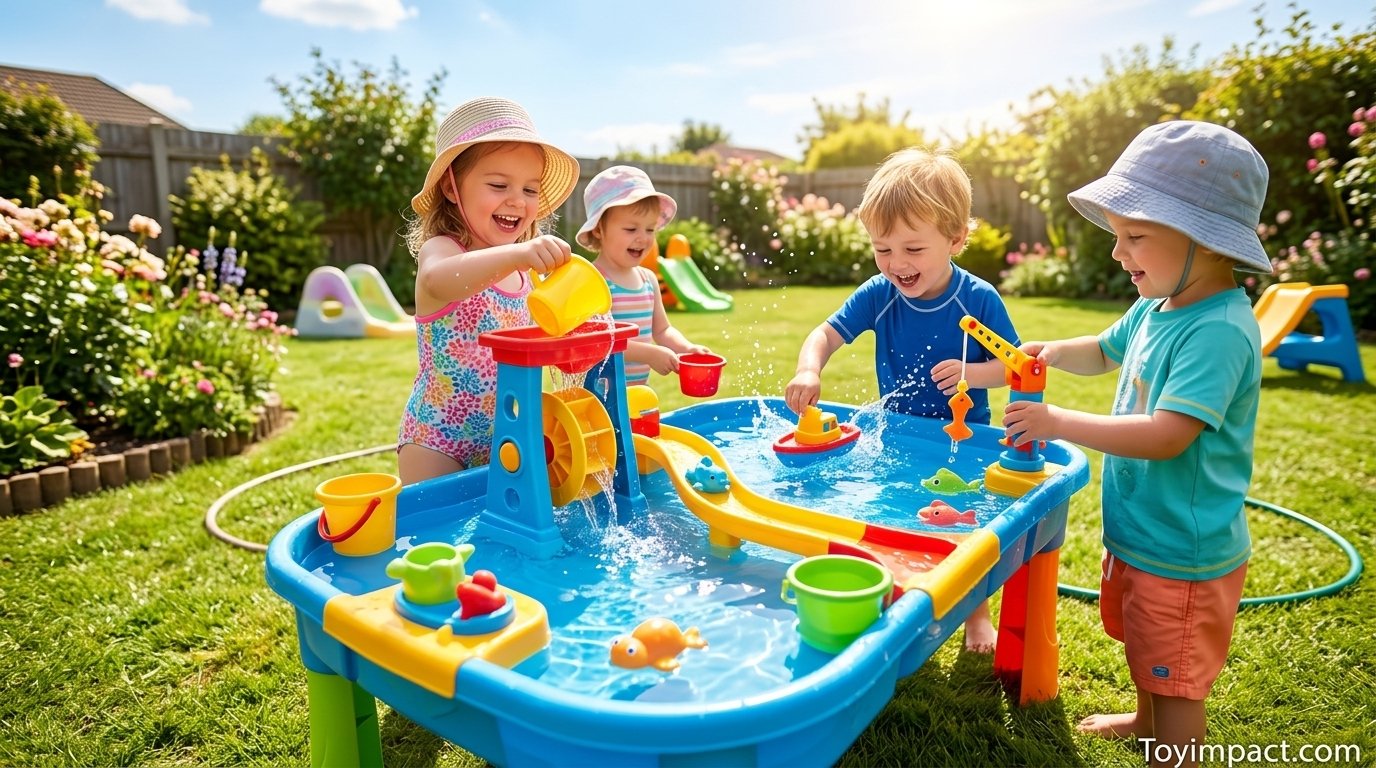
A hot afternoon, a hose, and a few splashes of imagination can turn any yard into the best seat in the house. Water tables give toddlers and preschoolers a safe, low-mess way to explore pouring, scooping, and cause-and-effect play — and the right one can keep siblings entertained side by side for hours. Below, we break down the eight best backyard water tables on the market, who each one is best for, and everything you need to know before you buy.

Water tables have earned a permanent spot on backyard patios for a good reason: they’re one of the few toys that keep toddlers engaged for long, uninterrupted stretches while quietly building fine motor skills, hand-eye coordination, and early science concepts like floating, sinking, and volume. But not every water table is built the same. Some are little more than a shallow plastic tub, while others come loaded with slides, spinning wheels, boat accessories, and drainage plugs that make cleanup painless.
We compared build quality, play value, water capacity, age range, and real-world durability across the eight most popular backyard water tables from Step2, Little Tikes, and Hape. Whether you’re shopping for a single toddler, a pair of siblings who’ll fight over the same bucket, or a preschooler who’s ready for a mini waterpark, there’s a match for your yard below.
There’s also a practical, parent-focused reason water tables have stayed so popular: they solve the “what do I do with the kids for the next hour” problem better than almost any other backyard toy. Unlike a sprinkler or a full-size splash pad, a water table contains the mess to a single defined area, which means less mud tracked indoors and a much smaller cleanup job once playtime is over. That containment also makes supervision easier, since you’re watching one basin instead of a whole yard of wet, slippery grass. Add in the fact that most models fold down or stack for off-season storage, and it’s easy to see why these tables show up on so many “best backyard toy” shortlists year after year.
Before we get into individual reviews, it’s worth setting expectations: no single water table is objectively “the best” for every family. A table that’s perfect for a single 18-month-old in a small courtyard would be a poor fit for a daycare with six preschoolers running between stations. That’s why we’ve organized this guide around specific use cases — budget, siblings, pretend play, eco-conscious materials, and group settings — so you can jump straight to the section that matches your actual situation rather than reading eight full reviews to find the right one.
Quick Comparison Table
| Water Table | Best For | Age Range | Standout Feature |
|---|---|---|---|
| Step2 Rain Showers Splash Pond | Budget-friendly first table | 1.5–5 yrs | Rain shower dome + pond bowl |
| Little Tikes Dual Dumping Delight | Multiple kids playing together | 2–6 yrs | Twin dumping buckets on a crank wheel |
| Step2 Naturally Playful Sand & Water | Combo sand + water play | 2–6 yrs | Split tub for sand and water |
| Little Tikes Anchors Away Pirate Ship | Imaginative/pretend play | 2–6 yrs | Pirate ship theme with steering wheel |
| Step2 Big Freeze Ice Cream Water Table | Themed pretend play + role-play | 2–6 yrs | Ice cream shop accessories |
| Hape Rain or Shine Water Table | Eco-conscious families | 18 mo–5 yrs | Wooden construction, natural finish |
| Step2 Great Outdoors Water Table | Large groups / daycare use | 2–6 yrs | Multi-zone activity layout |
| Little Tikes Slide ‘N Splash Waterpark | Active, older toddlers | 2–6 yrs | Built-in slide into water basin |
How We Chose These Water Tables
Every table on this list was evaluated against the same core criteria so you can compare apples to apples rather than marketing copy to marketing copy.
Water Capacity & Basin Design
A shallow basin dries out fast and limits play time, while a deep, wide basin holds enough water for multiple kids to scoop, pour, and float toys without constantly needing a refill from the hose.
Age-Appropriate Play Value
We looked at whether the accessories genuinely challenge a toddler’s developing motor skills (spinning wheels, cranks, sliding gates) versus tables that are just a tub with a lid.
Durability & Material Quality
Backyard toys live outside in sun, rain, and temperature swings, so wall thickness, UV-resistant plastic, and sturdy leg bases matter far more than they do for indoor toys.
Drainage & Cleanup
A table without a drain plug means tipping gallons of water by hand at the end of the day — a small detail that makes a big difference for parents.
Value for Money
We weighed price against how many kids can realistically play at once and how long the table will stay in rotation as your child grows.
Assembly & Ease of Setup
A water table that takes forty-five minutes and a full toolbox to assemble is a frustrating start to summer. We favored models that snap together without tools or that require, at most, a screwdriver and ten minutes of patience, since most of these tables are purchased with the expectation of same-day backyard play.
Weather & UV Resistance
Because these tables spend the entire season outdoors, plastic quality matters more than it would for an indoor toy. Cheaper resin can turn brittle and fade within a single summer of direct sun exposure, while UV-stabilized plastic holds its color and structural integrity through repeated hot afternoons. We prioritized brands with a track record of standing up to real outdoor conditions rather than just looking good in a product photo.

1. Step2 Rain Showers Splash Pond Water Table
Step2 Rain Showers Splash Pond
If you’re testing the waters — literally — before committing to a bigger setup, the Rain Showers Splash Pond is the easiest entry point. It’s compact enough to tuck against a patio wall but still offers two distinct play zones: a rain shower dome that toddlers spin to create a gentle sprinkle, and a lower pond bowl for scooping, pouring, and floating small toys.
The rain shower mechanism is the real draw here. Kids turn a hand crank that lifts water up through a spinning dome, and it rains back down into the pond below — a satisfying loop that keeps toddlers engaged long after a plain tub would lose their interest. The table includes two cups and a boat accessory, and the legs are wide enough to keep the whole unit stable even with an excited toddler leaning on the rim.
At under two feet tall, it’s sized for younger toddlers rather than school-age kids, so if you’re shopping for an older sibling too, you may want to pair it with a table further down this list, like the Little Tikes Dual Dumping Delight.
One frequently overlooked advantage of the Rain Showers Splash Pond is its low water usage. Because the basin is smaller than most competitors, you’ll go through noticeably less water per session — a detail that matters in regions with summer watering restrictions or for families who simply don’t want to run the hose for five minutes straight before playtime starts. The trade-off is that the smaller volume warms up faster in direct sun and evaporates more quickly on especially hot afternoons, so repositioning the table to a partly shaded area or topping it off halfway through a long session are smart moves. The rain shower dome is also an excellent introduction to the concept of cause-and-effect for toddlers who haven’t yet used crank-operated toys; the connection between turning the handle and seeing the sprinkle start is immediate and visually satisfying, which is exactly the kind of instant feedback loop that keeps younger toddlers coming back for another try. Parents who’ve moved on from this table often pass it down to younger siblings or gift it to a neighbor, because the build quality holds up well enough to survive multiple seasons of toddler-level wear even though the price stays firmly in the “starter” category.
Pros
- Very affordable compared to larger sets
- Rain-shower crank mechanism adds sensory variety
- Compact footprint fits small patios and balconies
- Simple to fill and drain
Cons
- Basin is shallow, so water evaporates or splashes out quickly
- Only comfortably fits one or two toddlers
- Fewer accessories than pricier competitors

2. Little Tikes Fun Zone Dual Dumping Delight Water Table

Little Tikes Dual Dumping Delight
This is the table we recommend most often for families with siblings close in age, because it was engineered around parallel play from the ground up. Two identical buckets sit at opposite ends of a crank wheel; as one child turns the handle, both buckets tip and dump water back into the shared basin at the same time — so nobody has to wait their turn.
Beyond the dumping buckets, the table includes a spinning waterwheel in the center, a boat accessory, and a wide, stable basin that holds noticeably more water than entry-level tables. The legs snap together without tools, and the whole thing folds flatter than most competitors for off-season storage.
Because two kids can play at full capacity without crowding each other, it’s one of the better options if you’re also weighing toys from our guide to toys siblings can play with together.
The dual-bucket design also turns out to be an unexpectedly effective teaching tool for the concept of “fairness,” which matters enormously to toddlers. Because both buckets dump simultaneously when the crank turns, there’s no arguing about whose turn it is — a small engineering detail that sidesteps a surprisingly common source of sibling conflict during shared water play. The central waterwheel adds a secondary sensory loop: kids watch the wheel spin faster or slower depending on how much water they pour into the buckets above, which introduces the very earliest ideas about water pressure and flow rate without anyone needing to use those words. The basin itself is generously sized at roughly twenty-eight inches across, giving two toddlers enough elbow room to scoop and pour independently without constantly bumping forearms. That said, the table is wide enough that it does require a somewhat flat, stable surface; setting it up on an uneven lawn can cause one side to sit lower, which shifts the water pool and makes the dumping buckets behave unevenly. A flat patio, a deck, or a section of level grass is the ideal placement. For families who anticipate three kids sharing the same table, the Step2 Great Outdoors Water Table below is a better match, but for two-kid households the Dual Dumping Delight is genuinely hard to beat.
Pros
- Purpose-built for two kids playing at once
- Dumping buckets add a satisfying cause-and-effect loop
- Large basin holds substantial water volume
- Tool-free assembly and compact folded storage
Cons
- Larger footprint needs more patio or lawn space
- Plastic seams can trap standing water if not dried
- Pricier than single-zone tables

3. Step2 Naturally Playful Sand & Water Table

Step2 Naturally Playful Sand & Water Table
Instead of choosing between a sandbox and a water table, this one splits the difference — literally, with a divided basin that keeps sand on one side and water on the other. A lid doubles as a checkerboard-style play surface, so it converts into a dry activity table when you’re not filling it up.
The two-in-one design is the main appeal, but it also means neither the sand side nor the water side is quite as large as a dedicated single-purpose table. Parents who want the biggest possible water capacity may prefer the Step2 Great Outdoors Water Table instead, while families most interested in tactile play might also browse our roundup of sensory toys for additional ideas.
Cleanup is straightforward thanks to a drain plug on the water side, and the included lid keeps debris and leaves out between play sessions — a small but genuinely useful feature if the table lives outdoors year-round.
What makes the combination design particularly appealing is the way it encourages cross-material experimentation. Kids naturally start mixing sand into the water side and water into the sand side, which produces entirely different sensory experiences — wet sand that can be molded into shapes, muddy water that changes color and texture — and that kind of open-ended, self-directed exploration is exactly what developmental psychologists mean when they talk about “creative play.” The checkerboard lid also extends the product’s usable life well beyond the water-play season; in cooler months, families fill the dry side with kinetic sand, dried pasta, or even small building blocks and use the table as a low indoor activity station. This kind of year-round versatility is something single-purpose water tables simply can’t offer, and it’s a big part of why the Naturally Playful model consistently appears on bestseller lists even though its individual play features are more modest than those of some competitors. One practical note: if you plan to use both sides simultaneously, filling the sand side first and pressing it down firmly before adding water to the other side prevents the sand from shifting under the weight of the water and creating an uneven floor.
Pros
- Two play modes in a single footprint
- Lid converts the table into a dry activity surface
- Drain plug simplifies water-side cleanup
- Sturdy, wide base resists tipping
Cons
- Each side is smaller than a dedicated single-purpose table
- Sand can migrate into the water side if kids aren’t careful
- No included canopy or shade cover

4. Little Tikes Anchors Away Pirate Ship Water Table

Little Tikes Anchors Away Pirate Ship
Shaped like an actual pirate ship, this table leans hard into pretend play rather than pure sensory exploration. A working steering wheel, a cannon that shoots water, and a treasure-map deck give kids a narrative to act out instead of just scooping and pouring.
The ship hull doubles as the water basin, and the raised deck keeps smaller accessories from floating away during active play. Because so much of the appeal is thematic, it tends to hold a toddler’s attention longer than a plain tub — particularly kids who already gravitate toward story-based toys, which pairs well with ideas from our educational toys for 3-year-old boys guide.
One trade-off: the irregular ship shape means less flat water surface than a traditional rectangular basin, so it suits one or two kids better than a larger group.
Parents consistently report that the pirate ship theme produces some of the longest independent play sessions they’ve seen from any toy, and the reason is straightforward: the ship gives children a story framework. Rather than simply filling and dumping water — which can lose novelty after fifteen minutes for some toddlers — the pirate ship turns every scoop into “bailing out the hull,” every pour into “firing the cannon,” and every spin of the steering wheel into “steering toward treasure island.” That narrative layer, which children supply themselves with minimal prompting, is what child development researchers call “narrative play,” and it’s strongly linked to language development, emotional processing, and early social skills because children have to sequence events, assign roles, and resolve conflicts within the story they’re creating. The working cannon is a particular favorite because it combines fine motor skill practice — squeezing the trigger mechanism — with a visible, splashy result that rewards effort immediately. One caution for parents setting this up on a deck or balcony: the cannon’s water stream can travel further than you’d expect, so orienting the ship so the cannon faces away from windows, doors, or dry seating areas is worth thinking through before you fill the basin. The ship’s raised deck also functions as a natural “dry zone” for small figurines or action figures that aren’t meant to get wet, which extends the kinds of toys kids can bring into their pirate scenario without turning everything into a soggy mess.
Pros
- Strong pretend-play theme keeps attention longer
- Working steering wheel and cannon accessory
- Raised deck keeps loose toys from drifting
- Distinctive design stands out on a play patio
Cons
- Irregular hull shape limits usable water surface
- Best suited to one or two kids at a time
- Accessories can be easy to misplace in grass

5. Step2 Big Freeze Ice Cream Water Table

Step2 Big Freeze Ice Cream Water Table
This table turns water play into a pretend ice cream stand, complete with scoop molds, cone accessories, and a “freezer” bin that kids fill and scoop from. It’s a clever twist on the standard formula: instead of generic cups and boats, the accessories double as props for role-play, which tends to extend play sessions since kids narrate their own “shop” scenarios.
The basin is moderately sized — big enough for two kids to share the scooping station without bumping elbows, though not as expansive as the largest tables on this list. A tip-resistant base and rounded edges make it a solid pick for younger toddlers who are still a little wobbly on their feet.
If pretend play is the main draw for your child, it’s also worth browsing our list of gift toys for 5-year-old girls for complementary role-play sets.
The ice cream theme also happens to be one of the most gender-neutral pretend-play scenarios available, which makes it a reliable choice when you’re buying a gift and don’t want to lean into themes that skew heavily toward one interest group. Kids of all temperaments gravitate toward the idea of “making” something for someone else — scooping an ice cream cone for a parent, a sibling, or a stuffed animal — and that social generosity is itself a form of early emotional learning. The “freezer” compartment is an interesting design choice because it introduces the idea of hot and cold contrast during play; kids can fill the freezer with cold hose water and then scoop it into the warmer basin, which naturally sparks the kind of “why is that different?” questions that signal growing scientific curiosity. For parents who want to add a layer of number practice, the cone-and-scoop system lends itself naturally to counting games: “Can you make me a three-scoop cone?” becomes a fun challenge that sneaks in early math without feeling like a lesson. The rounded base deserves a special mention for parents of younger toddlers who are just beginning to stand independently and lean on surfaces for support — the wide, curved bottom is specifically engineered to resist tipping even when a child puts their full weight on the rim, which isn’t true of every table on the market.
Pros
- Novel ice-cream-shop theme extends engagement
- Scoop and cone accessories double as role-play props
- Rounded, tip-resistant base suits younger toddlers
Cons
- Theme may not appeal to every child equally
- Basin size is moderate, not oversized
- Small scoop pieces can get lost in grass or gravel

6. Hape Rain or Shine Water Table

Hape Rain or Shine Water Table
Hape is best known for wooden toys, and this water table follows the same philosophy: a sturdy wood frame paired with a removable plastic basin, finished in muted natural tones instead of the bright primary colors most competitors use. It’s a table that looks intentional on a patio rather than like a toy that needs to be tidied away.
Functionally, it plays similarly to other basic water tables — kids scoop, pour, and float the included accessories — but the wood frame is noticeably sturdier over time than all-plastic legs, and it holds up well season after season if it’s stored somewhere dry in winter. The trade-off is a higher price point relative to its play features, since you’re paying partly for the material upgrade.
Parents drawn to natural-material toys may also want to review our guide on the best age to introduce Montessori toys, since Hape’s design philosophy overlaps closely with Montessori-style play.
The Rain or Shine table is also worth considering if aesthetics matter to you — and for many families, they genuinely do. A bright red-and-yellow plastic table parked on a carefully designed patio can feel visually jarring, whereas the Hape’s muted wood tones and clean lines blend into outdoor living spaces without announcing “children’s toy” from across the yard. That’s not a superficial concern; parents who feel comfortable with how a toy looks in their living space tend to leave it out and accessible more often, which means more spontaneous play for the child. The removable basin is a thoughtful engineering detail that many competitors miss: rather than draining water through a small plug and wiping the inside in awkward positions, you can simply lift the entire basin out, carry it to a grassy area, and dump it cleanly. That design choice also makes it far easier to give the basin a thorough scrub, since you can bring it to a sink instead of crouching over a table on the patio. One maintenance note specific to the wooden frame: while Hape’s finish is water-resistant, it’s not waterproof in the way that molded plastic is, so leaving the frame directly exposed to rain for weeks without cover will eventually cause the wood to swell or develop surface roughness. A simple wipe-down and indoor storage during the off-season, or even just covering it with a tarp during extended rainy periods, preserves the frame’s finish and structural integrity for years longer than leaving it out year-round. For families who appreciate the Montessori alignment, the Rain or Shine table’s simplicity is actually an asset rather than a limitation: fewer built-in mechanisms means children have to supply more of their own ideas about what to do with the water, which is the core Montessori principle of child-led exploration.
Pros
- Durable wood frame with a natural, low-key aesthetic
- Removable basin simplifies cleaning and draining
- Holds up well to years of outdoor use if stored properly
Cons
- Higher price relative to the number of included accessories
- Wood frame needs to be kept dry when not in use
- Fewer built-in mechanisms (no cranks or wheels)

7. Step2 Great Outdoors Water Table

Step2 Great Outdoors Water Table
This is the largest table on our list, and it’s built for volume — both in water capacity and in the number of kids who can play at once. Multiple activity zones spread around the perimeter mean three or four children can each have their own scooping station without constantly bumping into each other, which is exactly why it’s a favorite among in-home daycares.
The basin holds substantially more water than any of the smaller tables above, so it stays play-ready longer between refills. A wide, reinforced base keeps the whole structure stable even when several kids are leaning on the rim at once, and drainage plugs make end-of-day cleanup manageable despite the larger volume.
The obvious trade-off is footprint: this table needs real yard space and isn’t a good fit for small patios or balconies. If your outdoor space is limited, the compact Step2 Rain Showers Splash Pond is a better match.
In group settings — whether a home daycare, a family reunion, or a neighborhood playdate — the Great Outdoors table solves a problem that smaller tables simply can’t: it distributes activity across enough stations that children naturally self-organize rather than crowding around a single point of interest. This is important because research on preschool-age group play consistently shows that children play longer and more cooperatively when they have easy access to their own “territory” within a shared space. Each activity zone on the Great Outdoors table offers a slightly different experience — one corner might feature a spinning water wheel, another has a scooping station, a third has a pouring spout — which means kids can rotate between stations without anyone feeling displaced. The larger water volume also means less temperature fluctuation; while a small basin can heat up to uncomfortable levels in an hour of direct sun, the Great Outdoors’ deeper, wider basin stays at a more stable temperature for longer, which matters when you have four or five kids cycling in and out of play over a full afternoon. For daycare operators tracking cleanup logistics, the dual drainage plugs — one at each end of the basin — are a standout feature: rather than lifting or tilting a heavy, water-filled table to drain it, you simply open both plugs and let gravity do the work into a nearby garden bed or drain area. That detail alone can save fifteen minutes of end-of-day labor when you’re already tired from a full day of childcare.
Pros
- Largest water capacity on this list
- Multiple activity zones support 3–4 kids at once
- Reinforced base stays stable under heavy use
- Popular, well-reviewed pick for daycare settings
Cons
- Large footprint requires real yard space
- Heavier and harder to move once filled
- Higher price point than compact tables

8. Little Tikes Slide ‘N Splash Waterpark

Little Tikes Slide ‘N Splash Waterpark
Unlike the other tables on this list, the Slide ‘N Splash is built around motion rather than stationary scooping. A short slide feeds directly into the water basin, so kids send toy figures or small boats down the ramp and watch them splash into the pool below — a mechanic that appeals strongly to toddlers who are past the pure sensory stage and want more active, repeatable play.
Because it leans into physical, gross-motor play more than the average water table, it pairs naturally with active outdoor toys generally, and parents cross-shopping for movement-based options may also like our picks for toys for long car rides when the same active kids need quieter entertainment on the go.
The slide mechanism does add moving parts, which means slightly more to monitor for wear over multiple seasons compared to a simple static tub, but most families find the added play value worth the trade-off.
What sets the Slide ‘N Splash apart from every other table on this list is its emphasis on gross motor skill development. While the other seven tables primarily exercise fine motor control — the small wrist and finger movements involved in scooping, pouring, and turning cranks — the Slide ‘N Splash adds a full-body component: kids walk up to the slide, position a toy, push it down, watch the splash, then walk around to retrieve it and start again. That walking loop, repeated dozens of times per session, builds leg strength, balance, and spatial awareness in a way that stationary tables don’t. It also introduces basic physics concepts in a more dramatic fashion than any other table here: the speed at which a toy slides down the ramp, the size of the splash it creates, and the distance the water splatters are all directly related to the angle of the toy, its weight, and how hard it’s pushed — variables that toddlers begin to experiment with intuitively even before they have the language to describe what they’re doing. For parents of kids who tend to get bored with sitting in one spot, the Slide ‘N Splash addresses that restlessness directly by giving them a reason to move between two points rather than remaining planted at a single basin edge. The splash pool at the bottom is also deep enough to double as a miniature wading pool for action figures and small plastic animals, which means the table supports both active play (sending things down the slide) and quiet play (floating figures around the pool) in the same session — a versatility that keeps it relevant as kids shift between high-energy and low-energy moods throughout the day.
Pros
- Slide mechanic adds active, repeatable play
- Great fit for toddlers who’ve outgrown simple scooping
- Basin doubles as a splash pool for figures and boats
Cons
- Moving slide parts need periodic wear checks
- Less ideal for very young toddlers still working on balance
- Takes up a slightly taller footprint than flat tables

Step2 vs. Little Tikes vs. Hape: Which Brand Makes the Best Water Tables?
When shopping for a backyard water table, the brand name on the box matters more than most parents initially realize — not because of logo prestige, but because each manufacturer approaches water table design with a fundamentally different philosophy that affects everything from the thickness of the plastic to the kind of play the table encourages. Understanding those differences upfront saves you from buying a table that looks great in a product photo but disappoints in your actual backyard.
Step2: The Play Feature Leader
Step2 is the dominant name in backyard water tables, and their product line reflects decades of iteration on what keeps toddlers engaged. Their design philosophy prioritizes interactive mechanisms — spinning domes, cranking wheels, tipping buckets, water channels with gates — because their research (and the parent feedback they collect obsessively) shows that mechanical play loops hold a toddler’s attention significantly longer than open basins with cups. The trade-off is that Step2 tables tend to use moderately thick, UV-stabilized polyethylene plastic that’s durable enough for several summers but won’t survive being left outside through a harsh winter without some degradation. Step2 tables also consistently include drain plugs, which sounds like a small detail until you’ve spent twenty minutes trying to tip a heavy, water-filled table without flooding your patio. If you value play variety and thoughtful small features, Step2 is usually the best starting point for a backyard water table.
Little Tikes: The Durability-First Brand
Little Tikes has been making outdoor plastic toys since the 1970s, and their water tables reflect that heritage: the plastic is generally a bit thicker and more impact-resistant than Step2’s, which means their tables can take more abuse from rowdy toddlers jumping on rims or dragging tables across concrete. Little Tikes also tends to design around multi-child play — their Dual Dumping Delight and Anchors Away Pirate Ship are both built to accommodate two kids comfortably at once, which reflects their broader brand focus on shared sibling and playgroup experiences. Where Little Tikes occasionally falls short compared to Step2 is in the quantity and variety of included accessories; their tables often ship with fewer small pieces, which means you’ll likely want to supplement with aftermarket cups, boats, and scoops sooner than you would with a Step2 table. Still, if your primary concern is “will this table survive my toddler standing on it,” Little Tikes is the safer bet.
Hape: The Design-Conscious Choice
Hape occupies a very different lane from both Step2 and Little Tikes. Their water tables are designed with as much attention to how the toy looks in your home as how it plays, and that means wood frames, natural color palettes, and a general absence of the bright plastic aesthetic that defines most American water table brands. Hape’s play philosophy skews Montessori-inspired: fewer built-in mechanisms, more open-ended exploration, and an expectation that children will supply their own play narratives rather than following the script that a themed table (pirate ship, ice cream shop) implies. The trade-off is that Hape tables cost more per play feature and require more careful maintenance — the wood frame needs to stay dry when not in use, and the overall water capacity tends to be smaller than comparably priced plastic tables. Hape is the right choice for families who want a water table that blends into their outdoor living space and who value material sustainability over mechanism density, but it’s the wrong choice for parents looking for the most play features per dollar spent.
Which Brand Should You Pick?
If your top priority is play variety and smart design features, Step2 is the strongest default. If you need a table that can take a beating and handle multiple rough-and-tumble kids daily, Little Tikes is the answer. If you want the table to look like part of your patio rather than a piece of playground equipment, Hape is worth the premium. For most families buying their first water table, the Step2 line offers the best overall balance of price, play value, and durability — which is why four of the eight tables on this list are Step2 models.
Best Water Table by Scenario: Apartment Balcony, Big Backyard, Daycare & More
Reading individual product reviews is useful, but sometimes you need the answer to a more specific question: “Which table works best for my particular situation?” Below, we’ve matched the most common real-world scenarios to the water table on this list that handles them best.
Small Patio or Apartment Balcony
Space is the limiting factor here, so you want the smallest footprint that still delivers genuine play value. The Step2 Rain Showers Splash Pond is the clear winner for constrained spaces: its base measures roughly twenty inches across, it sits low enough to tuck under a railing, and it uses less water per session than any other table on the list, which matters when you’re filling it from a kitchen sink rather than a backyard hose. The Hape Rain or Shine is a close second for balcony use, partly because its wood-frame aesthetic looks more natural on a small urban patio than a brightly colored plastic table, and partly because its removable basin makes it easier to carry inside when the forecast turns rainy.
Large Backyard with Multiple Kids
When yard space isn’t an issue and you regularly host playdates or have three-plus kids using the same table, the Step2 Great Outdoors Water Table is purpose-built for exactly this scenario. Its multi-zone layout lets several children play simultaneously without the territorial disputes that plague smaller tables, and its larger basin volume means fewer mid-session refills. For families with exactly two kids, the Little Tikes Dual Dumping Delight is arguably even better because its synchronized dumping mechanism specifically prevents the “I want a turn” conflict that two kids at a shared table inevitably produce.
Home Daycare or Preschool
Daycare settings need tables that can handle daily use by multiple children, drain quickly between groups, and resist the kind of wear that comes from being used for six hours straight, five days a week. The Step2 Great Outdoors is the most popular choice in this category, and its dual drain plugs are a genuine operational advantage for daycare workers who need to empty and refill the table between morning and afternoon groups. Some in-home daycare providers also keep a second, smaller table like the Rain Showers Splash Pond as a backup or a station for younger toddlers who aren’t yet ready for the larger table.
First-Time Buyers Who Want to Test the Waters
If you’re not sure your toddler will actually use a water table regularly and don’t want to spend a lot to find out, start with the Step2 Rain Showers Splash Pond. It’s the least expensive option on this list, and if your child takes to water play, you can always upgrade to a larger model next summer without feeling like you wasted money on a barely used first table. This low-risk entry strategy is also smart for gift-givers who aren’t sure whether the recipient family has outdoor space for a larger unit.
Gift for a Specific Age
Buying a water table as a birthday or holiday gift adds the challenge of not knowing exactly how tall the child is, how much outdoor space the family has, or whether the child has any particular interests. The safest general-purpose gift pick is the Little Tikes Dual Dumping Delight: it works for a wide two-to-six age range, its dumping mechanism is universally engaging regardless of a child’s specific interests, and it accommodates siblings sharing the gift, which eliminates the awkward scenario of buying a single-child toy for a family with multiple kids.
Eco-Conscious or Material-Sensitive Families
If you actively avoid plastic toys when possible, or if your child has sensitivities to certain materials, the Hape Rain or Shine Water Table is the only table on this list with a predominantly wood construction. Its removable plastic basin is BPA-free, and the wood frame uses water-based finishes. It’s not entirely plastic-free — you’d be hard-pressed to find a water-holding basin made of anything else at a consumer price point — but it uses meaningfully less plastic than any other table here.
Kids Who Get Bored with Stationary Toys
If your child is the type who loses interest in a toy after ten minutes unless it does something new, the Little Tikes Slide ‘N Splash Waterpark keeps engagement high by combining a physical action (sliding toys down a ramp) with a visual payoff (the splash), and the loop is endlessly repeatable without feeling repetitive. For kids who prefer narrative over mechanics, the Little Tikes Anchors Away Pirate Ship offers a story framework that extends play sessions through imaginative scenarios rather than physical activity.
How to Set Up Your Water Table for Maximum Fun
A water table is one of the simplest backyard toys to get running, but a few setup decisions made on day one affect how much use the table gets all summer. Here’s how to get it right from the start.
Choosing the Right Spot
Location is the single most important setup decision, and it’s worth spending five minutes thinking about it before you fill the basin for the first time. You want a flat, level surface — even a slight slope causes water to pool on one side and leave the other dry, which limits play options and makes the table less stable. A patio, deck, or flat section of lawn all work well. If possible, choose a spot that gets a mix of sun and partial shade: full shade keeps the water too cold on breezy mornings, while full afternoon sun heats a shallow basin to uncomfortable temperatures and accelerates evaporation. A tree-shaded section of lawn is the goldilocks option for most families.
Leveling the Table
Most water tables have four independent legs that can wobble slightly on uneven ground. Before filling, press down on each corner and check for rocking. If one leg is short, a flat stone, a square of rubber matting, or even a folded piece of cardboard underneath that leg stabilizes the whole structure. This matters more than it sounds: a wobbly table spills more water, tips more easily when kids lean on the rim, and generally frustrates toddlers who are trying to focus on scooping and pouring rather than balancing.
Water Temperature
Hose water that’s been sitting in a sun-heated black rubber hose can come out at 110°F or higher — hot enough to startle or even mildly burn a toddler’s hands. Always run the hose for thirty seconds before filling the table, letting the hot water flush out. Conversely, on cool mornings, mixing in a kettle of warm water takes the chill off and makes the play experience more comfortable, especially for younger toddlers who are sensitive to cold water on their hands and arms. The goal is a water temperature that feels neutral to the touch — neither warm nor cold — since that’s what encourages the longest play sessions.
Accessorizing Before Play
Most tables ship with a handful of accessories, but adding a few extras before the first session dramatically increases the play possibilities. A set of measuring cups, a plastic colander, a turkey baster, a small watering can, and a few rubber ducks or waterproof figurines are all inexpensive additions that extend the table’s play range. Lay these out near the table before the child approaches — having them within arm’s reach means less running inside to grab things mid-play, which disrupts the kind of focused, self-directed exploration that makes water table time so valuable.
Setting Expectations
Before the first splash, it helps to walk your child through two simple rules: no drinking the water, and the water stays in the table. Toddlers are naturally going to test both rules — that’s normal — but stating them clearly from the start and repeating them calmly each time they’re broken establishes a framework that most kids internalize within a few sessions. Having a towel nearby specifically for wiping wet hands and faces (rather than relying on shirts or bare arms) also reduces the “I’m all wet!” complaints that can cut sessions short for sensory-sensitive kids.
Timing Your Sessions
Water table play works best when it’s framed as a distinct activity with a beginning and an end, rather than something that’s just always available in the yard. Setting up the table, filling it, and putting it away at roughly the same time each day gives the activity a ritual quality that toddlers respond to, and it also prevents the mosquito-breeding problem that comes from leaving standing water out indefinitely. Late morning (around 10 a.m.) and late afternoon (after 4 p.m.) are the ideal times in most climates — the sun isn’t at peak intensity, the water stays at a comfortable temperature, and it’s a natural transition point between other activities.
20 Water Table Activities and Games That Keep Kids Engaged
A water table on its own is fun for a while, but kids — especially older toddlers approaching the four- and five-year mark — eventually master the basic scoop-pour-dump loop and start looking for something new. These twenty activities and games add layers of challenge, creativity, and social interaction to any water table, and most require nothing more than items you already have around the house.
Sensory Exploration Activities
These activities focus on the physical experience of water — its temperature, texture, weight, and movement — and are especially well-suited for toddlers in the eighteen-month to three-year range who are still building their sensory vocabulary.
1. Ice Excavation: Freeze small plastic animals, coins, or colorful beads inside a large block of ice (a Tupperware container works perfectly). Drop the ice block into the water table and let kids use warm water from a squeeze bottle to “excavate” the treasures trapped inside. This activity can keep a toddler busy for thirty minutes or more as they experiment with different ways to melt the ice faster — pouring warm water directly on it, holding it in their hands, or chipping at it with a plastic spoon. It also introduces the concept of states of matter (solid to liquid) in a way that’s tangible and memorable.
2. Color Mixing Station: Add a few drops of food coloring to separate cups of water — red, blue, and yellow are the classic starting palette — and let kids pour them together in the table to discover what happens. Red and blue make purple, yellow and blue make green, and so on. This works particularly well in a white or light-colored basin where the color changes are dramatic and easy to see. Keep paper towels handy; food coloring can stain clothes, so an art smock or old shirt is a smart precaution.
3. Texture Discovery: Drop various household objects into the water table and let kids sort them by what happens: things that float (corks, foam pieces, rubber ducks), things that sink (metal spoons, marbles, stones), and things that do something unexpected (a sponge that floats at first and then slowly sinks as it absorbs water). Sorting by physical behavior is an early classification skill that maps directly onto scientific thinking.
4. Bubble Station: Squirt a small amount of dish soap into the water table and give kids whisk, a slotted spoon, or even a handheld egg beater to create bubbles. The challenge of whipping up the biggest possible bubble pile is oddly mesmerizing for toddlers, and the tactile experience of popping bubbles with their fingers is a sensory regulation activity that occupational therapists frequently recommend.
5. Warm vs. Cold Exploration: Fill one side of the table (or two separate bowls placed inside the table) with warm and cool water, and let kids move their hands between the two. Ask them which is which, and talk about the difference. This builds temperature vocabulary — warm, cool, hot, cold — and is a gentle introduction to the concept of thermal sensation that will later support science learning.
Fine Motor Skill Builders
These activities specifically target the small hand and finger muscles that toddlers need for writing, cutting, and self-care tasks like buttoning and zipping.
6. Turkey Baster Transfer: Give kids a turkey baster and two containers — one filled with water, one empty. The challenge: use the baster to move all the water from one container to the other. Squeezing the bulb and controlling the stream requires coordination that strengthens the same hand muscles used for pencil grip. For older kids, add food coloring to make it a color-mixing game as well.
7. Pom-Pom Rescue: Drop colorful pom-poms into the water table and give kids clothespins or plastic tongs to “rescue” them one at a time, placing them in a dry bowl. The act of gripping a wet, slippery pom-pom with a clothespin is significantly harder than gripping a dry one, which adds a level of difficulty that keeps the challenge appropriate for older toddlers.
8. Sponge Squeeze: Cut a kitchen sponge into smaller pieces and let kids soak them in the water table, carry them to a bucket outside the table, and squeeze the water out. The squeezing motion builds hand strength, and the challenge of carrying a dripping sponge without losing water is a coordination exercise in itself. For a game element, set up two buckets and have siblings race to fill their bucket first using only sponges.
9. Ladle and Pour: Replace the standard cups with a ladle and challenge kids to fill a narrow-necked bottle or small vase. Pouring accurately from a ladle into a narrow opening is a precision task that requires steadiness and patience — both valuable skills for the preschool years ahead.
10. Clothesline Water Painting: Clip a sheet of paper to a string or clothesline near the water table, give kids a wet paintbrush, and let them “paint” on the paper with plain water. The designs appear dark and then evaporate, creating a naturally repeating canvas. This combines fine motor practice with the fascinating concept of evaporation — a science lesson disguised as art.
Imaginative Play Scenarios
For kids three and up, water tables become significantly more engaging when the water serves a story. These scenarios turn the table into a setting for narrative play.
11. Pet Washing Station: Drop waterproof plastic animals or dolls into the water table and let kids “wash” them with a small cloth and a squirt bottle. This is a wonderful pretend-play activity for kids who love animals, and it naturally produces the kind of nurturing, caretaking behavior that supports emotional development.
12. Pirate Treasure Hunt: Drop gold-painted rocks, plastic coins, or shiny beads into the water table and give kids a small net or slotted spoon to fish them out. For the full experience, tell them they’re searching for sunken treasure and let the narrative grow from there. This works especially well with the Little Tikes Anchors Away Pirate Ship but can be done with any table.
13. Car Wash: Fill the water table with soapy water and let kids drive toy cars through the “car wash.” Adding a scrub brush or old toothbrush completes the scene. Kids who are obsessed with vehicles will spend a surprising amount of time carefully washing each car, drying it with a towel, and lining up the clean cars on a “lot” beside the table.
14. Garden Watering Station: Give kids a small watering can and let them fill it from the water table to water real plants around the yard. This turns the water table into the “water source” for a larger activity, which gives kids a purpose beyond the table itself and teaches the caretaking responsibility of caring for living things.
15. Boat Race: If the water table has a channel or a gentle slope (or if you can create one by propping up one side slightly), floating small boats from one end to the other and racing them adds a competitive element that older preschoolers especially enjoy. Blowing the boats with a straw adds lung-capacity exercise to the mix.
Social and Cooperative Play Games
These activities are designed for two or more children and build the social skills — turn-taking, negotiation, cooperative problem-solving — that water table time naturally supports.
16. Water Relay: Set up two cups on one side of the table and two empty cups on the other. Two kids each have a sponge; they race to soak their sponge, carry it to the empty cup, and squeeze out as much water as possible. First cup to overflow wins. The cooperative version: both kids work together to fill one giant cup as fast as they can.
17. Guess the Object: One child closes their eyes while the other drops an object into the water. The blindfolded child reaches in and tries to identify the object by touch alone. This builds tactile discrimination and listening skills, and the suspense of not knowing what you’re about to touch makes kids giggle every time.
18. Fill to the Line: Draw a line on the inside of a cup with a waterproof marker. Kids take turns pouring water into the cup, trying to reach the line without going over. This sounds simple, but the self-control required to pour slowly and stop precisely is a genuine executive-function challenge for toddlers and preschoolers.
19. Sink or Float Predictions: Before dropping an object in the water, each child guesses whether it will sink or float. Then they test it and see who was right. Keeping a simple tally on a piece of paper adds a math element, and the repeated cycle of predict-test-record is exactly the scientific method in its most basic form.
20. Water Telephone: Two kids stand on opposite sides of the table. One pours water into a cup on their side and passes the cup to the other child, who carries it to a designated bucket and dumps it in. The goal is to transport as much water as possible without spilling. This is surprisingly challenging for toddlers and naturally produces the kind of gentle teamwork — “careful, don’t spill!” — that builds cooperative social skills.
Water Table STEM Experiments for Curious Kids
Water tables are one of the most underappreciated STEM learning tools available to parents of toddlers and preschoolers. The concepts that show up naturally during water play — volume, displacement, buoyancy, flow rate, surface tension, and basic hydraulics — are the same concepts that form the foundation of physics and engineering curricula years later. These experiments require nothing more than common household items and a few minutes of adult guidance, and they’re designed to feel like play rather than lessons.
Experiment 1: The Boat Load Challenge
Concept: Buoyancy and weight distribution.
What you need: Aluminum foil, small coins or washers, and the water table.
What to do: Have your child shape a small boat from a square of aluminum foil and float it in the table. Then, one coin at a time, load the boat and count how many coins it takes before the boat sinks. Ask your child: “What do you think will happen if we make the boat wider?” Then reshape the foil into a wider, flatter boat and repeat. Kids discover that a wider boat holds more weight — an intuitive introduction to the principle of displacement that ship engineers rely on every day.
Experiment 2: Water Wheel Speed
Concept: Flow rate and energy transfer.
What you need: A spinning water wheel (included with some tables or available as an aftermarket accessory), a cup, and a timer (optional).
What to do: Pour water slowly onto the wheel and observe how fast it spins. Then pour water quickly and compare. Ask: “What makes the wheel spin faster?” This introduces the idea that the speed and volume of water flow directly affects how much energy is transferred to a mechanical component — the same principle behind hydroelectric dams, just at a much smaller scale.
Experiment 3: The Floating Egg
Concept: Density and salinity.
What you need: A raw egg, table salt, and two cups or bowls inside the water table.
What to do: Fill both cups with water. Add several tablespoons of salt to one cup and stir until dissolved. Place the egg in the plain water — it sinks. Then place it in the saltwater — it floats (or at least floats noticeably higher). Explain that salt makes the water “heavier” (denser), which pushes the egg up. This is the same reason people float more easily in the ocean than in a swimming pool, and it’s one of the most visually dramatic density experiments you can do with young kids.
Experiment 4: Gravity Fountain
Concept: Gravity and water pressure.
What you need: A plastic bottle with a small hole poked near the bottom, tape, and the water table.
What to do: Fill the bottle with water, cover the hole with your finger, and hold it over the table. Release your finger — water shoots out. Ask: “What happens if we make the hole bigger? What happens if we hold the bottle higher?” Kids discover that higher water (more height) means more pressure and a stronger stream. This is the same principle that drives water towers and plumbing systems in homes.
Experiment 5: Capillary Action Rainbow
Concept: Capillary action and absorption.
What you need: Paper towels, food coloring, and three cups.
What to do: Fill three cups with water and add a different color of food coloring to each. Place the cups inside the water table with empty cups between them. Fold paper towels into long strips and drape one end into a colored cup and the other end into an empty cup. Over time, water travels up the paper towel and drips into the empty cup, mixing colors in the process. This slow-moving experiment works best as a “set it and check back later” activity, and it introduces the concept of capillary action — the same force that pulls water up through plant roots and tree trunks.
Experiment 6: The Dam Builder
Concept: Engineering, barriers, and water pressure.
What you need: Rocks, sand (if available), small sticks, and a section of the water table where you can create a slope (propping one side up slightly).
What to do: Challenge your child to build a dam that stops water from flowing down the slope. Let them experiment with different materials and arrangements until they find one that holds. This is a hands-on introduction to civil engineering: dams, levees, and water barriers all work on the same principle, and building one from natural materials teaches kids that engineering is fundamentally about solving problems with the resources at hand.
Why STEM Water Play Matters
The value of these experiments isn’t that your toddler will remember the term “displacement” — they won’t. The value is that they’ll have a physical memory of watching a wide boat hold more coins than a narrow one, and that memory becomes the intuitive foundation on which later, more formal science understanding is built. STEM learning at the toddler and preschool level is about building familiarity with physical phenomena, not memorizing vocabulary. A child who has spent hundreds of hours watching how water behaves is a child who walks into a fourth-grade physics class already comfortable with the concepts being taught — and that comfort comes from play, not worksheets.
Can You Use a Water Table Indoors? A Practical Guide
The short answer is yes, with some preparation. The longer answer is that an indoor water table session is different enough from an outdoor one that it’s worth thinking through the logistics before you fill a basin in your living room.
Why Parents Bring Water Tables Inside
The most common reason is weather: rainy days, cold winter months, or extreme heat that makes outdoor play impractical all push parents to find indoor alternatives. But some families also use indoor water table sessions as a calming, sensory-regulation activity for kids who need structured downtime after a stimulating outing or a challenging day at daycare. The repetitive motion of scooping and pouring has a measurable calming effect on many children, and having that tool available year-round — not just during warm months — is a genuine benefit for families who rely on it.
Preparing Your Space
The absolute minimum protection is a large towel or a waterproof mat underneath the table to catch splashes and drips. For a more robust setup, a plastic drop cloth from a hardware store, spread underneath and slightly beyond the table’s footprint, protects flooring far better than towels alone. Bathrooms and kitchens are the easiest indoor locations because the floors are already water-resistant and cleanup is a mop rather than a carpet-cleaning event. If you’re using a tiled bathroom, you can even fill the table from the bathtub faucet and drain it directly into the tub when play is done.
Water Volume Adjustments
Indoor sessions should use less water than outdoor ones — roughly half to two-thirds of what you’d put in outside. The reason is simple: less water means smaller splashes, which means less floor mess and less risk of slipping on a wet surface. With a shallower fill, kids can still scoop, pour, and play with accessories; the main thing you lose is the ability to float larger objects, which is a trade-off most parents are willing to accept for the sake of their floors.
Choosing the Right Table for Indoor Use
Smaller tables like the Step2 Rain Showers Splash Pond and the Hape Rain or Shine work better indoors than larger models like the Great Outdoors, simply because they take up less floor space and use less water. If you’re buying a table specifically for year-round indoor and outdoor use, prioritize a model that’s easy to carry between locations and that has a reliable drain plug so you don’t have to tip a heavy basin over your bathroom floor.
Accessories That Work Better Indoors
Indoors, swap out any accessories that encourage aggressive splashing — squirt guns, large pouring buckets — and focus on calmer activities: sponges, turkey basters, small cups, and floating figures. The activity ideas listed earlier in this guide that focus on fine motor skills and sensory exploration work particularly well in an indoor context, while the more active, splashy games are better saved for the backyard.
Setting Boundaries
Toddlers are more likely to splash enthusiastically indoors because the environment is new and exciting. Before starting, clearly explain that the water stays in the table, and be prepared to end the session calmly but firmly if the rules aren’t followed. Having a “three splashes and we’re done” rule — stated before play begins — gives kids a clear consequence framework without being punitive. Most kids adapt to indoor water table rules within one or two sessions once they understand the expectations.
Drying and Cleanup
After an indoor session, drain the basin, wipe it dry, and mop or towel the surrounding floor immediately. Leaving wet floors to air-dry creates a slip hazard, especially on hard surfaces like tile or hardwood. The table itself should be dried and either stored or returned outdoors the same day to prevent any trapped moisture from developing mildew smells overnight.
DIY Water Table Alternatives: When Buying Isn’t the Only Option
Not every family needs — or wants — a purpose-built water table. Maybe you’re looking for a quick solution for a single afternoon, maybe your toddler’s attention span doesn’t justify the investment yet, or maybe you simply enjoy building things. Whatever the reason, there are several effective DIY alternatives that deliver genuine water-play value without buying a dedicated table.
The Storage Bin Water Table
The simplest DIY water table is a large, shallow plastic storage bin set on top of an overturned crate, a small bench, or even a sturdy cardboard box at toddler height. A 20-quart clear storage bin works perfectly: it’s wide enough for two kids to scoop side by side, deep enough to hold a few inches of water, and transparent enough that kids can see the water level and any objects floating below the surface. Fill it with cups, funnels, and a few rubber ducks, and you have a functional water table that costs under ten dollars and can be stored flat when not in use. The downside is stability — storage bins on crates can wobble, so test the setup before letting kids lean on it.
The Rain Gutter Water Channel
A length of vinyl rain gutter from a hardware store, propped at a slight angle on a pair of sawhorses or bricks, creates a long, narrow water channel that kids can float boats down, pour water along, and experiment with damming using rocks or corks. This is a surprisingly engaging outdoor activity for kids three and up, and it introduces the concept of slope and water flow in a way that a flat-bottomed table can’t. The gutter can be filled from one end with a hose or watering can, and water drains naturally from the lower end into the grass or a bucket below.
The Kiddie Pool Conversion
A small inflatable kiddie pool, filled with just two or three inches of water and stocked with cups, funnels, and waterproof toys, functions as a water table that kids stand around rather than reach up to. This works well for toddlers who are tall enough to comfortably reach into a low pool but not yet steady enough to stand and lean over a raised table. The trade-off is mess: kiddie pools splash more freely than contained tables, and the cleanup area is larger, but for a dedicated outdoor play session on a hot day, it’s a perfectly viable alternative.
The Nested Bowl System
For the simplest possible version: set three or four bowls of different sizes on the ground or on a low outdoor table, fill them with varying amounts of water, and give your child cups, spoons, and sponges to transfer water between them. This zero-cost setup introduces the same core concepts — pouring, scooping, comparing volumes — that a manufactured water table does, just without the structure. It’s an excellent way to test whether your toddler has any interest in water play at all before committing to a purchased table.
When DIY Makes Sense vs. When to Buy
DIY water tables make sense for occasional use, for testing a child’s interest before buying, or for families who simply prefer a minimalist approach to toys. But if water table play becomes a daily activity — and for many toddlers it does — a purpose-built table offers advantages that DIY setups can’t match: built-in drainage plugs, stable bases designed for enthusiastic leaning, themed accessories that extend play sessions, and UV-resistant plastic that survives a full season outdoors. The product reviews earlier in this guide can help you choose the right one once you’ve confirmed that your child is a dedicated water player.
Water Table Play Ideas by Age Group
The way a child interacts with a water table changes dramatically as they grow, and matching your play setup to their current developmental stage keeps the table feeling fresh rather than repetitive. Here’s what water play looks like at each age and how to get the most out of it.
12–18 Months: First Water Experiences
At this age, water play is almost entirely sensory and exploratory. Babies and young toddlers are fascinated by the feeling of water on their hands — the temperature, the texture, the way it moves when they slap it. Don’t expect scooping or pouring; instead, focus on letting them splash, pat, and grab at the water with open hands. Use very shallow water (an inch or less), stay within arm’s reach, and keep the session short — five to ten minutes is plenty at this stage. Floating a few rubber ducks or colorful balls gives them something to reach for and grab, which works the early pincer grasp that later supports self-feeding and eventually writing.
18 Months–2.5 Years: Scooping and Dumping
This is the stage where water tables come into their own. Toddlers at this age are developing the wrist control to scoop water with a cup and pour it (roughly) into another container, and they’re endlessly entertained by the cycle of filling and emptying. Simple mechanisms like the rain dome on the Step2 Rain Showers Splash Pond or the spinning wheels on the Hape Rain or Shine give them cause-and-effect loops that match their current motor abilities. At this age, kids are also beginning to imitate adult actions, so demonstrating “washing” toy animals or “pouring tea” for a stuffed bear gives them scenarios to copy that extend play naturally.
2.5–4 Years: Mechanism Mastery and Pretend Play
By two and a half, most kids can operate cranks, turn wheels, and manipulate gates independently, and they’re beginning to layer narrative onto their play. This is the sweet spot for themed tables like the pirate ship and the ice cream table, because kids at this age have the imagination to create stories and the motor skills to act them out simultaneously. It’s also a great age for the STEM experiments described earlier, since kids are old enough to make predictions (“I think this will sink!”) and observe results. Cooperative play with siblings or friends also becomes more reliable at this age, making multi-kid tables like the Dual Dumping Delight a smart investment.
4–6 Years: Advanced Challenges and Active Play
Older preschoolers need more challenge to stay engaged, and the basic scoop-and-pour cycle that captivated them at two now feels babyish. This is where active tables like the Slide ‘N Splash Waterpark earn their keep, and where more complex activities — building dams, running timed relay races, conducting structured experiments — add the difficulty level that keeps older kids interested. It’s also worth introducing “real-world” water tasks at this age: filling a watering can and watering actual plants, washing plastic dishes in the table as practice for helping in the kitchen, or using a siphon (a clear plastic tube) to move water between containers by gravity. These tasks bridge the gap between play and practical skill-building, and they help kids see water play as something that connects to the adult world rather than just a toddler activity they’re outgrowing.
Beyond 6 Years: Transitioning Away
Most kids lose interest in water table play between ages five and seven, and that’s perfectly normal — it means their play needs have evolved beyond what a water table can offer. Rather than forcing continued use, transition the same sensory and STEM impulses into bigger projects: real kitchen science experiments, swimming lessons, gardening with actual tools, or building projects that involve water in more complex ways. The fine motor skills, cause-and-effect reasoning, and scientific curiosity that water table play built are now the foundation for more advanced learning — the table did its job even if your child doesn’t realize it.
Keeping Your Water Table Sanitary All Season
A water table that isn’t cleaned regularly becomes a breeding ground for bacteria, algae, and — if you leave standing water — mosquito larvae. The good news is that a consistent five-minute routine after each play session prevents all of these problems without requiring special products or significant effort.
After Every Session: The Five-Minute Routine
Drain the basin completely through the drain plug (or tip it if there’s no plug). Rinse the interior with a quick spray from the hose to dislodge any debris, sand, or organic matter. Wipe the rim and any flat surfaces where kids rest their hands with a damp cloth. Turn the table upside down or prop it at an angle so that any remaining water drains out and the interior air-dries. This routine takes less time than it takes to read this paragraph, and it prevents ninety percent of the sanitation problems that plague neglected water tables.
Weekly Deep Clean: The Ten-Minute Scrub
Once a week during heavy summer use, give the basin a more thorough cleaning. Mix a solution of one tablespoon of white vinegar or mild dish soap per quart of warm water, and scrub the interior with a soft-bristle brush or sponge. Pay special attention to corners, seams, and the area around the drain plug — these are where biofilm (the slimy film that develops on wet plastic surfaces) accumulates fastest. Rinse thoroughly with clean water and air-dry. Avoid bleach unless the table has visible algae or mildew; a vinegar solution is sufficient for routine cleaning and is safe if residue remains, unlike bleach, which can irritate skin.
Dealing with Algae and Mildew
If you notice green discoloration (algae) or dark spots (mildew) on the basin walls, the table hasn’t been dried properly between sessions. Scrub the affected areas with a paste of baking soda and water, let it sit for ten minutes, then rinse thoroughly. For persistent algae, a diluted bleach solution (one tablespoon of bleach per gallon of water) can be used, but rinse the basin at least three times afterward and let it dry completely in the sun before allowing kids to play in it again. UV light from direct sunlight is itself a mild disinfectant, so leaving the table in a sunny spot after cleaning helps prevent regrowth.
Accessory Cleaning
Small accessories — cups, boats, scoops, figurines — get overlooked during routine cleanup but are just as susceptible to biofilm and mildew. Once a week, collect all accessories, wash them in warm soapy water, rinse, and spread them out on a towel to dry completely before storing. Mesh bags or ventilated bins are better storage containers than sealed plastic tubs, which trap moisture and create the exact conditions that mildew thrives in.
Preventing Mosquito Breeding
Mosquitoes can lay eggs in as little as a tablespoon of standing water, and the eggs can hatch within twenty-four to forty-eight hours in warm weather. The single most effective prevention method is draining the table completely after every session — not every other day, not when you remember, but every single time. If you’ve left water sitting for more than two days in warm weather, check the surface for tiny wrigglers (mosquito larvae) before draining; if you see any, dump the water onto dry ground away from the play area rather than into a garden bed where the larvae could survive in moist soil.
End-of-Season Deep Clean
At the end of summer, before storing the table for winter, give it a final thorough cleaning. Scrub the entire basin inside and out, clean all accessories, and let everything dry completely in the sun for at least a full afternoon before packing it away. Any moisture left in the table during storage creates a perfect environment for mold growth over the winter, and you’ll open the storage area next spring to a musty, unusable table that needs much more work than a quick rinse would have required.
Water Tables for Special Needs and Sensory Processing
Water play is one of the most frequently recommended activities by pediatric occupational therapists, and for good reason: it addresses multiple sensory systems simultaneously, requires no verbal instructions, and naturally calms the nervous system through repetitive, rhythmic motion. For children with autism spectrum disorder, sensory processing disorder, ADHD, or developmental delays, a water table can be one of the most effective tools in a parent’s outdoor activity toolkit.
Why Water Play Works for Sensory Seekers
Children who are sensory seekers — those who crave physical input and constantly move, touch, and press against things — find water play inherently regulating because it engages multiple senses at once. The tactile sensation of water on skin, the visual feedback of splashing and pouring, the proprioceptive input of lifting a heavy cup of water, and the auditory input of water sounds all combine to create a rich sensory experience that satisfies the seeking behavior without the need for rough, overstimulating play. Occupational therapists often use water tables specifically because the sensory load is high enough to satisfy a seeker while the environment remains calm and contained enough to prevent overstimulation.
Why Water Play Works for Sensory Avoiders
Children who tend to avoid sensory input — those who resist getting their hands dirty, dislike messy textures, or become anxious around new physical sensations — benefit from water tables for the opposite reason: the table provides a controlled, predictable environment where they can gradually increase their comfort with wet textures at their own pace. A child who won’t touch paint or sand might willingly dip a single finger into clear water, and that small step forward is meaningful progress. Over multiple sessions, most sensory-avoidant children increase their tolerance significantly, eventually scooping and pouring with the same enthusiasm as any other child. The key is never forcing the interaction — let the child approach on their own timeline and celebrate small steps.
Best Tables for Children with Special Needs
Children with physical disabilities or limited mobility benefit from tables with wide, stable bases that won’t tip if leaned on, and from basins that are accessible from a seated position (wheelchair or adaptive seating). The Step2 Great Outdoors Water Table, with its large, stable footprint and multi-zone layout, is a strong choice because children can access different activity areas from different positions without needing to walk around the table. For children who are easily overstimulated, the Step2 Rain Showers Splash Pond — with its simpler, quieter design and fewer competing stimuli — is a better match. The Hape Rain or Shine, with its muted colors and gentle aesthetic, also works well for kids who become agitated by bright, visually busy environments.
Structured vs. Unstructured Water Play
For neurotypical children, unstructured free play at a water table is usually ideal. For children with special needs, a mix of structured and unstructured play tends to work better. Structured activities — “fill this cup to the line,” “sort these objects by sink or float,” “transfer water from here to there using this baster” — provide the predictability and clear goals that many children with autism and ADHD thrive on, while still leaving room for self-directed exploration between activities. The activity ideas and STEM experiments listed earlier in this guide provide a ready-made library of structured options.
Using a Water Table as a Calm-Down Tool
Many parents of children with ADHD and emotional regulation challenges find that five to ten minutes of water table play serves as an effective “reset” after a meltdown or a period of high activity. The repetitive motion of scooping and pouring activates the parasympathetic nervous system (the body’s calming response) in a way that’s comparable to other calming strategies like deep breathing or squeezing a stress ball, but with the added benefit of being a fun activity rather than a coping exercise that feels clinical. Integrating water table time into the daily routine — perhaps as a transition activity between school and dinner, or between outdoor play and quiet time — gives children a reliable, predictable calming ritual that they can learn to self-select over time.
Consulting an Occupational Therapist
If your child has a diagnosed sensory processing condition or developmental delay, their occupational therapist can recommend specific water table activities tailored to their therapeutic goals. Many OTs actively incorporate water table play into their sessions and can suggest adaptations — particular cup sizes, specific hand positions for pouring, timed challenges — that align with the child’s current therapy plan. Sharing the list of available tables and activities from this guide with your child’s OT can help them make specific, personalized recommendations.
Water Table vs. Kiddie Pool vs. Water Play Mat: Full Comparison
Water tables, kiddie pools, and water play mats all promise to keep kids cool and entertained on a hot day, but they serve different purposes, suit different ages, and produce very different levels of mess. Understanding the differences helps you choose the right one — or, for some families, the right combination of two or even all three.
Kiddie Pools: The Full-Body Experience
A kiddie pool gives kids the closest thing to a swimming experience without visiting a pool or beach: they sit, stand, splash, and submerge their entire lower body in water. This full-body immersion is better for physical cooling on extremely hot days than a water table, since the water contacts a much larger surface area of skin. The trade-off is significantly more mess (water spreads across a wide area), higher water usage, and the need for constant close supervision since even a shallow kiddie pool presents a drowning risk for young toddlers. Kiddie pools also require more setup time — inflating, filling, and draining a pool-sized volume of water — compared to the quick five-minute fill-and-play cycle of most water tables.
Water Play Mats: The Baby-Safe Option
Water play mats are flat, inflatable pads filled with water that babies and young toddlers can lie on, press, and watch as the water moves underneath them. They’re the safest option for pre-walking babies (six to twelve months) who aren’t yet ready for the standing-and-leaning posture that a water table requires. Play mats offer zero play accessories and minimal opportunities for scooping or pouring, but they’re excellent for early sensory exploration and tummy time motivation. For families shopping for an infant, a water play mat is the right first step; a water table becomes the right choice once the child is walking steadily and can reach the basin comfortably.
How They Compare on Key Factors
| Factor | Water Table | Kiddie Pool | Water Play Mat |
|---|---|---|---|
| Best age range | 18 months–6 years | 2–8 years | 6–18 months |
| Water volume | Low to moderate | High | Very low (sealed) |
| Mess level | Low to moderate | High | Very low |
| Supervision needed | Close, constant | Close, constant (drowning risk) | Moderate |
| Fine motor development | High | Low to moderate | Low |
| Physical cooling | Moderate (hands and arms) | High (full lower body) | Low |
| Setup time | 5 minutes | 15–30 minutes | 5 minutes |
| Storage | Compact, some fold flat | Bulky, needs space | Folds very small |
Can You Use Them Together?
Absolutely. Some families set up a kiddie pool for full-body splash time and a water table nearby for fine motor play, letting kids move between the two as their energy and interests shift. Others use a water play mat as the infant’s station alongside a water table for the toddler, giving siblings of different ages their own water play experience within the same outdoor session. The only caution is space: all three produce water in different ways, and setting them all up in a small yard can create a slippery, muddy mess that outweighs the fun. In a larger yard, though, a multi-station water play setup is one of the best ways to keep kids of varying ages entertained for an entire summer afternoon.
Water Table Party Ideas for Summer Birthdays
A water table at a toddler or preschool birthday party does something almost no other party activity can: it keeps a group of small children independently entertained in one area while adults manage the rest of the event. Here’s how to make a water table the centerpiece of a successful summer party.
Setup for a Party Crowd
For a party with more than four kids, you’ll need more than one water table — either a large table like the Step2 Great Outdoors plus a smaller backup, or two medium-sized tables placed near each other. The goal is to give every child an accessible play station without a long wait, since toddlers and preschoolers don’t queue patiently. Fill the tables before guests arrive so play can start immediately; having kids arrive to an empty table and wait while you fill it invites chaos.
Themed Water Table Stations
Set up each table (or each zone of a large table) around a different theme to give kids choices and encourage rotation. Ideas include a pirate treasure hunt (gold coins and nets in the water), an ice cream shop (scoop molds and cones), a car wash (soapy water and toy cars), and a fishing station (magnetic fishing rods and floating fish). Each station gets its own set of accessories, and kids naturally drift between them as interest shifts — which is exactly the kind of self-directed activity flow that makes a party feel easy and fun rather than over-scheduled.
Party Favors from the Water Table
Instead of generic goodie bags, let each child take home a small water play accessory — a rubber duck, a set of bath crayons, a mini watering can, or a bath squirt toy. These are inexpensive (usually under two dollars each), immediately useful, and tie directly into the party’s water play theme. Set up a “treasure chest” (a decorated cardboard box) beside the water table, and tell kids they can choose one treasure to take home at the end of the party.
Managing the Mess
For a party, set up the water table on grass rather than a hard surface to minimize slip hazards from splashed water. Have a stack of towels nearby — one per child — and suggest to parents at drop-off that kids wear swimsuits or clothes that can get wet. A designated “dry zone” with chairs and a shade canopy for adults keeps the socializing area separate from the splash zone, which makes the whole event feel more organized than it otherwise would with a dozen wet toddlers running around.
Party Timing
Water table play works best during the middle third of a party — after kids have arrived and settled in, but before cake and food, when you want them dry and seated. A typical flow looks like this: arrival and free play (15 minutes), structured water table activities (20 minutes), towel off and transition to food (10 minutes), cake and singing (10 minutes), free play and departure (15 minutes). Total party time: about 70 minutes, which is the sweet spot for toddler and preschool parties — long enough to feel like a real event, short enough to avoid the overstimulation meltdown that hits most kids around the ninety-minute mark.
Best Water Table for Twins and Close-Age Siblings
Buying a water table for twins or for siblings less than two years apart is a different challenge than buying for a single child, because the design features that matter most shift from “play value” to “conflict prevention.” When two kids the same age share a single play space, every asymmetry — one side getting more water, one child controlling the only mechanism, one accessory being more desirable than the other — becomes a potential argument. The tables that handle twin and close-age sibling play best are the ones engineered around the concept of simultaneous, parallel access.
Why the Dual Dumping Delight Wins for Twins
The Little Tikes Dual Dumping Delight is the best water table on this list for twins, full stop. Its defining feature — two identical dumping buckets on opposite ends of a shared crank — means both children have the exact same experience at the exact same time. There’s no “my turn” and “your turn” because the mechanism operates symmetrically: when the crank turns, both buckets dump simultaneously. This engineering choice eliminates the most common source of toddler conflict at a shared toy — the perception that one child is getting more than the other — and it does so through design rather than through adult mediation, which is always more effective because it removes the parent from the role of referee.
Other Strong Options for Two-Child Households
For twins or close-age siblings who have different play preferences (one likes scooping, one likes mechanisms), the Step2 Naturally Playful Sand & Water Table works well because its divided basin naturally creates two distinct zones, each with its own type of play. This allows children to self-select their preferred side without competing for the same activity. The Step2 Great Outdoors Water Table also handles two children comfortably, and its multiple activity zones provide enough variety that both kids can find something interesting even if their preferences diverge.
What to Avoid for Twins
Tables with a single dominant mechanism — one crank, one steering wheel, one cannon — tend to produce more conflict when shared by same-age children, because both kids want to operate the mechanism at the same time. The Little Tikes Anchors Away Pirate Ship, for example, has a single steering wheel that twins will inevitably fight over unless an adult intervenes. This doesn’t make it a bad table — it just makes it a poor fit for two-child households where both kids will want the same feature simultaneously.
A Practical Tip for Twin Parents
If you already own a single-mechanism table and your twins are fighting over it, adding a second set of identical accessories — two of every cup, scoop, and boat — dramatically reduces conflict even without changing the table itself. Toddlers are less likely to fight over a shared crank if they each have their own cup to use while they wait for the crank, and the waiting period becomes a teachable moment about taking turns rather than a trigger for a meltdown.
Common Water Table Problems and How to Fix Them
Water tables are simple machines, but real-world use produces a handful of recurring issues that parents should know how to handle. Here are the most common problems and their solutions.
Problem: Water Won’t Drain
Cause: The drain plug is clogged with debris, sand, or biofilm buildup.
Fix: Remove the drain plug (most unscrew or pull out) and clean the opening with a pipe cleaner or a thin bottle brush. Rinse the plug and the drain hole thoroughly before reinserting. If the drain plug’s rubber gasket is cracked or warped, the plug may not seat properly, causing slow leaks during use rather than blockages — a replacement gasket or a thin ring of food-safe silicone around the plug usually solves this.
Problem: Cracked or Leaking Basin
Cause: UV degradation over multiple seasons, impact damage from dropping or tipping, or winter freeze damage from water left in the basin during cold weather.
Fix: Small hairline cracks can be repaired with waterproof epoxy or marine-grade silicone sealant applied to the exterior of the basin and allowed to cure for twenty-four hours before refilling. Larger cracks or holes in the basin wall usually mean it’s time to replace the table — patching a severely cracked basin is rarely worth the effort because the patch tends to fail under the water pressure of a full fill. To prevent freeze damage in the first place, always drain and dry the table completely before winter storage.
Problem: Stuck or Hard-to-Turn Crank
Cause: Sand, dirt, or dried soap residue has accumulated in the crank’s pivot point.
Fix: Flush the crank mechanism with a strong stream of water to dislodge loose debris, then apply a small amount of food-safe lubricant (coconut oil works in a pinch) to the pivot point. Work the crank back and forth several times to distribute the lubricant. If the crank is plastic-on-plastic and has developed a squeak, the same lubricant eliminates the noise.
Problem: Discoloration or Fading
Cause: UV exposure over one or more summers.
Fix: Plastic discoloration from UV exposure is cosmetic and doesn’t affect the table’s function or safety. If the appearance bothers you, storing the table under a cover or in a shaded area when not in use slows further fading. Some parents have success restoring faded plastic with a light application of plastic restorer (sold at auto parts stores for faded car trim), though this is strictly an aesthetic fix. Discoloration is not the same as structural degradation — if the plastic still feels flexible rather than brittle, the table is still safe to use even if the colors have faded.
Problem: Child Lost Interest After a Few Weeks
Cause: The novelty of the table has worn off, and the built-in play options feel repetitive.
Fix: Before concluding that your child has outgrown the table, try introducing new accessories and activities. A turkey baster, a set of measuring cups, ice blocks with frozen toys inside, or food coloring for color-mixing experiments can revive interest in a table that felt “done” just a week earlier. The twenty activity ideas listed earlier in this guide are specifically designed to refresh a water table’s play value. You can also try repositioning the table — moving it from the patio to the lawn, or from a sunny spot to a shaded one — because the change in environment alone can make an old toy feel new again.
Problem: Mosquitoes Around the Table
Cause: Standing water left in the basin for more than forty-eight hours.
Fix: Drain the table completely after every single session. If mosquitoes are already present, drain the water onto dry ground away from the play area, scrub the basin to remove any eggs attached to the walls, and let it dry in the sun. Going forward, a strict drain-after-every-use policy eliminates the problem permanently. If you live in an area with a heavy mosquito population, this rule is non-negotiable — a neglected water table can produce hundreds of mosquitoes in a single week.
Problem: Table Tips Over Easily
Cause: Uneven ground, too much water on one side, or a child leaning heavily on the rim.
Fix: First, check that the surface is level. If it is and the table still tips, the legs may need to be spread wider — some models have adjustable leg positions that parents don’t realize they can change. Adding weight to the base (a sandbag or a gallon jug of water tucked under the table) stabilizes lightweight models that tend to tip. For children who lean aggressively on the rim, setting the table on a soft surface like grass rather than a hard surface reduces the tipping risk because the legs grip the ground rather than sliding on smooth concrete.
Problem: Sand Contaminating the Water Side (Combo Tables)
Cause: Kids mixing materials between the sand and water sides of a combo table like the Step2 Naturally Playful.
Fix: This is largely unavoidable with young children, who instinctively want to see what happens when sand meets water. Rather than fighting it, accept that the water side will have some sand in it and plan to rinse the water basin more frequently. Some parents embrace the mix intentionally, adding a handful of sand to the water side to create a “mud kitchen” experience that kids find deeply satisfying. If separation is truly important to you, draining and refilling the water side before each session — rather than topping off with the hose — resets the water quality each time.
Water Table Safety Tips
Water tables are shallow by design, but “shallow” doesn’t mean risk-free — active supervision is still the single most important safety rule for any water play, full stop. A few practical habits make backyard water play safer without taking any of the fun out of it.
Always Stay Within Arm’s Reach
Toddlers can lose their balance and tip forward into even a few inches of water, so an adult should be close enough to react instantly, not just watching from a lawn chair across the yard.
Check Water Temperature
Hose water that’s sat in a black hose in direct sun can get surprisingly hot, while water left out overnight can turn uncomfortably cold — test it with your hand before letting kids dive in.
Empty the Table When Play Ends
Standing water becomes a mosquito breeding ground within days and a slip hazard on patio surfaces, so drain the basin fully after each session rather than leaving it to evaporate.
Inspect Accessories Regularly
Small scoops, boats, and cups can crack over a season of sun exposure; check for sharp edges or broken pieces before each use, especially with tables that have moving cranks or wheels.
Apply Sun Protection
Water reflects UV rays, so reapply sunscreen more often than you would for regular outdoor play, and consider a shaded spot or umbrella over the table during peak afternoon hours.
Watch for Slippery Surfaces Nearby
Splashed water on a hard patio or concrete surface around the table can get slick fast, especially for barefoot toddlers running back and forth. A rubber-backed outdoor mat or simply setting the table up on grass instead of a hard surface removes most of this risk without any extra cost.
Set Clear Play Rules Early
Simple, repeated rules — no drinking the water, no climbing onto the table’s rim, no throwing accessories — take only a few reminders to stick for most toddlers and prevent the majority of minor water-table injuries before they happen.
Developmental Benefits of Water Play
Beyond keeping kids cool, water tables quietly support several developmental milestones at once, which is part of why pediatric occupational therapists frequently recommend open-ended water play.
Fine Motor Skills
Pouring from a cup into a narrow opening, twisting a spigot, or turning a crank all strengthen the small hand and wrist muscles kids will later use for writing and buttoning clothes.
Cause-and-Effect Reasoning
Watching a wheel spin when water hits it, or a bucket tip once it fills, teaches early cause-and-effect logic in a hands-on way that’s more memorable than any flashcard.
Early Science Concepts
Floating and sinking, volume and displacement, and simple hydraulics all show up naturally during water play — real STEM learning disguised as splashing around. If your child is showing curiosity in this direction, our guide on introducing STEM toys to preschoolers offers useful next steps.
Sensory Regulation
The repetitive motion of scooping and pouring can be calming for kids who benefit from sensory input, which is part of why water tables show up often on lists of sensory-friendly outdoor activities.
Social Skills
Tables designed for multiple kids — like the Dual Dumping Delight — naturally encourage turn-taking, sharing, and cooperative play as siblings or friends work the same mechanism together.
Language Development
Water play naturally produces a stream of describable action — pouring, splashing, floating, sinking, dripping — which gives caregivers an easy, low-pressure opportunity to narrate what’s happening and introduce new vocabulary in context, something speech-language pathologists often recommend as a simple daily habit.
Emotional Regulation
The slow, repetitive rhythm of filling and emptying a cup can have a genuinely calming effect on kids who run hot after a long day, making a short water table session a useful transition activity between an active outing and quiet time indoors.
Concentration and Focus
Water table play naturally stretches a toddler’s attention span because the feedback loop — scoop, pour, watch, repeat — is immediately rewarding and encourages kids to stay with one task longer than they typically would with less responsive toys. A child who can focus on a water table activity for twenty minutes is building the same neural pathways that support classroom focus years later, and they’re doing it through play rather than through any structured attention-training exercise. The key is protecting that focus by not interrupting: when your child is deep in water table play, resist the urge to comment, correct, or redirect unless safety requires it. Letting them sustain their own concentration is one of the most valuable things a parent can do during water play time.
Water Table vs. Sandbox vs. Splash Pad
Water tables aren’t the only warm-weather outdoor option, so it’s worth understanding how they stack up against two common alternatives.
| Feature | Water Table | Sandbox | Splash Pad |
|---|---|---|---|
| Mess level | Low to moderate | High (sand tracked indoors) | High (large wet area) |
| Supervision needed | Constant, close | Moderate | Constant, close |
| Setup effort | Fill once, drain after | Minimal, ongoing raking | Requires hose hookup running continuously |
| Best age range | 1.5–6 years | 2–8 years | 2–8 years |
| Portability | Movable, some fold flat | Usually stationary | Rolls up but needs open space |
Water tables generally win on mess control and supervision ease compared to a splash pad, since the water stays contained in one basin rather than spreading across the whole lawn. Sandboxes offer a different kind of tactile play but come with the well-known downside of sand migrating into the house for weeks afterward.
For families trying to decide between a sandbox and a water table, the combination approach — a table like the Step2 Naturally Playful Sand & Water Table that includes both materials — eliminates the need to choose and gives kids the tactile variety of sand play without the dedicated footprint of a standalone sandbox. For families leaning toward a splash pad, keep in mind that splash pads are binary: they’re either on (and soaking everything) or off (and doing nothing), whereas a water table offers continuous, child-directed play that doesn’t require a running hose and that kids can engage with at whatever intensity matches their mood that day.
Choosing the Right Water Table by Age
Age isn’t the only factor, but it’s the most reliable starting point for narrowing down which table fits your child right now.
18 Months – 2.5 Years
Younger toddlers do best with simple, shallow tables that have rounded edges and minimal moving parts, like the Rain Showers Splash Pond or the Hape Rain or Shine. Fewer small parts also means fewer choking hazards to monitor.
2.5 – 4 Years
This is the sweet spot for most tables on this list. Kids at this age can operate cranks and wheels independently and start to enjoy themed pretend play, making options like the pirate ship or ice cream table especially popular.
4 – 6 Years
Older preschoolers get more out of active, mechanism-driven tables like the Slide ‘N Splash Waterpark or high-capacity group tables like the Great Outdoors, which reward more advanced coordination and cooperative play.
For more general guidance on matching toys to developmental stages, our article on what age kids stop playing with toys is a useful companion read, as is our piece on how often to rotate kids’ toys to keep any water table feeling fresh through the season.
Age Is a Guide, Not a Rule
Remember that age ranges on product packaging are safety-based minimums, not engagement maximums. A physically small three-year-old may not be able to comfortably reach the rim of a table rated for ages two and up, while a tall, coordinated two-year-old might be ready for features that the packaging suggests waiting until age three to try. Use your own child’s height, motor development, and interest level as the final decision factors, and treat the manufacturer’s age range as a useful starting point rather than a rigid boundary.
Storage, Cleaning & Maintenance
A little routine maintenance goes a long way toward keeping a water table sanitary and structurally sound for multiple summers.
Daily Cleanup
Drain the basin fully after each play session, wipe down the interior with a damp cloth, and let it air-dry upside down or tilted so water doesn’t pool in seams overnight.
Weekly Deep Clean
Once a week during heavy summer use, scrub the basin with a mild soap-and-water solution to prevent algae or mildew buildup, especially in tables that sit in direct sun for hours at a time. Our full walkthrough on how to clean plastic toys safely covers safe products to use around kids.
Off-Season Storage
Most plastic tables fold flat or disassemble for winter storage in a garage or shed; wooden-frame tables like the Hape should be stored somewhere fully dry to prevent warping. If storage space is tight, our guide to organizing toy storage in small spaces has practical layout ideas.
Accessory Care
Rinse small accessories like cups, boats, and scoops separately and let them dry fully before storing in a bin, since trapped moisture is what usually leads to mildew smell showing up the following spring.
Checking for Cracks Between Seasons
Before the first fill-up each spring, run your hands along the basin walls and any moving joints — cranks, hinges, drain plugs — to check for hairline cracks that can develop from winter temperature swings even in storage. Catching a small crack early means a quick patch or accessory replacement instead of a leaking basin mid-season.
Dealing with Hard Water Stains
If you live in an area with hard water, you may notice white mineral deposits building up on the basin walls over the course of a summer. These are harmless but can feel gritty to the touch and make the table look dirtier than it actually is. A paste of white vinegar and baking soda, applied with a soft cloth and left for ten minutes before scrubbing and rinsing, dissolves mineral deposits effectively without scratching the plastic. For heavy buildup, a second application may be needed. Preventing the problem is easier than fixing it: wiping the basin dry after each use, rather than letting it air-dry with water still in it, dramatically reduces mineral deposit accumulation.
Water Table Accessories Worth Adding
Most tables ship with a basic set of cups, boats, or scoops, but a few inexpensive add-ons can meaningfully extend how long a table stays interesting.
Water Wheels & Funnels
Aftermarket spinning wheels and funnel sets are widely compatible with standard water table basins and add a new mechanism for kids to experiment with once the built-in features start to feel routine.
Floating Bath Toys
Simple floating figures — boats, ducks, animals — work in any basin and are an easy, low-cost way to refresh play without buying a new table.
Squirt Guns & Sprayers
For older kids using tables like the Slide ‘N Splash Waterpark, adding a small squirt gun turns simple scooping into a more active game, though these are best reserved for kids old enough to understand not to spray siblings in the face.
Storage Bins for Accessories
A dedicated mesh or ventilated bin keeps loose accessories from cluttering the yard between sessions and helps them air-dry fully, which cuts down on mildew smell significantly compared to tossing wet toys straight into a closed container.
Magnetic Fishing Sets
A small magnetic fishing rod with magnet-tipped plastic fish is one of the most cost-effective water table accessories available. The fine motor challenge of maneuvering a magnetic rod to connect with a floating fish is calibrated perfectly for the two-to-five age range, and the satisfaction of “catching” a fish keeps kids repeating the loop long after other accessories have lost their appeal. These sets are available at most toy retailers for just a few dollars and are one of the best per-dollar investments you can make in water table play value.
Watering Cans
A small, child-sized watering can serves double duty at a water table: kids fill it from the basin and pour it back in (fine motor practice), and they can also use it to water nearby plants (connection to the natural world). Choose a can with a removable rose (sprinkler head) so kids can experiment with the difference between a concentrated stream and a diffuse spray.
Ice Cube Trays and Molds
Freezing small toys, food coloring, or glitter inside ice cube trays and larger silicone molds creates ready-made “treasure ice” that kids can drop into the water table for a melting and excavation activity. This is one of the highest-engagement, lowest-cost accessories you can add, and it takes about five minutes of adult prep the night before.
Water Table Dimensions and Space Planning Guide
Before you click “buy,” it’s worth measuring your available outdoor space and comparing it to the table’s footprint — not just the basin dimensions, but the total area the table occupies including its legs and any accessories that extend beyond the rim. Here’s a practical space-planning guide for every table on this list.
Small Space Tables (Under 24″ Wide)
The Step2 Rain Showers Splash Pond and the Hape Rain or Shine Water Table both fit comfortably in spaces smaller than two feet across, making them viable for apartment balconies, narrow side yards, or small patios where a larger table would overwhelm the area. You’ll still need clearance on at least two sides so kids can approach the table without climbing over furniture, but the overall footprint is manageable even in urban outdoor spaces.
Medium Space Tables (24″–32″ Wide)
The Little Tikes Dual Dumping Delight, Step2 Naturally Playful Sand & Water Table, Little Tikes Anchors Away Pirate Ship, Step2 Big Freeze Ice Cream Water Table, and Little Tikes Slide ‘N Splash Waterpark all fall in the mid-range footprint category. These tables need roughly a six-by-six-foot clear area when you account for the table itself plus the space kids need to stand, move around, and access all sides comfortably. A standard backyard patio can usually accommodate one of these without rearranging furniture, but measure your space before assuming it will fit alongside existing patio items like grills, seating, or planters.
Large Space Tables (Over 32″ Wide)
The Step2 Great Outdoors Water Table is the only table on this list that genuinely requires dedicated yard space. Its multi-zone layout is designed for a footprint of roughly three by four feet for the table alone, and you’ll want at least a ten-by-ten-foot clear area to give multiple children room to walk around it, access different stations, and play without bumping into each other or nearby objects. If your yard can spare this space, the play value per square foot is excellent — but if space is tight, a smaller table with aftermarket accessories will deliver better results per inch of occupied patio.
Don’t Forget Vertical Clearance
Tables with slides, raised decks, or tall accessories — like the Slide ‘N Splash Waterpark and the Anchors Away Pirate Ship — have a taller vertical profile than flat basins. If you’re setting up under a patio cover, pergola, or tree canopy, check that overhead branches or ceiling height won’t interfere with the table’s tallest point. The Slide ‘N Splash, in particular, needs enough vertical clearance for kids to approach the top of the slide without ducking.
Frequently Asked Questions
What age is appropriate for a water table?
Most water tables are designed for children roughly 18 months to 6 years old, though always confirm the manufacturer’s recommended age range printed on the box, since basin depth and small parts vary by model. Some parents introduce water table play as early as twelve months with very shallow water and constant supervision, but the majority of tables on the market are engineered for the eighteen-month-and-up range when children can stand independently and reach a raised basin rim comfortably.
Do water tables need constant adult supervision?
Yes. Even a few inches of water is enough of a risk for young toddlers that an adult should remain within arm’s reach at all times during play, regardless of how shallow the basin appears. Drowning can occur in as little as two inches of water, and toddlers don’t have the reflexes or spatial awareness to recognize and correct a tipping-forward situation quickly enough to prevent a dangerous submersion. Stay close, stay attentive, and treat water table supervision with the same seriousness you’d bring to a swimming pool — because from a safety standpoint, the depth of the water is the only difference.
How much water do most backyard water tables hold?
It varies widely by model, from a few gallons in compact tables like the Rain Showers Splash Pond to significantly more in large-capacity tables like the Great Outdoors, which is built to support several kids playing simultaneously. Most mid-range tables hold between three and six gallons, which is enough for two kids to scoop and pour comfortably without the water level dropping noticeably during a thirty-minute session.
Can water tables be used indoors?
They’re designed for outdoor use, but some families use them indoors on a tiled or easily wiped floor with towels underneath during colder months — just expect more splashing to manage than an outdoor setup. Smaller tables are better suited to indoor use; see our dedicated section on using a water table indoors for detailed preparation and setup advice.
How do I prevent mosquitoes from breeding in a water table?
Drain the basin completely after every play session rather than letting water sit for days, since standing water is what attracts mosquitoes to lay eggs in the first place. Mosquitoes can complete their egg-to-larva cycle in as little as forty-eight hours in warm weather, so even a day or two of standing water is enough to start a breeding problem. If you’ve noticed mosquitoes near the table, scrub the basin walls to remove any attached eggs before the next fill-up.
Are water tables safe for two toddlers to share?
Tables designed with multiple activity zones, like the Dual Dumping Delight or the Great Outdoors, handle shared play better than single-zone tables, which can lead to more crowding and squabbling over the same spot. For detailed recommendations by sibling configuration, see our section on water tables for twins and close-age siblings.
What’s the difference between a water table and a sensory bin?
A water table is a larger, freestanding outdoor structure meant for open water play, while a sensory bin is typically a smaller, portable container filled with varied materials (water, rice, beads) for more controlled indoor exploration. Sensory bins are more versatile in content — you can fill them with virtually any material — while water tables are purpose-built for water play and include features like drain plugs, built-in mechanisms, and stable bases that sensory bins lack. Many families use both: sensory bins for indoor, year-round exploration and water tables for outdoor warm-weather play.
How long do plastic water tables typically last?
With regular cleaning and proper off-season storage, a well-built plastic water table can reasonably last several summers before UV exposure or cracking accessories make replacement worthwhile. Tables from Step2 and Little Tikes consistently report three to five years of regular seasonal use in parent reviews, though direct sun exposure, freeze damage from inadequate winter storage, and heavy daily use can shorten that lifespan. The Hape’s wooden frame can last even longer if stored dry, though its plastic basin follows the same degradation timeline as all-plastic models.
Can I use a water table for sensory play beyond just water?
Yes — combo tables like the Step2 Sand & Water Table are built for this, but even single-purpose water tables can be filled with items like water beads, foam shapes, or colored ice for extra sensory variety. See our section on water table activities and games for specific ideas on using the table for sensory exploration beyond plain water. Just be sure to clean the basin thoroughly between different materials, especially if using food items like cooked pasta or colored water, to prevent bacterial growth.
Do any of these water tables come with a canopy or shade cover?
Most of the tables on this list don’t include a built-in canopy, so if sun exposure is a concern, pairing the table with a separate outdoor umbrella or setting it up in natural shade is worth planning for. Some third-party manufacturers sell universal shade canopies that clip onto the rim of standard water tables, but these add cost and may not fit every model perfectly. The simplest, most reliable sun protection is positioning the table under a tree or on the shady side of the house during peak afternoon hours.
What’s the best water table for a small backyard or patio?
The Step2 Rain Showers Splash Pond has the smallest footprint on this list and works well in tight spaces where a large multi-zone table like the Great Outdoors simply wouldn’t fit. The Hape Rain or Shine is the second-best option for small spaces, with its clean-lined wood frame that’s easier to tuck against a wall or in a corner than a wide-based plastic table. For more detail on matching table size to your available space, see our dimensions and space planning guide.
Can I leave my water table outside all summer?
You can, but doing so without any maintenance accelerates wear. A table left outside 24/7 in direct sun will fade faster, and a table left with standing water will attract mosquitoes and develop algae. If you plan to leave it out, drain it after each use, position it in a spot that gets at least partial shade, and cover it with a tarp or fitted cover when not in use for more than a day or two. This approach lets you avoid the daily hassle of moving the table while still protecting it from the worst effects of constant outdoor exposure.
What should I do if my toddler drinks the water?
A small sip of water from a clean water table is unlikely to cause any harm — it’s essentially the same as bathwater, which most toddlers swallow at some point. The concern arises when the water has been sitting for multiple days and may contain bacteria, algae, or soap residue. If your child regularly drinks from the table, use fresh water each session, avoid adding soap or food coloring, and drain and refill more frequently. Consistently enforcing a “the water is for playing, not drinking” rule — stated calmly and repeatedly — is the long-term solution, and most children internalize it within a few weeks.
Is it worth buying a water table for just one child?
Absolutely. While some of the tables on this list are specifically designed for multi-child play, every water table provides value for a single child through the developmental benefits — fine motor skills, cause-and-effect reasoning, sensory regulation, and early STEM concepts — that come from regular water play. Single-child households may actually get more focused, uninterrupted play from a water table than multi-child households, since there’s no competition for space or accessories. Start with a mid-range table like the Step2 Naturally Playful Sand & Water Table if you want a versatile first table, and upgrade if and when siblings arrive.
How do I keep my toddler interested in a water table long-term?
Rotate accessories every one to two weeks rather than leaving the same set of cups and boats in the basin all season. Introduce new materials — ice cubes, food coloring, sponges, water beads — on a regular schedule to keep the sensory experience fresh. Move the table to different spots in the yard occasionally, since the change in environment alone can make the same table feel like a new toy. And when interest truly wanes despite these efforts, it may be time for a structured activity or game that adds challenge, or a temporary break — putting the table away for a week and then reintroducing it often reignites interest more effectively than any accessory swap.
Do water tables work with well water or hard water?
Yes, but hard water leaves mineral deposits on the basin walls over time, appearing as white, chalky residue. This is harmless but can feel gritty. Wiping the basin dry after each use prevents most buildup, and periodic cleaning with a vinegar solution dissolves existing deposits. Well water is generally safe for water table play, though if your well water has a strong sulfur smell or unusual color, filtering it through a standard garden hose filter before filling the table improves the sensory experience for kids who are sensitive to smells or visual differences in water color.
Can I add bubble bath or soap to my water table?
Can I add bubble bath or soap to my water table?
A small squirt of dish soap is fine for occasional use and creates a fun bubble-making activity, but avoid using it every session. Soap residue is harder to rinse off plastic than you’d expect, and the slippery film it leaves on the basin walls can make the table feel slimy during the next use. Bubble bath products designed for children are formulated to be gentler on skin but can produce excessive suds in a water table’s shallow basin, which quickly becomes more mess than fun. If you do add soap, rinse the basin thoroughly afterward and let it dry completely before the next fill-up.
What’s the best way to transport a water table to a grandparent’s house or a park?
Most water tables are designed to be carried when empty, but their irregular shapes make them awkward to fit in a standard car trunk. Tables that fold flat or disassemble — like the Dual Dumping Delight — transport most easily. For non-folding tables, removing the legs (usually a simple twist-and-pull operation) reduces the package to just the basin, which fits more easily in a trunk or back seat. Pack accessories separately in a mesh bag or reusable grocery bag so they don’t scatter during transit. If you’re heading to a park, bring a gallon jug of water from home so you don’t depend on finding a hose at your destination.
Are replacement parts available if something breaks?
Step2 and Little Tikes both have customer service departments that sell replacement parts — drain plugs, crank handles, accessories — directly to consumers, though availability depends on the specific model and how recently it was manufactured. Hape’s replacement part availability is more limited due to their smaller market share in the water table category. For generic accessories like cups, boats, and scoops, there’s no need to buy brand-specific replacements; aftermarket accessory sets are widely available and universally compatible with standard basin sizes.
Can my baby use a water table before they can walk?
Most water tables aren’t designed for pre-walking babies because the raised basin requires the child to stand and lean forward to reach the water, which isn’t safe or comfortable for babies who aren’t yet steady on their feet. For babies six to eighteen months who are interested in water play, a water play mat or a shallow sensory bin on the floor is a safer, more developmentally appropriate choice. Once your child is walking confidently and can reach the basin rim without straining, they’re ready for a water table.
How do water tables hold up in extreme heat?
In temperatures above 95°F, the plastic surface of a water table in direct sun can become warm enough to be uncomfortable on bare skin, and the water inside heats to bath-temperature within an hour. This doesn’t damage the table — UV-stabilized plastic is rated for these conditions — but it does affect the play experience. Shading the table during peak heat hours, refreshing the water with cool hose water every thirty minutes, or scheduling water table time for early morning or late afternoon avoids the worst of the heat. In extremely hot climates (Arizona, inland Texas, etc.), storing the table in a garage or shed during the hottest months and bringing it out during spring and fall extends both the table’s lifespan and the comfort of the children using it.
Final Verdict
If you only need one takeaway, it’s this: match the table to how many kids will actually be playing and how much yard space you have, rather than picking the flashiest option in photos. The Rain Showers Splash Pond is the easiest low-cost starting point, the Dual Dumping Delight is the strongest all-around pick for siblings, and the Great Outdoors is worth the extra footprint if you regularly host playdates or run a home daycare.
Whichever table you choose, a little daily draining, weekly cleaning, and consistent supervision will keep backyard water play safe, sanitary, and — most importantly — genuinely fun for the whole summer.
And remember: a water table isn’t just a toy. It’s a tool for building fine motor skills, introducing scientific thinking, encouraging cooperative play, and giving your child hundreds of hours of self-directed, screen-free outdoor exploration. Few backyard investments deliver that kind of return for the price of a single product. If this guide helped you narrow down your choice, the Amazon links throughout the article will take you directly to current pricing, customer reviews, and availability for every table we’ve covered.