Best Toys Under $20 for Toddlers: 10 Budget Picks Parents (and Toddlers) Actually Love
You don’t need a big budget to find a toy that gets real playtime. These ten picks all ring in under $20 and cover sensory play, fine motor skills, imaginative play, and bath time — tested against what actually holds a toddler’s attention past day one.
Why Budget Toys Can Beat Expensive Ones
Walk into any toy store and it’s easy to assume that a bigger price tag means a better toy. Anyone who has actually watched a toddler play knows the truth is far less predictable. A $60 interactive robot can get five minutes of attention before a $4 measuring cup from the kitchen drawer wins the afternoon. Toddlers are drawn to toys that let them repeat an action over and over — stacking, dumping, pressing, sorting, splashing — and most of those toys simply don’t need to be expensive to do their job well.
That’s the philosophy behind this list. Every toy below sits under the $20 mark, and every one of them was chosen because it does something specific well: builds fine motor control, introduces cause and effect, supports open-ended pretend play, or turns bath time into a learning moment instead of a battle. None of them are filler picks added just to round out a list. If you’re also shopping for an older sibling, our gift guide for 5-year-old girls and educational toy guide for 3-year-old boys round out the picks here nicely for multi-kid households.
Budget toys also solve a real practical problem: toddlers grow out of interests fast. A toy that’s a huge hit at 14 months might be ignored by 20 months, and spending big money on something with a short shelf life rarely feels good. Lower-cost, high-engagement toys let you rotate in something fresh without guilt, which matters more than most gift guides admit.
There is another side to the budget toy conversation that often goes unmentioned: the psychological freedom it gives parents. When a toy costs less than a takeout meal, the stakes of it not landing are essentially zero. You’re not agonizing over whether your toddler will like it the way you might with a $75 activity center. You grab it, try it, and if it flops, you’ve learned something about your child’s current interests for the cost of a coffee. That low-pressure approach to toy buying actually leads to better outcomes, because parents who aren’t stressed about “wasting” a purchase tend to experiment more freely, and experimentation is how you discover the specific kinds of play your toddler gravitates toward at any given stage.
It’s also worth pushing back on the assumption that expensive toys are engineered better. In many cases, a $50 electronic learning center and a $10 set of wooden blocks go through the same consumer safety testing and meet the same ASTM or EN71 standards. What you’re paying for with the pricier option is often the electronics, the brand name, or the packaging — not a fundamentally safer or more durable product. A well-made budget toy from a reputable brand can outlast and out-engage a flashy electronic toy that breaks or gets boring, and this guide is built around proving exactly that with every pick.
How Toddlers Learn Through Play: The Developmental Science Behind Toy Selection
Before diving into specific toy recommendations, it helps to understand what’s actually happening in a toddler’s brain during play. This isn’t abstract academic theory — it directly determines which toys get played with and which collect dust. Understanding the mechanics of toddler learning also helps explain why certain cheap, simple toys consistently outperform expensive, complex ones.
The Four Pillars of Toddler Play
Child development researchers generally organize toddler play into four overlapping categories, each supporting different aspects of cognitive, physical, and social growth. Nearly every toy on this list maps to at least one of these pillars, and the best ones hit two or three simultaneously.
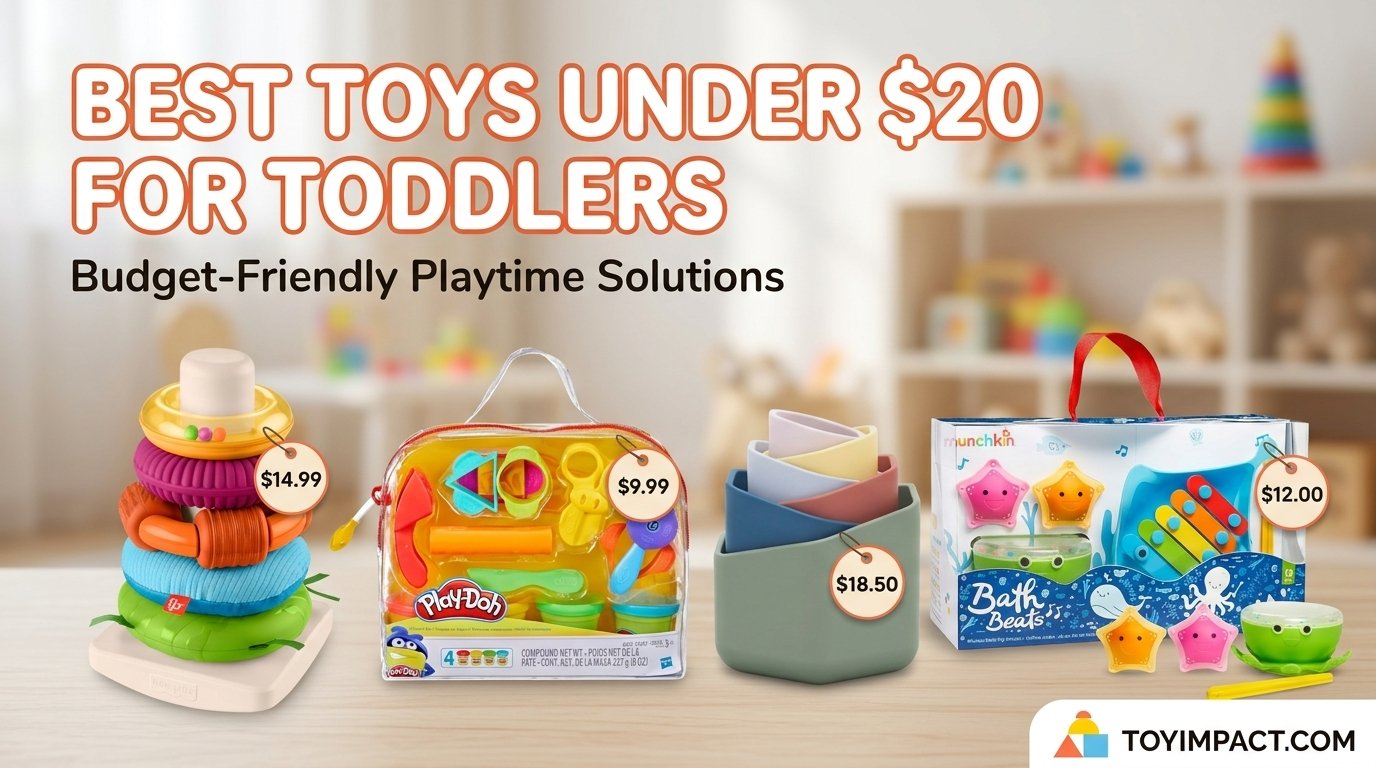
Sensorimotor play is the foundation. From birth through roughly age two, toddlers learn primarily through their senses — touching, tasting, hearing, seeing, and manipulating objects. A baby who shakes a rattle is learning cause and effect. A toddler who squishes Play-Doh is exploring texture, resistance, and hand strength. This is why sensory-rich toys (things that crinkle, rattle, spin, or squish) tend to dominate the “most played with” category for the youngest toddlers. The Fisher-Price Sensory Rock-a-Stack at the top of our list is a textbook sensorimotor toy: each ring offers a different texture, sound, and visual experience, all within a simple stacking framework.
Symbolic and pretend play begins emerging around 18 months and accelerates through the toddler years. This is when a block becomes a phone, a stacking cup becomes a hat, and a cardboard box becomes a house. Toddlers are beginning to understand that one thing can stand for another — a foundational cognitive skill that later supports reading (letters standing for sounds), math (numerals standing for quantities), and social understanding (facial expressions standing for emotions). Open-ended toys like DUPLO blocks and stacking cups are especially valuable here because they don’t dictate what they “are.” A toddler has to supply the imagination, which is exactly the point.
Constructive play involves building, creating, or making something with a goal in mind. Stacking a tower, fitting shapes into a sorter, or poking quills into a hedgehog — these are all constructive play. It overlaps with sensorimotor play for younger toddlers (who are mostly just exploring the physical action) and with problem-solving play for older toddlers (who start planning what they want to build). Toys like Spike the Hedgehog, Baby’s First Blocks, and DUPLO all live in this category.
Games with rules are the last to develop and mostly emerge closer to age three or beyond. Simple matching games, Simon Says, and “roll the ball back and forth” are early examples. Most toddler toys don’t require formal rules, but some — like the interactive “Don’t Push the Button!” book — introduce a playful pseudo-rule structure (“don’t push it!”) that toddlers delight in breaking, which is itself a form of early logical thinking.
Why Repetition Is the Engine of Toddler Learning
If there’s one thing that surprises new parents about toddler play, it’s the sheer repetition. A toddler will stack the same tower 40 times in a row. They’ll pour water from one cup to another for 20 minutes straight. They’ll press the same button on the same toy until the batteries die. This isn’t a sign of boredom or lack of imagination — it’s the primary mechanism through which toddlers build neural pathways.
Neuroscientists call this “experience-dependent development.” Each time a toddler repeats an action — picking up a block, placing it on a stack, watching it fall — the neural connections responsible for that action get slightly stronger and more efficient. After dozens or hundreds of repetitions, what was once a challenging motor task becomes automatic, freeing up cognitive resources for the next challenge. This is why a toddler who mastered the Rock-a-Stack at 12 months might ignore it by 18 months — they’ve literally rewired their brain around that skill and are ready for something harder.
This has a direct practical implication for toy buying: the best toddler toys are ones that support extended repetition of a single, well-defined action. Simple stacking rings, shape sorters, water wheels, and push-button books all fit this model. Complex electronic toys that cycle through many different activities in rapid sequence tend to be less effective because they don’t give toddlers enough time to repeat any single action enough times to build mastery. A toy that does ten things okay is less useful than a toy that does one thing excellently, and this principle holds remarkably consistently across the entire toddler age range.
The Zone of Proximal Development and Toy Selection
Psychologist Lev Vygotsky introduced the concept of the “zone of proximal development” (ZPD) — the sweet spot between what a child can do independently and what they can do with a little help. Toys that land in this zone are the ones that get the most playtime because they’re challenging enough to be interesting but not so hard that a toddler gives up in frustration.
For a 12-month-old, the Rock-a-Stack sits right in the ZPD: stacking rings is achievable with a bit of trial and error, and the wobble base makes the reward (a satisfying topple) almost inevitable even when the stacking isn’t perfect. For a 24-month-old, DUPLO bricks sit in the ZPD: connecting two bricks is manageable, but building a recognizable structure requires planning and spatial reasoning they’re actively developing.
The practical takeaway is that the “right” toy isn’t just about age labeling on the box — it’s about matching the toy’s core action to where your specific toddler is developmentally right now. A toy that’s too easy gets abandoned. A toy that’s too hard gets thrown. A toy that’s just right gets played with for months. This is one reason we recommend having a few different toys spanning slightly different difficulty levels available at any given time, rather than a single “perfect” pick.
How We Chose These Toys
We didn’t just pull ten cheap items and call it a list. Each toy had to clear a few practical bars before making the cut:
- Genuine engagement: toys that hold attention beyond the first few minutes, based on patterns in parent reviews and observed play behavior.
- Durability at a low price: a $12 toy that cracks in a week isn’t actually cheap — it’s expensive twice. We prioritized toys with a track record of surviving toddler-level abuse.
- Developmental value: stacking, sorting, squeezing, twisting, and splashing all map to real motor and cognitive milestones, and we leaned toward toys that build those skills without feeling like flashcards.
- Safety for the age range: every pick here is sized and constructed appropriately for toddlers, with attention to choking hazards and material safety.
- Low mess or manageable mess: because “under $20” shouldn’t mean “requires a full afternoon of cleanup.”
If you’re wondering when it’s actually appropriate to introduce more structured, skill-based toys, our guide on the best age to introduce Montessori toys is a useful companion read alongside this list, since several picks below lean into similar open-ended, self-directed play principles.
Our Testing Philosophy
We approach every toy recommendation with a simple question: would a real toddler, in a real living room, actually pick this up and play with it voluntarily? That sounds obvious, but a surprising number of toy reviews are based on spec sheets, brand reputation, and adult assumptions about what looks fun rather than actual observed play behavior. A toy that looks educational on paper but doesn’t compel a toddler to reach for it isn’t a good toy — it’s a decoration.
To get closer to real-world accuracy, we look at patterns across hundreds of parent reviews, paying particular attention to comments that mention how long the toy held attention, whether the toddler returned to it after the first day, and how it held up after weeks or months of use. We also look for red flags: recurring complaints about durability, misleading age recommendations, or toys that require constant parental involvement to remain interesting (which defeats the purpose of independent play).
Price stability matters too. A toy that’s occasionally $8 but usually $25 isn’t really a “budget pick” — it’s a premium toy that sometimes goes on sale. Every toy on this list has a consistently low street price, typically well under $20 at major retailers, so you’re not relying on a flash sale to get a reasonable deal.
What We Excluded and Why
Several popular budget toy categories were considered but ultimately left off this list, and it’s worth explaining why.
Cheap electronic learning tablets were the biggest exclusion. While many fall under $20, they tend to offer screen-based interaction that competes with (rather than complements) the hands-on play that toddlers benefit from most at this age. The Tonies figure, which is screen-free, earned its spot specifically because it delivers audio content without introducing a screen into a toddler’s play routine.
Bulk packs of small figurines were excluded because they tend to be poorly made at the under-$20 price point, with paint that chips and parts that break into choking hazards. A single, well-made figure is a better investment than a bag of 20 cheap ones.
Battery-operated “walking” or “dancing” toys were considered but left off because while they generate an initial burst of excitement, the parent-review data consistently shows they’re among the fastest-to-be-ignored toy categories. A toddler can’t control, modify, or repeat the action independently — they can only watch — and watching is the least engaging form of play for a child in the sensorimotor stage.
Fidget and pop-it toys are everywhere in the under-$20 range, and while they do offer sensory feedback, they don’t build the same developmental skills that stacking, sorting, and constructive play do. They’re fine as a supplementary sensory tool, but they didn’t offer enough standalone value to earn a slot on a top-ten list focused on meaningful engagement.
Types of Toddler Toys Explained: A Complete Category Breakdown
Walking into the toddler toy aisle — or scrolling through pages of options online — can feel overwhelming because there are so many categories, sub-categories, and cross-category hybrids. Understanding the major toy types and what each one actually does for development makes it significantly easier to build a balanced toy collection without overspending or ending up with five versions of essentially the same toy.
Stacking and Nesting Toys
These are among the earliest “real” toys toddlers interact with, and for good reason. Stacking rings (like the Rock-a-Stack), nesting cups (like the Lalo set), and basic block towers all teach spatial relationships — understanding how objects fit together in three-dimensional space. The motor component is significant too: placing a ring on a peg or balancing a block on a stack requires hand-eye coordination, grip control, and the ability to make small adjustments in real time.
From a cognitive perspective, stacking toys introduce early concepts of size ordering (big to small), sequencing, and planning. A toddler who tries to put the big ring on top of the small one learns through failure that order matters — a surprisingly deep lesson for a 14-month-old. Nesting toys add the concept of containment (things inside other things), which is a spatial reasoning skill that later supports understanding of categories and classification.
The budget advantage here is significant: stacking and nesting toys are among the least expensive toy categories to manufacture well, which means even high-quality options from brands like Fisher-Price and Lalo stay well under $20. You don’t need to spend more to get a good stacking toy — you just need one with appropriately sized pieces and a stable base or nesting structure.
Shape Sorters
Shape sorters are a specific sub-category of constructive play toys that combine spatial reasoning with problem-solving. A toddler has to identify the shape of the piece, find the matching hole, orient the piece correctly, and push it through — a multi-step sequence that challenges developing executive function skills like planning and persistence.
Fisher-Price Baby’s First Blocks includes a shape-sorter lid, making it a dual-purpose toy that transitions from free stacking play to structured sorting as the toddler’s skills develop. That kind of built-in progression is valuable because it extends the useful life of the toy without requiring you to buy a separate, more advanced sorters later.
Shape sorters also naturally teach frustration tolerance — a critical emotional skill. A toddler who tries to push a square through a round hole, fails, rotates the piece, and eventually succeeds is practicing the exact emotional regulation sequence (try, fail, adjust, persist, succeed) that underpins resilience later in life. It’s a small moment, but multiplied across hundreds of play sessions, it builds a meaningful foundation.
Art and Creative Play Materials
Creative play materials — Play-Doh, crayons, washable markers, finger paints — occupy a different space than structured toys. There’s no “right” outcome, which makes them both more flexible and more intimidating for parents who worry about mess. But the developmental value is enormous: creative materials build fine motor strength (squeezing dough, gripping crayons), bilateral coordination (holding paper with one hand while drawing with the other), and self-expression (a toddler deciding what to make, even if the result is an abstract blob).
The Play-Doh Starter Set earned its spot on this list because it provides a contained creative experience — multiple colors and basic tools — without requiring a parent to buy a full art supply kit. The mess factor is real but manageable with a designated play surface, and the dough itself is inexpensive to replace when it dries out or gets contaminated with crumbs.
One underappreciated aspect of creative play materials is their social dimension. When two toddlers sit together with Play-Doh, they naturally start imitating each other, sharing tools, and commenting on what they’re making — early forms of cooperative play and communication that structured toys don’t always encourage. If you have multiple toddlers or play dates, creative materials are one of the highest-value categories for shared engagement.
Building and Construction Toys
Building toys range from simple stacking blocks for the youngest toddlers to interlocking systems like DUPLO for older ones. The developmental trajectory is consistent: toddlers start by stacking vertically (a tower), then begin connecting horizontally (a wall or bridge), then combine both directions into more complex structures as spatial reasoning improves.
LEGO DUPLO is the standout in this category for toddlers because the brick size is specifically designed for small hands, the connection mechanism is easy enough for 18-month-olds but interesting enough for 5-year-olds, and the ecosystem is massive — meaning a starter set can be expanded with themed sets over years without compatibility issues. That long-term scalability is rare in the under-$20 price range and is a big part of why DUPLO earns its “best long-term value” badge on this list.
Building toys also support executive function development in ways that aren’t immediately obvious. A toddler who plans to build a tower and then has to figure out why it keeps falling is practicing hypothesis testing — “maybe if I use the bigger block on the bottom, it won’t fall” — which is the same logical process scientists use, just at a toddler scale.
Bath and Water Play Toys
Bath toys deserve their own category because they turn a routine caregiving task into a play opportunity — which is a win for both the toddler (who gets more play time) and the parent (who gets a cleaner child with less resistance). The key challenge with bath toys is mold prevention: any toy that traps water inside can become a health hazard, which is why we specifically look for designs that drain fully and dry quickly.
The Munchkin Bath Beats and Bath Water Wheel Toy on this list both address the mold issue by design — the Bath Beats pads don’t have internal cavities, and the water wheel’s open structure allows full drainage. The Lalo Stacking Cups also work well as bath toys precisely because their simple, open shape doesn’t trap water at all.
Water play has a unique sensory dimension that dry play can’t replicate. The resistance of water, the way it flows and splashes, and the temperature feedback all provide sensory input that supports body awareness and sensory processing development. For toddlers who are hesitant about bath time, introducing a few engaging water toys can genuinely transform the experience from a daily struggle into a daily highlight.
Books and Audio Toys
Books might seem like a separate category from toys, but for toddlers, interactive books function as play objects as much as reading material. The “Don’t Push the Button!” book on this list is a perfect example: it has a clear cause-and-effect mechanic (push the button, something changes), physical interaction (turning pages, pressing), and repeat-play value (the story works the same way every time, which toddlers find reassuring).
Audio toys like the Tonies figure occupy a complementary niche — they deliver narrative and music content without requiring visual attention, which makes them suitable for background play, car rides, and wind-down time. The emerging category of screen-free audio players for kids is one of the more exciting developments in the toddler toy space, because it addresses the screen-time concern without sacrificing content richness.
Fine Motor and Sorting Toys
Fine motor toys focus specifically on hand and finger dexterity — the small muscle movements needed for writing, buttoning, zipping, and manipulating small objects. Spike the Hedgehog is a quintessential fine motor toy: the quills are sized to require a pincer grip (thumb and forefinger), and the insertion holes demand precision placement.
The sorting component adds a cognitive layer on top of the motor exercise. When a toddler sorts Spike’s quills by color, they’re practicing categorization — the ability to group objects by shared attributes — which is a foundational pre-math skill. Color sorting, size sorting, and shape sorting all build toward the abstract thinking needed for more complex classification tasks later in school.
Fine motor toys tend to be compact and portable, which makes them excellent travel companions. They also tend to be quiet, which makes them excellent restaurant and waiting-room companions — a practical benefit that’s hard to overstate for parents of toddlers.
Pretend and Imaginative Play Toys
Pretend play toys — play kitchens, doctor kits, dolls, tool sets — are more common in the $20-plus range, which is why this list focuses more on the open-ended toys that can double as pretend play props. A DUPLO brick becomes a phone. A stacking cup becomes a soup bowl. A set of blocks becomes a garage for toy cars. The more open-ended the toy, the more pretend play scenarios it supports, which is why “open-ended” is a recurring theme across our picks.
Pretend play is critical for social-emotional development because it allows toddlers to practice real-world scenarios in a safe, consequence-free environment. A toddler who “cooks” in a play kitchen is practicing sequencing and role-playing. A toddler who “reads” a book to a stuffed animal is practicing narrative skills and empathy. These aren’t frivolous activities — they’re one of the primary ways toddlers make sense of the world around them.
Age-by-Age Buying Guide: What to Buy and When
Age labels on toy packaging are useful starting points, but every toddler develops at their own pace, and a toy that’s perfect for one 18-month-old might bore another. That said, there are reliable developmental windows where certain toy types tend to land well, and knowing those windows helps you buy more strategically — especially when you’re working within a budget and can’t afford to experiment endlessly.
12 – 15 Months: The Explorer Phase
At this age, toddlers are learning to walk (or have just started) and are driven by a need to touch, taste, and manipulate everything. The best toys for this window are simple, safe for mouthing, and reward a single clear action.
- Fisher-Price Sensory Rock-a-Stack — wobble base and textured rings are perfect first-stacker material
- Fisher-Price Baby’s First Blocks — oversized blocks are safe to mouth and easy to grip
- Lalo Stacking Cups — simple enough for the youngest toddlers, interesting enough to keep around
- Focus on: cause-and-effect toys, soft blocks, rattles, push-pull toys
- Avoid: toys with small parts, complex mechanisms, or anything requiring fine motor precision
15 – 20 Months: The Repeater Phase
Toddlers in this window are obsessed with repetition — doing the same thing over and over until they’ve mastered it. They’re also beginning to understand basic spatial concepts like “in,” “on,” and “under.”
- Spike the Hedgehog — pincer grip practice starts becoming relevant around 15-18 months
- Shape sorting with Baby’s First Blocks — the sorting lid becomes relevant as spatial awareness grows
- Bath Water Wheel Toy — cause-and-effect loops are endlessly fascinating at this age
- Focus on: stacking, nesting, simple sorting, water play, push-button books
- Avoid: toys that require sustained attention or multi-step planning
20 – 30 Months: The Builder Phase
This is when toddler play gets genuinely creative. Children begin combining toys, creating scenarios, and building recognizable (to them) structures. Fine motor skills are refined enough for more precise manipulation.
- LEGO DUPLO Deluxe Brick Box — open-ended building becomes genuinely engaging around 20+ months
- Play-Doh Starter Set — hand strength and creative interest align for productive dough play
- “Don’t Push the Button!” Book — interactive narrative play matches growing comprehension
- Focus on: building sets, creative materials, pretend play props, interactive books, more complex sorters
- Avoid: toys that are too simple and get abandoned quickly
2.5 – 3 Years: The Pretender Phase
Pretend play explodes during this window. Toddlers are narrating their play, assigning roles to objects, and beginning cooperative play with peers. Language is developing rapidly, and toys that support storytelling and social play become especially valuable.
- Tonies Favorite Children’s Songs — independent music selection supports autonomy and language
- LEGO DUPLO — building becomes more purposeful (“I’m making a house for my figure”)
- Play-Doh — creative play matures from squishing to deliberate “making”
- Focus on: dress-up, dolls, play vehicles, more complex building sets, audio content, interactive books
- Avoid: toys that are too simplistic — frustration tolerance is high enough for real challenges now

1. Fisher-Price Sensory Rock-a-Stack
The Rock-a-Stack has been a nursery staple for generations, and the sensory version updates the classic stacking rings with textured surfaces, varied sounds, and a wobble base that rewards a good push. It’s one of the simplest toys on this list, and that simplicity is exactly why it works — toddlers can figure out the “rules” of the toy almost immediately, which builds confidence before they move on to more complex stacking toys.
What sets this apart from a generic stacking ring set is the sensory layer. Each ring has a different texture or rattle sound, so toddlers get tactile and auditory feedback with every stack, unstack, and knock-over. That repetition — stack, topple, repeat — is exactly the kind of cause-and-effect play that toddlers are wired to seek out. It also travels well; the base is compact enough to toss in a diaper bag, which makes it a natural companion pick alongside our best toys for car rides and long trips roundup.
For families exploring sensory-friendly toys more broadly, this is also a solid entry point. It doesn’t overload a child with lights and sound the way many electronic toys do, and the predictable, textured feedback loop is often called out specifically in our sensory toys and autism gift guide as the kind of toy that works well for kids who benefit from consistent, low-stimulation sensory input.
The durability factor is worth emphasizing as well. The Rock-a-Stack is made from hard, smooth plastic that resists cracking, doesn’t absorb moisture, and wipes clean in seconds — which matters more than most reviews mention when a toy is going to be used by a toddler who treats every object as a potential teething device. The rings themselves are sized too large to pose a choking hazard, and the central pole has a rounded cap that prevents any sharp edges from being exposed. For under $10 at most retailers, it’s one of the highest-value picks on this entire list in terms of cost-per-play-hour.
Pros
- Multi-sensory: texture, sound, and motion in one toy
- Wide base resists tipping onto a child
- Compact and easy to pack for travel
- Durable plastic construction
Cons
- Rings can end up scattered around the house
- Less engaging once a toddler masters basic stacking

2. Play-Doh Starter Set 9-Piece Kit
Play-Doh doesn’t need much of an introduction, but this starter kit is worth calling out specifically because of what it includes: multiple colors, basic tools, and enough dough to actually last through several play sessions rather than drying out after one afternoon. For toddlers just getting into pretend and sensory play, squishing, rolling, and cutting dough is a genuinely valuable fine motor exercise disguised as messing around.
The appeal here goes beyond squishing dough into shapes. Toddlers are building hand strength and pincer grip every time they pinch, roll, or press the dough with a tool, which are the same muscle groups used later for holding pencils and using scissors. It’s a low-cost way to build pre-writing skills months before “pre-writing skills” ever shows up on a preschool checklist.
Because Play-Doh does involve some mess, it pairs naturally with a designated play mat or tray, and it’s worth thinking through storage from day one — our guide on organizing toy storage in small spaces covers exactly this kind of small-parts, easy-to-lose toy category.
A few practical notes from experienced Play-Doh households: keeping the dough soft requires sealing containers tightly after every use, and a small spritz of water can revive dough that’s started to dry. Mixing colors is inevitable and actually part of the fun — toddlers who discover that red and blue make purple are getting an unplanned color theory lesson. Just know that once colors are mixed, they can’t be separated, so if your toddler is particular about color purity, it might be worth keeping certain colors for supervised-only sessions. The dough itself is wheat-based, which is worth noting for families managing wheat or gluten allergies, even though it’s not intended for consumption.
Pros
- Builds fine motor and hand strength
- Multiple colors keep play varied
- Non-toxic formula designed for young kids
- Inexpensive to replace when dough dries out
Cons
- Requires supervision for toddlers who still mouth toys
- Can dry out if lids aren’t sealed properly

3. Lalo Stacking Cups (Sage)
Stacking cups are one of those toys that never really go out of style, and Lalo’s version leans into a clean, muted aesthetic that fits homes that would rather not have a rainbow of primary-colored plastic in every room. Beyond the look, the cups nest cleanly, stack into a tower, work in the bath, and double as sandbox scoops — one toy covering four different play contexts.
This is also a strong toy for parents interested in Montessori-style, open-ended play, since there’s no “right way” to use stacking cups. A toddler might nest them, knock them over, use them to scoop bath water, or turn them into makeshift drums. That flexibility is exactly what keeps a toy relevant across a wider age range than most single-purpose toys manage.
Because these cups genuinely work in water, they’re an easy add-on to bath time alongside dedicated bath toys, and they hold up well outdoors too — a nice complement if you’re building out a backyard water table setup. They’re also compact enough to pass between siblings without much fuss, which our toys for siblings to play together guide touches on directly.
One aspect of stacking cups that often gets overlooked is their mathematical foundation. When a toddler nests cups from largest to smallest, they’re internalizing a sequence — a precursor to understanding number ordering. When they build a tower and count the cups (or hear a parent count them), they’re connecting physical objects to numerical concepts. And when the tower falls and they start again, they’re learning that the process of building has more value than the final structure — a mindset that supports persistence and experimentation throughout childhood. The sage color palette of the Lalo version also makes these cups a surprisingly nice shelf or nursery decor item when they’re not in use, which is a small but real practical benefit for parents who value a tidy-looking home.
Pros
- Works in bath, sandbox, and dry play
- Neutral aesthetic fits most home decor
- Nests compactly for storage
- Simple enough for younger toddlers, flexible enough for older ones
Cons
- Higher price than generic stacking cup sets
- No sound or texture variation between cups

4. Munchkin Bath Beats Bath Toy
Bath time toys tend to fall into two categories: things that mold and things that get ignored after week one. The Bath Beats toy avoids both problems by turning bath time into a light music session, letting toddlers tap out patterns on floating pads that trigger different sounds. It’s genuinely one of the more engaging bath toys in this price range because it gives a toddler a reason to stay in the tub a few extra minutes without a parent having to negotiate.
From a developmental angle, tapping targeted pads is a decent hand-eye coordination exercise, and the cause-and-effect feedback (tap, hear a note) reinforces the same kind of learning loop that makes stacking and sorting toys effective. Because it’s designed specifically for water use, it also avoids the mold problem that plagues foam bath toys and squirters that trap water inside.
If bath time toys are a category you want to build out further, this pairs naturally with the stacking cups above and the water wheel toy later on this list — three toys that together turn a bath into a genuine mini play session rather than a quick rinse.
A note on bath toy longevity: electronic bath toys have a mixed reputation because water and electronics are natural enemies, even when the product is designed for water use. The Bath Beats toy handles this better than most by keeping its electronic components sealed and elevated above the waterline, but it’s still worth drying the unit off after each use and storing it outside the bathroom where humidity is lower. Batteries typically last several weeks of regular use, and replacing them is straightforward with a small screwdriver. The musical element is genuinely fun for toddlers — most parent reviews mention that their child started requesting “music bath” specifically after being introduced to this toy, which is about as strong an engagement endorsement as you can get.
Pros
- Interactive sound feedback keeps bath time engaging
- Designed to resist mold buildup
- Floats and sticks to tub walls for easy setup
- Encourages hand-eye coordination
Cons
- Requires batteries, which need periodic replacement
- Sound can be repetitive for adults listening from outside the bathroom

5. Tonies Favorite Children’s Songs
Tonies figures work with the Toniebox system to play music and stories without a screen, and the Favorite Children’s Songs figure is one of the easiest entry points for families new to the platform. A toddler places the figure on top of the box and it starts playing — no menus, no swiping, no parent handing over a phone. That simplicity matters enormously at an age when screen time debates are constant.
Beyond the novelty, there’s real value in a toy that toddlers can operate entirely independently. Being able to “choose” and start their own music builds a small but meaningful sense of autonomy, and singalong songs support early language development through repetition and rhythm. It’s also genuinely portable — the figure itself is small, durable, and travel-friendly, making it a strong pick for our best travel toys for airplane trips guide.
Worth noting: the figure itself is the affordable under-$20 piece here, while the Toniebox player is a separate, larger purchase. If your family already owns a Toniebox, this figure is an easy, low-cost way to expand the music library without buying another full system.
The children’s songs figure specifically includes a curated collection of classic nursery rhymes and singalong tracks that toddlers tend to gravitate toward. Songs like “Wheels on the Bus,” “Itsy Bitsy Spider,” and “Old MacDonald” are included not just because they’re fun but because they have a strong rhythmic and repetitive structure that supports language acquisition. Toddlers learn new words and phrases faster through song than through speech alone, partly because the melody provides memory scaffolding — the tune helps them recall the words even before they fully understand the meaning. Over time, you’ll likely notice your toddler singing along (or at least attempting to), which is a significant language milestone that shows they’re processing the content actively rather than just passively listening.
Pros
- Screen-free, toddler-operable audio play
- Encourages independence and choice
- Compact and travel-friendly
- Supports early language and rhythm skills
Cons
- Requires a separately purchased Toniebox to play
- Not a standalone toy without the box

6. Learning Resources Spike the Fine Motor Hedgehog
Spike is a foam hedgehog that comes with colorful “quills” a toddler pokes into pre-made holes, sorts by color, and pulls back out to start again. It looks simple, but it’s one of the more effective fine motor toys on this list because it isolates a specific movement — pinching and inserting — that toddlers need for everything from buttoning clothes to eventually holding a pencil correctly.
It’s also a genuinely portable toy, since all the pieces fit inside the hedgehog itself, which means no loose parts rolling under the couch and no separate storage bin needed. That self-contained design makes it another strong option for the car ride and long trip toys list, since it doesn’t have a dozen tiny pieces to lose in the back seat.
For parents thinking ahead to more structured learning toys, Spike is often mentioned as a natural stepping stone toward STEM-adjacent play, since sorting by color and counting quills lays early groundwork covered in more depth in our guide to introducing STEM toys to preschoolers.
One thing that makes Spike stand out among fine motor toys is the softness of the foam body. Unlike hard plastic sorters that can pinch fingers or make unpleasant contact when a toddler gets frustrated and throws the toy (which will happen), the foam construction absorbs impact and is gentle on both the child and your floors. The quills themselves have a satisfying tactile quality — slightly textured, with a rounded tip that’s easy to grip but won’t poke. The color variety (typically red, orange, yellow, green, blue, and purple) also gives parents an opportunity to practice color naming during play: “Can you find the blue one? Where does the blue one go?” This kind of guided play alongside an otherwise simple toy is one of the best ways to extend its educational value without adding complexity to the toy itself.
Pros
- Isolates pincer grip and fine motor development
- Self-contained storage, no loose parts to lose
- Soft foam construction is safe for young toddlers
- Doubles as a color-sorting activity
Cons
- Foam quills can wear down with heavy use over time
- Limited play variety once the sorting task is mastered

7. Fisher-Price Baby’s First Blocks
Before a toddler is ready for LEGO DUPLO, they usually go through a phase with soft, oversized blocks that are easy to grip, safe to chew on, and forgiving when a tower inevitably gets knocked down (often by the toddler who built it). Fisher-Price’s Baby’s First Blocks fill exactly that gap, with a shape-sorter lid included so the same set supports both stacking and sorting play.
The dual-purpose design is what makes this one worth calling out specifically. A toddler can stack the blocks into towers, sort them by shape into the included bucket lid, or simply carry them around — three different play patterns from one $20 set. That kind of versatility tends to extend a toy’s useful life well beyond single-purpose alternatives.
This is also a solid entry point if you’re building toward a full building-block collection later; it pairs naturally with the DUPLO set below, and if siblings are sharing toys, both sets tend to blend well together, which is a theme we cover more in the siblings’ shared toys guide.
The bucket itself becomes a toy once the blocks are out — toddlers love filling, carrying, dumping, and refilling containers, and the handle on this bucket is sized for small hands. That “the container is also a toy” design philosophy is a hallmark of well-thought-out toddler products, and it means you get even more play value from the same purchase. The blocks come in primary colors (red, blue, yellow, green, orange) with shapes including stars, triangles, squares, circles, and hexagons — enough variety to keep sorting interesting without overwhelming a toddler with too many options. When the sorting lid isn’t in use, the bucket serves as a natural storage solution, which helps keep the play area from becoming a permanent obstacle course of scattered blocks.
Pros
- Soft, oversized blocks are safe and easy to grip
- Shape-sorter lid adds a second play mode
- Good bridge toy before harder building blocks
- Lightweight and quiet compared to hard plastic blocks
Cons
- Softer material shows wear faster than hard plastic
- Fewer building possibilities than interlocking block sets

8. LEGO DUPLO Deluxe Brick Box 10914
If we had to pick one toy on this list most likely to still be in heavy rotation a year from now, it’s the DUPLO Deluxe Brick Box. The large, toddler-safe bricks come in a wide range of colors and shapes, and unlike most toys on this list that serve one specific play pattern, DUPLO bricks are genuinely open-ended — a toddler can build a tower today and a “car” tomorrow, and the set grows with them as their building skills improve.
The bricks themselves are compatible with the wider DUPLO ecosystem, which means this starter box can be expanded later with themed sets without needing to replace anything. That long-term compatibility is a big part of why DUPLO consistently shows up as one of the highest cost-per-play-hour toys parents actually recommend, even though the upfront price sits comfortably under $20.
DUPLO is also one of the better options for shared play between toddlers and older siblings, since the pieces are large enough to be safe for younger kids but still interesting enough for a 4- or 5-year-old to build something more complex — see our shared sibling toys guide for more on toys that work across age gaps. It’s also frequently recommended as an early STEM-adjacent toy, a topic our STEM toys for preschoolers guide covers in more depth.
The Deluxe Brick Box specifically includes a baseplate, wheel pairs, a window, a door, and numbered bricks alongside the standard rectangular pieces — which means it supports more complex building scenarios than a basic brick-only set. The baseplate alone is a game-changer for toddler building, because it gives structures a stable foundation that prevents the all-too-common frustration of a carefully built tower collapsing because the bottom bricks shifted on a smooth surface. The included figure and dog also immediately jumpstart pretend play scenarios, which is something purely structural sets don’t offer. And when all the pieces are done being used, they fit back into the sturdy cardboard box, which doubles as both storage and (if your toddler is anything like most toddlers) a secondary play object — boats, houses, and “cars” have all been improvised from empty DUPLO boxes in homes around the world.
Pros
- Open-ended building play with long-term replay value
- Compatible with the wider DUPLO brick ecosystem
- Large pieces are appropriately sized for toddlers
- Works well across a range of ages, good for siblings
Cons
- Pieces take up more storage space than smaller toys
- Stepping on a stray brick barefoot is an experience

9. Don’t Push the Button! A Funny Interactive Book for Kids
This one technically lives in the book aisle, but it plays like a toy, which is exactly why it earns a spot here. The premise is simple: a character on the page insists the reader shouldn’t push the button, and every page turn reacts to whether the toddler pushes it anyway. That direct, physical interaction — turning a normally passive activity into something a toddler actively controls — is a big part of why this book gets requested on repeat far more than a typical picture book.
Beyond the entertainment factor, interactive books like this one support early language development, cause-and-effect understanding, and the beginnings of narrative comprehension, since toddlers start predicting what happens next before the page even turns. It’s also a genuinely good screen-free alternative for the moments where a parent might otherwise reach for a tablet, particularly during travel.
For families building a rotation of engaging, low-cost gifts, this book pairs well with the audio-based Tonies figure above as two very different approaches to the same goal: keeping a toddler engaged without a screen.
What makes this particular interactive book stand out from the growing category of “press here” style children’s books is the humor. The character (a purple monster named Larry) is genuinely funny — he begs, pleads, and dramatically reacts to every button push, and toddlers who are just beginning to understand jokes and silliness find his reactions absolutely hilarious. That emotional response — laughing at a book — is a more powerful engagement driver than any educational feature, because a toddler who laughs will ask for the book again, and a toddler who asks for the book again is building a positive association with reading that can last years. The board book construction also holds up well to the rough handling that interactive books inevitably receive; pages that need to be pressed, poked, and rubbed need to be sturdier than standard paper pages, and this one is.
Pros
- Highly interactive format holds attention
- Encourages early cause-and-effect understanding
- Durable board-book style pages built for toddler handling
- Screen-free entertainment option
Cons
- Novelty may wear off faster than physical toys
- Requires an adult to read along, less independent than other picks

10. Bath Water Wheel Toy
A water wheel toy is one of those simple mechanisms that seems to fascinate toddlers disproportionately to how much it actually does. Water gets poured or scooped in, a wheel spins, and that’s essentially the whole toy — but that basic mechanical cause-and-effect loop is exactly the kind of thing toddlers will replay dozens of times in a single bath.
It suctions to the tub wall, which keeps it in place better than floating toys that drift out of reach, and the spinning wheel action doubles as an early introduction to simple mechanics — gears, motion, and force in a form a toddler can actually manipulate with their hands. It’s a natural pairing with the stacking cups above, since scooping water with the cups and pouring it into the wheel turns bath time into a small, self-directed science experiment.
If your toddler loves this kind of water play, it’s worth extending the same idea outdoors during warmer months — our best water table toys for the backyard guide covers larger-scale versions of the same water-and-motion play pattern.
There’s something almost meditative about watching a toddler play with a water wheel. The action is predictable — pour, spin, pour again — and that predictability is part of the appeal. Toddlers are comforted by knowing exactly what will happen when they perform an action, and a spinning wheel provides that certainty while still offering the visual spectacle of motion and flowing water. It’s the toddler equivalent of watching a campfire: the pattern is repetitive but never quite the same, and the sensory experience (the feel of water, the visual motion, the sound of splashing) keeps the brain engaged. For parents who struggle with bath time resistance, introducing a water wheel (alongside the Bath Beats toy and stacking cups) can genuinely shift the dynamic from “I don’t want to take a bath” to “Can I take a bath now?” — and that transition alone is worth the small investment.
Pros
- Suctions to tub wall, doesn’t float away
- Simple mechanical cause-and-effect play
- Pairs well with other bath toys for extended play
- Easy to rinse and dry between uses
Cons
- Suction cups can weaken over time on some tub surfaces
- Limited play value outside of bath or water contexts
Sensory Play Benefits: Why It Matters More Than You Think
Sensory play — any activity that engages a toddler’s sense of touch, sight, sound, smell, or taste — is often marketed as a buzzword on toy packaging, but the developmental science behind it is solid and worth understanding before you decide which toys to prioritize. Several picks on this list (the Rock-a-Stack, Play-Doh, stacking cups, water toys) are fundamentally sensory play tools, and understanding why sensory engagement matters helps you get more out of every one of them.
What Sensory Play Actually Does in the Brain
When a toddler touches a textured ring, squishes Play-Doh, or feels water running over their hands, their brain is processing multiple streams of sensory information simultaneously — texture, temperature, pressure, resistance, and spatial position. Each of these inputs travels along dedicated neural pathways from the sensory receptors (in the skin, ears, eyes) to the brain’s processing centers, where the information is integrated, interpreted, and filed for future use.
The key word is “integrated.” A toddler who feels the difference between a smooth stacking ring and a textured one isn’t just learning about texture — they’re building the neural infrastructure that allows them to process and respond to multiple types of sensory input at once. This integrated sensory processing is the foundation for everything from handwriting (which requires integrating touch, vision, and motor control) to navigating a crowded playground (which requires integrating vision, hearing, spatial awareness, and proprioception — the sense of where your body is in space).
Sensory play also triggers the release of neurotransmitters associated with focus and calm. This is why toddlers who are fussy or overstimulated often settle down when given something to squeeze, pour, or manipulate — the sensory input provides a regulatory function that helps organize their nervous system. Parents of toddlers who benefit from this kind of regulation often find our sensory toys for autism gift guide useful for identifying toys that provide consistent, predictable sensory feedback, which is often more effective than toys with variable or unpredictable stimulation.
Types of Sensory Input and Which Toys Provide Them
Tactile (touch): Play-Doh, textured stacking rings, foam quills, water play. These provide feedback through the skin and are the most accessible form of sensory play. Almost every toy on this list provides some tactile input, but the Rock-a-Stack, Play-Doh, and Spike the Hedgehog are the most tactile-intensive.
Proprioceptive (body awareness): Stacking blocks, pushing water wheels, squeezing dough. These involve resistance and force, helping toddlers understand how much pressure to apply and where their hands are in space. DUPLO blocks are excellent for this — the act of pressing two bricks together until they “click” provides clear proprioceptive feedback.
Vestibular (balance and motion): Knocking over stacked towers, spinning water wheels, rocking the Rock-a-Stack base. These activate the inner ear’s balance system and support the development of coordination and spatial orientation.
Auditory (sound): Rattling rings, tapping Bath Beats pads, Tonies music. Sound-based sensory input supports auditory processing, which is foundational for language development. Toddlers who regularly engage with musical and sound-producing toys tend to develop stronger phonological awareness — the ability to distinguish between different speech sounds — earlier than peers who don’t.
Visual (sight): Color sorting with Spike, watching water flow through a wheel, building colorful DUPLO structures. Visual processing is the sense most parents focus on (bright colors! flashing lights!) but it’s actually the least impactful for toddler development when used in isolation. Visual input is most valuable when it’s paired with another sensory channel — seeing AND feeling a textured ring is more developmentally useful than just seeing a bright light.
Sensory Play and Emotional Regulation
One of the most underappreciated benefits of sensory play is its role in emotional regulation. Toddlers experience emotions intensely but lack the cognitive tools to manage them — a minor frustration can feel like a catastrophe, and transitions between activities can trigger meltdowns. Sensory toys provide a grounding mechanism during these moments: the repetitive action of squeezing dough, pouring water, or stacking blocks activates the parasympathetic nervous system (the “calm down” system), which helps bring emotional arousal back to a manageable level.
This is why many occupational therapists recommend keeping a few sensory toys accessible during transition times — before meals, before nap, before leaving the house. A toddler who can spend two minutes squeezing Play-Doh while you prepare their lunch is more likely to sit calmly for the meal than a toddler who had to stop an activity abruptly with nothing to fill the gap. It’s not about “distracting” the child with a toy — it’s about giving their nervous system a bridge between activities.
The toys on this list that provide the strongest regulatory benefits are Play-Doh (for tactile and proprioceptive input), the Rock-a-Stack (for predictable, repetitive stacking and unstacking), and water play toys (for the combined tactile, visual, and auditory input of flowing water). Having one or two of these available during your toddler’s most common transition points can make a noticeable difference in daily routine smoothness.
Screen-Free Play: Building Healthy Habits Early
The American Academy of Pediatrics recommends avoiding screen time (other than video calls with family) for children under 18 to 24 months, and limiting it to one hour per day of high-quality programming for children 2 to 5. Whether you follow these guidelines strictly or take a more flexible approach, having a robust collection of screen-free toys makes it significantly easier to keep toddler play grounded in hands-on, interactive experiences rather than passive consumption.
Why Screen-Free Play Matters for Toddlers
The concern isn’t that screens are inherently harmful — it’s that screen time displaces other activities that are more developmentally valuable at this age. A toddler watching a video is receiving information passively. A toddler stacking blocks is generating information actively — testing hypotheses, adjusting strategies, processing sensory feedback, and building motor plans. The difference in cognitive engagement between passive reception and active manipulation is enormous, and it’s the reason child development experts consistently prioritize hands-on play over screen-based entertainment for this age group.
There’s also a physical dimension. Screen time is, by definition, sedentary, and toddlers need to move. The physical actions involved in hands-on play — reaching, grasping, crawling to retrieve a dropped toy, standing to build a tower — contribute to gross motor development, core strength, and coordination in ways that watching a screen simply doesn’t. A toddler who spends 30 minutes building with DUPLO is getting a workout (of sorts) that supports their physical development alongside their cognitive growth.
Several toys on this list were specifically chosen for their ability to replace screen time with equally engaging but more developmentally productive alternatives. The Tonies figure delivers music and stories without a screen. The “Don’t Push the Button!” book provides interactive entertainment that requires physical participation. Play-Doh offers creative engagement that can hold a toddler’s attention for 20 to 30 minutes at a stretch — comparable to a TV episode but with completely different developmental outcomes.
Practical Strategies for Reducing Screen Dependence
If your toddler already has established screen habits and you want to shift toward more hands-on play, the key is substitution rather than elimination. Simply removing screens without providing an alternative creates a vacuum that a frustrated toddler will fill with protest. Instead, identify the specific moments when screens are typically used — during meal prep, during the “witching hour” before dinner, during car rides — and pre-position a specific toy for each moment.
During meal prep: A tub of Play-Doh on a designated mat near the kitchen gives a toddler something to do with their hands while you cook. The proximity matters — toddlers are more likely to engage with a toy if they can see you while playing with it.
During the witching hour: Bath toys like the water wheel and Bath Beats move bath time earlier in the evening routine, giving the toddler an engaging water-play session during the period when they’re most likely to demand screen time.
During car rides: Spike the Hedgehog (self-contained, no loose parts) and the Tonies figure (audio only, no screen needed) are both designed for on-the-go engagement. Our full car ride toys guide covers this strategy in more detail.
During wind-down before bed: Interactive books like “Don’t Push the Button!” and audio content from Tonies provide calm, focused engagement that doesn’t stimulate the visual system the way screens do, making the transition to sleep smoother.
Montessori vs. Traditional Toys: What’s the Difference at This Price Point?
The Montessori approach to toys and play has become increasingly mainstream, and many parents wonder whether “Montessori toys” are meaningfully different from traditional toys, especially when both are available at similar price points. The honest answer is that the distinction is less about the toy itself and more about how it’s designed to be used — and several picks on this list work beautifully in both Montessori and traditional play environments.
Core Montessori Toy Principles
Maria Montessori’s educational philosophy, developed in the early 1900s, emphasizes child-directed learning through carefully prepared environments. In the toy context, Montessori principles generally translate to a few key design characteristics:
Single-purpose focus: Montessori toys typically do one thing well rather than combining multiple activities. A shape sorter that only sorts shapes is more “Montessori” than a shape sorter that also plays music, lights up, and counts. The reasoning is that combining too many features into one toy overstimulates the child and dilutes the learning focus.
Natural materials: Montessori environments favor wood, metal, fabric, and other natural materials over plastic. The tactile experience of natural materials provides richer sensory feedback, and the visual simplicity of natural colors (wood grain, muted tones) is less distracting than bright primary colors.
Self-correcting design: Montessori toys are ideally designed so the child can see their own mistake without adult intervention. A shape sorter is self-correcting — if the shape doesn’t fit the hole, the child knows to try a different hole. A stacking ring set is self-correcting — if the big ring is on top of the small one, the tower is visibly wrong. This builds independence and problem-solving skills because the child doesn’t need a parent to tell them something is wrong.
Open-ended potential: While individual Montessori toys tend to be single-purpose, the broader play environment is designed to offer variety through multiple different single-purpose toys available simultaneously. A child chooses what to work with, which builds autonomy and intrinsic motivation.
How This List Maps to Montessori Principles
Several toys on this list align naturally with Montessori philosophy even though they’re not marketed as “Montessori toys”:
Lalo Stacking Cups are an excellent Montessori toy — single-purpose, open-ended, and designed with clean, muted aesthetics. They’re the most explicitly Montessori-friendly pick on this list.
Fisher-Price Baby’s First Blocks function as a self-correcting shape sorter (Montessori-aligned) and a free-form stacking toy (more traditional). The dual purpose is technically a deviation from strict Montessori, but the shape-sorter mode alone meets the criteria.
Spike the Hedgehog is a fine motor and sorting toy — exactly the kind of purposeful, focused activity Montessori environments are built around. The color-sorting component is self-correcting and the pincer-grip practice is precisely the kind of practical life skill Montessori emphasizes.
LEGO DUPLO is more of a traditional open-ended building toy, but it supports the Montessori principle of child-directed, creative work. The key difference is that DUPLO is plastic rather than wood, which purists might object to, but functionally it provides the same kind of constructive, self-directed play experience.
Play-Doh occupies an interesting middle ground. It’s creative and child-directed (Montessori-aligned), but it’s also messy, multi-sensory, and unstructured in a way that strict Montessori environments typically don’t embrace. It’s more accurately described as a “Reggio Emilia” style material — another respected educational philosophy that emphasizes creative expression and sensory exploration more than Montessori does.
How to Evaluate Toy Quality Without Overspending
Price and quality have a relationship in the toy world, but it’s not as direct as most people assume. A $40 toy isn’t automatically twice as good as a $20 toy, and a $10 toy isn’t automatically half as good. Knowing what to look for — and what to ignore — helps you make better purchasing decisions at any price point, but it’s especially valuable when you’re shopping under $20, where the range of quality is widest.
The Five Quality Indicators That Actually Matter
1. Material weight and density. Pick up the toy (or read reviews from people who have). Thin, flimsy plastic that bends easily when pressed is a red flag — it’s more likely to crack under the stress of being thrown, stepped on, or chewed. Toys with thicker walls and more material density last longer. This is one area where budget toys can vary widely: some $12 toys are surprisingly solid, while others at the same price feel like they’ll break in a week.
2. Joint and connection quality. Anywhere two pieces meet — a lid on a container, a ring on a peg, a suction cup on a wall — is a potential failure point. Look for tight, well-molded connections with no visible gaps. Loose lids fall off. Poorly molded pegs wobble. Weak suction cups don’t stick. These details matter more than the toy’s overall appearance because they determine how the toy actually functions during play.
3. Surface finish. Run your finger over the toy’s surface (or look at high-resolution product photos). Rough seams, sharp flashing (the thin line of plastic left from the mold), and uneven paint are signs of low manufacturing quality. These aren’t just cosmetic issues — rough edges can scratch skin, and poorly applied paint can chip off and become a choking hazard. Reputable brands generally maintain better quality control here, which is one reason brand name matters more than price point when evaluating toddler toys.
4. Battery compartment security. For any electronic toy, check whether the battery compartment requires a screwdriver to open. This is a safety requirement (not just a convenience feature) for toddler toys — a compartment that can be pried open by small fingers exposes button batteries, which are a serious ingestion hazard. Every electronic toy on this list meets this standard, but cheap unbranded electronic toys sometimes skip the screw for cost savings.
5. Review patterns, not individual reviews. A single five-star review or one-star review tells you very little. What matters is the pattern across dozens or hundreds of reviews. If 80% of reviewers mention that the toy held up well after months of use, that’s a strong quality signal. If 30% of reviewers mention cracking, breaking, or falling apart within the first week, that’s a clear warning — regardless of how good the product page looks.
Brand vs. No-Name: When Does It Matter?
For toddler toys, brand matters more than in many other product categories, for two main reasons. First, established toy brands (Fisher-Price, LEGO, Learning Resources, Munchkin) have reputations to protect and invest more in quality control and safety testing than no-name manufacturers selling through marketplace platforms. Second, established brands stand behind their products — if a Fisher-Price toy breaks prematurely, customer service is more likely to offer a replacement than a random Amazon seller.
That said, brand isn’t everything. Some newer, smaller brands (like Lalo) produce excellent products that compete with or exceed the quality of major brands. The key is to evaluate each product on its own merits using the quality indicators above, rather than assuming a known brand always means better quality or an unknown brand always means worse.
Reading Between the Lines on Product Listings
Online product listings are marketing documents, not objective evaluations. A few common listing tactics to be aware of:
“Ages 3 and up” on a toy that’s clearly for toddlers. This sometimes means the toy contains small parts that the manufacturer couldn’t certify as safe for under-3s, not that the toy is too advanced for a toddler. If the age rating seems mismatched to the toy’s complexity, small parts are usually the reason.
“Educational” without specifics. The word “educational” on a toy listing is essentially unregulated — any toy can be called educational. Look for specific claims: “develops fine motor skills,” “teaches color recognition,” “builds hand-eye coordination.” Specific claims are more likely to reflect actual developmental value.
Inflated piece counts. A “50-piece set” might count every individual Play-Doh container lid, tool component, and sticker as a separate piece. Focus on what you’re actually getting — how many colors of dough, how many functional tools, how many unique building elements — rather than the raw number.
Photoshopped product images. Product photos often show toys at angles or in contexts that make them look larger, more detailed, or more vibrant than they are in person. Reading reviews that include customer-submitted photos gives a much more accurate picture of what to expect.
Common Toy Buying Mistakes Parents Make (and How to Avoid Them)
Even experienced parents fall into predictable traps when buying toddler toys. Knowing the most common mistakes before you shop saves money, reduces clutter, and increases the odds that your toddler actually plays with what you buy.
Mistake #1: Buying for the Parent’s Aesthetic, Not the Child’s Interest
It’s tempting to choose toys based on how they’ll look in your living room — the Instagram-worthy wooden toy set in muted earth tones, the beautifully designed Scandinavian stacking toy. And while aesthetics are a legitimate consideration (you’re the one who has to look at these toys every day), prioritizing look over play value is one of the fastest ways to end up with expensive shelf decorations. The Lalo Stacking Cups on this list are a rare exception — they genuinely balance aesthetics with play value — but in general, if you’re choosing between a toy your toddler will love and a toy that matches your couch, go with the one your toddler will love.
Mistake #2: Overloading with Too Many Toys at Once
This is the most common mistake by a wide margin. Parents — especially first-time parents, especially around birthdays and holidays — tend to present a toddler with a dozen new toys simultaneously. The result is almost always the same: the toddler plays with two or three, ignores the rest, and the parent feels frustrated that the other toys “didn’t land.” The problem isn’t the toys — it’s the volume. Toddlers are easily overwhelmed by choice, and research consistently shows that children play longer and more deeply with fewer options. Introducing one or two new toys at a time, and rotating others out of sight, produces dramatically better engagement than a big reveal of everything at once.
Mistake #3: Choosing Toys That Require Adult Operation
If a toy needs a parent to set it up, narrate the play, or push buttons to make it work, it’s not really a toddler toy — it’s a parent toy that a toddler watches. The best toddler toys can be picked up and used independently within seconds. A toddler who can grab a stacking cup and start nesting without any help is going to play with that cup far more than a toy that requires 15 minutes of assembly before play can begin. This is one reason the simplest toys on this list (stacking cups, blocks, the Rock-a-Stack) tend to have the highest long-term engagement scores — they’re always ready to go, with zero setup friction.
Mistake #4: Ignoring Storage Implications
Every toy you buy needs a place to live when it’s not being used, and toddlers don’t clean up after themselves (at least not reliably). Toys with lots of small pieces (Play-Doh, Spike’s quills, DUPLO bricks) require dedicated storage solutions, and if you don’t plan for that storage from the beginning, you end up with toys scattered across every floor surface in the house. Our guide on organizing toy storage in small spaces covers practical systems for exactly this problem, but the short version is: choose toys whose storage requirements match your available space, and get the storage sorted before the toy arrives.
Mistake #5: Buying for the Age the Child Is, Not the Age They’re Becoming
A toy that perfectly matches a toddler’s current developmental level will be outgrown in weeks. A toy that’s slightly ahead of where they are now will keep them challenged for months. When in doubt, err toward the more advanced option — as long as it doesn’t include safety hazards (like small parts) that make it inappropriate for the child’s current age. DUPLO bricks are a perfect example: a 14-month-old might only be able to stack two or three bricks today, but by 20 months they’ll be building recognizable structures, and by 30 months they’ll be creating elaborate scenarios. The same toy supports all three stages because it was designed for the upper end of the toddler range.
Mistake #6: Equating “Electronic” with “Educational”
Electronic toys that claim to teach letters, numbers, and colors are among the most purchased and least played-with categories in the toddler market. The issue is that the “learning” is passive — a toy that recites the alphabet at a toddler isn’t teaching the alphabet any more effectively than a parent singing the alphabet song. Meanwhile, a set of blocks that lets a toddler physically stack, count, and sort is providing active, hands-on learning that builds deeper understanding. The educational toy industry spends billions on marketing the idea that electronics equal learning, but the developmental research consistently points in the opposite direction for the toddler age group.
Mistake #7: Not Considering the Mess Tolerance of the Household
Play-Doh is a fantastic toy for toddlers. It’s also a messy toy for toddlers. If the thought of finding dried dough crumbs in your carpet fills you with dread, it might not be the right pick for your household right now — and that’s completely fine. Choosing toys that match your household’s actual mess tolerance (not your ideal mess tolerance) leads to toys that actually get used rather than toys that stay in the closet because the parent dreads the cleanup. Every toy on this list has a mess rating in the comparison table for exactly this reason.
Toy Rotation: A Practical Guide for Busy Families
Toy rotation — the practice of keeping only a subset of toys accessible while storing the rest out of sight, then swapping them periodically — is one of the simplest, cheapest, and most effective strategies for keeping a toddler’s play fresh without buying new toys. It’s backed by both Montessori philosophy and modern child development research, and it works at every budget level because it maximizes the value of toys you already own.
Why Rotation Works
Toddlers are drawn to novelty, but they also thrive on familiarity — a paradox that toy rotation resolves neatly. When a toy disappears for two or three weeks and then reappears, the toddler’s brain processes it with a blend of recognition (“I remember this!”) and novelty (“It’s been a while!”), which triggers renewed interest. This is the same psychological mechanism behind why toddlers want to read the same book 50 times but also get excited when a “new” (actually forgotten) book appears on the shelf.
Rotation also reduces the overwhelm that comes with too many options. A living room with 30 accessible toys is visually and cognitively noisy for a toddler, often leading to the “toy dumping” behavior where a child pulls everything out, plays with nothing, and moves on. A living room with six to eight carefully chosen, rotated toys creates a calmer, more focused play environment where each toy gets more individual attention.
A Simple Rotation System That Works
You don’t need an elaborate system to make toy rotation work. Here’s a straightforward approach that takes minimal time to maintain:
- Gather all toddler toys into one place. This gives you a complete picture of what you own, which is often more than you realize. Discard anything broken, donate anything that’s clearly outgrown, and clean everything that’s staying.
- Sort into categories. Group toys by type: stacking/nesting, building, creative/sensory, bath, books/audio, fine motor. This prevents you from accidentally rotating in three stacking toys and zero creative toys — variety across categories matters more than variety within categories.
- Select six to eight toys for the current rotation. Pick one or two from each category, aiming for a mix of familiar favorites and slightly challenging newer options. These go in the accessible play area.
- Store the rest out of sight. A closet, a high shelf, under-bed storage — anywhere the toddler can’t see or reach the stored toys. Out of sight truly means out of mind for toddlers; if they can see a toy, they’ll want it.
- Rotate every two to four weeks. Swap out two or three toys from the accessible set with two or three from storage. You don’t need to change everything at once — partial rotations keep things fresh without the overwhelm of an entirely “new” setup.
- Watch what happens. Some toys will get picked up immediately when they reappear. Others will be ignored again. That’s useful data — toys that consistently get ignored across multiple rotations can be donated or stored long-term, while toys that consistently generate excitement are keepers.
Rotation Frequency: How Often Is Enough?
The two-to-four-week range works for most families, but the right frequency depends on your specific toddler. A child who plays deeply and independently with each toy might go four weeks before interest wanes. A child who gets bored quickly might benefit from weekly swaps. The key signal is behavior: when a toddler starts ignoring the current rotation toys and seeking out non-toy objects (remote controls, kitchen utensils, shoes) for play, it’s time to rotate.
Holidays and birthdays are natural rotation triggers. After a birthday or holiday influx of new toys, rotate most of the new ones into storage immediately and introduce them gradually over the following weeks. This prevents the overwhelm that comes with a dozen new toys at once and extends the “new toy excitement” over a much longer period.
Seasonal rotation is also worth considering. Bath toys might rotate into storage during months when bath time is quick and uneventful, then rotate back in when the weather makes long baths more appealing. Outdoor toys get stored in winter. Holiday-themed toys come out in November and go away in January. This seasonal rhythm keeps the collection feeling relevant to the child’s current context without requiring any new purchases.
Pairing Toys for Maximum Engagement: Combinations That Work Better Together
Individual toys are great, but certain combinations create play experiences that are greater than the sum of their parts. Strategic pairing — putting two complementary toys in the same play space — extends engagement, introduces new play patterns, and gives toddlers the kind of creative cross-pollination that drives deeper learning.
The Bath Time Trio
The Lalo Stacking Cups + Munchkin Bath Beats + Bath Water Wheel Toy creates a complete bath play ecosystem. The cups scoop and pour water. The water wheel responds to the pouring. The Bath Beats adds musical feedback. Together, they transform a five-minute rinse into a 20-minute play session that covers sensory, cause-and-effect, and musical play simultaneously. Each toy works independently, but the combination is where the real magic happens — a toddler scooping water with a cup, pouring it into the water wheel, watching it spin, then tapping a Bath Beats pad in celebration is engaging in a multi-step play narrative that exercises planning, sequencing, and creativity.
The Fine Motor Development Pair
Spike the Hedgehog + Play-Doh creates a comprehensive fine motor workout. Spike isolates the pincer grip (thumb and forefinger) through its quill-insertion activity, while Play-Doh works the broader hand muscles through squeezing, rolling, and pressing. Alternating between the two — five minutes of quill work, then five minutes of dough work — gives both the small and large hand muscles a balanced exercise session. This pairing is especially valuable for toddlers who are approaching the age where they’ll start holding crayons and pencils, because it builds both the precision grip and the hand strength needed for writing tools.
The Building Progression Pair
Fisher-Price Baby’s First Blocks + LEGO DUPLO Deluxe Brick Box creates a natural building-skill progression. Start with the soft, oversized blocks for younger toddlers who are just learning to stack, and introduce DUPLO bricks as their coordination and spatial awareness develop. Because both sets involve the same basic actions — stacking, connecting, building — the transition is smooth, and a toddler who mastered the simpler blocks will approach DUPLO with confidence rather than frustration. Having both available simultaneously also allows for mixed play, where a toddler might build a DUPLO tower on top of a base of First Blocks, discovering through trial and error that the two types connect differently — a hands-on lesson in material properties.
The Screen-Free Entertainment Combination
“Don’t Push the Button!” book + Tonies Favorite Children’s Songs figure provides two very different screen-free experiences — one interactive and reading-based, the other audio and music-based. Together, they cover the two main modes of screen-free toddler entertainment (visual/interactive and auditory/immersive) without any overlap. This pairing is especially useful for car trips, where one works in the morning and the other in the afternoon, or for evenings where the book is for active time and the Tonies figure is for wind-down time.
The Sensory Exploration Pair
Fisher-Price Sensory Rock-a-Stack + Lalo Stacking Cups creates a sensory-rich stacking experience that covers twice the sensory channels as either toy alone. The Rock-a-Stack provides texture, sound, and wobble-based motion feedback. The stacking cups provide visual, spatial, and water-compatible play. Having both available gives a toddler the option to choose which sensory experience they’re drawn to on any given day — and watching which one they choose can tell you a lot about what kind of sensory input they’re seeking, which is useful information for future toy purchases.
Toys That Grow With Your Child: Getting the Most Mileage From Each Purchase
One of the smartest budget strategies in the toddler toy world is choosing toys that serve multiple developmental stages — toys that a 12-month-old can use one way and a 36-month-old can use differently, with the toy’s relevance shifting as the child’s skills evolve. This “grow with your child” approach maximizes cost-per-play-hour and reduces the constant pressure to buy new toys as the child develops.
How “Growth” Works in Practice
A toy “grows” with a child when it supports multiple levels of complexity within the same physical object. DUPLO bricks are the clearest example on this list:
At 12-15 months: A toddler picks up bricks, bangs them together, and puts them in and out of the box. This is sensorimotor play — exploring the physical properties of the objects.
At 18-22 months: The toddler starts connecting two or three bricks vertically, building simple towers. This is early constructive play — creating something with intention.
At 24-30 months: The toddler builds horizontal structures, adds windows and doors, and begins creating recognizable objects (a house, a car). This is constructive play with planning — the toddler has a goal before they start building.
At 30-36 months: The toddler assigns narratives to their builds (“This is a castle for the dragon”) and begins collaborative building with siblings or parents. This is constructive play combined with pretend play — a significant cognitive leap.
That’s roughly two years of evolving play from a single under-$20 purchase. The same principle applies (to varying degrees) to stacking cups, Play-Doh, and the Rock-a-Stack, which is why these toys consistently appear in “best long-term value” conversations.
Toys That Don’t Grow (and Why That’s Okay)
Not every toy needs to last two years. Some toys serve a specific developmental window and then get outgrown — and that’s completely fine as long as you know what you’re buying. Spike the Hedgehog, for instance, is primarily relevant during the 15-24 month window when pincer grip and color sorting are active developmental targets. After that, a toddler who has mastered those skills will lose interest. The Rock-a-Stack similarly has a narrower window — once basic stacking is mastered (usually by 18 months), the toy doesn’t offer much new. These are still excellent purchases because they’re inexpensive, they serve their specific window extremely well, and they can be passed on to a younger sibling or donated when they’re outgrown.
The key is knowing which kind of toy you’re buying. Broad-growth toys like DUPLO, stacking cups, and Play-Doh deserve permanent space in the toy collection. Narrow-window toys like Spike and the Rock-a-Stack deserve temporary space in the rotation, with the understanding that they’ll be retired once they’ve served their purpose.
Gender-Neutral Toy Selection: Why It Matters and How to Do It
The toy industry has historically been heavily gendered — pink aisles for girls, blue aisles for boys — but a growing body of research suggests that gendered toy marketing limits children’s play experiences in ways that affect development. The toys on this list are almost entirely gender-neutral by design, and that’s a deliberate selection criterion worth explaining.
What the Research Says
Studies on toy preferences show that while some differences exist in average play patterns between boys and girls, the overlap is far greater than the distinction. Boys and girls both benefit from building toys, creative materials, and fine motor activities. The developmental skills these toys support — spatial reasoning, hand strength, problem-solving, creativity — are equally important for all children, regardless of gender.
When toys are marketed heavily toward one gender, children of the other gender are less likely to encounter them, even if the toy would be a great match for their interests and developmental needs. A boy whose parents never consider Play-Doh because it’s displayed in the “girls” section (which happens in some retailers) misses out on a valuable creative play experience. A girl whose parents overlook building blocks because they’re marketed with boys on the packaging misses out on spatial reasoning practice. Gender-neutral toy selection avoids these artificial limitations.
Practical Approaches to Gender-Neutral Toy Buying
The simplest approach is to choose toys based on developmental value and the child’s demonstrated interests, rather than the gender of the child shown on the packaging. Every toy on this list works equally well for boys and girls — stacking cups stack regardless of who’s stacking them, DUPLO bricks connect regardless of who’s connecting them, and Play-Doh squishes regardless of who’s squishing it.
Color is another consideration. Primary-colored toys (red, blue, yellow) tend to be perceived as gender-neutral, while pastel-colored toys (pink, lavender, mint) are often coded as “for girls.” The Lalo Stacking Cups in sage are a good example of a color choice that’s aesthetically distinctive without being gendered — the muted green works for any child and any home decor.
It’s also worth noting that the “pink tax” — the tendency for products marketed to girls and women to cost more than equivalent products marketed to boys and men — exists in the toy world as well. Choosing gender-neutral toys sidesteps this pricing bias and keeps you focused on value rather than marketing category.
Where to Find the Best Deals on Toddler Toys Under $20
Finding a good toy is step one. Finding it at a good price is step two. While every toy on this list is already priced under $20 at standard retail, there are reliable strategies for getting even better deals — or at least ensuring you never overpay for a budget toy.
Amazon Price Tracking
Amazon prices for toddler toys fluctuate constantly, sometimes by 30-50% within a single week. Using a price tracking tool (like CamelCamelCamel or Keepa) lets you see the price history of any product and set alerts for when it drops below a target price. This is especially useful for toys you’re planning to buy as gifts — you can set an alert weeks in advance and wait for a dip rather than paying whatever the price happens to be on the day you shop.
Subscribe & Save and coupon clips on Amazon can also stack with sale prices, occasionally bringing an already-budget toy down to essentially pocket change. The Play-Doh Starter Set, for instance, frequently has a clipable coupon that shaves 15-20% off the listed price.
Target and Walmart Sales Cycles
Both retailers run predictable toy sales throughout the year. Target’s “Circle Week” events and Walmart’s “Rollback” promotions both regularly feature toddler toys at 20-40% off. The post-holiday period (January-February) is particularly good for toy deals as retailers clear seasonal inventory. Shopping these sales for birthday and holiday gifts months in advance is one of the most reliable budget strategies available.
Secondhand and Consignment
Toddler toys — especially durable ones from brands like Fisher-Price and LEGO — hold up well enough to be excellent secondhand purchases. Facebook Marketplace, local parent groups, and children’s consignment stores are all reliable sources for barely used toys at 50-75% off retail. DUPLO bricks, stacking toys, and shape sorters are particularly good secondhand buys because they’re easy to clean and don’t have wear-prone soft materials. Bath toys and Play-Doh are better bought new, since cleaning and hygiene concerns make secondhand versions less appealing.
Store Brand and Generic Alternatives
For simple toy types — stacking cups, basic blocks, bath squirters — store brand versions from Target (Bright Starts), Walmart (The Learning Journey), or Amazon (various Amazon Basics equivalents) often deliver 80-90% of the quality at 50-60% of the brand-name price. The gap between brand-name and generic is smallest for toys with simple designs and largest for toys with complex mechanisms or specialized materials. A generic stacking cup set is usually just as good as a branded one. A generic DUPLO-compatible brick set, on the other hand, often has looser connections and less consistent quality than the LEGO original.
Eco-Friendly and Sustainable Budget Toy Options
Sustainability in the toy world is a growing concern for many families, and it intersects with the budget conversation in interesting ways. The most sustainable toy isn’t necessarily the most expensive one — it’s the one that gets played with the most, lasts the longest, and can be passed on or recycled when it’s done. By that measure, several picks on this list are surprisingly eco-friendly choices.
Durability = Sustainability
A cheap toy that breaks after a week ends up in a landfill faster than an expensive toy that lasts for years — but a cheap toy that lasts for years (like DUPLO bricks, which routinely survive a decade or more of play across multiple children) is the best of both worlds. Durability is the single most important factor in a toy’s environmental footprint, because the longer a toy stays in use, the lower its per-play environmental cost. The toys on this list were selected partly for their durability track record, which makes them more sustainable than their price point might suggest.
Plastic vs. Wood: The Honest Comparison
Wooden toys are often positioned as the “eco-friendly” alternative to plastic, but the reality is more nuanced. Wood is renewable and biodegradable, which is a genuine advantage. However, many wooden toys are manufactured in countries with less stringent environmental regulations, finished with paints and lacquers that aren’t always eco-friendly, and shipped long distances. Meanwhile, a high-quality plastic toy from a responsible manufacturer (LEGO, for instance, has committed to sustainable materials and carbon-neutral manufacturing) might have a lower total environmental footprint than a wooden toy produced and shipped from across the world.
The most eco-friendly approach is to buy fewer, better toys that get played with more — which is precisely what this list is designed to help you do. A toddler with five well-chosen, highly engaging toys has a lower environmental footprint than a toddler with twenty toys that barely get touched, regardless of whether those toys are made of wood or plastic.
Passing Toys Forward
One of the best sustainability practices in the toy world is also one of the simplest: when a toy is outgrown, pass it on rather than throwing it away. Durable toys like DUPLO bricks, stacking cups, and shape sorters can serve three, four, or five children before they’re truly worn out. Local parent groups, buy-nothing groups, and children’s shelters are all grateful recipients of gently used toddler toys, and passing them on extends the useful life of the product while reducing waste.
Play-Doh is the one category on this list that’s inherently disposable — once it’s contaminated with crumbs, hair, or mixed into an unusable brown lump, it goes in the trash. The good news is that Play-Doh is made primarily from flour, water, and salt, and is technically biodegradable, though it shouldn’t be composted due to the added colorants and preservatives.
Toys for Specific Developmental Milestones: A Practical Matching Guide
Every toddler hits developmental milestones at their own pace, but certain milestones create natural windows where specific toy types become especially relevant and engaging. Matching toys to milestones — rather than just to age — is a more precise way to choose toys that will get real playtime.
| Milestone | Typical Age Range | Best Matching Toys From This List | Why It Works |
|---|---|---|---|
| Pincer grasp develops | 9-14 months | Spike the Hedgehog, Rock-a-Stack | Quill insertion and ring stacking both require pincer grip, providing practice during the window when the skill is emerging |
| First words emerge | 12-18 months | Tonies Songs, “Don’t Push the Button!” | Music and interactive reading both support vocabulary building through repetition and rhythm |
| Walking independently | 12-18 months | Rock-a-Stack, Baby’s First Blocks | Post-walking, toddlers want to carry things and stack things while standing — these toys support upright play |
| Stacking 3-4 blocks | 15-22 months | Baby’s First Blocks, DUPLO | Both provide appropriately sized blocks for the early stacking phase |
| Shape sorting begins | 18-24 months | Baby’s First Blocks, Spike the Hedgehog | Shape sorter lid and color-sorting activity match emerging categorization skills |
| Two-word phrases | 18-24 months | Tonies Songs, “Don’t Push the Button!” | Singalong songs and interactive reading model two-word combinations and early sentence structure |
| Pretend play emerges | 18-30 months | DUPLO, Stacking Cups | Open-ended toys become props for imaginative scenarios as pretend play develops |
| Using scissors / crayons | 24-36 months | Play-Doh, Spike the Hedgehog | Hand strength built through dough squeezing and quill pinching supports early tool use |
| Building with purpose | 24-36 months | DUPLO, Baby’s First Blocks | Toddlers begin planning structures before building, which these toys fully support |
| Independent play stretches | 24-36 months | Play-Doh, DUPLO, Tonies | These toys support 15-30+ minutes of independent play as attention spans lengthen |
Use this table as a reference when you notice your toddler reaching a new milestone. The toys that match that milestone will suddenly become dramatically more interesting to your child — not because the toy changed, but because their brain is now wired to engage with what the toy offers. This is why a toy that’s been sitting ignored on a shelf for months can suddenly become a favorite: the toddler’s development finally caught up with the toy’s core action.
Multi-Child Household Toy Strategy: Sharing, Sequencing, and Sanity
Families with multiple children face a unique set of toy-related challenges: age gaps that make shared play difficult, ownership disputes that escalate quickly, and budgets that need to stretch across multiple developmental stages simultaneously. The toys on this list work particularly well in multi-child households for a few specific reasons, and a few practical strategies can make the whole system run more smoothly.
Toys That Work Across Age Gaps
The biggest challenge in a multi-child household is finding toys that both a 14-month-old and a 3.5-year-old can enjoy simultaneously. DUPLO is the strongest pick on this list for this scenario — the younger child builds simple towers while the older child builds complex structures, and both are using the same pieces in the same space. Stacking cups also work well because the younger child nests them while the older child uses them for more elaborate constructions or pretend play.
Play-Doh is another strong shared-play toy, though it requires some ground rules: younger toddlers who still mouth things need closer supervision, and the older child might get frustrated if the younger one mixes colors or smooshes their creation. A simple rule like “each person has their own color” can prevent most conflicts.
The “Special Toy” vs. “Shared Toy” Framework
One effective strategy is to categorize toys into “special” (belonging to one child) and “shared” (available to everyone). Each child gets a few toys that are specifically theirs — stored separately, and not required to be shared — while the majority of the toy collection lives in the shared category. This gives each child a sense of ownership and autonomy while keeping most toys available for cooperative play.
The toys on this list that work best as “shared” toys include DUPLO, stacking cups, Baby’s First Blocks, and bath toys — all of which are designed for open-ended use by multiple children. The toys that work better as “special” toys include Spike the Hedgehog (which has pieces that can easily get mixed up with another child’s) and Play-Doh (where color mixing becomes an ownership issue).
Sequencing Purchases Across Children
If you have two or more children at different ages, you can strategically sequence toy purchases so that each toy passes from one child to the next as they outgrow it. Buy the Rock-a-Stack and Baby’s First Blocks for the younger child; as they age into DUPLO and Play-Doh, the earlier toys pass to the next younger sibling (or get stored for a future sibling). This sequential approach means you’re never buying the same toy twice, and the per-child cost drops significantly with each additional child who uses the same toy.
DIY and Homemade Toy Alternatives Under $10
Some of the best toddler “toys” aren’t toys at all — they’re everyday household objects repurposed for play. While the ten picks on this list are all worth buying, having a repertoire of DIY alternatives extends your play options without spending anything, and many of them deliver the same developmental benefits as store-bought toys.
Kitchen Drawer Treasures
Measuring cups (stacking and pouring, similar to stacking cups), wooden spoons (drumming, stirring, reaching), colanders (sorting, threading, water play), muffin tins (sorting containers), and Tupperware with lids (opening and closing, nesting) are all toddler gold. These objects provide many of the same motor and sensory experiences as commercial toys because they involve the same core actions: stacking, sorting, pouring, and manipulating. The fact that they come from the kitchen adds a layer of “real-world” interest that toddlers find particularly compelling — they’re using the same objects they see their parents use, which satisfies their drive to imitate adult behavior.
Sensory Bins
A shallow plastic bin filled with dry rice, dried pasta, or water beads (with supervision) creates a sensory play station that rivals many commercial sensory toys. Add scoops, cups, and small containers for a complete activity. The cost is under $5 for the bin and filler material, and it provides 20-30 minutes of focused sensory engagement per session. For toddlers who love the tactile experience of Play-Doh but you want a lower-mess alternative, a rice bin with buried small toys to “discover” is an excellent substitute.
Cardboard Box Play
The classic “the box is the best part” observation has real developmental merit. A large cardboard box becomes a house, a car, a boat, a tunnel, or a hiding spot — all of which involve gross motor play, spatial reasoning, and pretend play. Cut holes for windows, add markers for decoration, and you have a multi-day play project that costs nothing beyond the box itself. This is also one of the few play experiences that naturally combines gross motor (climbing in and out), creative (decorating), and pretend (imagining the box as something else) play in a single activity.
Water Play Without Special Toys
A bowl of water on the kitchen floor with cups, spoons, and funnels provides the same fundamental water-play experience as a $15 bath toy. Toddlers will scoop, pour, splash, and experiment with water flow using any available containers. Adding a few drops of food coloring creates a color-mixing experiment. Frozen toys in a block of ice (made by freezing small figurines in a bowl of water) creates a “rescue” activity that combines sensory play (the cold ice), fine motor (picking at the ice), and problem-solving (how to get the toy out) — all for essentially zero cost.
Outdoor vs. Indoor Budget Toys: Maximizing Play Opportunities
Many of the toys on this list work both indoors and outdoors, but understanding the differences between outdoor and indoor play environments helps you choose toys that get used in both contexts rather than just one.
What Outdoor Play Adds
Outdoor play introduces sensory experiences that indoor environments can’t replicate — uneven terrain (balance and gross motor), wind (cause and effect), sunlight and shade (visual processing), grass and dirt (tactile exploration), and the sheer scale of being in an open space (spatial reasoning at a completely different level than a living room). Toys that work outdoors tend to be more physically active and more sensory-intensive than indoor toys, which is a developmental advantage worth leaning into during warmer months.
Which Picks From This List Work Outdoors
Lalo Stacking Cups are the most versatile outdoor toy on this list — they work in sandboxes, kiddie pools, garden dirt, and on patios. The simple construction means they won’t be damaged by sand, water, or mud, and they clean up with a quick rinse.
Baby’s First Blocks can be used outdoors for building on flat surfaces, though they’ll need to be cleaned more frequently due to dirt and grass debris. The included bucket becomes a carrying and dumping container for outdoor treasures — rocks, leaves, pinecones — which extends the toy’s utility in a completely new direction.
DUPLO bricks are technically usable outdoors, though the small pieces are harder to keep track of in grass. A blanket or mat provides a defined play surface, and the builds become more creative when the outdoor environment provides “accessories” — a stick becomes a flagpole, a leaf becomes a roof.
Play-Doh doesn’t work well outdoors in hot weather (it softens and becomes sticky) or windy conditions (it dries out fast). Cool, calm days in the shade are fine, but it’s primarily an indoor toy.
Budget Outdoor Toy Additions
If you want to expand your outdoor toy collection beyond what’s on this list, a few budget-friendly additions make a big impact: bubbles (under $3 and universally captivating for toddlers), a small watering can (watering plants is fine motor, cause-and-effect, and responsibility all at once), balls of various sizes (rolling, throwing, kicking for gross motor), and sidewalk chalk (creative play that washes away with rain). All of these are available for well under $10 each and provide high-engagement outdoor play.
Toy Gifts for Every Occasion: Budget-Friendly Gifting Strategies
Buying toddler gifts on a budget isn’t just about finding cheap toys — it’s about finding the right toy for the specific occasion. A birthday gift, a holiday present, a “just because” surprise, and a stocking stuffer each have different expectations and contexts, and matching the toy to the occasion makes a bigger impact than the price tag ever could.
Birthday Gifts Under $20
A birthday gift should feel special — it’s the one day a year that’s entirely about the child. The toys on this list that feel most “gift-like” are the ones with the most visual impact and the longest play potential: the LEGO DUPLO Deluxe Brick Box (comes in a nice box, feels substantial, will be played with for months), the Play-Doh Starter Set (multiple colors and tools feel generous and exciting to open), and the Tonies figure (the character figure feels like a collectible, even though it’s a functional audio toy). Wrapping any of these in colorful paper with a card makes for a birthday gift that feels far more expensive than its price point.
Holiday Gifts and Stocking Stuffers
Holiday gifts work best in pairs or small bundles — two or three budget toys presented together feel more generous than a single item at the same total cost. A “bath time bundle” of the Bath Beats toy + stacking cups + water wheel creates a themed gift set that’s practical, fun, and well under $40 total. A “creative play bundle” of Play-Doh + Spike the Hedgehog covers both sensory and fine motor play in one package. For stocking stuffers, individual items like the Tonies figure, the “Don’t Push the Button!” book, or a single set of stacking cups are appropriately sized and priced.
“Just Because” Gifts and Rewards
Sometimes the most meaningful toy is the one given for no particular reason — a Tuesday afternoon surprise that says “I was thinking about you.” The most affordable toys on this list (the Rock-a-Stack, stacking cups, the water wheel) are perfect for these spontaneous moments because they’re low-cost enough to not feel like a “big deal” purchase but high-quality enough to provide real play value. These spontaneous gifts also help normalize the idea that toys aren’t just for special occasions — they’re part of everyday life, available whenever a child’s interests shift or a new play pattern emerges.
Gifts for Other People’s Toddlers
When buying a gift for someone else’s toddler — a friend’s child, a cousin, a birthday party invite — you face the challenge of choosing without knowing the child’s specific interests. The safest bets are the toys on this list with the widest appeal: DUPLO bricks (universally popular), Play-Doh (universally exciting to open), and the “Don’t Push the Button!” book (universally funny). Avoid toys that require a specific context (the Tonies figure needs a Toniebox) or that might not match the family’s play style (Play-Doh requires mess tolerance). When in doubt, DUPLO is almost never the wrong answer for a toddler gift.
Building a Complete Toddler Toy Collection on a Budget: The Master Plan
Instead of buying toys randomly as occasions arise, building a deliberate toy collection ensures you’re covering all the developmental bases without redundancy. Here’s a practical framework for assembling a complete, budget-friendly toddler toy collection using picks from this list.
The Core Five: Essential Categories
Every toddler toy collection should cover at least five play categories. Here’s the most budget-efficient way to hit all five using toys from this list:
- Stacking/Sorting: Fisher-Price Sensory Rock-a-Stack (~$8-10) or Baby’s First Blocks (~$15-18)
- Building: LEGO DUPLO Deluxe Brick Box (~$18-20)
- Creative/Sensory: Play-Doh Starter Set (~$8-12)
- Bath/Water: Bath Water Wheel Toy (~$8-10) or Lalo Stacking Cups (~$12-15)
- Books/Audio: “Don’t Push the Button!” (~$8-10) or Tonies figure (~$15-18, if you own a Toniebox)
That’s five toys covering five distinct play categories, totaling roughly $60-85 — less than many single electronic activity centers, with far more developmental coverage and play variety.
The Expansion Pack: Adding Depth
Once the core five are in place, expand by adding complementary toys that deepen existing categories rather than creating new ones:
- For stacking/sorting depth: Add Lalo Stacking Cups (if you started with the Rock-a-Stack) or Spike the Hedgehog (for fine motor specificity)
- For bath depth: Add the Munchkin Bath Beats (if you started with the water wheel) or vice versa
- For creative depth: Add additional Play-Doh colors and tool sets when the original dough wears out
- For building depth: Add DUPLO themed sets (animals, vehicles, buildings) that connect with the starter box
- For books depth: Add more titles in the “Don’t Push the Button!” series or other interactive book formats
Each expansion costs under $20 and adds meaningful variety without creating the overwhelm of too many unrelated toys.
What NOT to Add
Resist the urge to fill every shelf with toys. A collection of ten to fifteen well-chosen toys, properly rotated, provides more play value than a collection of forty toys all accessible at once. The “more is better” instinct is the enemy of deep, focused play. Once your collection covers the core categories with a few expansions, invest your remaining budget in experiences (outings, classes, nature walks) rather than more toys.
The Science of Repetitive Play: Why Toddlers Do the Same Thing 100 Times
If you’ve ever watched a toddler stack the same tower, knock it down, and rebuild it for 45 minutes straight, you’ve witnessed one of the most important phenomena in child development — and understanding why it happens makes you a better toy buyer and a more patient play companion.
The Neurological Basis of Repetition
The human brain develops through a process called myelination — the gradual coating of neural pathways with a fatty substance (myelin) that makes electrical signals travel faster and more efficiently. Myelination is triggered by repeated use: the more a neural pathway fires, the more myelin it accumulates, and the more automatic the associated skill becomes. This is why a toddler who practices stacking 100 times gets genuinely, physically better at it — their brain is literally building faster, more efficient connections for that specific motor task.
This process is not optional or accelerated by external stimulation. It happens at the speed of repetition, which is why toddlers instinctively seek out activities they can do over and over. Their brains are telling them “this pathway needs more myelin — do it again.” Resisting or interrupting this process (by redirecting the child to a “new” activity before they’re done repeating) can actually slow skill acquisition, because the neural pathway doesn’t get enough repetition to fully myelinate.
What This Means for Toy Selection
The best toddler toys are the ones that support extended repetition without becoming stale. A toy that can only be used one way (press a button, get a result) has a short repetition life because the action itself is too simple. A toy that involves a physical skill (stacking, inserting, sorting, building) has a long repetition life because the skill being practiced keeps evolving — the 50th stack is more controlled, more intentional, and more successful than the 5th stack, which keeps the toddler motivated to continue.
This is why the simplest toys on this list tend to have the longest play lifespans. The Rock-a-Stack supports thousands of repetitions of the stacking action, each one slightly different from the last. DUPLO supports infinite variations of the building action. Play-Doh supports endless variations of the squeezing, rolling, and shaping action. The complexity isn’t in the toy — it’s in the child’s improving ability to manipulate it.
When Repetition Ends
A toddler stops repeating an action when the neural pathway is fully myelinated — when the skill has become so automatic that it no longer requires conscious effort. At that point, the brain seeks out the next challenge, which is why a toddler who mastered basic stacking suddenly wants to sort shapes or build structures instead. This transition isn’t a sign of boredom with the toy — it’s a sign that the brain has moved on to the next developmental target.
Recognizing this transition helps you know when to rotate toys out and when to introduce new ones. A toy that was getting heavy use suddenly being ignored usually means the skill it supports has been mastered, not that the toy is defective. Store it for later (a younger sibling might need it) and introduce something that targets the next developmental skill in the sequence.
Travel Toy Strategies for Toddlers: Keeping Little Hands Busy on the Go
Traveling with a toddler requires a different toy strategy than home play. Space is limited, mess tolerance is near zero, and the toys need to be engaging enough to hold attention in an unfamiliar, often boring environment (car seat, airplane seat, restaurant high chair). Several toys on this list are specifically strong for travel, and a few practical strategies make the whole experience more manageable.
The Travel Toy Criteria
A good travel toy meets four criteria: it’s self-contained (no loose parts that fall between seats), it’s quiet (no sounds that bother other passengers), it’s compact (fits in a diaper bag or carry-on), and it’s engaging enough to hold attention for at least 15-20 minutes at a stretch. Toys that meet all four criteria are rare, which is why having a dedicated “travel toy” rotation separate from your home rotation is worth the planning.
Best Picks From This List for Travel
Spike the Hedgehog is the single best travel toy on this list. All the quills fit inside the hedgehog body, making it completely self-contained. It’s silent. It fits in a side pocket of a diaper bag. And the pincer-grip activity provides 15-20 minutes of focused fine motor engagement. The only downside is that quills can occasionally slip out of small hands and roll under airplane seats, so some supervision is needed.
“Don’t Push the Button!” book is excellent for airplane and car travel because it’s silent, flat, and provides interactive engagement through the reading experience. An adult needs to be involved (reading the text and facilitating the button-pushing), but in a confined space where you’re sitting next to your toddler anyway, this is a feature, not a bug.
Tonies figure (if you bring the Toniebox too) is one of the few screen-free audio entertainment options that works in transit. The Toniebox is portable and battery-operated, and the figure can be changed without adult help. For longer car trips, having two or three Tonies figures gives the toddler control over what they listen to, which builds autonomy and reduces the “are we there yet?” factor.
Rock-a-Stack is less ideal for airplane travel (the rings can roll away) but works well in car seats where the child is contained and the pieces can be managed on a tray or lap.
The “Novel Toy” Strategy
One of the most effective travel strategies is saving a brand-new toy specifically for the trip. A toy the toddler has never seen before generates far more engagement during travel than a familiar toy from home, because the novelty factor is at its peak. Buy a toy from this list a week before the trip, show it to the toddler briefly (so it’s not completely unfamiliar), then put it away until departure day. When it reappears in the car or on the airplane, it feels both safe (they’ve seen it before) and exciting (it’s been hidden for a week) — the perfect engagement combination for a confined space.
Bath Time Play: Making the Most of Water Toys
Bath time is one of the few daily routines that doubles as a guaranteed play opportunity, and making the most of it with the right toys can transform a stressful transition into a highlight of the day. The three bath-capable toys on this list (Bath Beats, water wheel, and stacking cups) each serve a different purpose in the bath, and understanding how to use them strategically gets you the most engagement from each bath session.
Setting Up the Bath Play Environment
The key to successful bath play is making the toys accessible but not overwhelming. Having all three bath toys in the tub at once creates options but also potential for the toddler to bounce between them without engaging deeply with any. A better approach is to feature one toy per bath and have the others available as backups. Monday might be the water wheel day. Tuesday might be Bath Beats day. Wednesday might be stacking cup day. This gives each toy its moment of spotlight and prevents the bath toys from becoming background noise.
Water temperature matters for play duration. A slightly warmer bath (within safe limits — always test with your elbow or a thermometer) keeps a toddler comfortable longer, which extends play time. A bath that starts lukewarm will feel cold within 10 minutes, cutting play sessions short. Most toddler bath play runs 15-25 minutes, which is an ideal duration — long enough for meaningful engagement, short enough to avoid pruning and getting cold.
Extending Bath Play With Parent Involvement
While independent bath play is the goal, strategic parent involvement extends engagement significantly. Narrating what the toddler is doing (“You’re pouring water into the cup! Now watch the wheel spin!”) supports language development and helps the toddler connect actions with words. Asking simple questions (“Where does the water go? Can you fill the blue cup?”) introduces problem-solving prompts that keep the toddler thinking rather than just splashing.
For the Bath Beats toy specifically, tapping along with the toddler and making up simple songs to the rhythms creates a shared musical experience that strengthens the parent-child bond while supporting the toddler’s rhythmic and auditory development. It doesn’t matter if you’re off-key — toddlers aren’t critics, they’re collaborators, and they love it when you participate in their play.
Mold Prevention for Bath Toys
Mold is the number-one concern with bath toys, and it’s a valid one. The primary rule is: no toy should stay in the bathroom between baths. After each bath, rinse the toys with clean water, squeeze out any trapped water (for squirters — none of the toys on this list are squirters, which is part of why they were chosen), and store them in a mesh bag or open container outside the bathroom where air circulation is better and humidity is lower.
Once a week, soak bath toys in a solution of equal parts white vinegar and water for 10-15 minutes, then rinse and dry. This kills any mold spores that may have started to form and keeps the toys hygienic. The stacking cups are the easiest to clean (simple open shape, no hidden cavities). The water wheel requires a bit more attention (water can sit in the wheel mechanism) but dries well if stored vertically. The Bath Beats pads are the easiest of all since they’re flat electronic pads that don’t trap water.
Safety & Age Guidelines for Budget Toddler Toys
Price has nothing to do with safety, but it’s still worth double-checking a few things before any toy lands in a toddler’s hands, especially when shopping online where you can’t physically inspect the item first.
- Check the choking hazard warnings. Anything with pieces smaller than a toilet paper tube — loose blocks, quills, small figures — needs an age-appropriate size check, especially for toddlers still in the mouthing phase.
- Look for phthalate-free, BPA-safe materials on anything designed for teething or mouth contact, which includes most bath toys and soft blocks.
- Battery compartments should be screw-secured on anything electronic, like the Bath Beats toy above, so a curious toddler can’t pry them open.
- Rotate toys regularly rather than leaving everything out at once — not just for safety inspection, but because toys that disappear for a few weeks and reappear tend to get renewed interest. Our guide on how often to rotate kids’ toys breaks down a workable schedule.
- Clean toys on a regular basis, particularly bath toys and anything that gets mouthed frequently. Our step-by-step guide on how to clean plastic toys safely covers safe methods that won’t degrade plastic or foam over time.
Storage matters too, especially with toys that come with lots of small pieces, like the Play-Doh set or the Spike hedgehog’s quills. If clutter is becoming a problem, our guide to organizing toy storage in small spaces has practical, apartment-friendly systems that don’t require buying more furniture.
Understanding Safety Certifications
When shopping for toddler toys, you’ll encounter several safety certifications on packaging and product listings. Understanding what they mean helps you make informed decisions:
ASTM F963 is the U.S. toy safety standard, covering mechanical hazards, flammability, and toxic substances. Any legitimate toy sold in the U.S. should comply with this standard.
CE marking indicates compliance with European safety standards (EN 71 for toys), which are generally comparable to U.S. standards in stringency.
CPSIA (Consumer Product Safety Improvement Act) is U.S. legislation that mandates third-party testing for children’s products, including lead content testing and phthalate restrictions. Look for mention of CPSIA compliance on product listings.
UL certification applies to electronic toys and indicates that the product has been tested for electrical safety. The Bath Beats toy should carry or reference this standard.
These certifications are the minimum bar, not the gold standard. A toy that meets ASTM F963 is legal to sell but not necessarily excellent — it’s simply not dangerous. Quality, durability, and engagement are separate evaluations that certifications don’t address.
Quick Comparison: Best Toys Under $20 for Toddlers
If you’re deciding between a few of these at once, here’s how they stack up at a glance.
| Toy | Best For | Play Type | Mess Level |
|---|---|---|---|
| Fisher-Price Sensory Rock-a-Stack | Sensory play, first stacking toy | Stacking / tactile | None |
| Play-Doh Starter Set | Creative and fine motor play | Sensory / creative | Moderate |
| Lalo Stacking Cups (Sage) | Bath, sandbox, and dry play | Open-ended / stacking | Low |
| Munchkin Bath Beats | Extending bath time engagement | Musical / interactive | None (bath toy) |
| Tonies Children’s Songs | Screen-free audio play | Auditory / independent | None |
| Spike the Fine Motor Hedgehog | Pincer grip and sorting practice | Fine motor / sorting | None |
| Fisher-Price Baby’s First Blocks | First building and sorting toy | Stacking / sorting | None |
| LEGO DUPLO Deluxe Brick Box | Long-term open-ended building | Constructive play | None |
| Don’t Push the Button! Book | Screen-free interactive reading | Interactive book | None |
| Bath Water Wheel Toy | Cause-and-effect bath play | Mechanical / water | None (bath toy) |
Extended Comparison: Engagement Duration, Portability, and Age Range
The table above covers the basics, but a few additional factors help differentiate toys when you’re choosing between similar options:
| Toy | Avg. Engagement Per Session | Portability | Best Age Range | Gift-Ready? |
|---|---|---|---|---|
| Rock-a-Stack | 10-15 min | High | 6-18 months | Yes |
| Play-Doh Starter Set | 15-30 min | Medium | 2-5 years | Yes |
| Lalo Stacking Cups | 10-20 min | High | 6-36 months | Yes |
| Munchkin Bath Beats | 10-20 min | Low (bath only) | 12-36 months | Yes |
| Tonies Children’s Songs | 15-30 min | High (figure only) | 12-60 months | Needs Toniebox |
| Spike the Hedgehog | 10-20 min | Very High | 15-30 months | Yes |
| Baby’s First Blocks | 10-20 min | Medium | 6-24 months | Yes |
| DUPLO Brick Box | 20-45 min | Low (many pieces) | 18-60+ months | Excellent |
| Don’t Push the Button! | 5-10 min | Very High | 18-48 months | Yes |
| Bath Water Wheel | 10-15 min | Low (bath only) | 12-36 months | Yes |
Frequently Asked Questions
What’s the best toy under $20 for a 1-year-old specifically?
For a 1-year-old, the Fisher-Price Sensory Rock-a-Stack or Baby’s First Blocks tend to work best, since both are designed around simple, repeatable actions like stacking and unstacking that match early motor skill development, without small parts that create choking risks.
Are cheaper toys less safe than expensive ones?
Not inherently. Price reflects brand, materials, and marketing more than safety compliance. Reputable brands at any price point should meet the same basic safety standards, so it’s more useful to check age labeling and material safety than to assume price equals quality.
How many toys does a toddler actually need at once?
Fewer than most parents expect. Having a smaller, rotating selection out at any given time — rather than every toy accessible constantly — tends to hold attention better and reduces the overwhelmed, scattered play that comes with too many options at once.
Is the Tonies figure worth buying without owning a Toniebox?
No. The figure itself doesn’t play audio on its own — it requires the separately sold Toniebox player. If a family doesn’t already own the system, budget for the box as well before buying additional figures.
What toys under $20 are best for travel?
Compact, self-contained toys with no loose parts work best for travel — Spike the Fine Motor Hedgehog and the Rock-a-Stack are both strong picks here, since neither has pieces that easily fall and get lost in a car seat or airplane tray. For more ideas, see our best toys for car rides and long trips guide.
Do bath toys need special cleaning to prevent mold?
Yes, especially anything with an open cavity that traps water, like squirters. The picks on this list, including the water wheel and Bath Beats toy, are designed to minimize trapped water, but regular rinsing and full air-drying between uses still matters.
Is Play-Doh safe if my toddler still puts things in their mouth?
Play-Doh is non-toxic, but it’s still meant to be supervised rather than eaten, and it isn’t recommended for toddlers who are heavy mouthers, since ingesting large amounts can cause stomach upset. Supervised, short sessions are the safer approach at younger ages.
Are DUPLO bricks safe for toddlers, or only for older kids?
DUPLO bricks are specifically sized larger than standard LEGO to be appropriate for toddlers, generally starting around 18 months, and are a common recommendation specifically because they avoid the choking risk associated with smaller building bricks.
How often should I rotate my toddler’s toys?
Many parents find a two-to-four week rotation keeps toys feeling fresh without constant reorganizing. The right interval really depends on how quickly your toddler’s interest shifts, and our full breakdown on how often to rotate kids’ toys walks through a few different schedules.
At what age do kids typically stop being interested in toddler toys like these?
It varies a lot by child and by toy category, but most of the toys on this list see their strongest use between roughly one and three years old, tapering off as pretend play, books, and more complex building toys take over. Our guide on what age kids stop playing with toys goes deeper into how that shift typically happens by category.
Can I use these toys in a Montessori play environment?
Several picks align well with Montessori principles — Lalo Stacking Cups, Baby’s First Blocks (as a shape sorter), Spike the Hedgehog, and DUPLO all support the self-directed, focused, hands-on play that Montessori environments emphasize. The Rock-a-Stack works well as a Montessori-style introductory toy, and Play-Doh fits better with Reggio Emilia approaches but can still be used in Montessori settings during creative play periods. Our guide on the best age to introduce Montessori toys covers the broader topic in more detail.
Are electronic toys ever worth buying for toddlers?
Sometimes, but selectively. The Tonies system earns its place because it delivers audio content without a screen and gives toddlers independent control. The Bath Beats toy works because it provides interactive feedback in an environment (the bath) where non-electronic options are more limited. In general, electronic toys that supplement hands-on play are fine; electronic toys that replace it are less valuable at this age. The key question is always: does this toy require the toddler to do something with their hands and body, or does it just require them to watch and listen?
What’s the single best toy on this list if I can only buy one?
If forced to choose one, the LEGO DUPLO Deluxe Brick Box offers the widest age range, the most play variety, the longest useful life, and the best long-term value. It works for individual and shared play, supports multiple developmental skills, and expands over time through the DUPLO ecosystem. If DUPLO doesn’t fit the child’s current age (under 18 months), the Fisher-Price Sensory Rock-a-Stack is the best alternative for the youngest toddlers.
How do I know if my toddler is ready for more advanced toys?
Watch for two signals: the current toys are being used less frequently (not because of temporary disinterest, but consistently over two or more weeks), and the toddler is seeking out more challenging activities independently — trying to build taller, sort more precisely, or combine toys in new ways. When you see both signals together, it’s time to rotate in something that targets the next developmental level.
Should I buy toys that are specifically labeled “educational”?
The word “educational” on a toy label is essentially a marketing term with no regulated definition. Every toy on this list supports genuine developmental skills — fine motor, cognitive, sensory, creative, or social — but none of them rely on the “educational” label to sell themselves. Focus on what the toy actually does (what actions does it require? what skills does it exercise?) rather than whether it claims to be educational on the box.
What if my toddler doesn’t seem interested in any of these toys?
First, make sure you’re not offering too many at once — try limiting the accessible selection to three or four toys and storing the rest. Second, try playing with the toy yourself near the toddler without asking them to join; toddlers are natural imitators and often get drawn in when they see a parent engaged with a toy. Third, consider timing — a toddler who’s tired, hungry, or overstimulated won’t engage well with any toy, no matter how good it is. Try introducing new toys during your toddler’s most alert, well-fed, well-rested window of the day. If a specific toy still doesn’t land after a few genuine attempts across different days, it may simply not match your child’s current interests, and that’s fine — store it and try again in a month, or pass it along to another family.
Can I bring Play-Doh to a restaurant or waiting room?
Technically yes, but practically it’s messy enough to be challenging in public settings. A small amount of Play-Doh on a silicone mat or placemat can work if you’re confident your toddler will keep the dough on the mat, but for most restaurant situations, Spike the Hedgehog, an interactive book, or the Tonies figure are cleaner, less complicated alternatives that provide similar engagement without the cleanup logistics.
How do I clean toys that have been chewed on or dropped on dirty floors?
Hard plastic toys (Rock-a-Stack, stacking cups, blocks, DUPLO) can be washed with warm soapy water or wiped with a baby-safe disinfectant wipe. Foam toys (Spike the Hedgehog) should be spot-cleaned with a damp cloth and mild soap — submerging foam can trap moisture inside. Board books should be wiped with a barely damp cloth; never soak them. Our full guide on how to clean plastic toys safely has specific methods for each material type.
Are these toys available internationally, or just in the US?
Most of the brands on this list (Fisher-Price, LEGO, Learning Resources, Munchkin, Play-Doh) are sold internationally through Amazon and major retailers in most countries. The Lalo brand and Tonies system are US-focused but have expanding international availability. Pricing will vary by country, and some products may have slightly different packaging or model numbers in different markets, but the core products are largely the same worldwide.
What’s the difference between DUPLO and Mega Bloks for toddlers?
Both are oversized building block systems designed for toddlers, but DUPLO has a tighter connection mechanism that produces more stable builds and is compatible with the broader LEGO ecosystem as the child grows. Mega Bloks tend to be slightly cheaper but have looser connections that topple more easily, which can frustrate toddlers who are working on intentional building. For long-term value and build quality, DUPLO generally wins; for pure budget savings, Mega Bloks are an acceptable alternative.
How do I handle a toddler who throws toys?
Throwing is a normal developmental behavior — toddlers are exploring physics (trajectory, force, cause and effect) and testing social boundaries (what happens when I throw this?). Rather than punishing throwing, redirect it to appropriate contexts: throwing soft balls outside, tossing beanbags into a basket, or dropping blocks into a bucket. For indoor play, toys that are heavy or large enough to discourage throwing (like the Rock-a-Stack or DUPLO baseplate) are better choices than lightweight, throwable items during this phase.
Can these toys help with speech delay concerns?
While no toy is a substitute for professional evaluation if you have genuine speech delay concerns, several picks on this list support language-rich play. The Tonies figure provides music and narration that models language. Interactive books like “Don’t Push the Button!” create natural opportunities for labeling, describing, and narrating during play. Even toys like stacking cups and blocks support language when a parent narrates the play (“You put the red cup on top!”). Our educational toy guide for 3-year-old boys includes more picks specifically chosen for language-building potential. If you’re concerned about your toddler’s speech development, always consult your pediatrician or a speech-language pathologist for a professional assessment.
Final Verdict: You Don’t Need a Big Budget for a Toy That Actually Gets Played With
The toys on this list prove a point worth repeating: engagement doesn’t scale with price. A $12 hedgehog with foam quills can hold a toddler’s attention as effectively as a $60 electronic toy, often for longer, because it targets a specific skill a toddler is actively working on rather than trying to do everything at once.
If you’re shopping for a single gift, the Fisher-Price Sensory Rock-a-Stack and LEGO DUPLO Deluxe Brick Box are the safest bets across the widest age range within toddlerhood. If you’re building out a bath time or travel toy kit specifically, lean toward the water wheel, Bath Beats toy, and Spike the hedgehog instead. Either way, every pick above clears the two bars that actually matter for a budget toy: it holds real attention, and it survives real toddler use.
And if you’ve read this entire guide and still feel unsure about which toy to pick — just go with DUPLO. It works for almost every toddler, supports almost every developmental skill, lasts for years, and costs less than a pizza. You really can’t go wrong.





Pingback: What Are Gender-Neutral Toys? Parent's Guide
Pingback: How to Clean Squishy Toys Without Ruining the Squish