What Age Do Kids Stop Playing With Toys? A Real-World Guide for Parents
There’s no single birthday when toys disappear — but there’s a pattern most families follow, and knowing it can help you avoid buying (or tossing) too soon.
Most children begin drifting away from traditional toys somewhere between ages 9 and 12, with the shift accelerating sharply once middle school starts. But that’s an average, not a rule — plenty of ten-year-olds still love building sets and dolls, and that’s completely healthy.
If you’ve ever stood in the toy aisle wondering whether your child is “too old” for what’s on the shelf, you’re not alone. It’s one of the most common questions parents type into a search bar at 11 p.m. after finding a once-beloved toy shoved to the back of a closet. The honest answer is that there isn’t a single cutoff age — but there is a well-documented pattern of developmental stages, and understanding it will help you make smarter decisions about what to buy, what to keep, and what to let go.
In this guide, we’ll walk through exactly how toy interest evolves from toddlerhood through the tween years, what actually drives the timing (hint: it’s rarely just “age”), and how to keep imaginative play alive a little longer without forcing it.
We’ll also cover the practical side of the question: what to actually do once a toy has clearly been outgrown, how to tell the difference between a normal lull in interest and a genuine shift, and where cultural and household factors quietly shape a timeline that can look completely different from one family to the next. By the end, the goal isn’t to hand you a strict number — it’s to give you a framework flexible enough to fit your specific child.
Toy Play by Developmental Stage
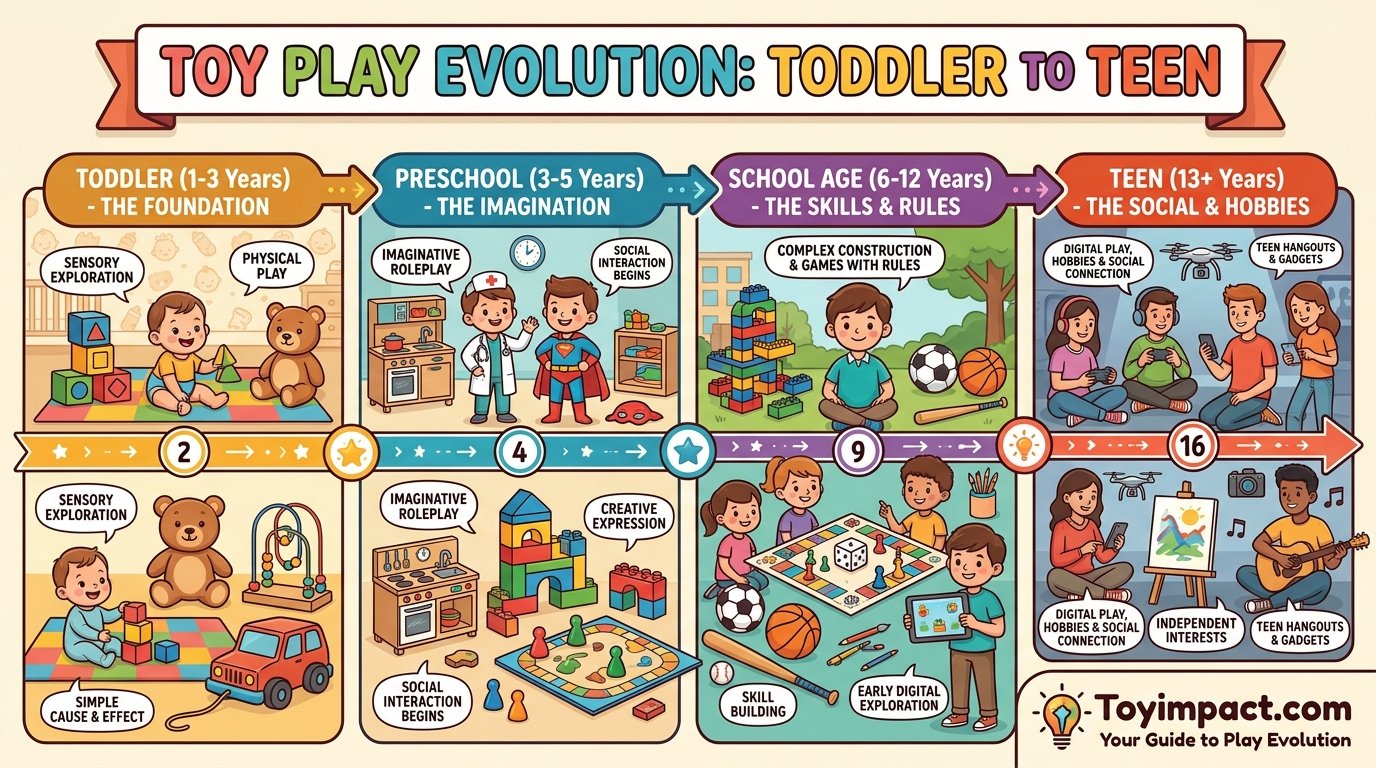
Child development researchers generally break play into overlapping stages rather than a strict age ladder. Each stage has its own toy preferences, attention span, and social component. Here’s a snapshot before we dig into each one individually.
| Age Range | Stage Name | Typical Toy Focus | Play Style |
|---|---|---|---|
| 1–3 | Sensorimotor / Toddler | Stacking, shape sorters, push toys | Solo, exploratory |
| 3–5 | Preschool | Dolls, action figures, blocks, pretend kitchens | Imaginative, parallel play |
| 6–8 | Early Elementary | LEGO-style building, board games, dress-up | Cooperative, rule-based |
| 9–12 | Tween | Collectibles, hobby kits, gaming consoles | Social, identity-driven |
| 13+ | Teen | Rare, novelty, or nostalgic items | Occasional, ironic or niche |
If you’re shopping for a specific age bracket right now, our toddler toy guide under $20 and our educational toys for 3-year-olds roundup are both built around these exact stages.
Toddlers (1–3): Toys Are Everything
At this age, toys aren’t optional entertainment — they’re the primary way toddlers make sense of the physical world. Stacking rings teach cause and effect. Push-and-pull toys build gross motor skills. Simple shape sorters lay the groundwork for problem-solving that shows up years later in math class.
This is also the stage where “outgrowing” a toy happens fastest, sometimes within weeks, simply because motor and cognitive skills are developing so quickly. A toy that felt like a genuine challenge in January might be mastered and abandoned by March.
Parent tip
Don’t rush to buy the next-stage toy the moment interest dips. Toddlers often circle back to “outgrown” toys weeks later once a new skill clicks into place.
It also helps to remember that toddler play is almost entirely body-driven rather than idea-driven. A toy that requires fine motor control a toddler doesn’t have yet will simply get tossed aside, not because the concept is boring but because the physical execution is frustrating. This is why the same toy can go from “ignored” to “favorite” in the span of a single month — the underlying interest was there the whole time, waiting on the motor skills to catch up.
Repetition is also a defining feature of this stage. Watching a toddler do the exact same stacking-and-knocking-down sequence for the fortieth time can feel tedious to an adult, but that repetition is doing real cognitive work — reinforcing object permanence, cause and effect, and predictive reasoning. Toys that support this kind of repeatable, low-stakes practice tend to be the ones toddlers reach for again and again.

Shop Toddler-Approved Toy Sets
Hand-picked stacking, shape-sorting, and push toys that match this exact developmental window.
Shop on AmazonPreschool (3–5): Imagination Peaks
Somewhere around age three, play changes shape entirely. Toddlers explore objects; preschoolers start telling stories with them. A wooden spoon becomes a microphone. A cardboard box becomes a spaceship. This is widely considered the golden age of imaginative, symbolic play, and it’s exactly the window where dolls, action figures, pretend kitchens, and dress-up costumes do the heaviest lifting.
Interest in any single toy tends to last longer here than in toddlerhood, because kids are now building ongoing narratives — a dollhouse family, a recurring dinosaur battle, a pretend restaurant that reopens every afternoon. If you’re building out a gift list for this age, our guide on introducing Montessori-style toys pairs well with this stage’s love of hands-on, open-ended play.
What tends to fade first
Simple cause-and-effect toys (light-up buttons, basic rattivity centers) are usually the first casualties of this stage, replaced by anything that supports pretend scenarios or open-ended building.
Language explosion also plays a huge role here. As vocabulary and sentence complexity grow, kids start narrating their play out loud, assigning voices and backstories to toys that previously had none. This is often the first time parents hear their child use complete, structured stories — “the dinosaur is sad because he lost his friend, so now he’s going to find him” — and it’s a genuine developmental milestone, not just cute chatter. Toys that support this kind of narrative flexibility (figures, animals, simple props) tend to stay in rotation far longer than single-function toys during this window, because the story keeps changing even when the toy itself doesn’t.
Social play also starts to emerge in a real way around age four, shifting from side-by-side “parallel play” toward genuine cooperative play, where two kids build a shared narrative together rather than just occupying the same space. This is part of why pretend kitchens, dress-up costumes, and dollhouses tend to hold appeal longer when there’s a sibling or regular playmate involved.
Early Elementary (6–8): The First Real Shift
This is where things start to get more nuanced. Kids in this bracket haven’t stopped playing with toys — far from it — but the toys themselves start to look different. Building sets get more complex. Board games with actual rules replace simple matching games. Dress-up play often shifts from “pretend family” to reenacting favorite shows or games.
You’ll also notice social play becoming much more important. A toy that was fun to use alone at age four might now only get pulled out when a friend is over, because the appeal has shifted from solo imagination to shared experience and competition.
| Toy Category | Typical Peak | Typical Decline |
|---|---|---|
| Stuffed animals | 3–6 | Gradual, often kept as comfort items past 10 |
| Action figures / dolls | 4–8 | 8–10 |
| Building sets (blocks/bricks) | 5–10 | Often continues into teens as a hobby |
| Board/card games | 6–12 | Rarely fully stops |
| Ride-on / outdoor toys | 2–7 | 7–9 |
| Pretend play sets (kitchens, tools) | 3–6 | 6–7 |
Reading skills also start reshaping what counts as “play” during this window. Instruction manuals for building sets stop being an obstacle and start being part of the fun. Rule booklets for board games go from something a parent reads aloud to something the child can reference independently, which opens the door to a much wider range of games than were accessible even a year earlier.
Long car rides are a great way to see this shift in real time — toys that hold attention for a two-hour drive at this age look very different from what worked at four. Our travel toy guide for long trips is built around exactly this age group’s changing attention span.
Tweens (9–12): The Great Toy Decline
If there’s one age range that answers “what age do kids stop playing with toys” most directly, it’s this one. Somewhere between fourth and sixth grade, most kids start prioritizing identity, social belonging, and independence over open-ended play. Traditional toy boxes get replaced — or at least supplemented — by hobbies that feel more grown-up: collectible card games, model kits, sports gear, art supplies, and gaming.
It’s worth noting this isn’t really a rejection of “play” itself. Tweens still play constantly — they just call it something else. A collectible card trading session, a LEGO Technic build, or a multiplayer video game session is functionally play, even if it doesn’t look like the toy aisle at Target.
Why this age specifically?
Middle school (or its equivalent) tends to be the tipping point because peer perception becomes a much bigger factor in identity than it was in elementary school. Kids become acutely aware of what’s considered “cool,” and traditional toys — especially anything associated with younger siblings or younger classmates — can start to feel embarrassing in front of friends, even when the child still privately enjoys them.
There’s also a psychological piece worth naming directly: tweens are actively constructing an identity, often for the first time in a conscious way, and hobbies become a tool for that construction in a way toys generally aren’t. A kid who says “I’m into card collecting” or “I’m really good at chess” is making a statement about who they are, not just what they do for fun. Traditional toys rarely carry that same identity-signaling weight, which is part of why they get deprioritized even when the underlying enjoyment hasn’t actually disappeared.
It’s common for this transition to happen unevenly across different toy categories rather than all at once. A tween might quietly retire dolls or action figures while simultaneously deepening their involvement in LEGO building, video games, or a specific sport — meaning the household “toy count” drops sharply even though the child’s overall engagement with hands-on, structured play hasn’t necessarily gone down at all.

Bridge the Gap With Hobby-Style Kits
Building sets, model kits, and STEM kits tend to hold tween attention far longer than traditional toys.
Shop on AmazonTeens (13+): Toys Rarely, Play Never
By the time most kids reach their teens, “toys” in the classic sense have largely been replaced by hobbies, technology, and social activities. That said, complete abandonment is rare and, frankly, not something to aim for. Many teens keep a handful of nostalgic items — a favorite stuffed animal, a display shelf of collectibles, a box of LEGO sets they still add to occasionally. Collecting, building, and even some forms of imaginative role-play (tabletop gaming, cosplay, fan fiction) are really just toy play wearing a teenage disguise.
Interestingly, a genuine resurgence of interest in “kid” hobbies sometimes shows up in later teen years, once social pressure around what’s considered age-appropriate loosens up a bit. It’s not unusual for a sixteen- or seventeen-year-old to rediscover a childhood building set or start a serious collectible hobby with far more disposable income and free time than they had as a tween, without any of the self-consciousness that shut the activity down a few years earlier.
What Actually Determines the Timing
Age is only one variable, and honestly not always the biggest one. If you compare two kids in the same classroom, born a month apart, it’s entirely possible for one to have packed away every toy while the other still has an active LEGO city on their bedroom floor. Here’s what tends to matter more than the calendar in practice.
1. Personality and temperament
Naturally imaginative, low-pressure kids often hold onto pretend and toy-based play longer than highly social, competition-driven kids, regardless of age. Kids who are more introverted or who process the world through storytelling tend to keep using toys as a thinking tool well past the point their more socially-driven peers have moved on, simply because the toy still serves a real purpose for them — it’s not just entertainment, it’s how they work through ideas and feelings.
2. Older siblings and peer group
A child with older siblings or older friends often “ages out” of toys earlier — not because they’ve outgrown the developmental need, but because they’re exposed to older interests sooner. This is sometimes called the “little sibling effect” among parenting researchers: younger kids absorb the interests, slang, and media of whoever is around them most, which can pull their entire developmental timeline forward by a year or two in terms of what feels age-appropriate to them.
3. Access to screens and gaming
Kids with early, unrestricted access to phones, tablets, or consoles frequently shift away from physical toys sooner than kids with more limited screen time. It’s worth noting this isn’t necessarily about screens being inherently more compelling — it’s often simply about time. A finite number of free hours exist in a day, and every hour spent on a screen is an hour not spent building, imagining, or manipulating physical objects.
4. School environment and culture
Schools (and even specific friend groups within a school) can create very different social pressure timelines around what’s considered “babyish.” A child who transfers schools or changes friend groups will sometimes report a noticeable shift in their own toy interests within a few months, purely as a result of adjusting to a new social environment’s unwritten rules about what’s cool.
5. Type of toy
Open-ended toys — building sets, art supplies, dress-up gear — tend to survive far longer than single-purpose toys with one obvious use, because kids can keep reinventing how they’re used. A single-function toy, like a talking plush with one built-in phrase, has a shelf life measured in weeks. A box of building bricks can realistically stay relevant for a decade because the play itself keeps evolving even when the pieces don’t.
6. Family culture and modeling
Households where parents, older siblings, or extended family actively engage in hobby-style play — model building, board games, puzzles — tend to see kids keep those categories of “toy” relevant much longer, since the activity is reinforced socially rather than treated as something to be outgrown.
Signs a Child Is Outgrowing a Toy
Clear signals
- The toy sits untouched for weeks, even during free play time
- They mention friends who “don’t play with that anymore”
- Play sessions get shorter and less engaged over several weeks
- They ask for the toy to be given to a younger sibling or cousin
- Interest shifts toward the toy’s “grown-up equivalent” (e.g., a real skateboard instead of a toy one)
Not real signals (don’t overreact)
- A single week of disinterest — could just be boredom or a new distraction
- Saying “I’m too old for this” once, out of frustration mid-task
- Preferring a screen for one afternoon
- Packing the toy away during a move or room reorganization
Do Boys and Girls Stop at Different Ages?
Broadly, research and parent-reported surveys suggest the overall timeline is similar for boys and girls — the tween years remain the biggest transition point for both. What tends to differ more is the type of toy that lingers rather than the age it disappears. Building and construction toys often stay relevant slightly longer for boys, while collectible and creative/craft toys often stay relevant slightly longer for girls — but these are broad tendencies, not rules, and plenty of kids break the pattern entirely. If you’re shopping for a specific child, our gift guide for 5-year-old girls is a useful example of how toy categories get tailored without leaning on stereotypes.
The Screen Time Effect
It’s tempting to blame screens entirely for kids “growing out” of toys early, and there’s some truth to it — but it’s more nuanced than a simple villain narrative. Screens compete for the same free-time slot that toy play used to fill, which can accelerate the transition. However, plenty of families successfully keep both in the mix by treating screen time as one option among several rather than the default.
The toys that tend to survive best in screen-heavy households are the ones with a strong hands-on, tactile element that a screen simply can’t replicate — building sets, art supplies, and physical games.
Siblings and Birth Order
Younger siblings almost always end up exposed to toys “early” simply by proximity to an older sibling’s interests, which can pull their own toy timeline forward. On the flip side, having a younger sibling around can actually extend an older child’s toy play, since younger kids often invite the older one back into pretend scenarios. If you have kids with a noticeable age gap, our guide to toys siblings can play with together is designed specifically to bridge that gap.
Transitional Toys That Bridge the Gap
Some toy categories are built to age with a child rather than being outgrown in one clean break. These are worth prioritizing if you want to extend the “toy years” naturally rather than forcing it.
- Building brick systems — sets scale in complexity from preschool through teens
- Collectible trading cards — the play evolves from simple collecting to strategic gameplay
- Puzzle and strategy board games — difficulty scales with age naturally
- Craft and model kits — shift from simple assembly to genuinely skilled hobbies
- Outdoor and water play equipment — stays social and active well into the tween years
For families with a backyard setup, our backyard water table guide shows how outdoor toys in particular tend to stretch across a wider age range than indoor ones.
What ties all of these categories together is that none of them have a single “correct” way to be used. A basic push-button toy has one outcome; a set of building bricks has essentially unlimited outcomes. The more possible outcomes a toy supports, the more room a growing brain has to keep finding it interesting, which is really the whole story behind why some toys get outgrown in a season and others get outgrown, if ever, over a decade.
How Culture and Household Values Shape the Timeline
It’s worth acknowledging that “what age kids stop playing with toys” isn’t a purely biological question — it’s shaped heavily by cultural expectations around childhood, media exposure, and even household finances. In households where toys are treated as ordinary, low-stakes items rather than status symbols, kids often feel less pressure to “graduate” from them quickly, since there’s no social currency attached to having moved on. In households or peer groups where owning the newest gadget or trend item carries more social weight, the pressure to abandon “childish” toys tends to arrive earlier.
Media exposure plays a role too. Kids who see older kids, teen influencers, or characters in shows aging out of toy play at a specific point sometimes internalize that as a benchmark, even if it doesn’t reflect their own actual interests. This is one more reason why comparing a child’s timeline to a sibling’s, a classmate’s, or a generic online milestone chart is often less useful than simply watching what your own child gravitates toward.

Toys That Actually Scale With Age
Building systems and strategy games are the closest thing to a “toy that never gets outgrown.”
Shop on AmazonHow to Extend Healthy Play (Without Forcing It)
What tends to work
- Rotating toys in and out of storage to renew interest
- Introducing open-ended toys instead of single-purpose ones
- Playing alongside your child instead of just supervising
- Letting kids modify or “level up” existing toys (custom builds, new rules)
- Connecting toy play to a genuine interest, like a movie or book series
What tends to backfire
- Insisting a toy is “too nice to get rid of” and pressuring continued play
- Comparing them to a sibling who “still loves” a toy
- Buying multiples of the same toy type hoping variety reignites interest
- Framing outgrowing toys as something to feel guilty about
A well-timed toy rotation schedule genuinely helps here — our toy rotation guide walks through practical timing for different age groups.
One underrated strategy is simply asking your child to teach you a game or a build rather than the other way around. Once kids feel like the expert in a play scenario — explaining the rules, showing off a technique, narrating what’s happening — engagement tends to jump noticeably, because the activity now carries a bit of social status and mastery on top of the original fun. This works especially well in the 8–11 range, right as tweens start caring more about competence and less about pure imagination for its own sake.
It’s also worth resisting the urge to buy an entirely new toy every time interest dips. Constant novelty can actually undermine deep engagement over time, training kids to expect a quick dopamine hit from something new rather than sticking with an existing toy long enough to get genuinely good at using it. A smaller, well-chosen toy collection that gets rotated and revisited tends to hold attention longer than an overflowing toy box where nothing gets much attention at all.
What to Do With Old Toys
Once it’s clear a toy has run its course, the goal is to clear the clutter without making the process feel like a loss — for you or for your child. A few practical paths, roughly in order of how much emotional weight they carry:
- Donate to a local shelter, daycare, or children’s hospital — a good option when the toy is in good condition but no longer a fit for your household
- Pass down to a younger sibling, cousin, or family friend — this one often feels the best to kids, since the toy stays “in the family” in some sense
- Sell gently used sets through local resale groups, consignment shops, or online marketplaces, especially for higher-value building sets or collectibles
- Rotate into storage for a few months before deciding for good — a surprising number of “outgrown” toys get a second wind once they’ve been out of sight long enough to feel novel again
- Keep a small “memory box” of one or two sentimental pieces instead of everything — this satisfies the emotional attachment without requiring you to store an entire toy collection indefinitely
One practical trick many parents use: let the child be part of the decision, even a small part. Asking “which of these would you want a younger kid to have” tends to go over far better than a parent quietly deciding and donating everything while the child is at school. It also gives kids some ownership over the transition rather than feeling like their childhood is being erased without consent.
If storage space is the real issue rather than actual disinterest, our small-space toy organization guide is worth a look before donating anything — sometimes a better system solves the problem without losing the toys at all.
Common Myths, Debunked
Myth: “Kids stop playing with toys the day they start middle school.”
Not accurate. The tween years are a gradual shift, not a switch that flips on the first day of sixth grade.
Myth: “If they still play with toys at 11, something’s wrong.”
Also not accurate. Plenty of perfectly typical 11- and 12-year-olds still enjoy building sets, dolls, or action figures, often alongside newer interests like gaming or sports.
Myth: “Boys stop earlier than girls.”
The overall age range is fairly similar between genders; what differs is usually the toy category, not the timeline.
Myth: “Screens are the only reason kids stop playing with toys.”
Screens are one factor among several — social pressure, personality, and toy type all matter just as much, sometimes more.
Myth: “There’s a right age to stop, and parents should aim for it.”
There isn’t a target age to aim for at all. Framing toy play as something to “graduate from” on a schedule tends to create more anxiety than it solves — for both kids and parents. The far more useful question isn’t “what age should this stop” but “is this still bringing genuine enjoyment,” which can be true at seven, eleven, or thirty-five.
Myth: “Once a toy is outgrown, it’s outgrown for good.”
Interest in specific toys is rarely permanent. Kids revisit old favorites surprisingly often, especially after a break, a move, or a stressful period where a familiar object provides comfort. Getting rid of everything the moment interest first dips can mean losing something a child genuinely wanted back a few months later.
When It’s Normal vs. When to Ask Questions
In the vast majority of cases, drifting away from toys is a completely normal, gradual part of growing up and nothing to worry about. That said, a sudden and complete loss of interest in all play — including social, physical, and imaginative activities, not just toys specifically — combined with withdrawal from friends or a drop in mood, is worth a conversation with a pediatrician or school counselor. The key distinction is scope: outgrowing toys is normal; losing interest in play and connection altogether is different and worth a second look.
It’s also worth separating “outgrowing toys” from “losing interest in play as a concept.” A child who has stopped playing with dolls but now spends hours building elaborate Minecraft worlds, choreographing dances, or organizing pickup basketball games is still playing — just in a different form. The form of play changes far more than the underlying need for it, which doesn’t really go away at any age.
For families supporting a child with different sensory needs, timelines can look a little different, and that’s completely okay. Development doesn’t follow a single script, and toy interest is no exception. Our sensory toy gift guide covers options that tend to stay engaging well beyond the “typical” toy years, precisely because they’re built around sensory needs rather than age brackets.
Frequently Asked Questions
What is the average age kids stop playing with toys?
Most research and parent surveys point to somewhere between 9 and 12 years old as the biggest transition window, though many kids keep some toy-based play going well beyond that in the form of hobbies and collectibles.
Is it normal for a 10-year-old to still play with toys?
Yes, completely normal. Ten is right in the middle of the typical transition window, and interest at this age often depends more on personality and toy type than on age alone.
Do kids stop playing with stuffed animals at a certain age?
Stuffed animals tend to hold on longer than most toy categories because of their comfort value. Many kids (and even teens) keep one or two well past the age they’ve stopped playing with other toys.
Why did my child suddenly stop playing with toys?
A sudden shift is often tied to a specific trigger — a new school year, new friend group, a sibling’s comments, or new access to a device or console — rather than age itself.
Should I get rid of toys my child doesn’t play with anymore?
It’s usually worth a short waiting period first — rotate the toy out of sight for a month or two before donating, since interest sometimes returns once the toy feels “new” again.
Do boys stop playing with toys earlier than girls?
Not dramatically. The overall age range is similar; the toy categories that stick around longest tend to differ more than the timing itself.
What toys last the longest before kids outgrow them?
Open-ended toys like building brick systems, art supplies, and strategy board games tend to scale with a child’s age instead of being outgrown outright.
Is playing video games instead of toys a bad sign?
Not inherently — for many tweens, gaming simply becomes the new form of play, complete with its own social and creative elements. Balance matters more than avoidance.
Can you encourage a child to keep playing with toys longer?
Yes, gently. Rotating toys, choosing open-ended options, and playing alongside your child all help extend interest naturally, without pressuring them.
At what age should I stop buying traditional toys as gifts?
There’s no strict cutoff — many tweens and even teens appreciate hobby-adjacent “toys” like building kits or collectibles well past the age they’ve stopped playing with toys in the traditional sense.
Do only children stop playing with toys at a different age than kids with siblings?
Only children sometimes hold onto imaginative solo play a bit longer, since they aren’t as exposed to an older sibling’s shifting interests, though this varies widely by personality.
What should I do with toys once my child has outgrown them?
Donating, passing down to a younger relative, or selling gently used sets are all good options — keeping one or two sentimental pieces in a memory box is a nice middle ground.
The Bottom Line
There’s no single age where toys switch off — it’s a gradual slope that usually steepens between 9 and 12, shaped far more by personality, siblings, screen access, and toy type than by a birthday on the calendar. The best approach isn’t chasing a deadline; it’s paying attention to what your specific child is telling you, through both words and behavior, and adjusting from there.
Browse Age-Appropriate Toys on Amazon





Pingback: What Are Quiet Time Toys? Parent's Complete Guide
Pingback: What Are Creative Toys? Guide to Imagination Play
Pingback: What Are Musical Toys? Complete Parent's Guide
Pingback: How to Clean Bath Toys: Mold-Free Bath Time Guide
Pingback: What Toys Have Button Batteries? Parent Safety Guide
Pingback: When Do Babies Start Playing With Toys? Month Guide