Best Ride-On Toys: The Ultimate Guide to Picking the Perfect One for Your Child
Tricycles, push cars, electric vehicles, bouncers, and everything in between — reviewed, compared, and ranked for real families.
Why Ride-On Toys Deserve a Spot in Every Playroom
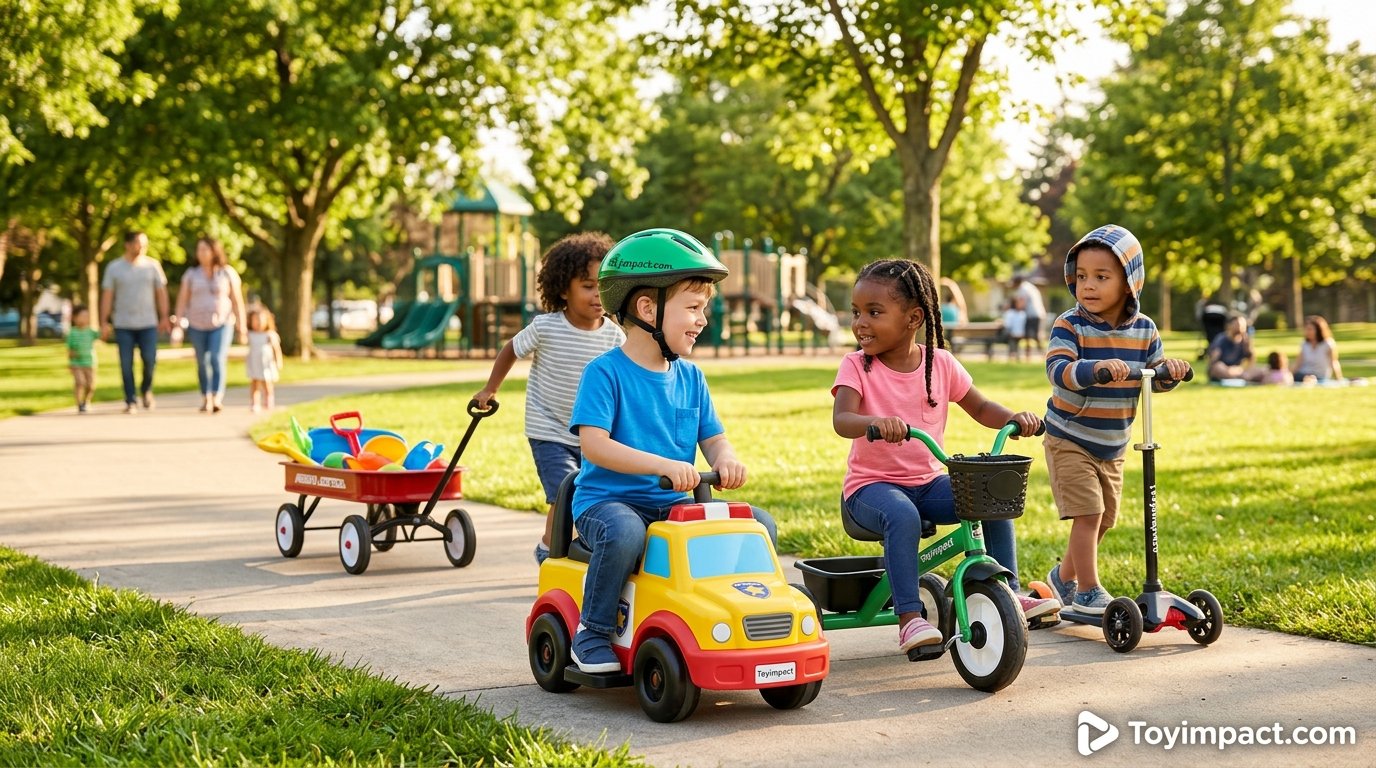
There is a moment — every parent has seen it — when a toddler first discovers that the thing beneath them moves. Maybe it is a plastic car they can scoot across the kitchen floor, maybe it is a tricycle wobbling down the sidewalk, maybe it is a bouncy hopper that sends them ricocheting off the couch cushions. Whatever the vehicle, the reaction is always the same: pure, electric joy. And behind that joy, something important is happening that goes far beyond simple fun.
Ride-on toys occupy a unique position in the landscape of children’s play. They are not passive objects to be stacked or sorted. They demand something from the child — balance, coordination, spatial judgment, decision-making — and they deliver something back in the form of movement, speed, and independence. A child on a ride-on toy is not just playing. They are learning to navigate a physical world that suddenly responds to what their body does.
The Physical Development Case
Consider what happens when a three-year-old climbs onto a tricycle for the first time. They have to coordinate their legs in a circular pedaling motion — something their body has literally never done before. They have to grip the handlebars with enough force to steer while maintaining the core stability to stay upright. They have to look where they are going and process obstacles in real time. Every single one of those tasks involves a different set of muscles and neural pathways, and the tricycle requires all of them simultaneously.
This is what developmental researchers call “whole-body integration,” and ride-on toys are one of the most effective ways to practice it during the preschool years. Gross motor skills — the big movements involving legs, arms, and torso — get an obvious workout. But the fine motor skills are just as engaged. Gripping handlebars, pressing foot pedals, squeezing a horn, pulling a parking brake: these small actions refine the hand strength and dexterity that children need for writing, buttoning coats, and using scissors later on.
Balance is perhaps the most underappreciated benefit. Ride-on toys that require the child to sit upright without a backrest — like scooters, balance bikes, and body-propelled vehicles — force constant micro-adjustments in posture. These adjustments train the vestibular system, which governs spatial orientation and is directly linked to reading readiness, attention, and classroom behavior in later years. In other words, the kid scooting around your living room on a PlasmaCar is building the same neurological infrastructure they will need to sit still in a chair and follow a lesson in school.
Cognitive and Emotional Growth
The cognitive benefits are less visible but equally real. Ride-on toys teach cause and effect in the most visceral way possible: push harder, go faster; turn the wheel, change direction; stop pedaling, slow down. For a toddler whose understanding of the world is still forming, these direct, immediate consequences are profoundly educational. The child is not being told how physics works. They are feeling it in their muscles.
There is also a significant confidence component. A child who masters a ride-on toy — who learns to steer around obstacles, stop at the edge of a patio, or pedal up a gentle slope — is building what psychologists call “self-efficacy”: the belief that they can accomplish something difficult through effort. This belief transfers. Children who develop physical confidence through ride-on play tend to approach new challenges in other domains — school, social situations, creative projects — with more willingness to try and more resilience when things go wrong.
If you are curious about how different types of play support overall development, our guide on how to introduce STEM toys to preschoolers explores how hands-on play builds the same kinds of problem-solving skills that ride-ons develop through physical movement.
The Outdoor Play Argument
In a world where screens compete for children’s attention from increasingly early ages, ride-on toys offer something screens cannot: fresh air, sunlight, and the sensory richness of the outdoors. A child on a ride-on toy outside is experiencing wind on their face, the texture of pavement versus grass, the sound of birds versus traffic, and the social dynamics of encountering other kids on the sidewalk or at the park. These are multi-sensory experiences that no app can replicate.
And ride-on toys are not limited to sidewalks and driveways. If your family spends time in the backyard, pairing a ride-on with other outdoor play options — like water table toys for the backyard — creates a full outdoor play station that can keep children engaged for hours. On days when outdoor play is not possible, smaller ride-on toys like the PlasmaCar or certain indoor-safe push cars can bring the same physical benefits into a playroom or basement.
What About Long Car Rides and Travel?
While ride-on toys are fantastic for active play at home, they are obviously not portable travel companions. For families who spend a lot of time in the car, pairing a ride-on toy at home with great toys for car rides and long trips ensures your child gets the physical activity they need at home and the mental stimulation they need on the road. The two categories complement each other perfectly: ride-ons tire children out physically, and travel toys keep them calm and engaged during the quieter, seated moments.
A Toy That Grows With Your Child
One of the most compelling things about ride-on toys is their longevity. A quality tricycle, push car, or bouncy hopper is not a one-season toy. The best ride-on toys can be introduced at one age, used in a completely different way at another, and still hold appeal months or even years later. A Cozy Coupe that starts as a parent-pushed stroller alternative for a 12-month-old becomes a self-propelled vehicle for a two-year-old and eventually a prop for imaginative play as a four-year-old “drives” to the grocery store in their bedroom. That kind of multi-year play value is rare in any toy category.
For families wondering when children naturally outgrow certain types of play, our article on what age kids stop playing with toys offers helpful perspective. The short answer: most children continue to benefit from ride-on toys well into their early school years, and the physical skills they develop along the way stay with them permanently.

Radio Flyer Classic Red Tricycle
The timeless steel-frame tricycle with an adjustable seat — built to last from ages 2 through 5 and beyond.
View on AmazonHow to Choose the Perfect Ride-On Toy: A Complete Buyer’s Guide
Walk into any toy store or browse any online retailer, and the sheer number of ride-on options can be paralyzing. Electric cars with Bluetooth speakers, vintage-style tricycles, character-themed push cars, inflatable bouncers, and everything in between — all promising to be the “best” choice for your child. The reality is that the best ride-on toy depends almost entirely on your child’s age, your living situation, and what kind of play you want to encourage. Here is a framework for thinking through the decision.
Age Appropriateness: Getting the Timing Right
The single most important factor in choosing a ride-on toy is matching it to your child’s current developmental stage. A toy that is too advanced will frustrate and possibly endanger your child. A toy that is too simple will bore them within days. Here is the rough breakdown:
- 10–18 months: Sit-in push cars with parental handles and low-profile scooters where the child’s feet reach the ground. At this age, the child needs full support and controls direction through foot-steering, not handlebars.
- 18 months – 2.5 years: Foot-to-floor ride-ons (like the Cozy Coupe), simple push-along tricycles with parental handles, and bouncy toys. Children at this age have the leg strength to propel themselves but lack the coordination for pedals.
- 2.5 – 4 years: Pedal tricycles, body-propelled vehicles like the PlasmaCar, and low-power electric ride-ons with parental remote controls. This is the golden age for ride-on toys, when most children have the motor skills to operate them independently.
- 4 – 6 years: Higher-power electric vehicles, balance bikes, two-seater ride-ons for social play, and more complex vehicles with working features like excavation arms or trailers.
Understanding developmental stages can also help when choosing complementary toys. If your child is in the preschool years, our guide on the best age to introduce Montessori toys explains how sensitive periods influence what kinds of toys resonate at each stage — a principle that applies to ride-on selection just as much as it does to educational materials.
Manual vs. Electric: Which Approach to Movement?
This is one of the first decisions most parents face, and the answer is not as obvious as it seems. Manual ride-on toys — tricycles, push cars, scooters, bouncers — require the child to supply the power. This is enormously beneficial for physical development, as it builds leg strength, cardiovascular endurance, and coordination. It also gives the child full control over speed and direction, which is both empowering and safer in most situations.
Electric ride-ons introduce a different kind of learning: understanding how machines work, managing speed with a throttle, and — when they include parental remote control — learning to share control with another person. Electric vehicles also tend to hold the attention of older toddlers and preschoolers who may have outgrown the novelty of foot-powered toys. The downside is battery management, higher price points, and the fact that the child is doing less physical work.
For most families, the ideal collection includes at least one of each type. A manual ride-on for everyday outdoor play and physical development, and an electric vehicle for special occasions and extended driveway sessions.
Indoor vs. Outdoor Use
Not all ride-on toys work well in all environments. Large electric vehicles with wide turning radii need driveway or patio space. Tricycles are best on flat, paved surfaces. But some ride-on toys — the PlasmaCar on hard floors, a bouncy hopper in a carpeted playroom, a small foot-to-floor car in a hallway — work beautifully indoors.
Before buying, think about where the toy will be used most often. If you live in an apartment without outdoor space, prioritize indoor-friendly options with rubber wheels that will not scratch hardwood floors. If you have a large backyard or live on a quiet street, bigger outdoor vehicles make more sense. And if you need to store the toy in a small space between uses, our tips on how to organize toy storage in small spaces can help you find room even in a cramped closet or entryway.
Safety Features to Look For
Safety should never be an afterthought with ride-on toys. Here are the features that matter most:
- Stable wheelbase: Wide-set wheels dramatically reduce the risk of tipping, especially on turns and uneven surfaces.
- Low center of gravity: The lower the seat, the more stable the ride. High seats on narrow bases are a recipe for falls.
- Parental speed control: On electric vehicles, look for models with at least two speed settings and a parental remote that can override the child’s throttle.
- Seat belts and doors: Electric ride-ons with opening doors and lap belts offer an extra layer of security, especially for younger children.
- Non-toxic materials: Verify that the toy is free from BPA, phthalates, and lead. Reputable brands are generally compliant, but it is worth checking.
- Weight capacity: Do not just check the minimum age — look at the maximum weight rating. A toy that is rated for up to 50 pounds will not safely support a 60-pound five-year-old.
Budget Considerations
Ride-on toys span a remarkable price range, from under $20 for a simple bouncy hopper to several hundred dollars for a licensed electric vehicle with all the bells and whistles. The good news is that price does not always correlate with play value. A $25 PlasmaCar can deliver years of daily play, while a $300 electric Mercedes might lose its novelty after a few weeks if the child does not enjoy the “driving” experience.
Our general advice: start with one affordable, high-quality manual ride-on toy in the $25–$75 range. See how your child responds. If they are clearly enthusiastic about wheeled play, you can add an electric vehicle or specialty ride-on later. There is no need to make a big investment before you know whether your child will actually use it. For budget-conscious parents, we also have a roundup of the best toys under $20 for toddlers that includes several ride-on-adjacent options.
Storage, Assembly, and Longevity
Some ride-on toys arrive ready to play. Others require 45 minutes of assembly with an Allen wrench and a prayer. If assembly is a concern, check reviews specifically for comments about setup difficulty. Also consider the toy’s footprint when not in use. A full-size electric car takes up serious garage space, while a folding tricycle or compact hopper tucks away easily.
Longevity — both in terms of physical durability and play interest — varies widely. Steel-frame tricycles and thick plastic push cars can survive years of rough use and be handed down to siblings. Lighter plastic vehicles and character-themed toys may crack or fade. Think about whether this is a toy for one child through one phase, or an investment you want to last through multiple children and multiple years.

Little Tikes Cozy Coupe
The iconic toddler car that has been a backyard and living room staple for decades — now available in the Cloud Collection edition.
View on AmazonRadio Flyer Classic Red Tricycle: The Timeless Classic

There is a reason the Radio Flyer Classic Red Tricycle has been a fixture on American sidewalks, driveways, and patios for generations. It is not flashy. It does not have Bluetooth speakers or LED headlights or a working FM radio. What it has is a steel frame that can survive being dropped off a porch, an adjustable seat that accommodates a growing child from roughly age two to five, and the kind of deep, glossy red finish that photographs beautifully and still looks good after years of scuffs and weather exposure.
This is a tricycle that takes the fundamentals seriously. The 12-inch front wheel is spoked and solid, providing a smooth ride on pavement and a stable base on slightly uneven surfaces. The rear wheels are set wide enough to prevent tipping during turns, which is a critical feature for younger riders who are still learning how much lean a turn requires. The handlebars have genuine rubber grips that small hands can hold comfortably without slipping, and the seat is contoured and adjustable — sliding forward and backward on the frame to accommodate legs of different lengths.
What Makes It Stand Out
The steel construction is the headline feature, and it matters more than you might think. Plastic tricycles are lighter, which sounds like an advantage until you realize that light weight also means easy tipping. The Radio Flyer’s steel frame gives it enough heft to feel planted and stable, especially on outdoor terrain. It also means the frame will not crack, warp, or fade the way cheaper plastic alternatives do. Parents who bought this tricycle for their first child regularly report that it was still in excellent condition when their second or third child was ready for it.
The controlled turning radius is another thoughtful design choice. The handlebars are engineered to prevent sharp turns that could cause the tricycle to tip over. This is one of those features that you might not notice until your child attempts a panicked swerve to avoid a puddle or a sibling, and the tricycle gently limits the turn rather than dumping the rider on the pavement.
Features at a Glance
- Steel frame with a durable red powder-coated finish
- 12-inch front wheel with real spokes and a solid rubber tire
- Adjustable seat (slides forward and backward on the frame)
- Controlled turning radius to prevent tipping
- Rubber handlebar grips for secure hold
- Wide-set rear wheels for stability
- Step-through frame design for easy mounting and dismounting
- Recommended age range: 2 to 5 years
- Weight capacity: approximately 49 pounds
Pros and Cons
Pros
- Exceptionally durable steel frame that lasts for years
- Timeless, classic design that never looks dated
- Controlled steering radius adds a real safety benefit
- Adjustable seat extends the usable age range significantly
- Stable wide-wheelbase design appropriate for beginners
- Resale value holds well — these tricycles are easy to pass along
Cons
- Heavier than plastic alternatives, which can be harder for very small toddlers to manage independently
- No storage basket on the base model (a separate accessory is available)
- Metal frame can get hot in direct sunlight during summer
- Limited to paved or hard-packed surfaces — does not handle grass or gravel well
- Assembly requires some patience and a screwdriver
Who It’s Best For
The Radio Flyer Classic Red Tricycle is the ideal first tricycle for a child between the ages of two and three who is ready to learn pedaling but still needs the stability and support that a traditional three-wheel design provides. It is also an excellent hand-me-down candidate — if you are buying for your first child and planning more, this is the kind of toy that will survive the journey. Families who value durability and simplicity over features and flash will appreciate this tricycle’s no-nonsense approach.
For parents who are also considering non-ride-on educational toys for this age group, the best educational toys for a 3-year-old boy guide includes several options that pair well with a tricycle for a balanced play diet of physical and cognitive activities.
Radio Flyer Classic Red Tricycle
Steel frame, adjustable seat, controlled turning radius — the ride-on classic built to outlast childhood.
View on AmazonLittle Tikes Cozy Coupe: The Iconic Toddler Mobile

If ride-on toys had a hall of fame, the Little Tikes Cozy Coupe would be in the first exhibit. This squat, cheerful, bright-red-and-yellow car has been a childhood staple since it debuted, and its enduring popularity is no accident. The Cozy Coupe does something very few toys manage to do: it works beautifully for an enormous range of ages, from a 12-month-old whose parent pushes it like a stroller to a four-year-old who “drives” it independently around the backyard, narrating an elaborate road trip to the grocery store.
The basic design is deceptively clever. The child sits inside the car with their feet flat on the ground, Flintstone-style, and propels themselves forward by walking or running while seated. For younger toddlers who lack the coordination for this, the floorboard can be left in place (creating a flat base for the feet), and a parent handle attaches to the back for push-along use. As the child grows, the floorboard is removed, allowing full foot-to-floor propulsion. This two-stage design means the Cozy Coupe has a usable age range that far exceeds most ride-on toys.
The Cloud Collection Update
Little Tikes has released several special editions of the Cozy Coupe over the years, and the Cloud Collection version is one of the most visually appealing. It features a softer, more contemporary color palette that trades the classic primary colors for pastels and muted tones. The underlying mechanics and build quality remain identical — same sturdy plastic, same door design, same parent handle — but the aesthetic update makes it a more attractive presence in a living room or playroom for parents who care about how toys look in their home.
If the visual cohesion of your child’s toy collection matters to you — and there is nothing wrong with that — the Cloud Collection version offers the same legendary functionality without the visual intensity of the original red-and-yellow colorway.
Features at a Glance
- Durable, UV-resistant plastic body
- Removable floorboard for two-stage use (parent-push or child-powered)
- Opening and closing door with a child-safe latch
- Working horn (mechanical, not electronic)
- Cup holder and dashboard storage area
- High seat back for support
- Parent push handle included (removable)
- Available in classic red/yellow and Cloud Collection pastel editions
- Recommended age: 18 months to 5 years
- Weight capacity: 50 pounds
Pros and Cons
Pros
- Exceptionally long usable age range due to the two-stage design
- Thick, durable plastic that resists cracking, fading, and weather damage
- Works on grass, pavement, sidewalks, and even carpet (with effort)
- No batteries, no charging, no electronic components to break
- Imaginative play potential is enormous — it becomes whatever the child wants
- Easy to clean with a hose or damp cloth
Cons
- Large footprint can be a storage challenge in small apartments
- The plastic wheels can be noisy on hard floors
- Parent handle is helpful but not height-adjustable for tall parents
- Door hinge can wear down after years of heavy use
- No suspension or shock absorption — bumpy on rough terrain
Who It’s Best For
The Cozy Coupe is the perfect ride-on toy for families who want one vehicle that will serve their child from late infancy through the preschool years. It is especially good for children who enjoy imaginative play — the “driving” scenario is endlessly adaptable and keeps kids engaged long after the novelty of the physical movement wears off. If you are buying a single ride-on toy and want maximum versatility and longevity, the Cozy Coupe is hard to beat.
Parents who prioritize natural materials might also explore our guide to the best wooden toys, which offers an alternative philosophy of toy design. While the Cozy Coupe is firmly in the plastic camp, wooden ride-on options exist for families who prefer that aesthetic and feel.
Little Tikes Cozy Coupe
The legendary toddler car — now in the Cloud Collection edition. Two-stage design grows from push-along to independent driving.
View on AmazonPower Wheels-Style 24V Electric Ride-On Car: The Full Experience

There is a category of ride-on toy that exists at the intersection of toy and vehicle, and the 24-volt electric ride-on car is its flagship. These are the battery-powered, two-motor, Bluetooth-equipped, parental-remote-controlled mini-cars that look like shrunk-down versions of real vehicles. They have working headlights, horn sounds, startup jingles, opening doors with actual latches, and — in the most feature-rich models — leather-style seats, MP3/Bluetooth audio input, spring suspension, and rubber tires. For a child between three and six, climbing into one of these and pressing the accelerator is the closest thing to driving a real car, and the thrill is undeniable.
The “24V” designation refers to the battery system, and it matters. Lower-voltage models (6V and 12V) are designed for younger children on flat surfaces and typically top out at 2–3 miles per hour. A 24V system provides noticeably more power, allowing the vehicle to handle grass, slight inclines, and rougher terrain while maintaining speeds of 4–6 miles per hour. That speed range is fast enough to feel exciting for a preschooler but slow enough for a parent walking alongside to maintain control. Dual motors (one for each rear wheel) ensure consistent power delivery and improve traction on uneven ground.
Parental Remote Control: The Real Game-Changer
The most important feature on these vehicles is not the Bluetooth speaker or the LED dashboard — it is the parental remote control. This handheld transmitter allows a parent to steer the car, accelerate, and brake from a distance of up to 50–100 feet (depending on the model). For younger children who are still developing the coordination to steer and accelerate simultaneously, the remote provides a safety net. The child can feel like they are driving while the parent prevents them from steering into a fence, a flower bed, or a parked car.
As the child’s skills develop, the remote can be used less and less until the child is driving independently. This graduated approach to autonomy is one of the things that makes electric ride-ons genuinely educational — the child is not just learning to operate a vehicle, they are learning to manage a machine with real consequences (bumping into things, running out of battery) in a controlled environment.
Features at a Glance
- 24V battery system with dual motors for improved power and traction
- Parental remote control with forward, reverse, left, and right commands
- Two speed settings: low (approximately 3 mph) and high (approximately 5–6 mph)
- Lockable doors with child-safe latches
- Built-in seat belt (lap style)
- Bluetooth audio and/or AUX input with built-in speakers
- Working LED headlights and dashboard lights
- Spring suspension (on premium models) for a smoother ride
- USB and SD card input for music playback
- Recommended age: 3 to 7 years
- Weight capacity: typically 66–130 pounds (varies by model)
Pros and Cons
Pros
- Parental remote control allows safe, graduated independence
- Powerful enough to handle grass, gravel, and gentle slopes
- Realistic features create a deeply immersive play experience
- Two-seater models available for social/sibling play
- Long play sessions — a full charge typically lasts 1–2 hours
- Bluetooth audio keeps older kids engaged with their favorite music
Cons
- Battery requires regular charging (6–12 hours for a full charge)
- Heavy — typically 40–70 pounds, making transport and storage challenging
- Higher price point than manual ride-on toys
- Electronic components can fail over time, especially in wet conditions
- Replacement batteries and motors can be difficult to source
- Takes up significant storage space
Who It’s Best For
The 24V electric ride-on is the ideal choice for a preschooler or kindergartner who has already outgrown foot-powered ride-ons and craves something more exciting. It is also a great option for families who want a shared activity — the parental remote means you are not just supervising, you are actively participating in the play. Two-seater models are particularly valuable for families with siblings close in age, as they turn driving into a social activity rather than a solitary one. For families considering how sibling play dynamics work with toys, our guide to the best toys for siblings to play together explores this topic in depth.

24V Electric Ride-On Car with Parental Remote
Dual motors, Bluetooth audio, seat belts, lockable doors — the “real driving” experience for preschoolers and up.
View on AmazonPlasmaCar: The Magic of Body-Powered Motion

The PlasmaCar is one of those toys that looks too simple to work and then works so well that you cannot figure out how it is possible. There are no pedals, no batteries, no gears, no chains, no motor. The child sits on the wide, low-slung seat, places their feet on the footrests, and turns the steering wheel back and forth. That is it. And somehow, impossibly, the car moves forward — smoothly, quietly, and at a speed that increases the faster the child wiggles the wheel.
The secret is a clever application of centrifugal force and friction. The steering wheel is connected to a series of wheels beneath the car, and the side-to-side rotation transfers energy into forward motion. It is genuinely physics in action — and for a child, it feels like magic. The learning curve is remarkably short. Most children figure out the basic wiggle-and-go motion within minutes, and within a few sessions, they are zooming around corners and weaving through obstacle courses they have built from couch cushions and cardboard boxes.
Indoor and Outdoor Versatility
One of the PlasmaCar’s greatest strengths is its adaptability across environments. On smooth indoor surfaces — hardwood, tile, laminate, polished concrete — it glides almost silently, making it one of the few ride-on toys that is genuinely apartment-friendly. There are no rubber tire marks on the floor, no motor noise to disturb neighbors, and no pedals to bang into furniture legs. The car’s low profile also means the child’s center of gravity is close to the ground, reducing the risk of tipping even during enthusiastic cornering.
Outside, the PlasmaCar works best on smooth pavement, driveways, and sidewalks. It does not handle grass, gravel, or rough terrain well — the small front wheels tend to snag on uneven surfaces. But on its preferred terrain, it is delightful. The lack of noise means children can play on it early in the morning without disturbing the neighborhood, and the absence of batteries means there is never a charging delay between play sessions.
Features at a Glance
- No batteries, pedals, gears, or motor — entirely body-powered
- Steering wheel-driven forward motion through centrifugal force
- Wide, low-slung seat for stability and comfort
- Smooth, quiet operation on hard surfaces
- Durable ABS plastic construction
- Available in multiple colors
- No assembly required beyond attaching the wheels
- Recommended age: 3 years and up (some children as young as 2 can use it)
- Weight capacity: up to 220 pounds (adults can ride it too)
Pros and Cons
Pros
- Zero maintenance — no batteries to charge, no chains to oil, no motors to burn out
- Extremely quiet, making it ideal for indoor use and apartments
- Enormous weight capacity means it grows with the child (and parents can try it too)
- Teaches physics concepts through intuitive, physical experience
- Lightweight and easy to carry between rooms or to the car
- Exceptional value for the amount of play it delivers
Cons
- Does not work on grass, carpet (with deep pile), or rough outdoor terrain
- The steering mechanism can feel stiff when new and requires a break-in period
- Hard plastic wheels can be loud on some outdoor surfaces
- No backrest — younger children may tire of sitting upright without support
- Limited aesthetic appeal compared to character-themed ride-ons
The Sensory and Coordination Connection
While the PlasmaCar is not marketed as a sensory toy, it has genuine sensory benefits. The rhythmic side-to-side motion of the steering wheel provides vestibular and proprioceptive input — the same kinds of input that occupational therapists recommend for children who seek movement-based stimulation. The predictable, repetitive motion can be calming for children who are overwhelmed or overstimulated, and the cause-and-effect nature of the ride helps build body awareness.
For families who have children with sensory processing differences or are on the autism spectrum, the PlasmaCar’s quiet operation, predictable movement, and lack of electronic stimulation make it an excellent choice. Our sensory toys for autism gift guide explores other toys that provide similar kinds of sensory input for children who benefit from movement-based play.
Who It’s Best For
The PlasmaCar is the best ride-on toy for families living in apartments or homes with hard flooring, parents who want a zero-maintenance ride-on that never needs charging, and children who enjoy speed and movement but find pedals or electric controls frustrating. It is also an excellent “second ride-on” — a complement to a tricycle or push car that fills a different niche in the child’s play repertoire.

PlasmaCar — No Batteries, No Pedals, All Fun
Body-powered, whisper-quiet, and rated for up to 220 lbs. The physics-defying ride-on that works indoors and out.
View on Amazon3-in-1 Ride-On with 17 Sensory Activities: The Grow-With-Me Pick

For parents who hate buying a toy that their child will outgrow in six months, the 3-in-1 ride-on with sensory activities is a revelation. This category of toy — typically designed for children from about 12 months to 3 years — transforms through three distinct configurations as the child develops. It starts as a parent-guided push walker, converts to a sit-and-ride scoot toy, and eventually becomes a standalone ride-on that the child propels independently. The “17 sensory activities” are integrated into the dashboard, sides, and under-seat area, offering additional play value during rest breaks and stationary play.
The three-stage design addresses one of the biggest frustrations in toy shopping: the gap between what a child can do now and what they will be able to do in a year. At 12 months, many toddlers can stand and cruise but cannot steer or pedal. The push walker mode meets them where they are, letting them hold on and walk behind the toy while a parent controls the speed and direction. By 18–20 months, most children are ready to sit on the seat and scoot with their feet, using the handlebars for balance. By age two or two-and-a-half, they are fully independent riders.
The Sensory Activities
The integrated sensory panels are more than just busywork — they are thoughtfully designed to develop fine motor skills and cognitive connections. Typical activities include spinning gears, sliding beads along a wire track, turning pages in a tiny book, pressing buttons that produce clicking or rattling sounds, and flipping switches that reveal hidden images. These activities serve a dual purpose: they keep the child engaged with the toy during non-riding moments, and they develop the same hand-eye coordination and cause-and-effect understanding that the riding component develops for gross motor skills.
The under-seat storage compartment is a surprisingly practical feature. Toddlers love putting things in containers and taking them out again — it is one of the defining activities of the 12-to-24-month age range — and the storage bin satisfies this impulse while giving the child a sense of ownership over their toy. They can carry a small stuffed animal, a snack cup, or a favorite small toy along for the ride.
Features at a Glance
- Three modes: parent-push walker, sit-and-scoot, independent ride-on
- 17 integrated sensory activities on dashboard and body panels
- Under-seat storage compartment
- Removable parent push handle with height adjustment
- Safety bumper on the front to prevent wall damage
- Wide wheelbase for stability
- Non-toxic, BPA-free plastic construction
- Recommended age: 12 months to 3 years
- Weight capacity: typically 44–55 pounds
Pros and Cons
Pros
- Three distinct modes of use extend the product’s lifespan significantly
- Sensory activities provide standalone play value beyond riding
- Smooth transition between modes — no tools required for conversion
- Under-seat storage adds imaginative and practical play value
- Designed specifically for the youngest riders (12+ months)
- Encourages both fine motor and gross motor development simultaneously
Cons
- Lower weight capacity means older or larger toddlers may outgrow it sooner
- Sensory panels are made of thinner plastic than the main body and may wear faster
- Lacks the longevity of the Cozy Coupe, which extends to age 5
- Some sensory activities are louder than expected — could be distracting during quiet time
- Not suitable for outdoor use on rough terrain; best on smooth surfaces
Who It’s Best For
This is the ideal ride-on toy for families with a child under 18 months who wants to get started with ride-on play early. The push walker mode provides a safe, supported entry point, and the gradual progression through the three stages mirrors the child’s natural motor development beautifully. It is also a smart choice for gift-givers who want a present that will hold the child’s interest for more than a few weeks — the evolving modes of play keep the toy fresh as the child grows.
Parents interested in the developmental philosophy behind matching toys to sensitive periods will find our article on the best age to introduce Montessori toys to be a helpful companion read. The same principle of meeting the child where they are and growing with them is at the heart of both approaches.

3-in-1 Ride-On with 17 Sensory Activities
Push walker, scooter, and ride-on in one — with 17 built-in sensory activities and under-seat storage for the youngest riders.
View on AmazonConstruction & Farm Favorites: Play22 Excavator and John Deere Tractor

Not every child wants a sports car. Some kids want to dig. Some kids want to plow. And for those children, two ride-on toys stand out as particularly compelling options: the Play22 Ride-On Excavator and the John Deere Ride-On Tractor. Both tap into the fascination that many toddlers and preschoolers have with heavy machinery and farm equipment, but they do so in very different ways and at very different price points.
Play22 Ride-On Excavator
The Play22 Ride-On Excavator is a sit-and-scoot toy with a working digging arm. The child sits on the main body, scoots around using their feet, and operates a real (plastic) excavation arm with handles. The arm can scoop up lightweight objects — sand, small balls, stuffed animals, leaves — and dump them elsewhere. For a child who is fascinated by construction sites, this is pure gold. They are not just riding around; they are doing a job.
The working arm is the defining feature and the main reason this toy has such strong play value. It transforms the ride-on experience from simple locomotion into a task-oriented activity. The child is not just going somewhere — they are going somewhere to dig something up and move it. This goal-directed play is enormously valuable for cognitive development, as it introduces planning, sequencing, and problem-solving into what would otherwise be purely physical play.
Play22 Excavator Features
- Sit-and-scoot ride-on base with wide, stable wheelbase
- Working excavation arm with dual-handle operation
- Rotating seat allows the child to face the digging direction
- Durable plastic construction designed for indoor and outdoor use
- No batteries or assembly required beyond attaching the arm
- Recommended age: 3 to 6 years
- Weight capacity: approximately 66 pounds
Play22 Pros
- Unique working arm adds enormous imaginative play value
- Rotating seat is a clever feature that few ride-on toys offer
- Encourages goal-directed, task-oriented play
- No batteries, no charging, minimal maintenance
- Affordable price point relative to play value
Play22 Cons
- The arm mechanism can stiffen over time without occasional lubrication
- Limited to flat surfaces — the small wheels do not handle terrain well
- The rotating seat, while fun, can pinch small fingers if used carelessly
- Plastic construction, while durable, is not as robust as metal-framed alternatives
John Deere Ride-On Tractor
The John Deere Ride-On Tractor takes a different approach to themed ride-on play. Instead of a working mechanical feature, it focuses on the iconic farm aesthetic and a straightforward, reliable riding experience. The child sits on the tractor-style seat, grips the wide steering wheel, and pedals with their feet. The John Deere green-and-yellow color scheme and branding are instantly recognizable to any child who has seen farm equipment, and the overall design has a chunky, sturdy feel that inspires confidence.
Where this tractor really shines is in its assembly simplicity and price point. Parents consistently report that it takes less than 15 minutes to assemble out of the box, with no tools beyond the included wrench. At its typical retail price, it sits comfortably in the “impulse buy” range — affordable enough that you do not need to agonize over the decision, but well-built enough that you will not regret the purchase.
John Deere Tractor Features
- Authentic John Deere green-and-yellow color scheme and branding
- Wide tractor-style seat for comfort during extended play
- Foot-to-floor pedaling motion
- Large, chunky steering wheel sized for small hands
- Durable plastic construction with UV-resistant finish
- Easy assembly — typically under 15 minutes
- Recommended age: 18 months to 3 years (older children may find it too small)
- Weight capacity: approximately 50 pounds
John Deere Pros
- Very easy assembly — parents love this
- Budget-friendly without feeling cheap
- Iconic design that farm-loving kids adore
- Wide seat and low center of gravity make it very stable
- Works on grass, pavement, and hard-packed dirt
John Deere Cons
- Younger age range — most children outgrow it by age 3
- No working features beyond basic riding and steering
- Plastic tires can be slippery on smooth indoor floors
- Simple design may not hold the interest of children who prefer complex toys
Which One Should You Choose?
| Feature | Play22 Excavator | John Deere Tractor |
|---|---|---|
| Age Range | 3–6 years | 18 months – 3 years |
| Working Features | Rotating seat + digging arm | Basic steering only |
| Propulsion | Foot scoot | Foot pedal |
| Indoor Friendly | Yes (smooth floors) | Yes, but tires can slip |
| Assembly | Minimal | Under 15 minutes |
| Best For | Construction-obsessed kids who want a task | Farm fans who want a simple, sturdy ride |
Choose the Play22 Excavator if your child is three or older and gravitates toward construction play, building, and digging. Choose the John Deere Tractor if you are buying for a younger toddler (18 months to 2.5 years) who loves farm themes and needs a simple, stable first ride-on. Both are excellent values for what they deliver.

Play22 Ride-On Excavator
Sit-and-scoot with a working digging arm and rotating seat — construction play that moves.
View on Amazon
John Deere Ride-On Tractor
Budget-friendly, easy assembly, authentic farm styling — the perfect first ride-on for tractor-loving toddlers.
View on AmazonPremium & Licensed Picks: Spider-Man ATV, Mercedes-Benz, and Bluey Hopper

Sometimes a ride-on toy is more than a vehicle — it is a statement. A Spider-Man fan who climbs onto an ATV bearing their hero’s likeness is not just riding around the yard. They are Spider-Man, patrolling the neighborhood. A child who buckles into a Mercedes-Benz two-seater convertible is not just playing. They are going on a road trip with their best friend, their sibling, or their favorite stuffed animal riding shotgun. And a toddler bouncing on a Bluey hopper is not just exercising. They are Bluey, bouncing through a playroom adventure.
Licensed and premium ride-on toys tap into the emotional and imaginative investment that children have in characters and brands, and when done well, that emotional connection translates into dramatically higher play engagement. Here are three picks that represent different approaches to the premium ride-on experience.
Spider-Man ATV-Style Ride-On
The Spider-Man ATV-style ride-on is a single-seater, foot-to-floor vehicle styled in the red, blue, and black of Marvel’s iconic web-slinger. The design is unmistakably Spider-Man — web patterns on the body panels, Spider-Man graphics on the seat, and character-themed details that fans will instantly recognize. The ATV format (as opposed to a car or truck) gives it a slightly sportier, more rugged look that appeals to children who imagine themselves on action-packed missions.
Functionally, it is a straightforward foot-to-floor ride-on: the child sits, steers, and propels with their feet. The wheels are wide-set for stability, the seat is contoured, and the overall build is sturdy enough for backyard play on grass and pavement. Where this toy excels is in the character engagement factor. For a Spider-Man-obsessed three-year-old, this is not just a ride-on toy — it is a costume, a prop, and a vehicle all in one. The imaginative play scenarios that emerge are worth the price alone.
Spider-Man ATV Features
- Official Marvel Spider-Man licensed design with detailed graphics
- Foot-to-floor propulsion with wide, stable wheelbase
- Single-seat design for individual play
- Durable plastic body designed for outdoor use
- No batteries required
- Recommended age: 3 to 6 years
- Weight capacity: approximately 55–65 pounds
Mercedes-Benz Convertible-Style Two-Seater
The Mercedes-Benz convertible-style two-seater is the luxury option in this lineup. Styled after a real Mercedes-Benz convertible — complete with the three-pointed star badge, sleek body lines, and open-top design — this ride-on is designed to impress. The two-seat configuration is its most practical feature: the child can bring a friend, a sibling, or a parent-sized stuffed animal along for the ride, transforming solo play into a social activity.
The two-seater format has a significant developmental benefit that is easy to overlook. When two children ride together, they have to negotiate: who steers, who “navigates,” where they are going, how fast they should go. These micro-negotiations build social skills, communication abilities, and conflict resolution — the same interpersonal competencies that serve children well in school, on playgrounds, and in life. If you have two children close in age, a two-seater ride-on is one of the best investments you can make for their social development.
For more ideas on toys that encourage cooperative play, our guide to the best toys for siblings to play together covers a range of options beyond ride-ons.
Mercedes-Benz Two-Seater Features
- Official licensed Mercedes-Benz convertible design
- Two-seat configuration for side-by-side riding
- Foot-to-floor or battery-powered options (varies by model)
- Opening doors with child-safe latches
- Realistic dashboard with steering wheel and horn
- Sleek, automotive-grade paint finish
- Recommended age: 3 to 7 years
- Weight capacity: typically 100–130 pounds combined
Hedstrom Bouncin’ Bluey Hopper
The Hedstrom Bouncin’ Bluey Hopper is the budget-friendly outlier in this premium section, and its inclusion here is deliberate. At a price point well under $20, it represents the lowest-risk entry into ride-on play available. Shaped like the beloved Bluey character, this inflatable bouncy hopper lets children sit on it and bounce around the room — or the yard, or the basement, or anywhere with a reasonably flat surface and enough ceiling clearance.
The hopping motion is excellent for core strength, balance, and vestibular stimulation. It also burns an impressive amount of energy in a short period — a fact that parents of high-energy toddlers appreciate deeply during long indoor days. The Bluey character design makes it a natural gift for fans of the show, and its low price point makes it an excellent “test the waters” purchase. If your child is interested in ride-on play but you are not sure they will stick with it, a $15 hopper is a much safer bet than a $200 electric car.
It also makes a great stocking stuffer or birthday party gift — especially when paired with other affordable options from our best toys under $20 for toddlers guide. And for children who are at the age where they might be getting a more substantial ride-on gift from another family member, the hopper is a perfect complement — it fills a completely different play niche and won’t duplicate anything else in the toy box.
Bluey Hopper Features
- Official Bluey character design from Hedstrom
- Inflatable vinyl body with textured, non-slip grip surface
- Includes hand pump for inflation
- Develops core strength, balance, and coordination
- Suitable for indoor and outdoor use
- Recommended age: 3 years and up
- Weight capacity: approximately 50–75 pounds
Pros and Cons Summary
| Feature | Spider-Man ATV | Mercedes-Benz Two-Seater | Bluey Hopper |
|---|---|---|---|
| Price Range | Mid ($40–$70) | Premium ($150–$300+) | Budget (under $20) |
| Propulsion | Foot-to-floor | Foot or battery | Bouncing |
| Seating | Single | Two seats | Single (sitting) |
| Imaginative Play | Very high (character) | High (social) | Moderate (character) |
| Physical Benefits | Moderate | Moderate | High (core, balance) |
| Indoor Use | Possible but large | Not recommended | Excellent |
| Best For | Spider-Man fans who want an outdoor ride-on | Families with two children; special occasion gift | High-energy toddlers; budget-conscious families; Bluey fans |

Spider-Man ATV-Style Ride-On
Licensed Marvel design with wide-set wheels and foot-to-floor propulsion — the superhero ride for action-loving kids.
View on Amazon
Mercedes-Benz Convertible Two-Seater Ride-On
Sleek, licensed, and built for two — the premium ride-on that makes sibling and social play effortless.
View on Amazon
Hedstrom Bouncin’ Bluey Hopper
Under $20, inflatable, and featuring everyone’s favorite Blue Heeler — the budget-friendly ride-on that burns energy fast.
View on AmazonSide-by-Side Comparison: All 10 Ride-On Toys at a Glance
When you are weighing multiple options, a clear comparison can cut through the noise. Below is a comprehensive table comparing all ten ride-on toys covered in this guide across the dimensions that matter most to parents: age range, price category, propulsion type, indoor suitability, durability, and standout features.
| Ride-On Toy | Age Range | Price | Propulsion | Indoor? | Seating | Standout Feature |
|---|---|---|---|---|---|---|
| Radio Flyer Tricycle | 2–5 yrs | Mid | Pedal | Limited | Single | Steel frame durability |
| Cozy Coupe | 18 mo–5 yrs | Mid | Foot-to-floor | Yes | Single | Two-stage design, parent handle |
| 24V Electric Car | 3–7 yrs | High | Electric + Remote | No | Single/Two | Parental remote, Bluetooth |
| PlasmaCar | 3+ yrs | Low–Mid | Body-powered | Yes | Single | No batteries, whisper-quiet |
| 3-in-1 Sensory | 12 mo–3 yrs | Mid | Push/scoot | Yes | Single | Three modes, 17 activities |
| Play22 Excavator | 3–6 yrs | Low–Mid | Foot scoot | Yes | Single | Working digging arm |
| John Deere Tractor | 18 mo–3 yrs | Low | Foot pedal | Limited | Single | Easy assembly, farm theme |
| Spider-Man ATV | 3–6 yrs | Mid | Foot-to-floor | Possible | Single | Licensed character design |
| Mercedes-Benz 2-Seater | 3–7 yrs | Premium | Foot or electric | No | Two | Two-seat, luxury design |
| Bluey Hopper | 3+ yrs | Budget | Bounce | Yes | Single | Under $20, energy burner |
Best Ride-On for Specific Situations
Looking at the comparison table, here is how each toy maps to common parenting scenarios:
| If You Need… | Best Pick | Runner-Up |
|---|---|---|
| Best overall first ride-on | Little Tikes Cozy Coupe | Radio Flyer Tricycle |
| Best for apartments / indoor use | PlasmaCar | Bluey Hopper |
| Best for outdoor driveway play | 24V Electric Car | Radio Flyer Tricycle |
| Best for babies / youngest riders | 3-in-1 Sensory Ride-On | Cozy Coupe (with parent handle) |
| Best for siblings | Mercedes-Benz Two-Seater | 24V Electric Car (two-seat model) |
| Best budget option | Bluey Hopper | John Deere Tractor |
| Best for imaginative / themed play | Spider-Man ATV | Cozy Coupe |
| Best for construction fans | Play22 Excavator | John Deere Tractor (farm alternative) |
| Best for burning energy | Bluey Hopper | PlasmaCar |
| Most durable / longest-lasting | Radio Flyer Tricycle | Cozy Coupe |
Price-to-Play-Value Analysis
Not all ride-on toys deliver equal play value per dollar spent. Based on our assessment of durability, age range, feature richness, and real-world play engagement, here is how each option stacks up:
Highest play value per dollar: The PlasmaCar and the Cozy Coupe consistently deliver more play hours per dollar than any other options in this guide. Both are priced in the low-to-mid range, require zero ongoing costs (no batteries, no replacement parts), and are used daily by most children who own them. The PlasmaCar edges ahead slightly due to its enormous weight capacity, which means it remains usable long after the child has outgrown it as a primary ride-on — older kids still hop on it occasionally, and parents can ride it too.
Best splurge: The 24V Electric Ride-On Car is the most expensive option, but for children in the 3-to-6 age range who are genuinely enthusiastic about “driving,” it delivers a play experience that no manual ride-on can match. The parental remote control extends its usability to younger ages, and the Bluetooth speaker feature keeps older kids engaged. If you are going to make one big ride-on purchase, this is the one that will get the most sustained, enthusiastic use.
Best impulse buy: The Bluey Hopper at under $20 is the safest purchase on this entire list. If your child loves it, you have an incredible value. If they do not, you are out less than the cost of a fast-food meal. It is also the easiest to gift — lightweight, flat-packable, and universally appealing to the toddler-to-preschool set.
When you are ready to clean and maintain these toys to keep them looking and functioning their best, our guide on how to clean plastic toys safely covers the right techniques for different materials and finishes.

PlasmaCar — Our Top Value Pick
No batteries, no pedals, no maintenance — and rated for up to 220 lbs. The ride-on with the best play value per dollar.
View on AmazonAge-by-Age Guide to Ride-On Toys
Choosing a ride-on toy is ultimately about meeting your child where they are developmentally. Here is a stage-by-stage breakdown of what to introduce, when, and what to watch for as your child grows from a tentative sitter to a confident rider.
10 to 18 Months: The Supported Phase
At this age, most children are pulling to stand, cruising along furniture, and possibly taking their first independent steps. Their core strength is limited, their balance is precarious, and their coordination is still forming. They are not ready for any ride-on that requires independent steering or propulsion.
What works: Parent-pushed ride-ons with high backs and footrests. The Cozy Coupe (floorboard in, parent handle attached) and the 3-in-1 Ride-On in push walker mode are both excellent choices. The child sits securely while the parent controls speed and direction, and the child begins to associate the sensation of movement with the ride-on toy. Keep sessions short — five to ten minutes is plenty at this stage — and always on flat, smooth surfaces.
This is also a good age to introduce complementary sensory play. The materials described in our guide on the best age to introduce Montessori toys align beautifully with the sensory development happening during this period, and rotating between ride-on play and material-based play gives the child’s brain varied stimulation.
18 Months to 2.5 Years: The Discovery Phase
This is when ride-on toys really start to click. Most toddlers in this range have the leg strength and coordination to propel a foot-to-floor ride-on independently, and many are beginning to experiment with steering. The Cozy Coupe (floorboard removed) is the gold standard for this age — it is low enough to the ground that falls are unlikely, the foot-to-floor propulsion is intuitive, and the enclosed design provides a sense of security.
The John Deere Tractor also works well here, particularly for children who are drawn to farm themes. The 3-in-1 Ride-On in its scooter mode is another strong option. The key at this age is simplicity. Children between 18 months and 2.5 years are still mastering the basics of locomotion, and anything that adds complexity — pedals, throttles, multiple controls — will frustrate rather than delight them.
For parents wondering about how play patterns shift during these years, our article on what age kids stop playing with toys provides helpful context. The short answer: ride-on toys have some of the longest play engagement of any toy category, often lasting years rather than months.
2.5 to 4 Years: The Golden Age of Ride-On Play
This is the sweet spot. Children in this range have the motor skills for pedals, the cognitive ability for steering, and the physical stamina for extended play sessions. Almost every toy in this guide is appropriate for this age group, making the selection both exciting and overwhelming.
The Radio Flyer Tricycle is a classic choice for learning to pedal. The PlasmaCar introduces body-powered physics play. The Play22 Excavator and Spider-Man ATV cater to specific interests. And if your child is ready for a bigger thrill, the 24V Electric Car (with parental remote) is safe and exhilarating at this age.
This is also the age when children begin to develop strong preferences and interests. A child who is obsessed with construction vehicles will get more out of the Play22 Excavator than a generic ride-on. A child who loves a specific character will play more with a character-themed toy. Following your child’s interests — rather than buying what looks best on paper — is almost always the right strategy.
Families shopping for this age group may also benefit from our curated list of the best educational toys for a 3-year-old boy, which includes options that complement ride-on play for a well-rounded toy collection.
4 to 6 Years: The Expansion Phase
By age four or five, many children have outgrown simple foot-to-floor ride-ons and are ready for more complex vehicles. The 24V Electric Car reaches its full potential here — children at this age can manage steering and throttle independently (while the parent remote remains available as a safety backup). The Mercedes-Benz Two-Seater and higher-power electric vehicles also become appropriate.
Manual ride-ons do not become obsolete, though. A five-year-old can still get tremendous play value from a Cozy Coupe or PlasmaCar, especially in the context of imaginative play scenarios. The physical vehicle becomes less important than the story it enables. A PlasmaCar is not just a PlasmaCar — it is a race car, a spaceship, a getaway vehicle in a game of tag.
If you are shopping for a gift for a child in this age range, particularly for a girl, our gift guide for 5-year-old girls includes ride-on-adjacent options alongside other play categories that complement active, outdoor play.
6 Years and Up: The Transition
By age six, most children are transitioning from ride-on toys to bicycles, scooters, and other more advanced vehicles. The ride-on toys that remain in play at this age tend to be the ones that serve a specific purpose — the PlasmaCar for indoor play on rainy days, the electric car for driveway sessions with younger siblings, or the bouncy hopper for energy release on indoor days. Ride-on toys do not disappear from a child’s life overnight; they gradually shift from primary play objects to occasional-use favorites.
This transition is natural and healthy. The physical skills, confidence, and spatial awareness that children built through years of ride-on play serve as the foundation for bicycle riding, skateboarding, roller skating, and other wheeled activities that take over in later childhood.
Little Tikes Cozy Coupe — Best Overall for Most Ages
From 18 months to 5 years, the Cozy Coupe’s two-stage design grows with your child through every phase of ride-on play.
View on AmazonSafety, Maintenance, Storage, and Creative Play Ideas
Buying the right ride-on toy is only half the equation. Knowing how to use it safely, maintain it properly, store it conveniently, and extend its play value creatively will determine whether that toy delivers weeks of fun or years of it.
Essential Safety Guidelines
Ride-on toys are among the safest categories of active play equipment, but they are not risk-free. Falls, collisions, and tip-overs are the most common injuries associated with ride-on play, and virtually all of them are preventable with basic precautions.
- Always use on appropriate surfaces. Tricycles and wheeled ride-ons need flat, smooth, paved surfaces. Avoid slopes steeper than a gentle grade, and keep children away from streets, driveways that connect to roads, and areas with vehicular traffic.
- Supervise actively, especially near water. Ponds, pools, fountains, and even large puddles can be hazards if a child rides into them. Never allow ride-on play near open water without direct, arm’s-length supervision.
- Check weight limits. Exceeding the manufacturer’s weight capacity compromises stability and can cause structural failure, especially on plastic-bodied toys.
- Inspect regularly. Loose screws, cracked plastic, worn wheels, and fraying straps can all create hazards. Do a quick visual inspection of the toy every few weeks during heavy-use periods.
- Use helmets for tricycles and electric vehicles. While it may seem excessive for low-speed play, a helmet teaches children a safety habit that will serve them for the rest of their wheeled-lives — on bicycles, scooters, and beyond.
- Set boundaries. Before each play session, establish where the child can and cannot ride. A consistent boundary — “stay on the driveway” or “stay where I can see you” — prevents the gradual drift toward unsupervised areas.
- Teach the stop. Before a child rides independently, make sure they know how to stop. For foot-powered ride-ons, this means putting their feet down. For pedal tricycles, it means ceasing pedaling and braking (if the model has a brake). For electric vehicles, it means releasing the throttle. Practice stopping before practicing going.
Maintenance Tips for Longevity
A well-maintained ride-on toy can last through multiple children and multiple years. Here is a simple maintenance routine:
Cleaning: Plastic ride-on toys can be cleaned with mild soap and water. Avoid harsh chemical cleaners that can degrade plastic or remove paint. For toys with fabric seats, spot-clean with a damp cloth and mild detergent. Always dry thoroughly before storing to prevent mold and mildew. Our detailed guide on how to clean plastic toys safely covers specific techniques for different materials and finishes.
Tire care: Rubber tires on tricycles and electric vehicles should be checked for wear and proper inflation (if applicable). Hard plastic wheels on lighter ride-ons can develop flat spots if stored with weight on them — hang or flip the toy to relieve pressure on the wheels during off-season storage.
Battery care (electric models): Charge fully before first use. Do not leave the battery on the charger indefinitely — overcharging degrades lithium-ion cells. Store the vehicle in a climate-controlled area, and bring the battery indoors during extreme temperatures. If the vehicle will not be used for several months, charge the battery to about 50% and store it separately in a cool, dry place.
Hardware checks: Tighten any loose screws or bolts monthly during the primary use season. Apply a small amount of lubricant (WD-40 or similar) to squeaky wheels, stiff steering mechanisms, and moving joints on articulated toys like the Play22 Excavator’s digging arm.
Storage Solutions for Small Spaces
Ride-on toys are bulky, and not every family has a garage or large closet to dedicate to toy storage. Here are practical solutions for small-space living:
Vertical storage: Many ride-on toys can be hung from wall-mounted hooks or a sturdy pegboard. The Cozy Coupe’s handle makes it easy to hang from a garage ceiling hook. Tricycles can be suspended from a wall-mounted bike hook. This approach keeps the floor clear and the toy accessible.
Under-furniture storage: Low-profile ride-ons like the PlasmaCar can slide under beds, sofas, or dining tables when not in use. Measure the clearance height before purchasing to make sure the toy fits.
Outdoor storage: If you have a covered porch, patio, or deck, a weatherproof storage bench or deck box can house ride-on toys between play sessions. UV-resistant covers are available for electric vehicles that must stay outdoors.
For a comprehensive approach to managing the physical space that toys occupy, our article on how to organize toy storage in small spaces offers room-by-room strategies that work for every toy category, not just ride-ons.
Toy Rotation and the Ride-On Collection
If your child has multiple ride-on toys, rotation is your best friend. Rather than making all toys available at once — which leads to choice paralysis and novelty fatigue — put some away for a few weeks, then bring them back. A Cozy Coupe that has been in the garage for a month feels brand new when it reappears in the living room. Our guide on how often you should rotate kids’ toys covers the ideal rotation schedule and the developmental benefits of this approach.
Creative Play Ideas to Extend Ride-On Engagement
The most-played ride-on toys are not the ones with the most features — they are the ones that children weave into imaginative scenarios. Here are ways to encourage that kind of creative integration:
- Set up a “town.” Use cardboard boxes as buildings, tape on the floor as roads, and paper plates as stop signs. Let your child drive their Cozy Coupe or electric car through the town, stopping at the “store,” the “hospital,” and the “school.”
- Create an obstacle course. Pool noodles, traffic cones (or plastic cups), and a chalk-drawn track create a course that challenges steering, speed control, and spatial judgment. Time their runs and let them try to beat their own records.
- Assign jobs. The Play22 Excavator can “dig” a garden plot (actually just moving mulch around). The John Deere Tractor can “haul” toys from one area of the yard to another. The Cozy Coupe can make “deliveries” to different rooms of the house. Goal-directed play extends engagement dramatically.
- Invite friends. Ride-on play is inherently social when multiple children are involved. Even if each child has their own ride-on, the shared activity of driving together, racing, and making up rules creates social bonds and negotiation practice. Two-seater models like the Mercedes-Benz convertible make this especially natural.
- Add music. If the ride-on has a speaker (like the 24V Electric Car), let your child create a driving playlist. If it does not, bring a portable speaker outside. Music transforms ride-on play from a physical activity into a multi-sensory experience.
- Weather play. Riding through puddles (in waterproof shoes and clothes) adds an element of novelty that children find irresistible. A rainy day does not have to end ride-on play — it can enhance it, as long as the toy is waterproof or easily dried afterward.
Ride-on toys also pair naturally with outdoor water play on warm days. Setting up a ride-on course that ends at a water table play station gives children a multi-activity outdoor experience that can fill an entire afternoon.
Radio Flyer Classic Red Tricycle
Steel frame, adjustable seat, built to last through years of play — and easy to maintain with basic care.
View on AmazonFrequently Asked Questions About Ride-On Toys
What age should I introduce a ride-on toy?
Are electric ride-on cars safe for toddlers?
Can ride-on toys be used indoors?
How long does the battery last on an electric ride-on car?
Do ride-on toys help with physical development?
What is the best ride-on toy for a small apartment?
Should my child wear a helmet on a ride-on toy?
How do I clean a ride-on toy?
Can two children ride in a single-seater ride-on?
What ride-on toy is best for a child with sensory sensitivities?
How long do children typically play with ride-on toys?
Are ride-on toys worth the investment?
Find the Perfect Ride-On and Watch Them Go
The best ride-on toy is not necessarily the most expensive one, the one with the most features, or the one that looks most impressive in a product photo. It is the one that matches your child where they are right now — their age, their interests, their motor abilities, and their personality — and grows with them as they develop.
For most families, the journey starts with a simple, sturdy, foot-powered ride-on like the Cozy Coupe or Radio Flyer Tricycle. These foundational toys teach balance, coordination, and spatial awareness while delivering the kind of pure, uncomplicated joy that defines the best of childhood. As your child grows, you can add variety — a PlasmaCar for indoor physics play, a character-themed vehicle for imaginative adventures, a bouncy hopper for energy release, or an electric car for the thrill of “real” driving.
Whatever you choose, remember this: the toy itself is only the starting point. The real magic happens when a child’s imagination transforms a plastic car into a spaceship, a tricycle into a race bike, and a hopper into a bouncing puppy on the way to the park. Your job is to provide the vehicle. Your child will take it from there.
Ready to Pick the Perfect Ride-On?
Browse the top-rated ride-on toys on Amazon and find the one that will get your child moving, imagining, and exploring.
Shop Ride-On Toys on Amazon