What Are Stacking Toys? A Parent’s Complete Guide to Types, Benefits, and Smart Buying
Stacking toys are some of the simplest objects in any playroom, yet they quietly teach more than most flashing gadgets ever will. If you have ever watched a toddler build a wobbly tower, knock it down with a grin, and start again, you have seen how much thinking goes into that small ritual. This guide explains what stacking toys are, how they work, what they teach, and how to choose ones that suit your child. For more picks across every category, browse Toy Impact.
1. What Stacking Toys Actually Are
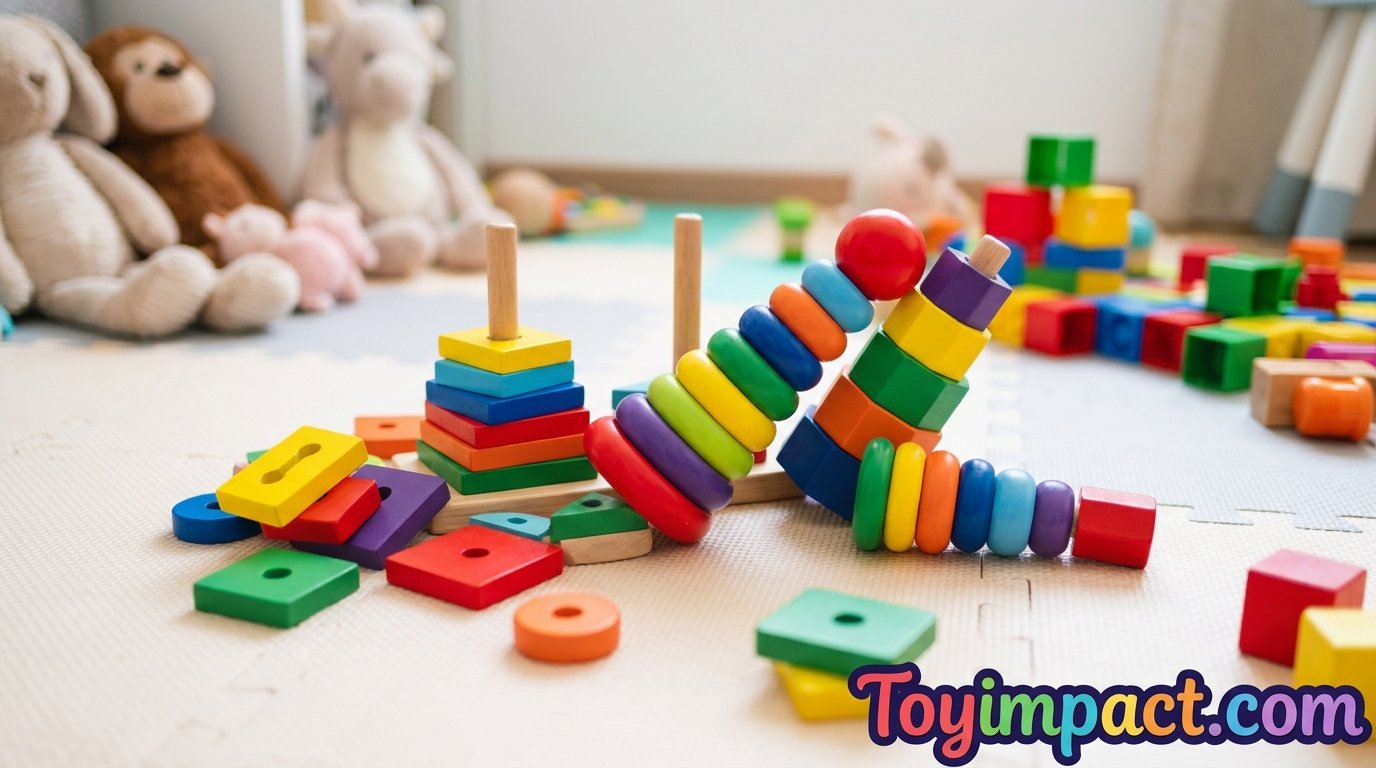
Stacking toys are playthings designed so that pieces sit on top of, inside, or around one another to form a tower, a nest, or a pattern. Most are made of rings, cups, blocks, or discs in graduated sizes. The child’s job is to work out which piece goes where, and the toy itself often gives quiet feedback: a ring that is too large will not fit on the peg, and a tower built in the wrong order leans and falls.
That feedback loop is the heart of the category. Nobody has to explain the rules, because the objects explain themselves. This is why stacking toys are a staple in early-years classrooms, therapy rooms, and nurseries, and why they show up so often in lists such as our roundup of the best toys overall.
Some people group stacking toys with building blocks, but there is a useful difference. Blocks are open-ended and can become anything. Stacking toys are usually guided: they have a built-in order or size logic. Many families keep both, since each supports different kinds of thinking.
Browse popular stacking toy sets on Amazon.
Shop Stacking Toys2. A Short History of Stacking Play
Children have stacked things for as long as there have been things to stack: stones, cups, pots, and lids. Formal stacking toys grew out of the nineteenth-century movement to design playthings that taught as well as entertained. Wooden blocks, ring towers, and nesting boxes became common as toy making moved from home workshops to small factories.
The classic ring-on-a-post tower became a household icon during the twentieth century, and nesting cups followed as plastic molding made bright, cheap, bath-safe versions possible. Later, educators inspired by hands-on learning approaches promoted simple wooden sets with natural finishes. If you are curious about that philosophy, our guide on the best age to introduce Montessori toys explains how it shapes toy choice.
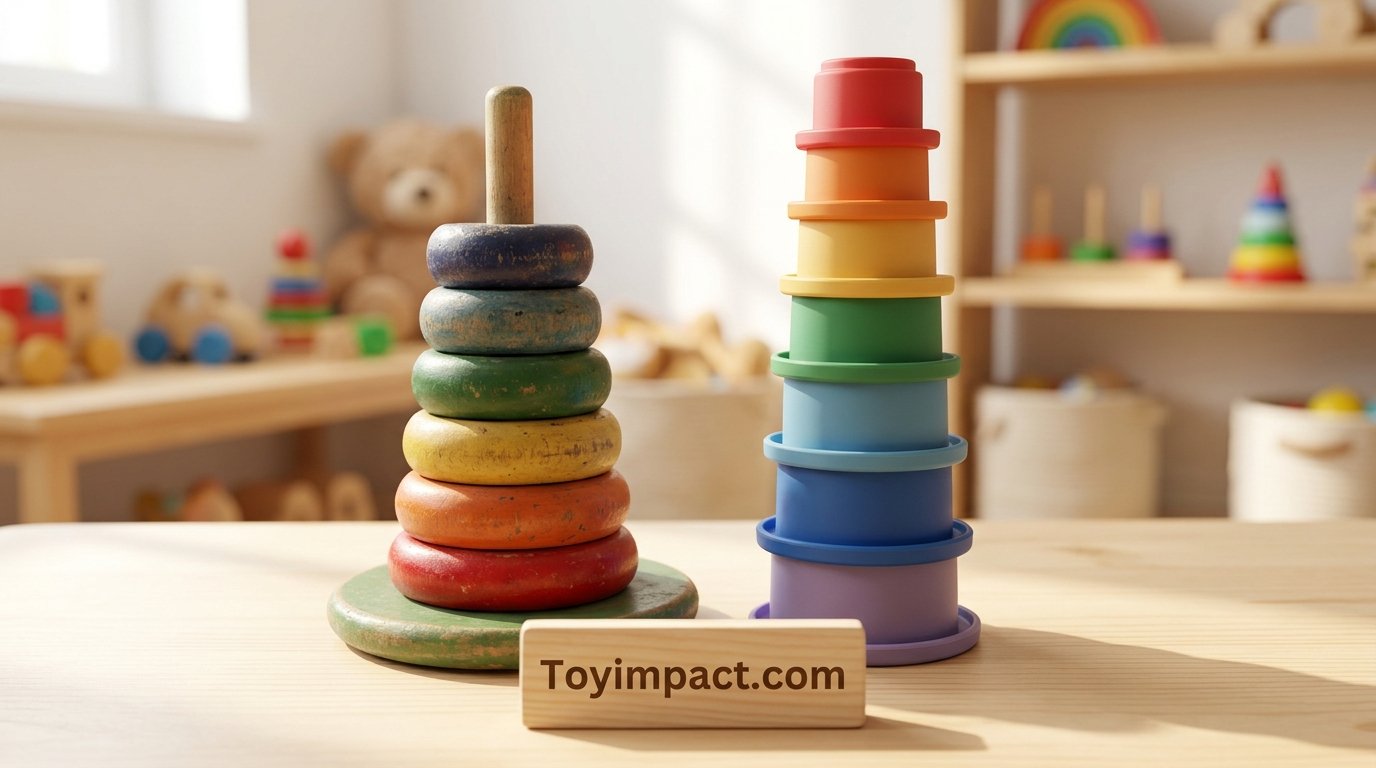
Today’s market spans everything from heirloom beech-wood rainbows to squishy silicone towers and magnetic or app-linked sets. The core idea has hardly changed, which says a lot about how well it works.
3. The Main Types of Stacking Toys
Stacking toys come in several families, and knowing them makes shopping far easier.
Ring stackers
Rings of decreasing size slide onto a central post. They are the entry point for babies and young toddlers because success is easy and the goal is clear.
Nesting and stacking cups
Cups fit inside each other for storage and stack into towers for play. They double as bath toys, sand scoops, and water pourers, so they earn their shelf space quickly.
Block and shape stackers
Blocks with cut-outs, pegs, or notches lock together in specific ways. They blur the line between stacking and puzzles, which makes them a good bridge toward puzzle toys.
Rainbow arches and balance stackers
Curved wooden pieces can be stacked, nested, bridged, or turned into tunnels. They are open-ended, and they tend to stay in use for years.
Challenge and balance games
Older children enjoy stacking games where pieces must be balanced without toppling, adding turn-taking and tension to the mix.
| Type | Typical Age | Best For |
|---|---|---|
| Ring stacker | 6 months to 2 years | First success, grasping |
| Nesting cups | 6 months to 4 years | Size order, bath and sand play |
| Block stackers | 1 to 4 years | Shape matching, problem solving |
| Rainbow arches | 1 to 8 years | Open-ended, creative builds |
| Balance games | 4 years and up | Focus, family play |
Compare ring stackers and nesting cups.
See Top Sets4. What Stacking Toys Teach
Because the play looks so basic, it is easy to underestimate. In reality, a child stacking rings uses several developing skills at once.
- Fine motor control: grasping, aligning, and releasing a piece precisely.
- Hand-eye coordination: judging distance and lining a hole up with a post.
- Early math: comparing sizes, sequencing largest to smallest, counting pieces.
- Cause and effect: a tall tower falls, a careful one stands.
- Persistence: trying again after a collapse builds frustration tolerance.
- Spatial reasoning: understanding how shapes fit together.
Those last skills are exactly what STEM learning builds on. If you are wondering how this connects, read what a STEM toy is and browse the best STEM toys, where simple stackers often sit alongside more technical options.
5. An Age-by-Age Guide
Babies (6 to 12 months)
At this stage, babies mostly mouth, bang, and drop pieces. Choose chunky, soft or lightweight rings and cups that are easy to grip. The tower is not the goal yet; exploring is.
Toddlers (1 to 2 years)
Now the first real towers appear, typically two or three blocks high. Ring stackers begin to make sense, and nesting cups become a favorite. For budget-friendly options, see our list of best toys under $20 for toddlers.
Ages 2 to 3
Children can stack six or more pieces, sort by color, and start pretending: cups become hats, arches become bridges. This is also when learning-focused choices help, such as those in our guide to the best educational toys for a 3-year-old boy.
Ages 4 and up
Older kids move to balance games, engineering builds, and creative structures. Stackers stay relevant, especially wooden sets used as building materials. Interest in toys does shift over time, a topic we explore in what age kids stop playing with toys.
Find age-appropriate stacking sets for your child.
Shop by Age6. Materials Compared
The material changes how a toy feels, how long it lasts, and how you care for it.
| Material | Strengths | Watch Out For |
|---|---|---|
| Solid wood | Durable, classic look, sturdy towers | Heavier when dropped, needs gentle cleaning |
| Plastic | Bright, light, affordable, easy to wash | Can crack over time, check for BPA-free labeling |
| Silicone | Soft, teething-friendly, bath safe | Can attract lint and dust |
| Fabric or foam | Very gentle for babies | Less precise stacking, harder to sanitize |
Wooden sets are popular with families who want long-lasting pieces, and our guide to the best wooden toys covers that style in depth. Plastic and silicone are practical for messy, wet, and travel-heavy play.
7. A Safety Checklist
Safety matters most at the youngest ages, where everything ends up in the mouth. Before buying, check the following:
- Pieces are too large to fit through a small-parts tester or cardboard tube.
- Paints and finishes are non-toxic and rated for children.
- No splinters, sharp edges, or loose components.
- Posts on ring stackers are rounded and fixed firmly.
- Age labels match your child’s stage.
Inspect toys regularly and retire any that crack or chip. Magnetic sets deserve special care: choose those with securely enclosed magnets and skip them for children who still mouth objects.
Look for non-toxic, well-reviewed stackers.
Browse Safe Picks8. How to Choose the Right Stacking Toy
With so many options, a few questions narrow the field quickly.
- How old is the child? Match piece size and difficulty to the current stage, not the aspirational one.
- Where will it be used? Bath, sandbox, and car seat each favor different materials.
- Is it open-ended? Toys with several ways to play last longer.
- How easy is it to clean? Smooth surfaces beat crevices.
- Does it fit your storage? Nesting designs save space.
Living in a small home? Nesting sets are helpful, and our tips on organizing toy storage in small spaces will help keep towers and cups tidy.
9. Play Ideas Beyond the Tower
Stacking toys become much more valuable when you play with them in several ways.
- Hide and find: hide a small toy under a cup and let your child lift them to discover it.
- Color hunts: ask for the red ring, then the biggest one.
- Bath pouring: nesting cups make excellent scoops and showers.
- Pretend cafe: cups, rings, and blocks become a tea party menu; see more in our guide to pretend play toys.
- Water play: take cups outside; our list of water table toys for the backyard has more ideas.
- Sibling challenges: race to build the tallest tower together, then compare it with ideas in toys for siblings to play together.
Grab a versatile set for water and sand play.
Shop Stacking Cups10. Cleaning, Storage, and Toy Rotation
Stacking toys get chewed, dropped, and dunked, so a simple routine helps. Wash plastic and silicone with warm soapy water; wipe wood with a damp cloth and dry it promptly instead of soaking it. Our detailed guide on how to clean plastic toys safely covers products and methods.
For storage, use a shallow bin or open shelf so pieces stay visible. Rotating a few sets in and out keeps them fresh, and you can learn how in how often you should rotate kids’ toys. If you wonder why novelty fades so quickly, see why kids get bored of toys so fast.
11. Pros and Cons at a Glance
Pros
- Simple, intuitive, and self-correcting
- Builds motor and early math skills
- Grows with the child through multiple stages
- Often affordable and durable
- Great for bath, sand, and travel
Cons
- Very basic sets can be outgrown quickly
- Small pieces can get lost
- Cheap paints and plastics vary in quality
- Rainbow-style sets can be pricey
- Toppling towers can frustrate some toddlers
Overall, the benefits clearly outweigh the drawbacks, provided you choose pieces that fit your child’s age and check quality before buying.
Compare prices and ratings for top-rated sets.
Check Best Sellers12. Gifting and Budget Tips
Stacking toys make easy, low-risk gifts. For a first birthday, a ring stacker or nesting cups is a safe bet. For an older child, a wooden rainbow or a balance game gives more room to grow. Pair a stacker with a picture book or a small basket of blocks to make a thoughtful bundle. If you are shopping for a preschooler, browse gift toys for a 5-year-old girl for comparison.
On a budget, look for sturdy plastic cups and simple ring sets; expensive is not always better. On a longer trip, small stackers pack easily, and you can find more ideas in our lists of toys for long car rides and travel toys for airplanes. Children who enjoy sensory experiences may also love textured or squishy sets, alongside picks in our sensory toys gift guide.
Ready to pick a gift-worthy stacking set?
Shop Gift SetsFrequently Asked Questions
What are stacking toys?
Stacking toys are toys with pieces, such as rings, cups, or blocks, that sit on or inside one another to build towers or nests.
What age are stacking toys for?
Simple ones suit babies from about six months, while balance games and rainbow arches remain fun for children into the early school years.
What skills do stacking toys develop?
They support fine motor control, hand-eye coordination, size comparison, patience, and early spatial reasoning.
Are wooden or plastic stacking toys better?
Neither is universally better. Wood is durable and classic, while plastic and silicone are lighter and easier for bath or travel.
Are stacking toys the same as building blocks?
Not quite. Stacking toys usually have built-in size or order logic, while blocks are more open-ended.
When do babies start stacking?
Many begin placing one block on another around 12 to 15 months, with taller towers appearing over the next year.
Are stacking cups good for the bath?
Yes. Plastic and silicone cups pour, scoop, and float well, and are easy to clean and dry.
How do I clean stacking toys?
Wash plastic and silicone in warm soapy water. Wipe wood with a damp cloth and dry it fully instead of soaking it.
Are stacking toys safe for babies who chew?
They can be if pieces are large, non-toxic, well-finished, and appropriately labeled for the child’s age.
How many stacking toys does a child need?
One or two versatile sets, such as nesting cups and a ring stacker, are enough. Rotate them for freshness.
Can older kids still enjoy stacking toys?
Yes. Rainbow arches and balance games support creative building, and many kids reuse simple stackers in pretend play.
Conclusion: Small Stacks, Big Learning
Stacking toys prove that great play does not need batteries. They teach coordination, patience, and early math through nothing more than pieces that fit together, and the good ones stay useful from the first grasp to imaginative builds years later. Choose quality materials, match the set to your child’s age, and let them knock things down as often as they like; that is part of the learning.
Start building your child’s stacking toy collection today.
Shop Stacking Toys on Amazon