What Toys Have Button Batteries? The Complete Parent and Gift-Giver Guide
Button batteries hide in far more toys than most families realize. Here is where they show up, why they matter, and how to keep them safely out of little hands.
What Button Batteries Are and Why So Many Toys Use Them
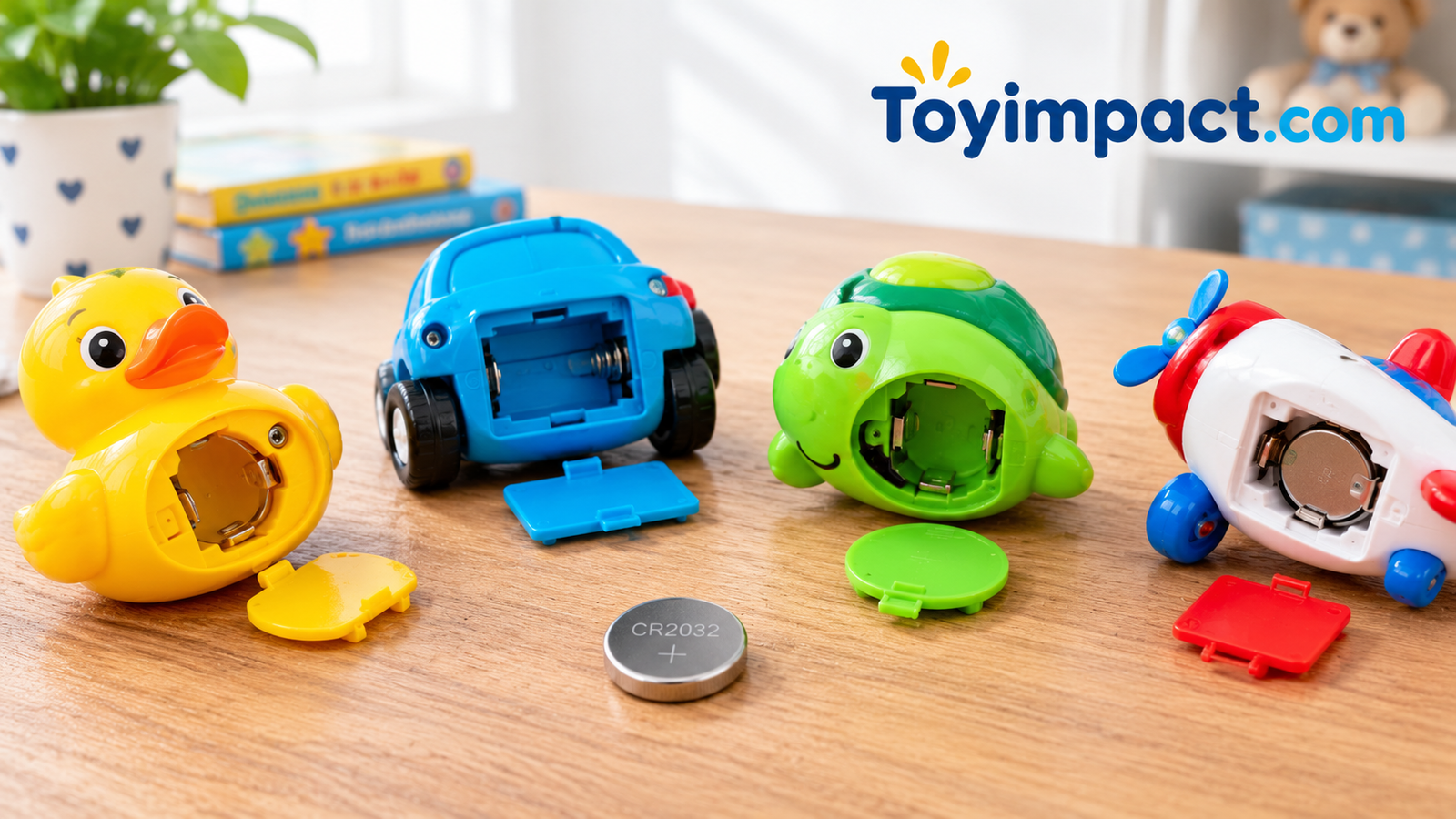
A button battery is a small, flat, round power cell, often called a coin cell or watch battery. It is shaped like a shiny little disc, roughly the size of a small button or a coin, and it packs a surprising amount of energy into a tiny space. That is exactly why toy makers love it. When a product needs a bit of light, a short melody, or a few electronic sounds, a button cell is cheap, light, and easy to tuck into a thin plastic shell.
You will see them described by codes such as CR2032, CR2025, CR2016, LR44, AG13 and SR44. The letters and numbers describe the chemistry and the size. Lithium coin cells, the ones that start with CR, are the most powerful and the most worrying for households with small children. Alkaline and silver-oxide versions, such as LR44 and SR44, are smaller and generally weaker, but they are still harmful if swallowed or pushed into the nose or ears.
Why they end up inside toys
Designers reach for button cells for practical reasons. They fit into palm-sized products, they hold a steady voltage for a long time, and they keep a toy light enough for a toddler to carry. A talking plush animal, a flashing ring, or a pop-up book with sound only needs a small burst of power, so a full-size AA or AAA cell would be overkill. The trade-off is that the smaller the battery, the easier it is for a child to hold, hide, or swallow.
Understanding where these cells live is the first step to keeping them controlled. The rest of this guide walks through the toys most likely to contain them, the sneaky items that do not look like toys but end up in toy boxes, how to check a product before you buy it, and what to do if something goes wrong.
Want toys that do not rely on coin cells at all? Browse simple, battery-free picks.
Shop battery-free toysWhy Button Batteries Are So Dangerous for Young Children
It is easy to think of a battery as a harmless object, especially one so small and smooth. The reality is different. When a button battery is swallowed and lodges in the throat or food pipe, the wet tissue there completes an electrical circuit. That current produces a chemical reaction that generates hydroxide, a strongly alkaline substance that can burn tissue very quickly. Serious damage can begin in as little as two hours, and it can continue even after the battery is removed.
Lithium coin cells carry the highest risk
Coin cells around 20 millimeters across, like the CR2032, are the most notorious. Their larger diameter makes them more likely to get stuck in a small child’s esophagus, and their higher voltage speeds up the burning process. Smaller cells can also cause harm, particularly if they are pushed into a nostril or an ear canal, where they can damage tissue in the same way.
Why symptoms are easy to miss
One of the scariest parts of a battery ingestion is how ordinary the early signs can look. A child may cough, drool, gag, refuse food, or seem fussy. Others show no symptoms at all at first. Many cases are mistaken for a cold, a stomach bug, or a sore throat. That is why prevention matters far more than reaction, and why any suspicion of a swallowed battery should be treated as an emergency without waiting for symptoms to develop.
Who is most at risk
Children under six are the group most often affected, and toddlers are especially vulnerable because they explore the world by putting things in their mouths. Older siblings, however, can play a role too. A battery removed from a remote or a light-up toy by a curious older child can end up on a shelf or the floor within reach of a baby. Homes with multiple ages need a consistent system for keeping batteries out of circulation.
Add a small screwdriver set so every battery door in your home can be locked down.
See precision screwdriver setsToys That Commonly Have Button Batteries
Button batteries appear across nearly every toy category, but certain types use them again and again. If your child owns any of the items below, it is worth checking the battery door today.
| Toy or item | Why it uses a button cell | What to look for |
|---|---|---|
| Light-up toys and LED spinners | Small LEDs need little power | Tiny battery door on the base or handle |
| Sound and musical books | Slim pages need a thin power source | Battery panel on the back cover or spine |
| Talking dolls and plush | Sound modules fit inside soft bodies | Zippered pouch or a small hatch on the back |
| Toy watches and wearables | Compact and light for wrists | Snap-off back plate |
| Flashing shoes | LED strips in the sole | Sealed pod under the insole or heel |
| Remote controls | Slim remotes for toys and TVs | Sliding tray or back cover |
| Novelty jewelry and rings | Flashing gems and pendants | Twist-off or pry-open casing |
| Mini games and digital pets | Pocket sized electronics | Battery cover with or without a screw |
| Bath toys with lights | Sealed LEDs for tub time | Waterproof twist cap or screw plate |
Light-up and flashing toys
Anything that glows, blinks, or pulses is a prime suspect. Light-up wands, glowing rings, flashing bouncy balls, LED yo-yos, and spinning tops all commonly run on coin cells. Because these are inexpensive and often sold as impulse buys, they also tend to have the flimsiest battery compartments.
Musical and sound-making toys
Sound books, musical greeting cards, mini keyboards, and toy phones frequently use button cells because the sound chip needs only a small current. If you are exploring the category more broadly, our explainer on what musical toys are covers how they work and how to choose thoughtfully.
Toys that come with a demo battery already inside
Some products ship with a battery installed and a plastic tab to pull out before first use. Others include a spare in a small plastic bag. Both situations create a moment of risk: the loose spare, the tab, and the packaging can all end up in a child’s reach while you are busy unwrapping. Pull the battery, install it, close the door, and dispose of the packaging right away.
Why button-cell toys appeal
- Lightweight and easy for small hands to carry
- Long standby life for simple light or sound features
- Low cost, which keeps toy prices friendly
The downsides
- Serious swallowing and insertion hazard
- Compartments are sometimes easy to open
- Batteries are tiny and easy to lose
Looking for sound and music with fewer risks? Compare instruments made without electronics.
Explore acoustic music toysSecure Battery Compartments: What Good Design Looks Like
A well-designed toy makes it hard for a child to reach the battery. A poorly designed one relies on a flimsy clip or a slide tab that a determined toddler can pop open in seconds. Knowing the difference helps you judge a product before it comes home.
Signs of a secure compartment
- A screw holds the door shut. This is the gold standard, because a child cannot open it without a tool.
- The door needs two independent actions. For example, pressing and sliding at the same time.
- The battery is sealed inside the product. Some toys are designed with no user-replaceable battery at all.
- Clear warning labels on the packaging and the toy. Look for wording about the swallowing hazard and the type of battery.
- No gaps around the door. A tight seam is harder to pry open with a fingernail.
Signs of a weak compartment
- A door that clips or slides open with one thumb push.
- Loose or bendy plastic around the door edge.
- A toy that rattles when shaken, which can signal a loose battery.
- No labeling of any kind on very cheap, unbranded items.
- A cracked or broken battery cover after a drop.
Battery covers that go missing
Battery doors are among the first parts to go missing on a well-loved toy. If a cover falls off, do not let the toy stay in circulation. Contact the manufacturer for a replacement, secure the compartment with strong tape as a temporary fix, or remove the battery and retire the toy until it is repaired.
Grab a replacement-friendly toolkit for tightening and sealing compartments.
Shop repair kitsHow to Check Any Toy Before You Buy or Gift It
You do not need to be a product safety expert to spot risks. A short routine at the shelf, or when a package arrives, can reveal most of what you need to know.
A simple five-step routine
- Read the box or listing. Look for battery types, warnings, and age recommendations. If the listing does not say what powers the toy, treat that as a red flag.
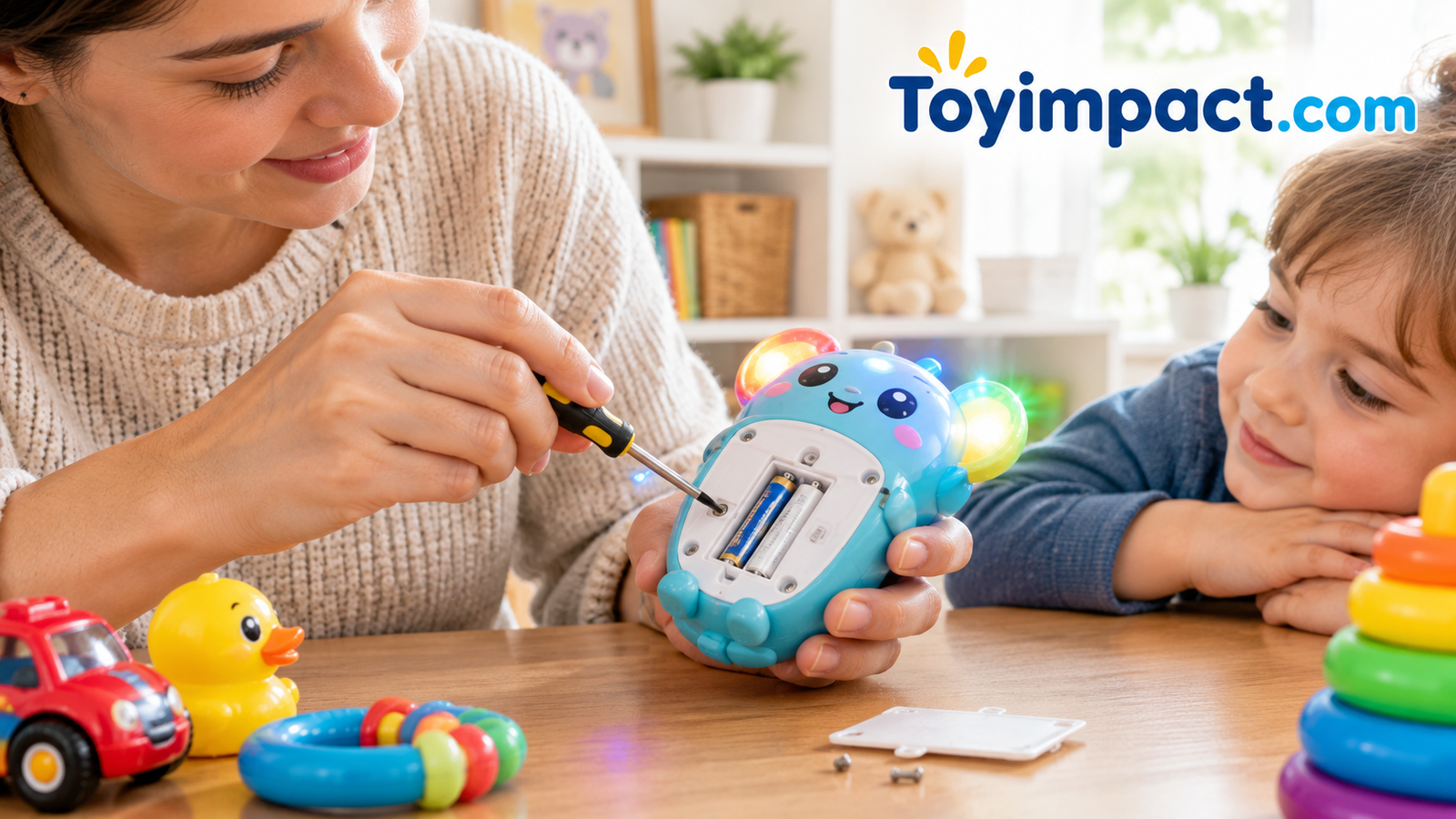
- Flip the toy over. Find the battery door. Is there a screw? Does it feel firm?
- Try to open it with a fingernail. If it opens easily, a child could open it too.
- Give it a gentle squeeze and shake. Cracks, loose parts, and rattles are all reasons to walk away.
- Check what comes in the box. Spare batteries, tools, and plastic tabs need to be handled or disposed of immediately.
Reading product descriptions online
When shopping online, scan the product details for phrases like coin cell, button cell, CR2032, LR44, or included batteries. Look at customer photos of the underside of the toy, and read reviews for mentions of battery doors popping open. A pattern of comments about loose covers is worth taking seriously.
Age labels are a starting point, not a guarantee
A toy labeled for older children can still land in a toddler’s hands, especially in a home with siblings. If you have mixed ages, judge each toy by the youngest child who could get to it. Our guide to the best toys under $20 for toddlers is a helpful place to browse safer, budget-friendly options.
| Checkpoint | Green light | Red flag |
|---|---|---|
| Battery door | Screw-secured, flush fit | Slides or clips open easily |
| Labeling | Clear battery warnings | No information at all |
| Packaging | Spare batteries sealed in child-resistant packs | Loose batteries in a plastic bag |
| Build quality | Firm casing, no gaps | Rattles, cracks, thin plastic |
| Seller | Known brand with contact details | Unbranded listing with no support |
Prefer to skip the guesswork? Start with a trusted list of tested, well-reviewed toys.
See safer toy picksParty Favors, Stocking Stuffers and Hand-Me-Down Toys
Some of the biggest risks come from places where nobody is looking at labels: goodie bags, holiday stockings, thrift finds, and boxes of toys passed down from cousins. These items arrive in bulk and rarely get the same attention as a single purchase.
Goodie bags and prize bins
Cheap party favors like light-up rings, flashing bracelets, mini spinners, and blinking pins nearly always run on coin cells. Their compartments are often glued or snapped rather than screwed. If you are hosting a party for young children, choose favors that skip electronics entirely, such as stickers, crayons, bubbles, or small puzzles. If you are attending, check what your child brings home before it goes into the toy box.
Fast-food and cereal box toys
Promotional toys sometimes include light or sound features. Read the packaging and, when in doubt, keep the toy away from children under three. Take a moment to look at the back before handing it over in the car.
Second-hand and inherited toys
Older toys are more likely to have worn or missing battery covers, and they often lack modern warnings. Before adding a hand-me-down to the rotation, open it, inspect the compartment, and remove old batteries that may be leaking. Clean it well afterward using the steps in our guide on how to clean plastic toys safely.
Grandparents, guests and sitters
Well-meaning relatives may not know how strict your household rules are. A friendly heads-up before visits goes a long way. Share a short list of no-go items, such as loose coin cells, key fobs, and light-up trinkets. Encourage visitors to keep purses, coats, and bags out of reach, since a purse is one of the most common places for a stray battery to hide.
Skip electronic trinkets. Choose party favors that are fun without batteries.
Find safe party favorsSafer Alternatives: Great Toys That Skip Button Batteries
Fewer batteries in your home does not mean less fun. Some of the best-loved toys have no electronics at all, and child development experts often praise them for encouraging open-ended play, creativity, and problem solving.
Classic, battery-free favorites
- Wooden toys. Blocks, pull-alongs, and shape sorters are sturdy and timeless. See our roundup of the best wooden toys.
- Puzzles. Chunky knob puzzles and floor puzzles build fine motor skills without electronics. Explore the best puzzle toys.
- Pretend play sets. Play kitchens, tool benches and doctor kits spark imagination. Browse the best pretend play toys.
- Stacking and nesting toys. Simple, satisfying, and endlessly reusable. Learn what stacking toys are and why they matter.
- Sensory toys. Textured balls, squishy shapes, and fabric books offer rich input with no batteries. Read what sensory toys are.
- Quiet-time activities. Lacing cards, sticker books, and busy boards fit calm moments. See what quiet time toys are.
When you do want a powered toy
Some toys just work better with electronics, such as remote-control cars. If that is the case, choose models that use standard AA or AAA batteries in screw-closed compartments, or rechargeable versions with sealed batteries. Our guide to the best remote control toys is a good place to start. For a wider look at recommended picks across categories, browse our best toys collection.
Travel and car ride entertainment without the hazard
Long trips are when parents often reach for light-up gadgets to keep kids busy. Choose calmer, battery-free options instead. Our lists of the best toys for car rides and long trips and the best travel toys for airplane flights are full of ideas that will not create a battery risk in a backseat or an aisle.
Benefits of battery-free toys
- No coin cell to swallow or lose
- Nothing to replace or recharge
- Encourage imagination over passive play
- Often sturdier and longer lasting
Possible trade-offs
- Fewer lights and sounds to catch attention
- Some children love the electronic feedback
- Quality wooden options can cost more upfront
Start a battery-free toy shelf with our favorite open-ended picks.
Shop wooden toysBattery Storage, Swapping and Disposal at Home
Even if every toy in your home is perfectly secured, batteries still have to be changed, stored and thrown away. Those moments are where many accidents happen, so build a routine that protects you every time.
Changing batteries safely
- Do it at a table, away from young children, and never over a soft surface where a battery could bounce out of sight.
- Put the new battery in first, close and screw the door, and only then deal with the old one.
- Do not leave the old battery on the counter, even for a moment.
- Wash your hands afterward, especially if a battery leaked.
Storing spares
Keep unused batteries in their original packaging in a high, locked cabinet. Avoid kitchen drawers, purses, nightstands, and coat pockets. Do not store them loose with coins or other metal objects, which can cause short circuits.
Tape the terminals before disposal
Used button batteries can still hold enough charge to cause harm. Wrap them with clear tape over both sides, and place them in a sealed container until you can take them to a recycling drop-off. Many electronics stores and community collection points accept them. Do not throw loose batteries into open trash bins or recycling bags.
Rotate toys and reduce the pile
Fewer toys out at once means fewer items to inspect. A simple rotation system helps you audit the electronics regularly. Our guides on how often to rotate kids toys and organizing toy storage in small spaces can help you set up a system that keeps powered toys separate from everything else.
Organize powered toys and spare batteries in a high, secure spot.
See locking cabinetsWarning Signs and Emergency Steps If a Battery Is Swallowed
Knowing what to do before an emergency happens can save precious minutes. Read this section once, then make sure every adult who cares for your child has read it too.
Possible warning signs
- Drooling, coughing, gagging or choking
- Chest or throat discomfort, or a child pointing to the throat
- Refusing food or drink, or vomiting
- Noisy or wheezy breathing
- Unusual fussiness or a change in voice
- Nosebleed, discharge or pain in the nose or ear after a suspected insertion
- No symptoms at all, which does not rule out a problem
What to do while you are on the way
- Go to the emergency department. Do not wait to see whether the battery passes on its own.
- Call for guidance. A hotline can give tailored advice and alert the hospital.
- Bring the packaging or the toy. It helps doctors identify the battery type and size.
- Do not induce vomiting. This can cause additional injury.
- Do not let the child eat or drink unless a medical professional instructs you to.
About honey
Current guidance from poison control experts says that, for a child over twelve months old who is awake and able to swallow, giving honey on the way to the hospital may slow tissue damage. The commonly cited advice is two teaspoons every ten minutes, for up to six doses. Never give honey to a baby under twelve months. Honey is never a substitute for emergency care and should be used only if a medical professional or hotline advises it, so always follow the instructions you are given on the phone.
Batteries in the nose or ear
A battery in the nose or ear is also an emergency. Do not try to remove it yourself. Seek immediate medical help. Tissue damage can happen quickly in these areas as well.
Keep a printed emergency card and a first aid kit where every caregiver can find them.
Shop first aid kitsTalking to Kids, Siblings and Caregivers About Battery Safety
Rules work best when everyone understands them. That includes older children who might casually carry a battery-powered gadget around the house, and adults who might not realize how quickly a small item can disappear into a small mouth.
Speaking to toddlers and preschoolers
Very young children cannot fully grasp danger, so lean on simple, consistent phrases and on physical barriers rather than lectures. Something like, “Batteries are not for mouths, they are for grown-ups,” repeated calmly, is enough. The real protection is an environment that gives them nothing to test.
Involving older siblings
School-age kids can be your best allies. Explain in age-appropriate language that button batteries can hurt little ones, and make them part of the solution. Give them a designated place for their own gadgets and a rule that any device with a loose battery cover goes to a parent immediately. Praise them when they follow through.
Sharing the rules with other caregivers
Nannies, grandparents, babysitters and daycare staff should know your household routine. A short one-page list on the fridge works well. Include the emergency steps and the hotline number, plus a reminder to keep coin cells, key fobs and light-up gadgets out of reach. If a child spends time at a relative’s house, ask them to do a quick sweep before your child arrives.
Make a monthly safety sweep a habit
Once a month, walk through the house at a toddler’s eye level. Check low drawers, coffee tables, remote controls, greeting cards, holiday decorations and bags left on the floor. It only takes a few minutes and often turns up a forgotten hazard. Pair it with a review of the toy bins. If the bins are overflowing, our piece on why kids get bored of toys so fast may help you rethink the number of toys out at once.
Cabinet and drawer locks turn everyday spaces into safe zones.
Browse safety locksLaws, Standards and Labels: What Protections Exist
Safety rules around button batteries have tightened considerably in recent years, largely because of tragic cases that pushed lawmakers and manufacturers to act. Understanding the basics helps you shop with more confidence, while remembering that rules cannot replace your own inspection.
Secure compartment requirements
In the United States, a federal law known as Reese’s Law, named after a young child who died after swallowing a button battery, directs the Consumer Product Safety Commission to require that consumer products using button or coin cells have secure battery compartments. It also requires clear warnings on packaging, and on the products and batteries themselves. Similar efforts exist in other regions, including Europe, Canada and Australia, where mandatory standards call for compartments that need a tool or two independent actions to open.
Child-resistant battery packaging
Coin cell packs are increasingly sold in packaging that resists opening by young children, such as blister packs that need scissors or firm pressure. Some manufacturers also coat batteries with a bittering agent to discourage swallowing. These measures reduce risk but do not remove it, so store every pack as if it were still dangerous.
What the labels mean in practice
Look for warning symbols about swallowing hazards, battery type information, and age grading. Products from established brands typically list their compliance with local toy safety standards. Be cautious with unbranded items from unknown sellers, especially marketplace listings without clear manufacturer information, since these can bypass the rules that reputable makers follow.
Limits of regulation
Older toys, imports, hand-me-downs, and non-toy items like remotes and candles may not meet the newest requirements. A compliant product can still break, lose a screw, or be tampered with. Regulation sets a floor. Your own checks, storage habits and conversations with other caregivers are what make the biggest difference day to day.
| Layer of protection | What it does | What you still need to do |
|---|---|---|
| Secure compartments | Make the battery hard to reach | Check screws and covers regularly |
| Warning labels | Flag the hazard clearly | Read them and share with caregivers |
| Child-resistant packs | Slow down access to spares | Store packs high and locked |
| Bitter coatings | Discourage swallowing | Do not rely on it as a safeguard |
Explore thoughtfully chosen toys that meet trusted safety standards.
Shop certified toysFrequently Asked Questions About Toys With Button Batteries
What toys have button batteries?
Common examples include light-up toys, musical and sound books, talking dolls and plush, toy watches, flashing shoes, novelty jewelry, remote controls, mini electronic games, and many party favors. Non-toy items such as key fobs and flameless candles also use them.
Are all button batteries equally dangerous?
No. Lithium coin cells around 20 millimeters, such as the CR2032, are considered the highest risk because of their size and voltage. Smaller alkaline or silver-oxide cells are less powerful, but they can still cause harm if swallowed or inserted into the nose or ears.
How quickly can a swallowed button battery cause damage?
Serious injury can begin within about two hours if the battery lodges in the food pipe, and damage can continue even after removal. That is why immediate emergency care is essential, even when a child seems fine.
How do I know if a toy’s battery compartment is secure?
Look for a screw that holds the door shut, or a design that needs two independent actions to open. If the cover clips or slides open with a fingernail, a child can probably open it too.
What should I do if I think my child swallowed a button battery?
Go to the nearest emergency department immediately and call a poison control center or battery ingestion hotline on the way. Do not induce vomiting, and do not give food or drink unless a medical professional tells you to.
Should I give my child honey after a battery ingestion?
Poison control guidance says honey may help in some cases for children over twelve months, but only as a bridge to emergency care and ideally on the advice of a professional. Never give honey to a baby under twelve months. Always follow hotline instructions.
Are bath toys with lights safe?
They can be, if the battery compartment is sealed and screw-secured. Check for cracks after drops, and clean them regularly. Our guide on how to clean bath toys explains how to do it without damaging the seals.
Can I make an unsafe toy safer?
If the compartment is not screw-secured, you can remove the battery and stop using the toy, or seal the door with strong tape as a temporary fix. Contact the manufacturer for a replacement cover. When in doubt, retire the toy.
How should I dispose of used button batteries?
Cover both sides with clear tape, place them in a sealed container, and take them to a battery recycling drop-off. Do not throw loose batteries into open trash or recycling bins.
What ages are most at risk?
Children under six are most often affected, with toddlers at the highest risk because they explore with their mouths. Still, older kids and even adults can be harmed, and older siblings can unknowingly leave batteries within a baby’s reach.
Are rechargeable toys safer?
Toys with sealed rechargeable batteries have no user-accessible coin cell, which reduces one risk. Still, check the product for warnings and any damaged casing, and keep chargers and cords out of reach.
What are good toys that do not use button batteries?
Wooden blocks, puzzles, stacking toys, pretend play sets, art supplies and books without sound modules are all excellent choices. Browse our best toys picks for ideas.
Conclusion: Small Batteries, Big Responsibility
Button batteries power some of the most beloved little gadgets in a child’s world, from glowing rings to singing books. They also pose one of the most serious hidden hazards in a modern home. The good news is that a few simple habits go a long way. Check battery doors and choose toys with screw-secured compartments. Store spares high and locked. Tape and recycle old cells promptly. Keep an eye on the non-toy items that sneak into playtime. And make sure everyone who cares for your child knows exactly what to do in an emergency.
You do not have to give up fun to stay safe. Many of the very best toys are simple, sturdy and battery-free, and they tend to last far longer than the gadgets that need a coin cell. Start with a quick sweep of your home this week, and build from there. For more ideas on choosing thoughtful toys, visit Toy Impact.
Ready to refresh the toy shelf with safer, screen-free, battery-free favorites?
Shop safer toys on Amazon