What Are Musical Toys? A Complete Guide for Parents, Gift-Givers, and Curious Grown-Ups
From the first rattle to a real little keyboard, musical toys turn everyday play into rhythm, melody, and a whole lot of joyful noise. Here is everything worth knowing before you buy one.
Walk into any toy aisle and you will hear them before you see them: tiny drums tapping, plastic pianos chirping, a shaker rattling somewhere near the bottom shelf. Musical toys are one of the oldest and most beloved categories in childhood, and they are also one of the most misunderstood. Some parents think of them as noise machines to be endured. Others see them as the first step toward a lifelong love of music.
The truth sits somewhere in the middle, and it is more interesting than either extreme. A good musical toy does real work. It teaches cause and effect, sharpens listening skills, builds coordination, and gives children a safe way to express feelings they do not yet have words for. A poorly chosen one, on the other hand, can be shrill, flimsy, or simply boring after a day.
This guide explains exactly what musical toys are, where they came from, how they help kids grow, and how to pick ones that will actually get played with. Whether you are shopping for a baby shower, a birthday, or just trying to survive a rainy afternoon, you will find practical answers below.
1What Are Musical Toys?
At the simplest level, a musical toy is any toy where sound is the point. That sound might be a clear note from a metal bar, the soft swish of beans inside a shaker, or a recorded voice singing the alphabet. What separates a musical toy from a regular toy that happens to make noise is intention. The design is built around helping a child explore pitch, rhythm, volume, or melody.
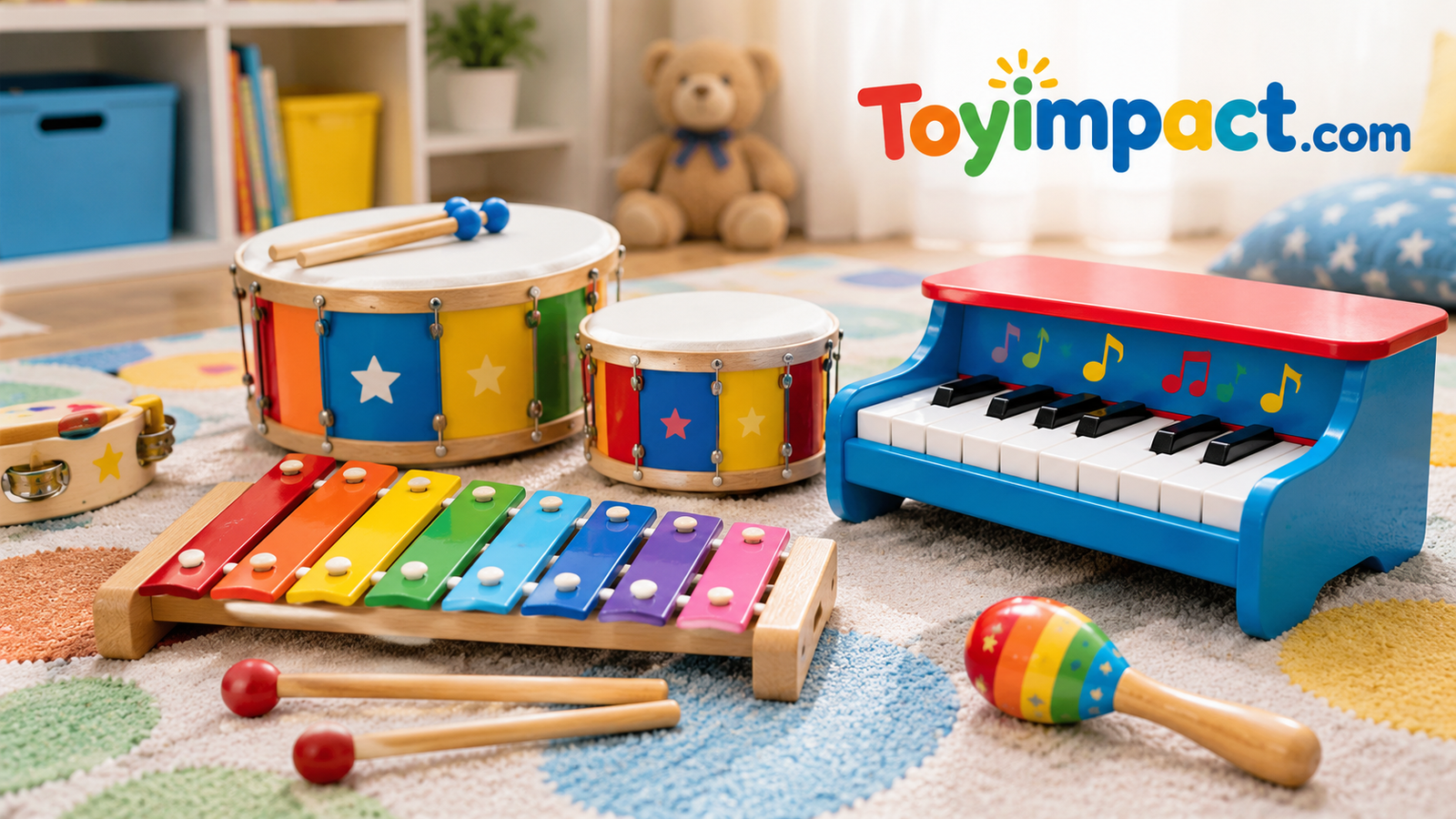
It helps to think of the category as a spectrum. On one end sit true instruments scaled for small hands, like a well-tuned xylophone or a ukulele with real strings. On the other end sit novelty sound toys, such as a stuffed animal that plays a lullaby when squeezed. In between are hundreds of hybrids: toy pianos that light up, drum sets with volume controls, microphones that echo a child’s voice, and tabletop activity centers that combine buttons, spinning gears, and songs.
What makes a toy “musical” instead of just noisy?
Ask a music teacher and they will usually point to three qualities. First, the sounds should be varied. A toy that only repeats a single beep teaches very little. Second, the child should be able to influence the sound through how hard they hit, how fast they press, or which key they choose. Third, the sound should be pleasant enough to want to repeat. Tinny, off-pitch tones tend to frustrate rather than inspire.
Toys that meet those three tests give children a genuine musical experience even if they cost very little. Toys that do not meet them may still be fun for a few minutes, but they rarely earn a permanent place in the toy box.
Who are musical toys for?
Almost everyone, at some stage. Newborns respond to gentle rattles and mobiles. Toddlers love banging on anything that makes a satisfying sound. Preschoolers begin to sing along, march to a beat, and invent their own songs. Older children use miniature instruments as stepping stones toward real lessons, and some grown-ups keep a music box on the shelf simply because it makes them smile.
Musical toys also fit neatly alongside other kinds of developmental play. If you are exploring what sits in the same family, our explainers on motor skill toys and creative toys show how sound-based play overlaps with movement and imagination.
Ready to see what is out there? Browse popular musical toys for kids.
Shop Musical Toys on Amazon2A Short History of Musical Toys
Musical toys are not a modern invention. Archaeologists have uncovered clay rattles and small whistles in the graves of children from ancient civilizations around the world. Some of these objects were shaped like animals, and many still produce a sound when shaken or blown. People have clearly understood for thousands of years that a child with a noisemaker is a happy child.
From clay rattles to music boxes
For most of history, musical toys were handmade from whatever was nearby: hollow gourds filled with seeds, carved wooden clappers, bone whistles, and stretched-hide drums. Wealthy families sometimes commissioned tiny replicas of adult instruments. The real turning point came with mechanical music. Small cylinder music boxes, powered by winding springs, appeared in Europe and quickly became prized nursery objects. Watching a comb of steel teeth pluck a melody from a rotating drum felt almost magical, and it still does.
The toy piano and the xylophone era
By the late nineteenth century, toy manufacturers were producing scaled-down pianos with metal bars or thin rods instead of strings. They sounded bright and slightly bell-like, and that distinctive tone became famous enough that composers later wrote pieces specifically for toy piano. Xylophones, glockenspiels, and small drums followed. Educators such as Carl Orff also built entire teaching methods around simple percussion instruments, which gave classroom-friendly instruments a lasting cultural boost.
The electronic revolution
Batteries and microchips changed everything in the second half of the twentieth century. Suddenly a toy could play a full song, imitate a dozen instruments, or respond to a child’s voice. Light-up keyboards, talking books with sound buttons, and karaoke microphones became mainstream. Today the category spans everything from hand-carved wooden kalimbas to Bluetooth-connected mini keyboards that pair with learning apps.
Despite all that technology, the classic acoustic toys have never gone away. A wooden drum from a hundred years ago works exactly like one from today, and many parents deliberately choose those simpler designs. If you love that timeless feel, take a look at our roundup of the best wooden toys, which includes several musical favorites.
Love the classics? Explore wooden and vintage-style musical toys.
See Wooden Musical Toys3The Main Types of Musical Toys
The category is broad, so it helps to sort it into families. Each family develops slightly different skills and suits different ages. The table below gives a quick overview, and the sections that follow explore the most important groups in detail.
| Type | Examples | Best For | Skills Practiced |
|---|---|---|---|
| Rattles and shakers | Baby rattles, egg shakers, maracas | Babies and toddlers | Grasping, rhythm, cause and effect |
| Percussion | Drums, tambourines, xylophones, bells | Toddlers to early elementary | Beat, coordination, listening |
| Keyboards | Toy pianos, mini keyboards, piano mats | Preschool and up | Pitch, finger isolation, melody |
| Wind toys | Harmonicas, recorders, kazoos, whistles | Ages four and up | Breath control, tone, pitch |
| String toys | Mini guitars, ukuleles, lap harps | Ages five and up | Finger strength, chords, tuning |
| Voice toys | Toy microphones, karaoke machines | Preschool and up | Confidence, singing, language |
| Sound-button toys | Song books, activity cubes, plush singers | Babies to preschoolers | Recognition, vocabulary, fine motor |
| Music boxes | Wind-up boxes, mobiles, carousels | Babies and keepsake gifts | Calming, attention, memory |
Acoustic versus electronic
Another useful way to sort musical toys is by how they make sound. Acoustic toys create noise through physical vibration: a struck bar, a plucked string, a shaken bead. Electronic toys use speakers and circuits to play recorded or synthesized sounds. Both have real strengths, and we compare them head-to-head in a later section.
Solo toys versus group toys
Some musical toys are designed for one child exploring alone, like a soft rattle or a single-key piano. Others shine in groups: a basket of assorted percussion instruments can turn a living room into a parade. Families with more than one child may want to read our guide to the best toys for siblings to play together, since shared musical play is one of the easiest ways to encourage cooperation.
Start a mini band at home with a starter set of instruments.
Shop Kids Instrument Sets4How Musical Toys Support Child Development
Musical play looks simple from the outside, but a surprising amount of learning is happening underneath. Researchers who study early childhood have long noted that music engages many parts of the brain at once, including areas tied to language, movement, memory, and emotion. Here is how that plays out in everyday terms.
Listening and language
Distinguishing a high note from a low one, or a fast beat from a slow one, trains the same listening skills children later use to tell similar-sounding words apart. Singing along to a favorite toy also introduces vocabulary, rhyme, and the natural rhythm of speech. Many speech therapists happily recommend songs and simple instruments for that very reason.
Motor skills and coordination
Hitting a drum in time, pressing a single piano key, or shaking a maraca on the beat all require a child to coordinate eyes, hands, and ears. Smaller instruments like finger cymbals or a xylophone strengthen the fine motor control needed for writing later on. If you are curious about that side of things, our overview of motor skill toys goes deeper.
Early math and pattern thinking
Rhythm is essentially math you can feel. Counting beats, repeating patterns, and recognizing sequences all reinforce concepts that appear in early arithmetic. That connection is one reason musical toys often turn up in discussions about what makes a STEM toy, particularly when a toy lets children experiment with pitch, vibration, or sound waves.
Emotional expression and confidence
Young children feel big emotions before they can describe them. Banging a drum when frustrated, swaying to a lullaby when tired, or belting a song into a toy microphone gives those feelings somewhere to go. Kids who feel safe making noise also tend to grow more comfortable performing, speaking up, and trying new things.
Social skills
Playing music together is one of the earliest forms of teamwork. Taking turns, following a leader, matching a partner’s tempo, and stopping when the music stops are all social lessons in disguise. A simple game of “freeze” with a tambourine can teach more about self-control than a dozen reminders.
- Auditory skills: pitch, volume, and tempo awareness
- Fine motor: grip, tapping, and finger isolation
- Gross motor: dancing, marching, swaying
- Cognitive: memory, patterns, cause and effect
- Language: rhyme, vocabulary, and speech rhythm
- Emotional: self-expression and calming
None of this means a toy will turn your child into a prodigy. Development depends on countless everyday experiences. But musical toys are an easy, joyful way to add one more layer of rich sensory experience to your child’s day.
Give little learners a head start with developmentally friendly music toys.
Shop Educational Music Toys5Musical Toys by Age
The right musical toy at the wrong age can be a dud. A drum set that thrills a four-year-old may overwhelm a six-month-old, while a simple rattle will bore a seven-year-old within seconds. Use the table below as a starting point, then read the age-by-age notes.
| Age | What They Are Ready For | Good Choices |
|---|---|---|
| 0 to 6 months | Tracking sound, reaching, gentle stimulation | Soft rattles, music mobiles, plush toys with quiet lullabies |
| 6 to 12 months | Shaking, banging, mouthing, discovering cause and effect | Chunky shakers, baby drums, sound-button activity toys |
| 1 to 2 years | Pressing buttons, tapping, marching, early singing | Simple xylophones, tambourines, toddler pianos |
| 3 to 4 years | Imitation, pretend performance, keeping a loose beat | Drum sets, toy microphones, mini keyboards, maracas |
| 5 to 7 years | Learning notes, following simple songs, playing along | Keyboards with lesson modes, ukuleles, recorders, harmonicas |
| 8 and up | Structured practice, real instrument transition | Beginner instrument sets, electronic pads, kalimbas |
Babies
In the first year, the goal is gentle exposure and simple discovery. Choose lightweight rattles that are easy to grip and impossible to swallow, and keep volume low. Babies do not need complicated songs. They need clear, soft, repeatable sounds that reward their first clumsy movements. Because babies explore with their mouths, everything should be easy to wash. Our guide on how to clean plastic toys safely covers the basics.
Toddlers
Toddlers are the natural audience for musical toys. They love pounding, pressing, and repeating, and they want the world to answer back. Durable percussion and big-button keyboards are ideal. This is also a good time to introduce open-ended toys rather than only pre-programmed ones. Parents on a budget will find several excellent picks in our list of the best toys under $20 for toddlers.
Preschoolers
By three or four, children begin to imitate what they see. A toy microphone, a mini guitar, or a drum set becomes part of elaborate pretend play, and music turns into a story tool. If your child loves make-believe, browse the best pretend play toys and pair a musical piece with a costume box. Curious about matching toys to a particular child? Our list of educational toys for a 3-year-old boy and our gift ideas for a 5-year-old girl both include musical options.
School-age children
Older kids can move from noise-making to real music-making. Look for toys that bridge the gap: keyboards with light-up teaching modes, ukuleles with nylon strings, or recorders. This is the stage where a toy can become the seed of a genuine hobby, so quality matters more than novelty. Montessori-minded families may also appreciate our note on the best age to introduce Montessori toys, since real, well-made bells and simple instruments are a Montessori classic.
Find the perfect fit for your child’s age and stage.
Shop Age-Appropriate Music Toys6Percussion Toys: Drums, Shakers, and Xylophones
If you only buy one kind of musical toy, make it percussion. Hitting, shaking, and tapping are the most natural ways for young children to make music, and they require no special skill. Percussion toys are also among the most durable and affordable options in the entire category.
Drums
A child-sized drum is the classic first instrument. Look for a sturdy rim, a head that produces a clear tone without being painfully loud, and mallets that are rounded and smooth. Toddlers do well with a single hand drum, while older children can graduate to small kits with a bass drum, snare, and cymbal. A good drum teaches steady beat, arm coordination, and a healthy sense of dynamics, since gentle taps sound very different from big whacks.
Shakers and maracas
Shakers are the perfect entry point. Egg shakers, maracas, and rainbow-colored rattles can be used from infancy and handle rough treatment with ease. They also teach an early lesson in cause and effect: move the toy, get a sound. Because different fillings produce different textures, a set of three or four shakers lets children compare soft, crisp, and rumbling tones.
Xylophones and glockenspiels
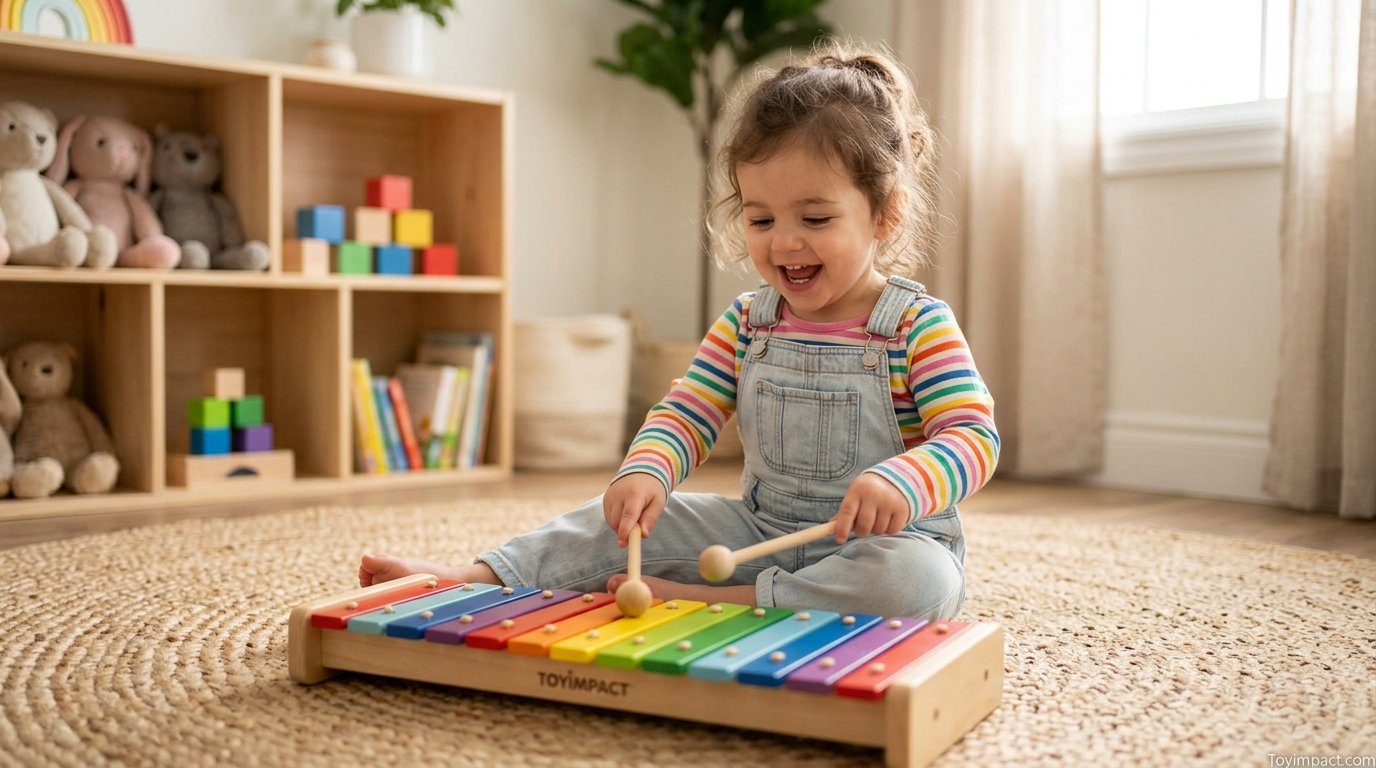
Xylophones bring pitch into the picture. Each bar plays a different note, and most children quickly notice that longer bars sound lower. A rainbow-colored xylophone with color-coded bars can even double as a beginner’s songbook. Choose one with bars that are securely attached and a tuning that sounds like an actual scale, since some cheap versions are noticeably out of tune. Wooden versions produce a warm, mellow tone, while metal glockenspiels ring brightly.
Tambourines, triangles, and bells
These small hand instruments are wonderful for group play. A tambourine can be tapped, shaken, or struck against a knee. Hand bells and jingle sticks add sparkle to holiday singing. Because they are inexpensive, they also make great party favors or classroom sets. Just check for any small removable parts on toddler-friendly versions.
Stacking, nesting, and hybrid percussion
Some of the smartest percussion toys pair sound with another skill. Nesting drums that stack by size, bell towers, and rattle-topped ring stackers combine music with spatial reasoning. If your child enjoys building, our explainer on what stacking toys are shows how sound-making versions fit into that wider category.
Pros of percussion toys
- Easy for any age to enjoy
- Very durable and affordable
- Teaches rhythm and coordination
- Great for group play
Cons to consider
- Can get loud quickly
- Cheap sets may be out of tune
- Mallets and small parts need supervision
- Limited melodic learning on drums alone
Add rhythm to the playroom with drums, shakers, and xylophones.
Shop Percussion Toys7Pianos, Keyboards, and Melody Makers
Keyboard toys are where many children first encounter the idea that music is made of individual notes. Because a piano lays every pitch out in a visible line, it is also the friendliest instrument for understanding how melody works.
Toy pianos
A classic toy piano produces sound through small metal rods struck by hammers, giving it that unmistakable bell-like sparkle. The tone is charming, the mechanism is quiet enough for apartments, and the design is easy for small hands. Wooden upright models double as nursery decor. The tradeoff is that the keys are limited and usually do not match the pitch accuracy of a real piano.
Electronic keyboards
Mini electronic keyboards offer far more variety. Many include rhythm presets, dozens of instrument voices, demo songs, and even lesson modes where keys light up to show the next note. For a child who shows real interest, a keyboard with full-size or nearly full-size keys and a headphone jack gives the best long-term value. Touch-sensitive keys, which respond to how hard the child presses, more closely resemble a real piano and encourage expressive playing.
Floor pianos and dance mats
Giant floor pianos let children play with their feet, turning music into a whole-body game. They are wonderful for active toddlers and preschoolers, and they double as gross motor practice. Because they are large and flat, they also stow easily under a bed or sofa.
Piano-style activity toys
For babies and younger toddlers, oversized keys, animal buttons, and simple melodies are better than a real layout. These toys teach cause and effect and are usually more forgiving of banging fists. Look for a volume control or a low-volume setting, since some pop-up piano toys blast loudly at the highest level.
What to look for in a keyboard toy
- Accurate pitch: Tunes that sound recognizable, not warped.
- Adjustable volume: Essential for sanity and hearing protection.
- Key size and feel: Keys wide enough for small fingers, with a comfortable press.
- Learning aids: Light-up keys, note labels, or simple songbooks.
- Sturdy build: Solid legs, secure battery doors, and a stable stand.
Compare toy pianos and beginner keyboards for kids.
Shop Kids Keyboards8Wind, String, and Singing Toys
Beyond drums and keys, several other musical toy families deserve attention. Wind, string, and voice toys develop different muscles and different kinds of listening, and they often become a favorite once a child has outgrown the basics.
Wind toys: harmonicas, recorders, kazoos, and whistles
Blowing into an instrument teaches breath control, an underrated skill that also supports speech and singing. Kazoos and slide whistles are goofy and immediate, making them ideal for younger children. Harmonicas and recorders are a step up, requiring children to match breath and finger placement to produce clear notes. Recorders in particular are a staple of elementary school music classes, so owning one at home gives kids a head start. Always check that mouthpieces are easy to clean, and wash them regularly.
String toys: mini guitars, ukuleles, and lap harps
A toy guitar with nylon strings is gentler on small fingers than a steel-string instrument, and a ukulele has only four strings, which makes chords approachable. Lap harps and simple zithers let children strum across a pre-tuned scale with no wrong notes, which is a wonderfully encouraging experience. The main caution with cheaper string toys is tuning. If the strings will not hold pitch, the toy quickly becomes frustrating.
Kalimbas and other world instruments
Thumb pianos, or kalimbas, produce soft, dreamy tones by plucking metal tines mounted on a wooden board. They are small, portable, and hard to make sound bad, so they are especially good for quiet-time play. Other world-inspired toys, such as rain sticks, ocean drums, and wooden frog guiros, bring texture and cultural variety to a child’s collection. If you are building a calmer play routine, read our overview of quiet time toys for more ideas that suit gentle sounds.
Voice toys: microphones and karaoke machines
Not every musical toy has to be a miniature instrument. Toy microphones and karaoke players celebrate the most personal instrument of all: the voice. Children who are shy about singing often blossom when handed a microphone, even a pretend one. Many models include echo effects, built-in songs, and Bluetooth connections. As a bonus, singing toys feed directly into imaginative play. Children stage concerts, host talk shows, and record silly radio programs, which links naturally to the ideas in our guide to creative toys.
Music boxes and lullaby toys
Wind-up music boxes and soft plush toys that play lullabies sit at the gentlest end of the spectrum. They are especially popular at bedtime and for children who find quiet, predictable melodies soothing. Children with sensory differences sometimes respond especially well to steady, repetitive sounds, and families exploring that topic may find our sensory toy gift guide useful.
Why families love these toys
- Build breath control and finger skills
- Bridge to real instruments
- Often quieter than drums
- Encourage self-expression
What to watch for
- Mouthpieces need regular cleaning
- Cheap strings may not stay in tune
- Some need adult help to start
- Small parts on younger-child models
Explore ukuleles, kalimbas, recorders, and karaoke toys.
Shop Wind & String Toys9Electronic vs. Acoustic Musical Toys
One of the biggest questions parents face is whether to buy a battery-powered toy that sings and flashes or a simple wooden instrument that only makes sound when a child does something. There is no universal winner, and most well-rounded collections include both. Understanding the tradeoffs will help you decide where to spend.
The case for acoustic toys
Acoustic toys are entirely child-powered. Nothing happens unless the child acts, which strengthens the link between effort and result. They also tend to last longer, need no batteries, and offer richer, more natural tones. Many educators prefer them for open-ended play because a xylophone can play a thousand tunes, while a button-activated song toy plays only the songs programmed into it.
The case for electronic toys
Electronic toys offer variety, instant gratification, and teaching features acoustic toys cannot match. A keyboard with lesson mode can walk a child through a song note by note. A sound-button book can introduce animals, letters, and numbers in a single package. For kids who need a bit of extra motivation to sit down and explore, lights and songs can be a welcome hook.
| Feature | Acoustic Toys | Electronic Toys |
|---|---|---|
| Sound quality | Natural, warm, varied by touch | Consistent, but can sound artificial |
| Open-ended play | Excellent | Depends on the design |
| Learning features | Requires an adult guide | Often built in |
| Batteries needed | No | Yes, usually |
| Volume control | Child controls it by touch | Varies, sometimes none |
| Durability | Usually very high | Moderate, electronics can fail |
| Typical price | Low to moderate | Low to high |
A balanced approach
A sensible strategy is to build a base of two or three acoustic instruments, then add an electronic keyboard or sound toy for variety. Rotating toys in and out of play keeps everything feeling fresh. If that idea appeals to you, our article on how often you should rotate kids’ toys explains a simple schedule.
Electronic toys: pros
- Built-in songs and lessons
- Lights and effects hold attention
- Many instrument sounds in one toy
- Headphone options available
Electronic toys: cons
- Can encourage passive button-pressing
- Batteries add ongoing cost
- Volume may be too high
- Harder to repair
Mix and match acoustic and electronic favorites for a balanced toy shelf.
Shop Electronic Musical Toys10Safety and Sound Levels
Musical toys are generally safe, but a few issues come up often enough to deserve a closer look. Paying attention to them costs nothing and protects both little ears and little mouths.
Protecting young hearing
Children’s ears are more sensitive than adults’, and some toys, especially electronic ones, can be surprisingly loud when held close. A good rule of thumb is to choose toys with a volume control or a low setting, and to test the toy yourself before handing it over. If it is uncomfortable to you at arm’s length, it is too loud for a child holding it at chest height. Some families cover the speaker lightly with a strip of tape or choose models with a headphone jack for longer sessions.
Small parts and choking hazards
Toys intended for children under three should not have detachable pieces small enough to fit in a mouth. Check mallets, bells, bead fillings in shakers, and battery compartments. Battery doors should be secured with a screw so curious fingers cannot open them. Button batteries in particular are dangerous if swallowed, so never leave a toy with a loose or broken battery door in reach of a young child.
Materials and finishes
Look for toys with non-toxic paint and smooth edges. Wooden instruments should be free of splinters and finished with child-safe coatings. For babies who chew, pick items that are easy to wash and clearly labeled for their age group. Our guide on cleaning plastic toys safely explains how to sanitize without damaging speakers or finishes.
Mind the household noise level
Noise is a safety and sanity issue. If you live in an apartment, look for instruments known for softer tones, like kalimbas, felt-tipped mallets, and rubber-headed drums. Setting up designated “music times” also keeps the fun from spilling into naps and meetings.
- Test the volume yourself before gifting.
- Check age labels and small-part warnings.
- Confirm the battery door is screw-secured.
- Inspect wooden toys periodically for cracks or splinters.
- Clean mouthpieces and teethers regularly.
Shop quieter, kid-safe musical toys with volume control.
Shop Kid-Safe Music Toys11How to Choose the Right Musical Toy
With so many options, a simple checklist keeps you from buying something that gets played once and forgotten. Work through the questions below and you will land on a better choice almost every time.
1. Match the toy to the child, not the box
Age ranges on packaging are a starting point, not a verdict. A child who loves banging on pots may be ready for a drum long before the label says so. A child who is anxious around loud noises may prefer a soft kalimba. Watch how your child already plays and follow their lead.
2. Prioritize sound quality
If possible, listen before buying. Read reviews for mentions of tuning, tinny speakers, or sudden volume spikes. A pleasant tone keeps children engaged and helps them develop a good ear.
3. Look for open-ended potential
The best musical toys can be used in many ways. A xylophone can play songs, patterns, or made-up tunes. A drum can be a beat, a rain storm, or a heartbeat. Toys that do only one thing tend to lose their appeal quickly, which is a big reason children get bored of toys so fast. Our post on why kids get bored of toys so quickly digs into that pattern.
4. Consider durability
Musical toys take a beating, literally. Sturdy joints, solid wood or thick plastic, and secure fasteners matter more than flashy features. A toy that survives being dropped, chewed, and stepped on is worth a few extra dollars.
5. Think about where it will live
A floor piano and a full drum kit are wonderful, but they need space. If your home is on the smaller side, consider compact choices and a clever storage plan. Our guide to organizing toy storage in small spaces has practical ideas for instruments, too.
6. Set a realistic budget
You do not need to spend much to get a lot of musical play. Egg shakers, a simple xylophone, and a hand drum are all inexpensive. Splurge only on items your child returns to repeatedly, such as a quality keyboard or a ukulele. For general inspiration, our master list of the best toys is a handy reference.
| Question to Ask | Why It Matters |
|---|---|
| Is the volume adjustable? | Protects hearing and household peace |
| Does the pitch sound accurate? | Builds a good musical ear |
| Can it be played more than one way? | Keeps interest over time |
| Are there small removable parts? | Safety for children under three |
| Is it easy to clean? | Hygiene, especially for mouthed toys |
| Will it fit our space? | Prevents clutter and frustration |
Gift shopping and travel
Musical toys make excellent gifts because they are easy to personalize for age and interest. For a road trip or flight, choose compact, quiet options and check our lists of the best toys for car rides and best travel toys for airplanes. Kalimbas, finger pianos, and small egg shakers pack easily and keep fellow travelers happy.
Ready to choose? Compare top-rated musical toys side by side.
See Top-Rated Musical Toys12Play Ideas, Storage, and Care
A musical toy is only as good as the play built around it. A few simple games can turn even a basic shaker into hours of shared fun and hidden learning.
Easy games to try
- Freeze dance: Play music and stop suddenly. Children freeze until it starts again, practicing self-control and listening.
- Echo the beat: Tap a short rhythm on a drum and have your child copy it. Gradually make the patterns longer.
- Loud and soft: Play the same shaker at different volumes and let your child guess whether it is a mouse or an elephant.
- Sound stories: Narrate a story and let your child add sound effects with instruments: thunder on the drum, rain on the shaker.
- Family parade: Give everyone an instrument and march through the house. Simple, silly, and surprisingly bonding.
- Copycat melodies: Play three notes on a xylophone and ask your child to find the same ones.
Mix in STEM and creativity
Musical play makes an easy on-ramp to science. Try filling glasses with different levels of water to discover how volume changes pitch, or stretch rubber bands across a box to build a homemade guitar. If your child enjoys experiments like these, read our advice on how to introduce STEM toys to preschoolers and browse the best STEM toys for more sound-and-science crossover ideas.
Keeping things fresh
Children tire of even great toys when everything is available at once. Store part of the collection out of sight and rotate a few instruments in each week. A basket by the door is perfect for a small “band,” while a top shelf holds the rest. This also keeps noise manageable and makes each reappearing toy feel new.
Cleaning and maintenance
Wipe plastic and wooden instruments with a lightly damp cloth and mild soap, and let them dry fully. Avoid soaking electronic toys. Check battery compartments for corrosion every few months and remove batteries from toys that will be stored for a long time. Re-tighten screws on drums and string toys, and keep wooden instruments away from radiators and damp basements.
Use music for quiet moments too
Musical toys are not only for high-energy fun. Soft chimes, a kalimba, or a gentle lullaby box can become part of a bedtime routine or a calm-down corner. That flexibility is one of the category’s best qualities.
Build a music corner with shakers, bells, and a simple storage basket.
Shop Music Corner EssentialsFrequently Asked Questions About Musical Toys
What are musical toys?
Musical toys are playthings built to make or respond to sound and music. They include miniature instruments like drums, xylophones, and keyboards, along with rattles, shakers, music boxes, and electronic toys that play songs.
At what age can babies start using musical toys?
Babies can enjoy soft rattles and gentle music mobiles from the earliest weeks. By six months many babies happily shake, bang, and mouth simple instruments, as long as the toys are age-appropriate and easy to clean.
Are musical toys good for child development?
Yes. They support listening skills, hand-eye coordination, rhythm awareness, early language, and emotional expression. They are not a magic shortcut, but they add valuable sensory experience to everyday play.
What is the best first musical toy for a toddler?
A sturdy hand drum, an egg shaker set, or a simple xylophone with rounded mallets are all excellent starters. They are affordable, durable, and easy for small hands to use without instructions.
Are electronic musical toys worse than wooden ones?
Not necessarily. Acoustic toys encourage open-ended, child-powered play, while electronic toys offer variety and built-in lessons. A mix of both usually gives children the richest experience.
How loud is too loud for a kids’ musical toy?
If a toy feels uncomfortably loud to you at arm’s length, it is too loud for a child holding it close. Choose toys with volume control, consider headphone-compatible models, and limit long, loud play sessions.
Can musical toys help with speech and language?
They often can. Singing, rhythm games, and listening to different pitches build the skills that support speech. Children who enjoy songs tend to pick up rhyme and vocabulary more easily, though any speech concerns should be discussed with a professional.
What is the difference between a toy instrument and a real instrument?
Toy instruments prioritize safety, low cost, and easy play, but their tuning and sound quality may be limited. Real instruments are built for accurate pitch and long-term learning. Many kids start with toys and move to real ones when their interest is clear.
How do I clean musical toys safely?
Wipe them with a damp cloth and mild soap, avoid submerging anything electronic, and dry thoroughly. Mouthpieces on recorders or kazoos need frequent washing. Remove batteries from toys you plan to store.
Are musical toys suitable for children with sensory needs?
Many children find predictable, gentle sounds soothing, while others are sensitive to sudden or loud noise. Soft instruments like kalimbas, ocean drums, and music boxes are popular choices, and volume-controlled toys allow easier adjustment. Watch your child’s reactions and adapt accordingly.
How many musical toys does a child really need?
Just a handful. Two or three acoustic instruments and one electronic keyboard or sound toy provide plenty of variety. Rotating toys in and out keeps things exciting without cluttering the house.
What are good musical toys to take on trips?
Compact, quiet options travel best: kalimbas, egg shakers, small harmonicas, and finger pianos. They pack easily, keep kids busy, and will not annoy fellow passengers when played gently.
Conclusion: Small Sounds, Big Benefits
Musical toys are far more than noisemakers. They are early instruments, first storytellers, and gentle teachers of rhythm, listening, coordination, and self-expression. The best ones are well made, pleasant to hear, easy to use, and open-ended enough to grow with a child.
You do not need a big budget or a room full of gear. A small shaker, a hand drum, and a xylophone can carry a child through years of play, especially when you join in with a song or a silly parade. Add a keyboard, ukulele, or kalimba when interest deepens, and keep an eye on volume, safety, and cleanliness along the way.
Most of all, remember that the goal is joy. When a child discovers that they can make something beautiful, or wonderfully silly, with their own two hands, they are building confidence that reaches far beyond music.
Ready to bring more music into your home? Start exploring today.
Shop Musical Toys on Amazon