When Do Babies Start Playing With Toys? A Month-by-Month Guide to Grabbing, Holding, and Real Play
Your baby will not hand you a toy on a schedule, but there is a very predictable path from staring at a rattle to shaking it on purpose. Here is what to expect, when to expect it, and how to help.
Jump to a section
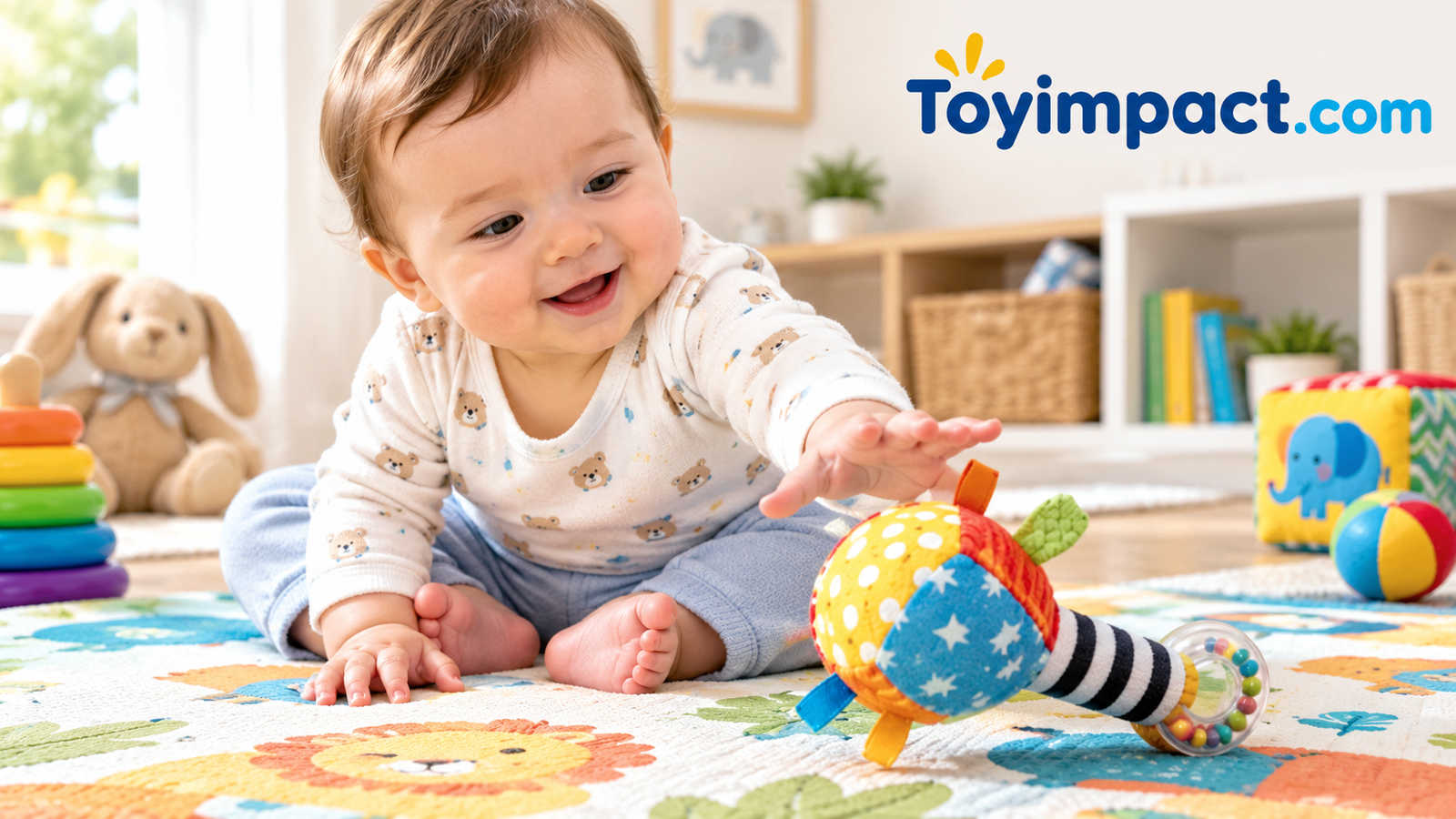
Somewhere around the third or fourth month, most parents notice the shift. The baby who used to stare past a dangling toy suddenly swipes at it. A few weeks later, a tiny fist closes around it, and the toy goes straight to the mouth. It feels like magic, and it is also the start of a long, wonderful stretch of learning through play.
If you have been wondering when babies start playing with toys, when they begin grabbing them, or when they can actually hold on to them, you are asking the right questions at the right time. The honest answer is that it happens gradually, in overlapping stages, and no two babies move through them at exactly the same speed. This guide walks through the whole journey, from the first reflexive grasp to the first proud drop-and-giggle game, so you know what is typical and what to do with that knowledge.
The Short Answer: When Do Babies Start Playing With Toys?
Quick answer: Most babies begin to bat at and reach for toys between 3 and 4 months, grab and hold them on purpose between 4 and 6 months, pass them from hand to hand around 6 to 7 months, and start using them in more purposeful ways (banging, dropping, poking, stacking) between 8 and 12 months.
That answer covers every version of the question. When do babies start playing with toys? Broadly, at about four months, once their hands and eyes begin working together. When do babies grab toys? Usually between four and six months, once the newborn grasp reflex fades and a deliberate reach takes its place. When do babies start holding toys? A baby may hold a light toy that is placed in their palm as early as the first two or three months, but holding on to it by choice, for a sustained stretch of time, tends to arrive closer to five or six months.
Those are averages, and averages hide a lot of normal variation. A baby who was born early, who spends less time on their tummy, or who simply has a different temperament may hit these moments a few weeks earlier or later than a neighbor’s baby. Development is a range, not a deadline.
It also helps to remember that “playing with toys” is not one skill. It is a bundle of smaller abilities: seeing clearly enough to notice the toy, being interested enough to want it, controlling the arm to reach for it, opening and closing the hand to grab it, and having enough curiosity to do something with it once it is there. Each of those abilities has its own timeline, and they snap together gradually over the first year.
What “Playing” Really Means in the First Year
Before we get into the timeline, it is worth adjusting what we picture when we say a baby is “playing.” Adults tend to imagine a child sitting with a toy, doing something clearly toy-like with it. A four-month-old’s version of play looks nothing like that. It might be a long, focused stare at a spinning mobile. It might be kicking a crinkly toy that is attached to the play gym and delighting in the noise it makes. It might be chewing on the corner of a soft book.
Researchers who study infant development often describe early play as exploration. The baby is gathering data. How does this feel in my mouth? What sound does it make when I shake it? Does it fall when I let go? Every one of those experiments teaches the brain something about cause and effect, texture, weight, and space.
Three kinds of early play
- Sensory play: Looking, listening, touching, and mouthing. This is the earliest form and it is the main event for the first several months. Sensory toys are built exactly for this stage.
- Motor play: Reaching, batting, grabbing, shaking, and passing. This is where motor skill toys earn their keep, because every repetition strengthens the shoulders, arms, wrists, and fingers.
- Social play: Peekaboo, sharing a toy back and forth with a caregiver, and copying sounds. A toy becomes far more interesting when a familiar face is holding the other end of it.
Notice that all three of these can begin before a baby is capable of picking a toy up on their own. That matters, because it means you do not have to wait for a milestone to start offering interesting things to look at, listen to, and touch. You are simply adjusting what you offer as your baby’s abilities change.
A gentle reminder: Babies do not need many toys, and they certainly do not need expensive ones. A handful of well-chosen items, plus your voice and your face, is a complete play environment for the first year.
Birth to 3 Months: Watching, Listening, and Reflexive Grasps
Newborns are not playing with toys in any sense you would recognize, but the groundwork is being laid every single day. In the first weeks, a baby sees best at a distance of roughly eight to twelve inches, which happens to be about the distance between your face and theirs while feeding. Anything beyond that is a blur. High-contrast shapes, black and white patterns, and bold, simple designs are easiest to make out at this stage, which is why so many newborn cards and soft books use them.
The grasp reflex is not the same as grabbing
Place a finger in a newborn’s palm and the tiny hand closes around it with surprising force. It is adorable, and it is a reflex. The baby is not choosing to hold your finger and cannot let go on purpose. The same thing happens if you put a light rattle in their hand. They may hold it for a moment, but the toy is more likely to drop when the muscles relax, and the baby will not seem to mind or notice.
This reflex begins to fade at around two to three months, and that is a positive sign. It clears the way for voluntary grasping, which needs the hand to be able to open and close under the baby’s own control.
What babies this age enjoy
- Your face, especially when you talk, sing, and make exaggerated expressions
- High-contrast cards or a soft book held at a comfortable distance
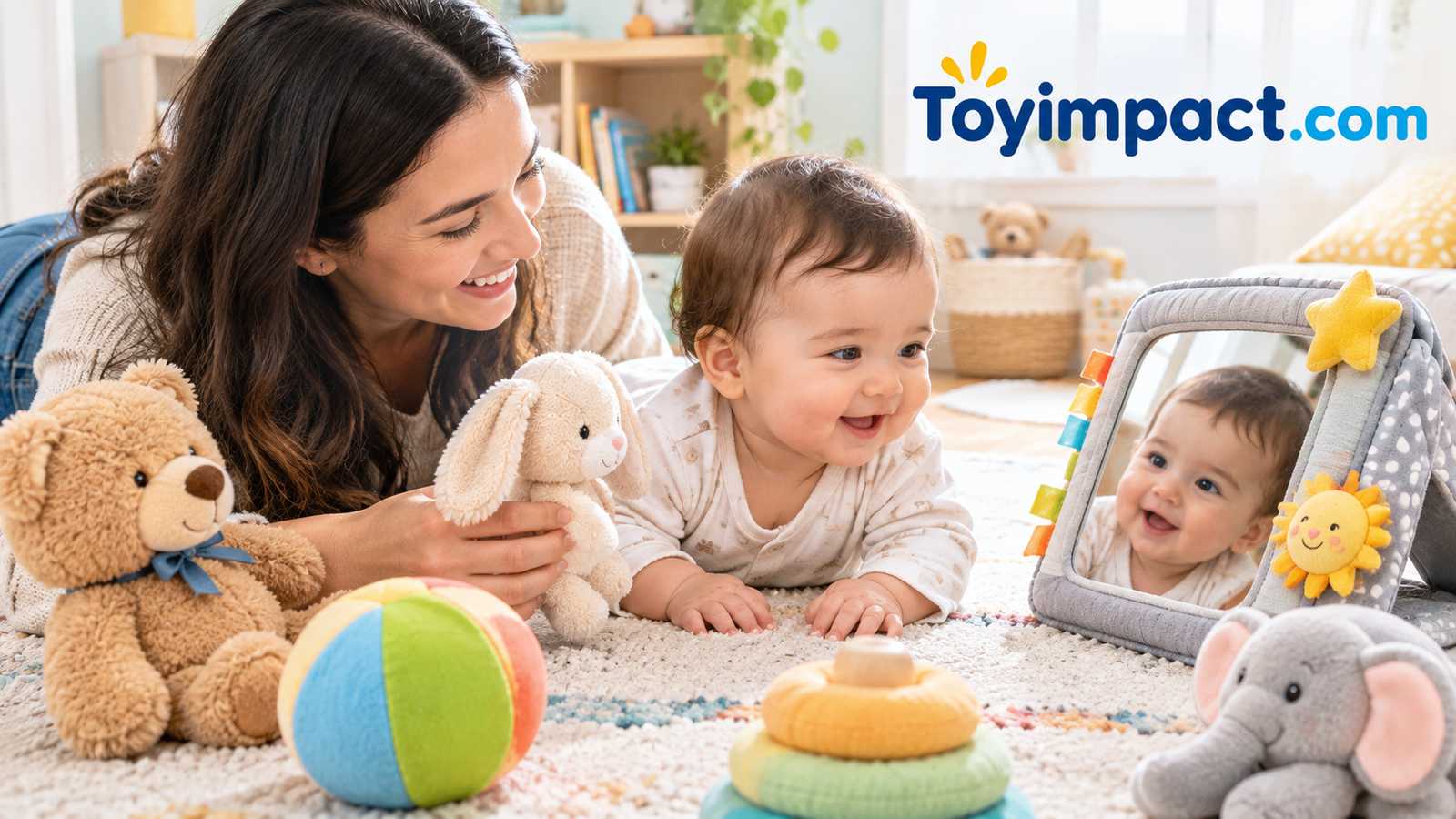
- A safe, baby-friendly mirror during supervised tummy time
- Gentle sounds such as a soft rattle, a wrist toy, or a wind chime heard from across the room
- Slow-moving objects held within their focus range
Tummy time is the secret first “toy” workout
Supervised tummy time does more for later toy skills than any gadget. Lifting the head strengthens the neck and upper back. Pushing up on the forearms builds shoulder stability. That shoulder stability is what allows the arm to reach out and the hand to work with precision later. A few short sessions a day while your baby is awake and alert, with a toy or mirror placed just in front of them, gives them a reason to lift, look, and eventually reach.
If your baby fusses during tummy time, you are in good company. Try short stretches, lie on the floor face to face, or lay them on your chest to start. Many babies who dislike the floor will tolerate it once there is something interesting to look at.
By the end of this phase, many babies will follow a toy with their eyes, smile at a favorite person, and start bringing their hands to their mouths. They may also begin to look at their own hands with fascination. That hand-watching is an early and important step toward controlling them.
3 to 6 Months: When Babies Start Grabbing Toys on Purpose
This is the window most parents are really asking about. Somewhere between three and four months, the world opens up. Hands come together at the midline, fingers get tangled and untangled, and the baby begins to swat at anything dangling within range. Early swipes are wild and rarely connect, but the intent is clear. The baby wants that toy.
The progression you will likely see
At three months, many babies bat at a hanging toy without being able to grasp it. At four months, they may manage to close a hand around a toy that is brought right to their palm or fingers. At five months, most can reach out, get their hand around a toy, and pull it toward them. By six months, many babies reach with either hand, grip with a whole-hand or palm grasp, and shift a toy toward their mouth without help.
Almost everything a baby grabs at this age goes straight into the mouth. That is not a bad habit to discourage. The lips and tongue have more sensory nerve endings than the fingers do at this stage, so the mouth is a more precise exploration tool than the hand. This is also why toy safety and toy cleanliness matter so much, which we will cover in later sections.
Best setups for this stage
- A play gym or activity mat with hanging toys at chest height gives constant targets for batting and reaching.
- Lightweight rattles with easy-to-hold handles let babies experience cause and effect. Shake, and it makes a noise.
- Soft fabric toys and teething rings are gentle on gums and easy to grip.
- Crinkle toys and textured balls give the fingers plenty to feel.
Position matters here too. Lying on the back, a baby can reach up and bat at overhead toys. On the tummy, they practice pushing up and reaching sideways. Propped in a supported sit, they get a whole new view of what is within reach. Rotating between positions throughout the day gives them varied experiences without any extra toys.
Try this: Hold a rattle just above your baby’s chest, slightly off to one side. When the baby reaches, let them touch it, then gently guide it into their hand. Repeat on the other side. This small game builds coordination and confidence, and it takes about two minutes.
If you want a starting point for quality picks that suit this stage, our guide to the best toys under $20 shows how far a small budget can go, and many of those ideas work just as well for babies nearing their first year.
6 to 9 Months: Holding, Transferring, and Exploring
By six months, most babies are experts at the palm grasp and are ready to level up. This is the window when toy play starts looking like real, deliberate exploration. Sitting, either with support or on their own, frees both hands. Now a baby can hold one toy in each hand, look from one to the other, and, in a landmark moment, pass a toy from one hand to the other.
Hand-to-hand transfer
Transferring a toy is a big deal. It requires the baby to understand that both hands belong to them, coordinate their movements, and release a grip deliberately. Many babies start doing it around six to seven months. It is common to see a baby pick something up with the right hand, pause, look at it, pass it to the left hand, and then bring it to the mouth.
Banging, shaking, and dropping
Around seven to nine months, play gets noisier. Babies discover that if they bang a toy on the high chair tray, it makes a sound. If they bang two toys together, the sound is different. If they drop a toy, it falls. If you pick it up, they can drop it again. Parents often find this last game maddening. Babies find it endlessly fascinating, and for good reason: they are studying gravity and testing whether you will keep coming back.
Raking and early finger use
As the grasp matures, babies begin to use the fingers more independently. You may see a raking motion, where the baby drags small objects toward the palm with all four fingers curled. Soon, the thumb starts joining the action. This precision is still developing, but it is the foundation of later feeding, drawing, and buttoning skills.
Great toy types at this stage
- Stacking toys, such as nesting cups, which double as bath toys and container games
- Soft blocks that are safe to chew, grip, and throw
- Board books with thick pages that little hands can turn
- Musical toys with simple buttons, shakers, or drums that respond to a baby’s movement
- Toys with different textures, such as fabric tags, ribbons, and crinkly sections
This is also the age when many babies begin to show clear favorites. One baby will shake anything with a bell inside. Another will spend twenty minutes mouthing the same soft giraffe. Follow those preferences. Interest is the engine of learning, and a baby who is absorbed in a toy is a baby who is learning.
9 to 12 Months: When Real Toy Play Begins
If the earlier months were about discovering that toys exist and that hands can grab them, this stretch is about figuring out what to do with them. Many parents feel this is when their baby truly “plays” for the first time, and it is easy to see why. The baby is mobile, curious, and increasingly intentional.
The pincer grasp arrives
Between about eight and twelve months, most babies develop the ability to pinch small objects between the thumb and index finger. It begins as a clumsy, inefficient version, using the sides of the fingers, and gradually becomes the neat, tip-to-tip grip we use as adults. You will notice it first during meals, when your baby picks up a single piece of soft food, and then during play, when they poke at buttons, pick up tiny pieces of lint from the carpet, and investigate every crack and hole.
That last part is important for safety. A baby who can pick up small things can put small things in their mouth. Sweeping the floor and checking toy pieces becomes a regular habit at this age.
Object permanence and hiding games
At this stage, babies begin to understand that objects still exist when they cannot be seen. That is why peekaboo becomes so thrilling, and why a baby will now search for a toy you hide under a blanket. Simple hiding games are both educational and delightful. Cover a toy partly, then fully, and let your baby find it.
Cause and effect gets sophisticated
Push a button, hear a song. Drop a block into a container, hear it clatter. Open a flap in a book, see a picture. Babies at this age love toys that respond to their actions, and they will repeat the action dozens of times. Repetition is not boredom, it is how they confirm what they have learned.
The first signs of pretend and functional play
Toward the end of the first year, some babies start using objects the way they are meant to be used. They might hold a toy phone to their ear, brush a doll’s hair with their hand, or offer a spoon to you. It is a simple version of the pretend play that will bloom in toddlerhood. When you are ready to explore that next chapter, our pretend play toy guide is a good next stop.
Toys that suit 9 to 12 months
- Chunky shape sorters and simple puzzles with big knobs
- Push and pull toys to encourage cruising and first steps
- Balls of various sizes for rolling games
- Toy containers with lids for putting in and taking out
- Wooden toys that are sturdy enough to withstand plenty of enthusiastic banging
How Grasping Develops: From Palm to Pincer
Grabbing and holding are not a single skill that switches on. They are a chain of hand patterns, each building on the one before. Understanding the chain helps you choose toys that fit your baby’s current ability instead of frustrating them with something too advanced.
| Approximate Age | Hand Skill | What It Looks Like | Toy That Fits |
|---|---|---|---|
| 0 to 2 months | Reflexive grasp | Fist closes around a finger placed in the palm | Very light rattle, soft wrist toy |
| 2 to 4 months | Hands to midline, batting | Swipes at hanging objects, clasps hands together | Play gym with dangling toys |
| 4 to 6 months | Voluntary palm grasp | Reaches, grabs, and pulls a toy toward the mouth | Easy-grip rattles, teething rings |
| 6 to 8 months | Hand-to-hand transfer, raking | Passes toys between hands, rakes small items | Soft blocks, stacking cups |
| 8 to 10 months | Developing pincer | Picks up small items with thumb and side of finger, pokes with index finger | Busy boards with big buttons, chunky knob puzzles |
| 10 to 12 months | Refined pincer | Neat tip-to-tip pinch, drops items into containers on purpose | Shape sorters, container toys |
Ages in the table are ranges, not deadlines. A baby may be right in the middle of one stage while showing early signs of the next. That overlap is completely normal, and you may see your baby switch between old and new grips in the same play session.
Why toy weight and shape matter
A toy that is too heavy will slip out of a small hand, and a toy that is too wide to wrap fingers around will be impossible to hold. For younger babies, lightweight toys with a slim handle or a ring shape are easiest. As the grasp strengthens, chunkier and more varied shapes become both manageable and interesting.
Helping without taking over
It is tempting to place the toy in your baby’s hand every time. Resist a little. Hold it slightly out of reach so they have to stretch. Place it on the tray rather than in the palm. Let them fail a few times and try again. Struggle, in small doses, is how motor skills develop. If your baby becomes upset, step in, help, and try again later. The goal is to make each attempt just hard enough to be interesting, not so hard that it becomes frustrating.
Helpful ways to support grasping
- Offer toys at chest height
- Switch sides so both hands practice
- Use lightweight, easy-to-grip shapes
- Give plenty of supervised floor time
Common missteps to avoid
- Putting a heavy toy in a tiny hand
- Overloading with too many toys at once
- Using devices that keep the baby restrained for long periods
- Rushing to stages the baby is not ready for
The Best Types of Toys for Each Stage
You do not need a room full of toys to support your baby’s development. In fact, a smaller, thoughtful collection tends to work better than a mountain of plastic. The best first toys share a few qualities: they are safe to mouth, easy to grip, appropriately sized, and interesting to at least two senses.
| Stage | Toy Types | Skills They Support |
|---|---|---|
| Newborn to 3 months | High-contrast cards, soft books, mobiles, baby-safe mirrors | Visual tracking, focus, awareness of faces |
| 3 to 6 months | Play gyms, lightweight rattles, teethers, crinkle toys | Reaching, batting, grasping, mouth exploration |
| 6 to 9 months | Soft blocks, stacking cups, textured balls, board books | Transferring, banging, cause and effect |
| 9 to 12 months | Shape sorters, push toys, simple puzzles, containers | Pincer grasp, problem solving, early pretend play |
Material choices: what to know
Toys made of wood, silicone, cloth, and food-grade plastics all have a place in a baby’s collection. Wood is durable and pleasant to hold, silicone is soft and easy to wash, cloth is gentle and lightweight, and plastic is inexpensive and widely available. Look for toys labeled as suitable for your baby’s age, and check for finishes and paints that are described as non-toxic.
What a great first toy has
- Smooth edges and no small removable parts
- Light enough for a young baby to lift
- Multiple textures or a gentle sound
- Easy to wipe clean or wash
What to skip
- Toys with long strings, cords, or ribbons
- Anything with tiny detachable pieces
- Overly loud electronic toys
- Hand-me-downs with worn paint or cracked plastic
Do babies need electronic toys?
Not really. Toys that light up and play songs can be fun in short bursts, but a baby who mostly watches a toy perform is doing less than a baby who is shaking, banging, or stacking. Toys that require the baby to do something tend to offer more developmental value. If a toy does everything on its own, consider it more of a novelty than a tool.
For a wider view of options across ages, our roundup of the best toys is a good place to browse once your baby is ready to graduate from the very first stage.
Toy Safety Basics for Grabbing, Mouthing Babies
The same milestone that delights you, your baby grabbing everything and putting it in their mouth, is the reason safety deserves careful attention. Babies cannot tell a safe toy from a dangerous object, so the adults have to do the sorting.
The small parts test
A simple rule of thumb many parents use is the toilet paper tube test. If a toy or any piece that can come off it fits inside a standard toilet paper tube, it is too small for a baby or young toddler and can be a choking hazard. Check toys regularly for loose eyes, buttons, or seams that are coming apart.
Button batteries and magnets
Two of the most serious hazards in and around toys are button batteries and small, strong magnets. If swallowed, either can cause severe internal injuries and requires urgent medical attention. Make sure any battery compartment is secured with a screw, and keep spare batteries, remote controls, and small electronics well out of reach. For a more thorough walkthrough, see which toys have button batteries and how to check them.
Batteries that leak inside a toy are a separate issue. If you ever find crusty residue in a battery compartment, our guide on how to clean battery corrosion in toys explains how to handle it carefully.
Strings, cords, and crib toys
Avoid toys with long strings or loops that could wrap around a baby’s neck or limbs. Play gym toys should be attached firmly and kept short. Once your baby can push up on hands and knees, remove any hanging toys from the crib or play gym so they cannot be pulled down.
Safe sleep and toys
The cot or crib should stay clear of toys, soft objects, and loose bedding. Toys are for supervised play time, not for sleep time. Follow current safe sleep recommendations from your pediatrician or local health authority.
A quick safety checklist
- Check the age label on every toy and follow it
- Inspect toys regularly for cracks, sharp edges, and loose parts
- Keep older siblings’ small-part toys in a separate space
- Never leave a baby unsupervised with a toy that could be pulled apart
- Discard broken toys instead of trying to repair them
- Stay on top of product recalls for any toy you own
How to Play With Your Baby to Encourage Skills
The single best toy for a baby is a responsive adult. Toys give babies something to explore, but you give them meaning. Talking about what they are holding, copying their sounds, and sharing their excitement is what turns a rattle into a rich learning experience.
Follow your baby’s lead
Pay attention to what your baby is looking at or reaching for, and join in. If they are staring at a soft toy, bring it a little closer and describe it. If they drop it, pick it up and hand it back with a smile. This back-and-forth builds early communication skills long before the first word.
Narrate everything
You do not need a script. Just say what is happening. “You found the red ball. You are squeezing it. It is bumpy!” Babies absorb an enormous amount of language this way, especially when the words are attached to something they can see and feel.
Simple games that work
- Reach and grab: Hold a toy just out of reach and let your baby stretch to get it.
- Peekaboo: Hide your face or a toy behind a cloth, then reveal it.
- Shake and stop: Shake a rattle, pause, and wait for the baby to signal for more.
- In and out: Put soft toys in a basket, tip them out, repeat.
- Copy me: Bang two blocks together and see if your baby tries the same.
Keep sessions short and joyful
Babies tire quickly, and a few minutes of focused play followed by a break is more effective than a long, overstimulating session. Watch for cues that your baby has had enough: turning away, fussing, arching, or losing interest. Ending the game there teaches your baby that their signals are noticed and respected.
Independent play matters too
Once your baby is comfortable, it is healthy to let them explore on their own for short stretches while you stay close. Independent play builds concentration and self-soothing. If your baby enjoys this, quiet time toys can help extend those calm moments, and creative toys become more useful as they head toward toddlerhood.
Play philosophies you may come across
Some families like the simple, open-ended, natural-material approach associated with Montessori. If you are curious, our piece on the best age to introduce Montessori toys explains how it fits with infant development. You do not have to follow any single approach. Blend what works for your home.
Toy Rotation, Storage, and Keeping Toys Clean
Once the toys start piling up, and they will, a little organization goes a long way. Babies do better with fewer options presented at a time, and parents do better when the living room is not buried in plastic.
Rotate rather than accumulate
Keep a small selection of toys out and store the rest. Every week or two, swap a few. Toys that have been out of sight for a while feel new again, and your baby gets a fresh experience without you buying anything. Our guide on how often to rotate kids’ toys covers a simple schedule, and it applies well to babies. If you ever wonder why children lose interest quickly, this explainer on why kids get bored of toys so fast gives helpful context.
Storage that works in real homes
Low baskets, fabric bins, and open shelves let babies see and reach what they want as they become mobile. If space is tight, see our tips on organizing toy storage in small spaces. The best system is the one you will actually keep up.
Cleaning toys the practical way
Because babies mouth everything, cleaning matters. Wash soft toys according to their care labels, wipe hard toys with a mild soapy solution, and let everything dry fully before returning it to the play area. Our guide to cleaning plastic toys safely covers the basics. Bath toys need extra attention because moisture can trap in the small openings, so it is worth reading how to clean bath toys, and if you have those soft, stretchy ones, this squishy toy cleaning guide will help.
| Toy Type | How Often to Clean | Simple Method |
|---|---|---|
| Teethers and mouthed toys | Daily, or after drops on the floor | Warm water and mild soap, rinse well, air dry |
| Hard plastic toys | Weekly | Wipe with a soapy cloth, rinse, dry |
| Soft and fabric toys | Every week or two | Follow care label; gentle wash and full drying |
| Bath toys | After each few uses | Rinse, squeeze out water, dry fully |
| Wooden toys | As needed | Wipe with a damp cloth; avoid soaking |
When to Talk to Your Pediatrician and What Comes After Year One
Every baby has their own pace, and most of the time a little delay in reaching for toys is nothing to worry about. Still, it helps to know which patterns are worth bringing up at a checkup.
Signs worth mentioning to your pediatrician
- Hands remain tightly fisted most of the time after about four months
- Your baby does not seem to reach for or show interest in toys by about six months
- Your baby uses one hand much more than the other, or one side seems stiffer or weaker
- Your baby does not follow objects with their eyes or does not respond to sounds
- You notice that your baby seems to be losing skills they once had
- You simply have a nagging feeling that something is off
Trust your instincts. Pediatricians would much rather hear a concern that turns out to be nothing than miss one that matters. They can screen development, offer reassurance, and refer you to early intervention services if needed. Early support tends to make a real difference. For sensory-related questions later on, our sensory toys gift guide may also be a helpful resource as your child grows.
Premature babies and adjusted age
If your baby was born early, use their adjusted age, calculated from the original due date, when thinking about milestones. A baby born eight weeks early may not reach for toys until eight weeks later than the typical timeline, and that is expected.
What comes after the first year
Once your baby is a walking, climbing, stacking toddler, play grows more complex. Pretend play, building, puzzles, and outdoor fun all take center stage. You may want to look at puzzle toys for growing problem solvers, ride-on toys for movement, and an introduction to what a STEM toy actually is for when curiosity turns into building and experimenting.
For now, though, enjoy this stage. The rattle-shaking, mouth-chewing, block-dropping months go by faster than they feel like they will.
Frequently Asked Questions
At what age do babies start playing with toys?
Most babies start interacting with toys around 3 to 4 months, when they begin batting at objects and bringing their hands together. Meaningful, purposeful play with toys, such as shaking, banging, and passing them from hand to hand, develops between roughly 6 and 9 months.
When do babies start grabbing toys?
Babies usually start grabbing toys between 4 and 6 months. Before that, the newborn grasp reflex causes the hand to close automatically around an object. Deliberate grabbing replaces that reflex as vision and arm control improve.
When do babies start holding toys on their own?
A baby might hold a toy briefly at 2 to 3 months if you place it in their hand, but most babies begin holding toys on purpose at around 4 to 6 months. Holding steadily with both hands and transferring toys tends to follow at about 6 to 7 months.
Is it normal for my baby to not reach for toys at 4 months?
It can be. Babies vary, and some take a little longer to show reaching. Offering more tummy time, holding toys within their view, and giving them plenty of floor play can help. If your baby still shows no interest in reaching by around 6 months, mention it to your pediatrician.
What are the best first toys for a baby?
Lightweight rattles, soft fabric toys, teething rings, and high-contrast cards are excellent early picks. As your baby grows, add soft blocks, stacking cups, and board books. The best first toys are safe to mouth, easy to grip, and simple.
Why do babies put everything in their mouths?
Mouthing is a natural way for babies to explore texture, shape, and temperature. The mouth is highly sensitive and gives babies more information than their hands can at this age. It also helps soothe sore gums during teething. Keep toys clean and safe for mouthing.
How many toys does a baby actually need?
Far fewer than most people expect. A small, varied collection of a handful of toys, with a few rotated in and out, is plenty. Your face, voice, and everyday household safe items are just as interesting to a baby as bought toys.
When do babies start passing toys from one hand to the other?
Most babies begin transferring toys between hands around 6 to 7 months. It is a sign that both sides of the body are starting to work together, and it often appears around the same time a baby begins sitting more steadily.
When does the pincer grasp develop?
The pincer grasp generally develops between 8 and 12 months. Early attempts use the side of the finger and thumb, and the grip becomes more precise over time. Because babies can now pick up tiny objects, keep small items and choking hazards out of reach.
Are electronic toys bad for babies?
They are not harmful in themselves, but toys that do all the work can limit hands-on exploration. Simple toys that require your baby to shake, stack, push, or drop tend to offer more developmental benefit. Use electronic toys in moderation and pair them with plenty of open-ended play.
How can I help my baby learn to grab toys?
Give them daily tummy time, hold toys just within reach, offer lightweight easy-grip items, and switch sides so both hands get practice. Keep sessions short and playful, and celebrate every attempt, whether or not it succeeds.
Should I be worried if my baby seems to favor one hand?
A strong preference for one hand in the first year is worth mentioning to your pediatrician. Most children do not settle on a dominant hand until later, often around age two or three, so a clear early preference is something a professional should look at.
Conclusion: Let Your Baby’s Play Unfold at Their Own Pace
So, when do babies start playing with toys? The gentle, gradual answer is that it begins with looking and listening in the early weeks, blossoms into batting and grabbing around four to six months, and matures into real hands-on play with passing, banging, dropping, and stacking by the end of the first year. Along the way, your baby is not just having fun. They are building the muscles, coordination, and curiosity that will carry them into toddlerhood and beyond.
You do not need to hurry any of it. Offer safe, simple toys that match where your baby is today, give them time on the floor, get down there with them whenever you can, and enjoy the small wins. The first time your baby closes a fist around a rattle and looks up at you as if to say “look what I did” is a moment worth savoring.
When you are ready to pick out a few new favorites, start small, keep safety at the center, and trust what you see in your baby. They will show you what they love.
You May Also Like
Looking for more toy ideas and guides for the next stage? Start with our Toy Impact home page or explore these picks.